Showing posts with label France. Show all posts

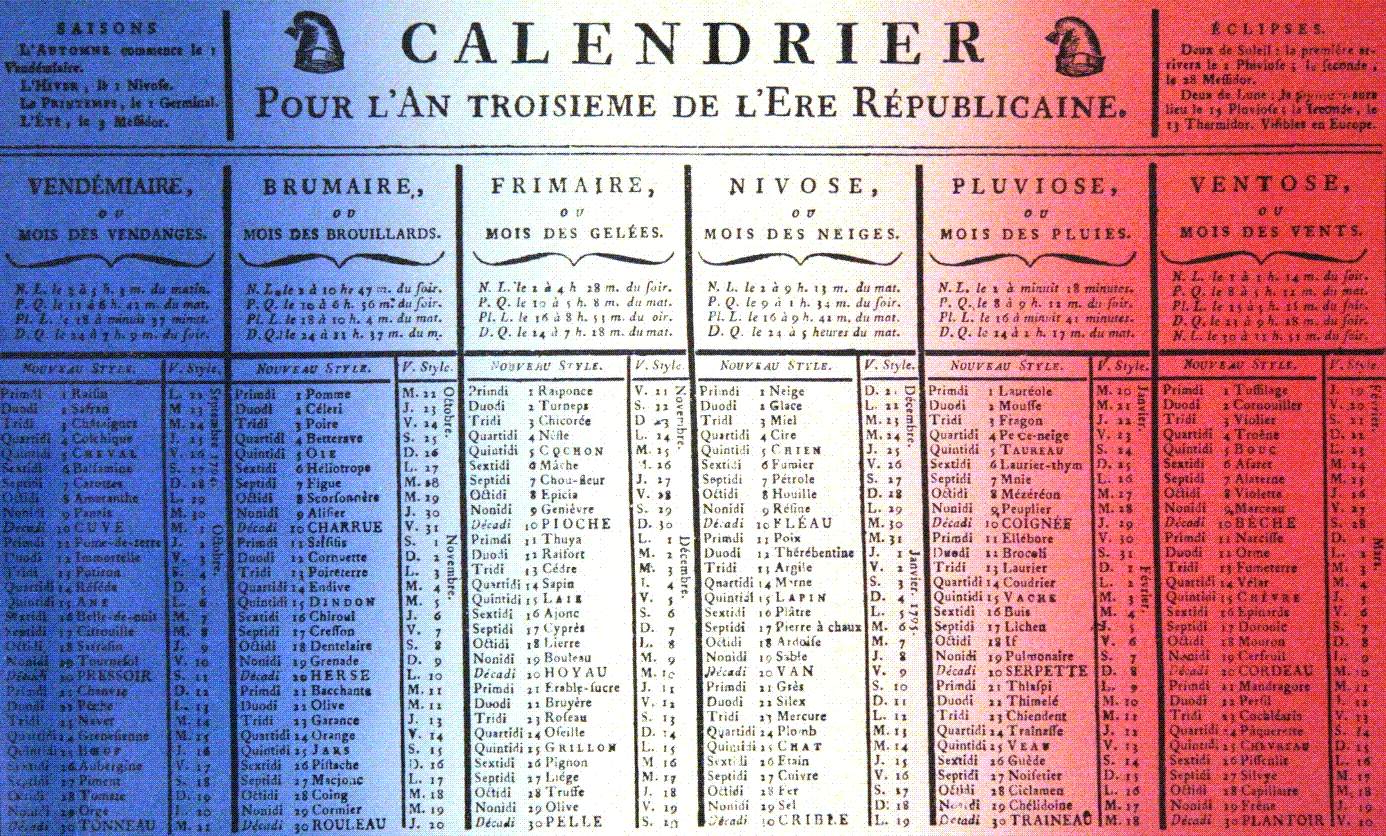
Primidi, 1 Vendémiaire CCXVIII, day of Grapes

French Republican Calendar
The French Republican Calendar – Year III

Today, September 22, is the day of the September , when Autumn begins in the Northern (and Spring in the Southern) hemisphere. It was also the first day of the French Republican Calendar. On September 22, 1792 in France, the First Republic was born, and the new calendar (although it was fully conceived some months later only) started on this very same Equinox day.

The new calendar was part of a plan of rationalizing, standardizing, and secularizing systems of measurements named the Metric System, then the (S.I.). At the time in Europe, you would not have a same value for a French, British, Spanish or Italian league, mile, pound, ounce, gallon, whatever. Values would even change between counties or cities in a same country sometimes. A few years earlier then, French King Louis XVI had commissioned a group of scientists headed by to create a unified and rational system of measures. The Revolutionary Government intensified it.

French scientists decided modern values should be based as much as possible on number 10. Their work led to the present unification and rationalization of measurements, with the development of meter, kilogram, then the second, kelvin, ampere, candela, mole, etc. The metric system/S.I. is of widespread use in science, and it has been progressively adopted  in ordinary life by every country in the world but three: Liberia, Myanmar and the USA.

One attempt was a failure though: the , that lasted for about 13 years only (plus 18 days in 1871 during the Paris Commune) and never spread outside France. Every year was written in Roman letters (year CCXVIII begins today). It had twelve months of 30 days each, that were given new names based on seasons and nature, principally having to do with the prevailing weather in and around Paris. For instance, Vendémiaire that begins today, means "the month of Winds". It obviously made the calendar pretty inaccurate in most countries, and especially in the Southern hemisphere.

Every months was divided into three decades, 'weeks' of 10 days called Primidi (first day), Duodi (second day), Tridi (third day) and so on. One Decadi every ten days instead of one Sunday every seven days was certainly another good reason for the new calendar to fail. Instead of Saints as in the Christian calendar, every day in the year was associated to a plant or a tool (Grape today for example).

    [BbN #10]

At the end of the year, 5 or 6 Complementary Days (or Sansculotides) were respectively called Celebration Day of Virtue, Talent, Labour, Convictions, Honours, and on lap years, Celebration of the Revolution.

Today is Primidi, 1er Vendémiaire CCXVIII, day of Grapes. Happy New Republican Year, everyone.
Paris in August

August in Paris
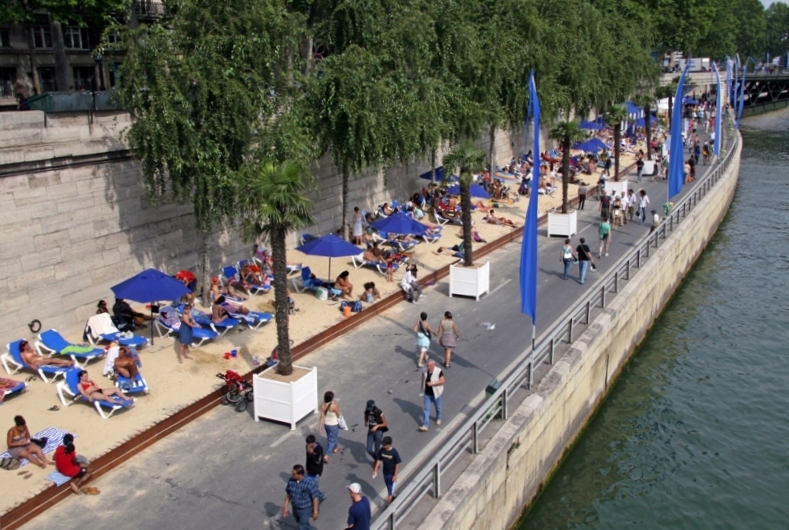
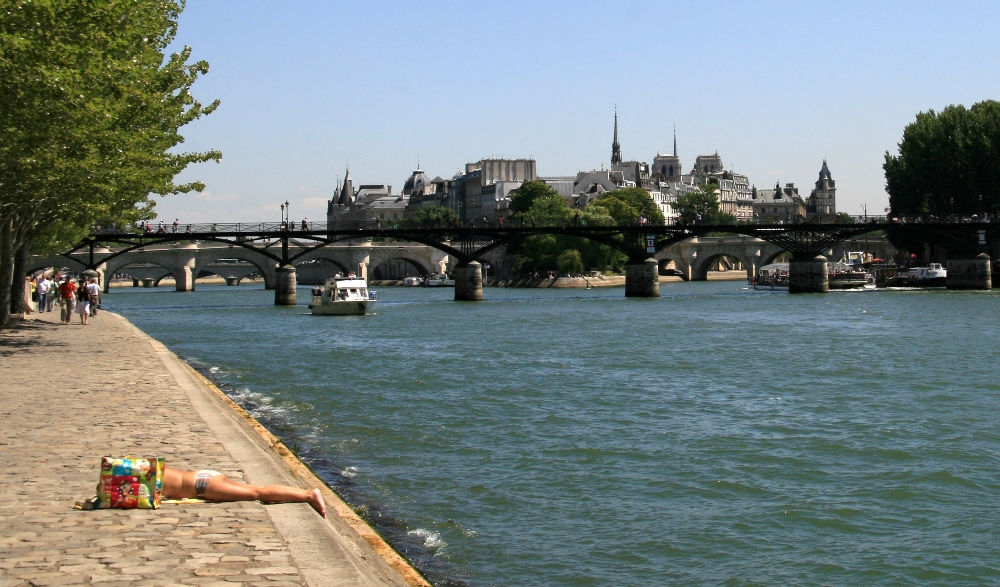
Taking a Sunbath in Paris

I love Paris in August. Because many people have the month of August off in France, several hundred thousand Parisians then leave the city for weeks. Fewer Parisians, many tourists, warm and sunny weather usually, there is a special atmosphere. The air is filled with tranquillity, like a Sunday that would last for one month.

You must go and work every day as usual; you feel as if you were in vacation though. For lunch, you will improvise a picnic with colleagues, in the or the . On the evening, you will stroll around, have a beer at the terrace of a café. You will sit on the grass in a garden perhaps, to take a nap or read a book.

It's August. The eighth month in the year, and a blessed month in Paris, when the City of Lights gets rid of its usual frenzy. Traffic jams, subway's crowd, all that makes it a hard place to live in sometimes, has disappeared for a while. The city reveals itself, warm and cheerful. It has put on its leisure clothes, for the sake of tourists, most of whom don't realize how special the atmosphere is.

Paris Plage
Paris-Plages, on the banks
of the Seine River

Paris is weightless in August. It's culture without stress, moving around without hurry. No more queues in front of movie theatres. No more traffic jams on the . You will find a parking space anywhere at once, and it's free! You can sit in the bus. Metro cars are empty.

You can take a (Paris' self-service bike-hire system) safely and bike everywhere, even on the .

    [BbN #8]
You may decide to go to ('Paris-Beaches', eighth occurrence this year) and have a sunbath on the banks of the Seine River or Bassin de la Villette, why not? You feel as if you were a tourist yourself.

In August, Parisians rediscover space in a city that misses it so much during the rest of the year. La Joie de Vivre is back, it is almost Italy. Oh yes. I do love Paris in August.

N°5

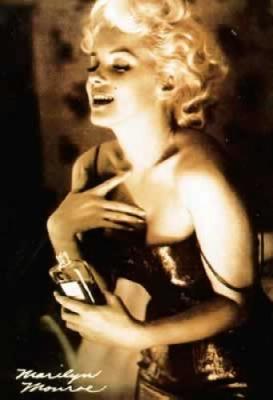
Marilyn Monroe
"What do I wear to bed? Why, Chanel N°5, of course"  (Marilyn Monroe)

Since my entry entitled Blogging by Numbers, I have written blogs under the constraint stated as 'Write blogs on topics one can associate with successive ascending numbers' — and still am I now. It was not the first time I assigned myself a constraint as a challenge, and a help to my inspiration as well: I did the same two years ago with a constraint of writing about the 5 senses and Paris. It ended up in blogs about Sight, Hearing, Touch, Taste, and Smell.

When you talk about the five senses, it is but logical to name sight and hearing first, because they are the most important senses in humans. Taste, and essentially smell, on the contrary, will be named last, because they are of much lesser use in humans than many animals.

It is the same when it comes to arts. Arts are usually based on one sense only, and arts based on a sense that acts from a distance — sight or hearing — are seen as noble arts. Painters, sculptors, composers, musicians, are undisputed artists. On the opposite, few people will spontaneously consider that chefs, wine experts and perfumers are artists as well. There is a hierarchy among senses: senses that need closeness are trivial. Touch, taste, and smell, especially.

Every art needs education and practice. It is the case especially with arts that rely upon underused senses. It is probably not only coincidental then that France, a country where even body smell has traditionally been considered a normal feature of men and women, is especially famous for its cuisine, cheeses, wines, and perfumes.

Everybody knows Leonardo, Picasso, Rodin, Mozart, and so many other artists relying on sight or hearing. Few people, on the opposite, have heard of , who invented the Eau de Cologne and served as a model for the character of César Birotteau in the novel by , or who created Chanel n°5, probably the most famous perfume ever.

quote I want to give women an artificial perfume. Yes, I really do mean artificial, like a dress, something that has been made. I am a fashion craft worker. I don’t want any rose or lily of the valley, I want a perfume that is a composition.
Coco Chanel

When Mademoiselle commissioned Ernest Beaux to make several perfumes for her choosing, she was already a famous fashion designer who had imposed her conception of elegance, with modern women feeling free because they wore simple and comfortable clothing.

At the time though, fashion and perfumes were distinct areas, and the idea of creating a perfume that would be an image of the brand was new. Beaux produced two series of samples numbered 1 to 5 and 20 to 24. Chanel chose the bottle labelled as N°5 and decided to keep the name, probably for superstitious reasons.

      [BbN #5]
The new perfume was introduced on May 5, 1921, on the 5th day of the 5th month of the year. In the light of what its destiny has been for more than 80 years, Coco Chanel was undoubtedly right in thinking that 5 was her lucky number.

Being the First, at any Price

Le Maillot Jaune [The Yellow Jersey]
Le Maillot Jaune

It is in the very nature of sport that competitors do as much as they can to win. For an athlete though, searching for the first place should not apply to the results of the competition only, but dignity, human excellence, and fair-play as well.

In other words, 'being the first at any price' is not defensible. There's a gap between being the first, thanks to your efforts, perseverance and biological aptitudes, and winning because you cheated.

Many people think that 'the end justifies the means' though. According to this logic, being the first is not the main goal in itself. It is a way to get honours, please a government, make money, and have many other people around make money also.

When I was a child, the punctuated July. I would spent hours watching it on TV. I undoubtedly learned a lot of French geography by writing down every stage, with distances, intermediate towns, passes to get over, etc. I would read every day in the local newspaper about the day's winner and the jersey holders: the white, spotted, green, and of course, Le Maillot Jaune.

Tom Simpson dies — Mont Ventoux, July 13, 1967
Tom Simpson
Mont Ventoux, July 13, 1967
And then... on July 13, 1967, died climbing Mont Ventoux. Millions people saw it . I did. "Heat exhaustion" they say. That's right, blame the heat... Even the child I was at the time understood it could not be related to heat only. We heard later that Simpson's autopsy found amphetamines and alcohol in his blood. Police also discovered amphetamine tablets in the pocket of his jersey and in a team support car.

As year passed, we heard of steroids, androgens, the 'pot belge', erythropoietin, and so on. We learned that, besides training, willpower, capacity for overcoming pain, that are still necessary in a crazy competition that aims at putting back the limits of human resistance to pain and effort, doping substances were and are still essential.

Richard Virenque, Marco Pantani, Jan Ullrich, Bjarne Riis, Floyd Landis… and . Dozens of cheats and liars who had sworn for years they were 'clean', until they were convicted of doping, and then cried and apologized. Many cyclists have not been caught yet, or have miraculously been put in the clear, scientifically guilty but not guilty on juridical grounds… What a farce.

Anyway. A lot of people still love the Tour de France… people outside France especially. Among the people who watch Le Tour on the French roads every year in July, there are a lot of fans from all over the world, bikers or not, who come to France especially to see it. Good for them.

Yet, as for me and millions of French people, I don't follow the Tour de France any more. I watch the News of the Tour sometimes though. Not because I want to hear about who won the stage or who leads the race. Only, I am a little interested in hearing which cheats will be unmasked this time.
[BbN: #1]

A Void

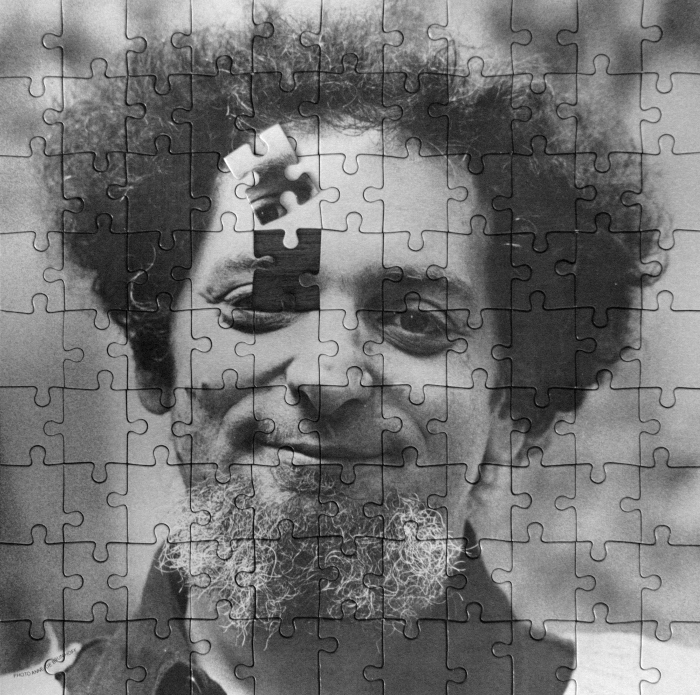
Georges Perec Jigsaw
Georges Perec's portrait as a jigsaw puzzle
Puzzle pour un portrait de Georges Perec
La Poésie dans un jardin — Festival d'Avignon 1988

Born in Paris in 1936, was the only son of two recent Jewish immigrants from Poland, Icek and Cyrla Peretz. His father volunteered for French Army during World War II, and was killed in 1940. His mother was deported by the Nazis and died in Auschwitz in 1943.

Georges survived because his mother had previously sent him by train to a little town in the Alps mountains, where relatives took charge of him. They had him baptized Catholic and his name frenchified to Perec. They adopted him formally after the war.

Disappearance of his parents when he was a child, disappearance of his Jewish roots, there is nothing so surprising that Perec was haunted by absence, loss, erasing, disappearance. “I have no memory of childhood” are the first words of his novel , an admission that he remembers almost nothing of his early life as a Jew in Nazi-occupied France.

In 1969, Georges Perec published a novel named La disparition, a phrase that means ‘the disappearance’ in English. A word for word translation of the title into English had to be replaced by A Void (Gilbert Adair) or A Vanishing (Ian Monk) though, because the letter E appears three times in ‘the disappearance’, and the whole novel  is a 300 pages written without ever using a E.

La disparition tells the story of the disappearance of a man, whose name is Anton Voyl (in French) or Vowl (in English), in a strange world from which an enigmatic part five of 26 has disappeared as well.

La disparition
It implicitly talks of its own lipogrammatic limitation, starting with the name of the missing person — Voyelle in French, Vowel in English, after the E's have been lost. Characters in the novel work out what is missing, but they risk fatal injury if their though gets too close to that taboo “circular symbol with a horizontal bar across it”.

The constraint that underlies the story induces endless tricks and distortions of language, and describes how a world can be built that fills that void. Besides the amazing lexicographic feats of writing a whole novel with zero occurrence of the most frequent letter in French and English though, the silent disappearance of the letter is a metaphor of loss, and suffering it causes.

In French, E is the only vowel in père [father] and mère [mother], and sans E [without E] sounds very much like sans eux [without them]. Furthermore, since the name Georges Perec is full of E's, the disappearance of the letter also ensures the author's own disappearance.

The absence of a sign is always the sign of an absence, and the absence of the E in A Void announces a broader, cannily coded discourse on loss, catastrophe, and mourning […] Each "void" in the novel is abundantly furnished with meaning, and each points toward the existential void that Perec grappled with throughout his youth and early adulthood. A strange and compelling parable of survival becomes apparent in the novel, too, if one is willing to reflect on the struggles of a Holocaust orphan trying to make sense out of absence, and those of a young writer who has chosen to do without the letter that is the beginning and end of 'écriture' [writing].     —

-:-:-:-:-

Postscript: When I challenged myself with the Blogging by numbers constraint, I decided the first entry in the series would be related to Number 0 — not 1 — and dedicated to A Void. It seemed fair enough because the very idea of the constraint was inspired in particular by the works of Georges Perec and Oulipo.

I did not know though that another void was just about to occur, when my I had my laptop fell from a table three weeks ago and its hard drive broke. Another aching void and a lot of work to do again, because I had not performed any save for a month or so. Anyway, I am back now.

[BbN: #0]

Persepolis

Persepolis by Marianne Satrapi
Marjane Satrapi is an Iranian/French graphic novelist. She was born in 1969 in Rasht, in the North of Iran, and now lives and works in Paris. She became famous because of her critically acclaimed autobiographical graphic novels Persepolis, which describe her childhood and adolescence in Iran and Europe.

Persepolis graphic novels were adapted by herself and Vincent Parronaud into an essentially black-and-white animated film bearing the same name. The movie was called 'islamophobe' and 'anti-iranian' by the Iranian President Mahmoud Ahmadinejad, thus it is not allowed for broadcast in Iran. Yet it is not a political movie. It deals with life in the real world. It is a work of poetry for all of us to delight in.

Image
When the movie starts, Marjane is a child. She lives in Tehran, in a progressive family involved with the socialist movements. She attends the Lycée Français in Tehran, and witnesses the growing oppression of civil liberties and the everyday-life consequences of Iranian politics. Then comes the Iranian revolution, the fall of the Shah, and the regime of Ayatollah Khomeini. After days of elation, disillusion follows quickly. Political opponents are put in jail again, many are executed, and islamist rules are imposed. Then the Iran-Iraq war starts. At the age of 14, her parents send Marjane to Vienna, Austria, to flee the Iranian regime. She discovers Europe, boys, and loneliness. She comes back to Iran.

The movie relates with realism and humour Marjane's years of hardship, she shared with million young Iranians of the time: overnight obligation to wear a veil, search for forbidden pirated audio cassettes, secret parties with friends where you dance and drink alcohol despite police raids.

Persepolis was awarded the Special Jury Prize in Cannes Film Festival in May 2007. Last Year, it was given the Better First Movie Award in the Cesar Award, the National film award for France. It also competed in Hollywood for the Oscar, as a nominee for best animated film, but had no chance against Disney's blockbuster Ratatouille.


Persepolis Trailer


Persepolis is a simple story told by simple means. It consists essentially of a series of monochrome drawings, their bold black lines washed with nuances of gray. Its flat, stylized depiction of the world — the streets and buildings of Tehran and Vienna in particular — turns geography into poetry. Yet it is good to be reminded that animation is rooted not in any particular technique, but in the impulse to bring static images to life.

Lily of the Valley

Lily of the valleyAlthough it was pretty early when I left home this morning, there were people on the sidewalks already, at every street corner. You may find it strange to hear that Frenchmen were awake early on the morning of a national holiday, especially on May Day: it is also Labour Day in France and many countries, a day where most people don't work then. There was good reason for it though: these people were vendors of lilies of the valley.
Lily of the valley, “le muguet”, is not any flower for the French. Although it is native to Japan, it became acclimated to Western Europe many centuries ago. In medieval France, it was considered the symbol of spring and nature's revival, and the emblem of a joyous, more-or-less pagan holiday, celebrating the return of nice weather and promises of spring's planting, and seeking Heaven's favour for harvests to come.

On May first, 1561, after he was given a sprig of Lily of the valley as a lucky charm, French King Charles IX decided he would give a sprig to every lady in his court on May 1st, every year from then on. A tradition was born. In France, is not permitted to sell things in the streets without a licence, but this is an exception: thanks to the nice tradition, everyone, not only florists, is allowed to sell lily of the valley in French streets on May Day.

Everywhere today, you will see people clutching their lily of the valley, to be offered to their wife, husband, girlfriend, boyfriend, parents, dinner host, boss, secretary, and so forth. As for me, I bought a couple of flowers this morning, and picked the sprig above on the internet for you. Happy May Day, and Good Luck!
[repost]

Eating Together

Eating together
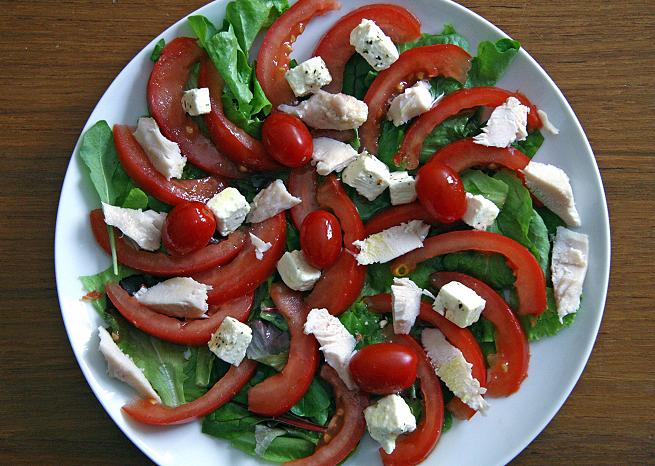
The starter I've prepared for dinner: a few cherry tomatoes and a big sliced one, feta cheese, some lettuce, a bit of chicken cut in dices, olive oil, vinegar, pepper, salt, that's it. Bon appétit!

'French women don't get fat', a US best-seller book stated. It's almost true: despite their food is usually considered rich, the French have the average lowest corpulence in Europe, relatively low rates of diabetes and coronary diseases, and are among the people with the longest longevity. Many reasons have been given as an explanation for this French paradox, that include habits of eating small portions of several foods rather than one huge portion, using olive oil, eating a lot of dairy produce and vegetables, drinking red wine, and walking rather than driving for short distances.

According to a recent study by the INSEE, the French Institute of Statistics and Economic Studies, there may be also another cultural reason: the ritualization of meals, a distinctive features of French people, most of whom still take their meals together at a given time. Such a synchronisation of meals, at around 13h for lunch and 20h for dinner, 'distinguishes France from most other countries in Europe and the United States, where traditional meal — conceived like a moment shared by all members of a family gathering together on this occasion — almost disappeared at the end of the 1970's', the study says.

Dinner, especially,'is still a mandatory stage in daily timetable of the French, one of last refuges of family socialization'. Indeed, it is often the only common activity for married people who go their separate professional life in the daytime, and the moment when parents and children have a time to talk together. Meals are not only considered a moment when you fill up your stomach as fast as possible, but a dedicated period of the day when you talk and share with your family.

I love the idea that gathering together and sharing meals is beneficial to relations between members of a family, and to health as well.

Oops, by the way... I got to go: it's 8:00 pm now, dinner time here!

Ada Lovelace Day: Pantheon of Women

[I have not found the time to write a blog about Marie Skłodowska Curie, as I thought of doing within the context of Ada Lovelace Day. I will use a subterfuge then: on March 8, 2008, for the International Women's Day, I posted an entry on my defunct blog on Yahoo! 360° that dealt with nine French Women who would deserve to rest in the Panthéon in Paris. The entry disappeared with that blog. Here it is again in this one. Granted, most of the women celebrated were not involved in technology. Yet everyone of them, each in her field, can be considered 'female role models' undoubtedly.]
 
— : — : — : — : — : —

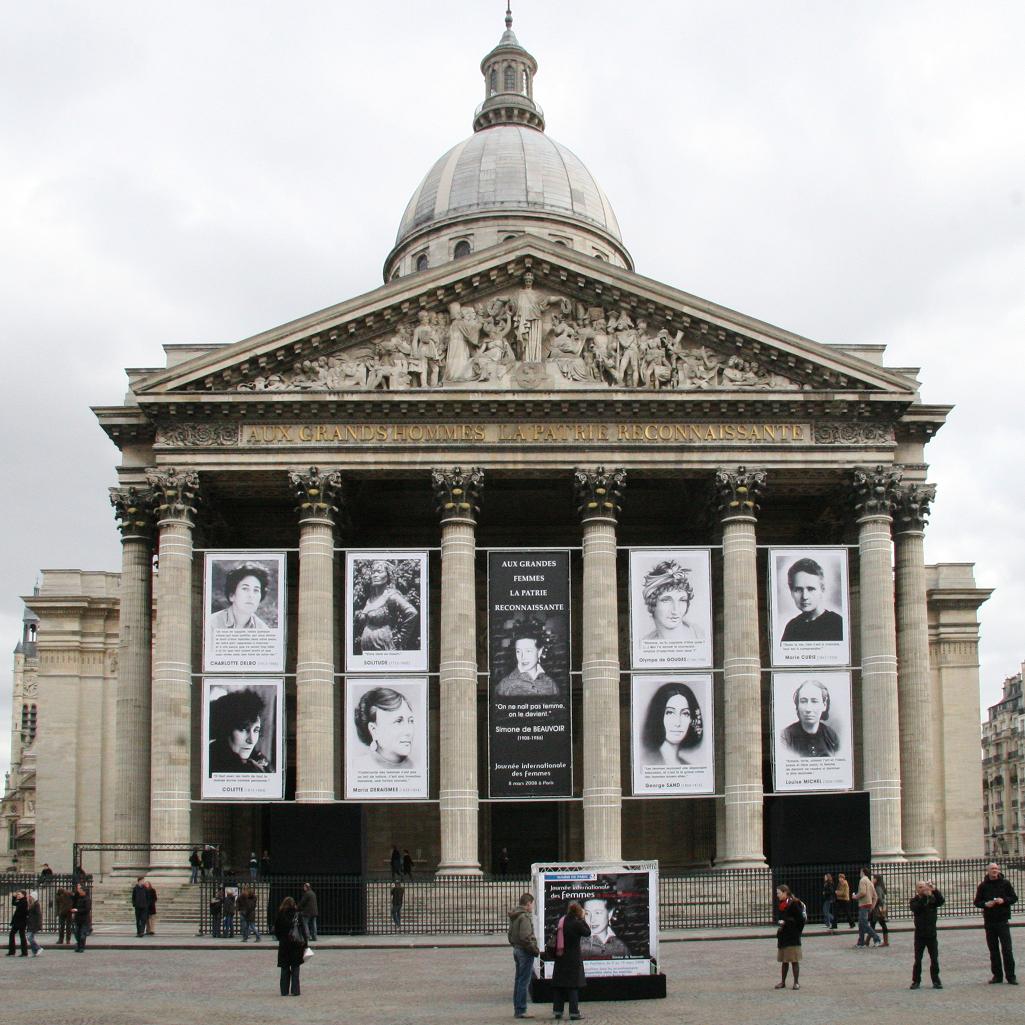
The Panthéon — Paris, 8 March 2008
I must say I am divided about the International Women's Day, celebrated every March 8th. I certainly agree women are still not considered equal to men in a lot of countries, for cultural and religious reasons. Even in western countries, there is no fair equality between genders in many fields, salaries especially.

On the other hand, I don't believe a yearly celebration can change the way men consider women, or make a religion evolves. I find it cheaply gives people clear conscience sometimes: one Women's Day a year, and 364 (365 even, this year) uncelebrated Men's Days!

Anyway... I went to the Panthéon this morning to see the portraits of nine French female figureheads displayed on its facade to celebrate Women's Day, and take pictures myself. Le Panthéon is a neoclassical monument on the top of the Montagne Sainte-Geneviève, in the 5th arrondissement of Paris. It was originally built as a church dedicated to St. Genevieve, the patron of the city. It is now the burial place for 'French National Heroes' (Pantheon in Greek means 'All the Gods'). The inscription in letters of gold above the entrance reads AUX GRANDS HOMMES LA PATRIE RECONNAISSANTE (To the great men [from] the grateful homeland).

The word Men here is supposed to mean Human beings, yet among the 73 honoured people buried here, there is only one woman, Marie Curie. Although it was definitely theoretical, I was interested to see which women the Parisian elites had considered deserving enough to be next to Mirabeau, Voltaire and Hugo. Here they are.

ImageSimone de Beauvoir (1908-1986 — philosopher and writer). An existentialist, she lived with Jean-Paul Sartre for several decades. She was among the most influential intellectuals in the second half of 20th century. Her book The second sex is regarded as a major feminist book.
ImageColette (1873-1954 — writer). Her literary talent was first exploited by her husband Willy, but she became emancipated... and scandalous for a time (music-hall shows and overt affairs with men and women). She published around 50 novels, one can divide into idyllic natural tales and dark struggles in relationships and love.
ImageMarie Curie (1867-1934 — Physicist) Born in Poland, Maria Skłodowska went to Paris aged 24 to study and became a naturalized French. At the Sorbonne, she met and married Pierre Curie. She won the Nobel Prize twice: in Physics in 1903 (discovery of radioactivity) and Chemistry in 1911 (discovery of Radium and Polonium).
ImageCharlotte Delbo (1913-1985 — resistance fighter). She was arrested by the Nazis in 1942 and sent to Auschwitz concentration camp. She was one of the 49 women who survived. She wrote several books about it, including a biography of every prisoner who was with her in the convoy to Auschwitz.
ImageMaria Deraismes (1828-1894 — politician and freemason). A figurehead of feminism, she was a republican (i.e. not royalist), antireligious politician. In 1893, she co-founded the first International Order of Mixed Freemasonry, advocating equality between women and men, Le Droit Humain.
ImageOlympe de Gouges (1748-1793 — politician). She is regarded as one of the first French feminists. In her Declaration of the Rights of Woman and the Female Citizen, she challenged the practice of male authority and the notion of male-female inequality. She was executed by guillotine during the Reign of Terror.
ImageLouise Michel (1830-1905 — politician). A revolutionary and an anarchist, she was active during the Paris Commune as an ambulance woman. After the Versaillais won, she was sentenced to deportation in New-Caledonia. She returned to Paris 7 years later and preached the revolution until her death, despite several stays in jail and exile in London.
ImageGeorge Sand (1804-1876 — writer) Born Aurore Dupin, she decided to take a male nick to be more easily published. She would dress as a man, smoke the pipe, ride like a man, yet she had tumultuous liaisons with Alfred de Musset and Frédéric Chopin. She was a feminist, asking for women's right to divorce and equality in civil rights.
ImageSolitude (1772-1802 — fighter against slavery). In 1794, the revolution freed this mulatto slave. When Napoléon Bonaparte restored slavery in 1802, Solitude rose up in arms although she was pregnant. She was wounded, captured and sentenced to death. Her hanging was delayed until the day after she gave birth. Slavery in France was abolished for good in 1848 only.

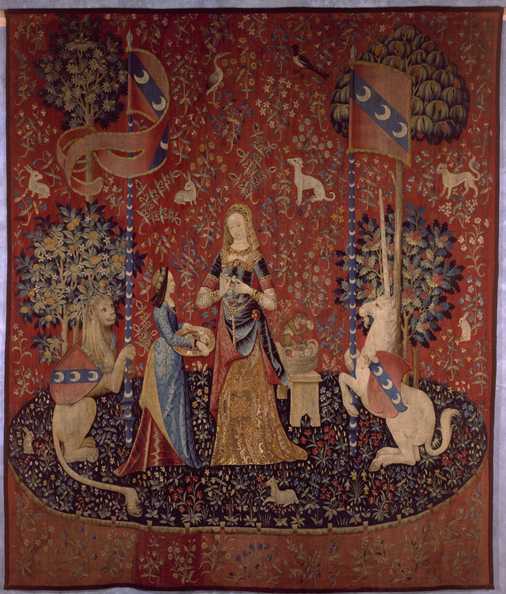
The Lady and the Unicorn

A mon seul désir
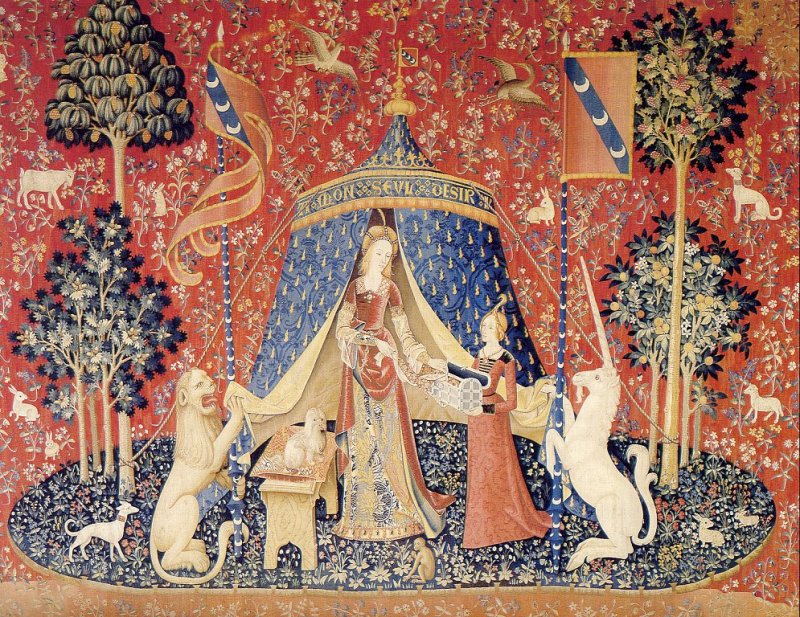
The Lady and the Unicorn — To my only desire.
Cluny Museum of Middle Ages, Paris.

The Hôtel de Cluny, in the Quartier Latin (the Latin Quarter) in Paris, was built in the 14th and 15th century. It is a beautiful structure that combines Gothic and Renaissance architecture. It is worth seeing as a building then, yet essentially it is the French Museum of the Middle-Ages. It houses many early Medieval sculptures, wonderful illuminated manuscript, and an important tapestry collection, that includes one of the greatest works of art of the whole Middle Ages, the famous series of tapestries named 'La dame à la licorne''The Lady and the Unicorn'.

The Lady and the Unicorn — Taste
Taste (detail)
Click for the whole image

The Lady and the Unicorn
by John Renbourn

I went there again yesterday, for the tenth time maybe, because they have just opened new rooms to the public, dedicated to art and life in the Middle-Ages. Also, I wanted to see the red tapestries again, a few months after I went to the Cloisters in New-York and watched the green series of Unicorn tapestries they hold there [This series was the topic of the last blog I published on Yahoo. I might post an emended version of it here some day].

The Lady and the Unicorn — Sight
Sight (detail, click)

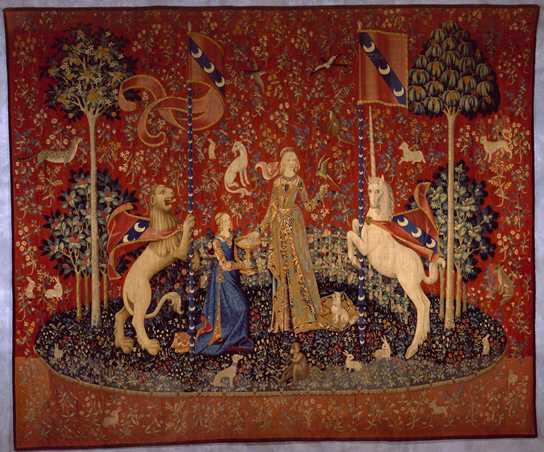
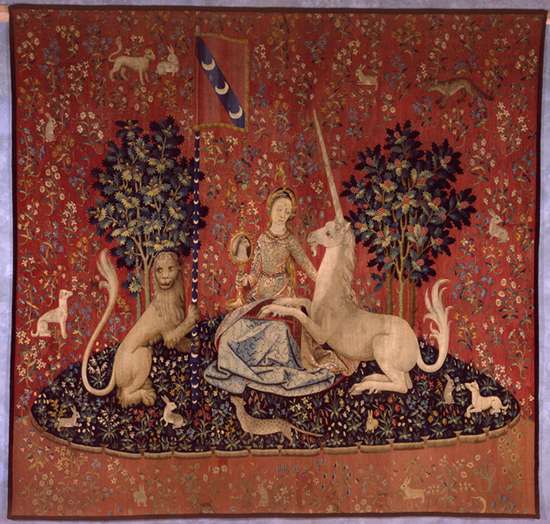
Both series are dated back to the 15th century. They are so-called 'Tapisseries mille fleurs' ('Thousand flowers tapestries'), named that way because they contain thousands of details, flowers and small animals especially.

While the Unicorn is the main character of the green tapestries held in New-York, that tell the story of the Hunt of the Unicorn, the Lady is the centre of the red tapestries displayed in Cluny Museum. My eyes this morning remain filled with visions of the beautiful, enigmatic Lady.

The Lady and the Unicorn — Touch
Touch (detail, click)
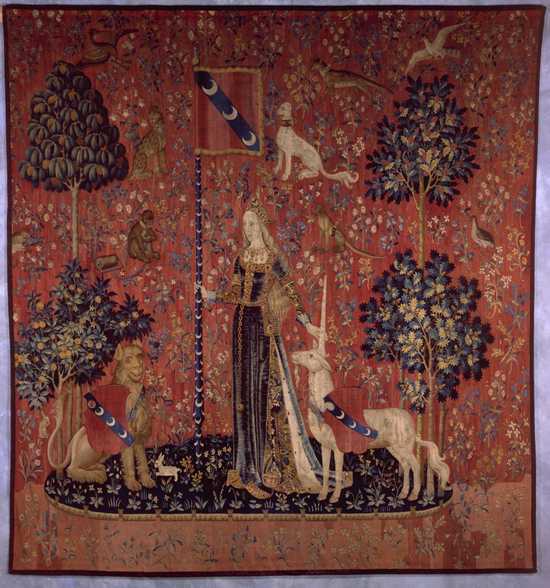
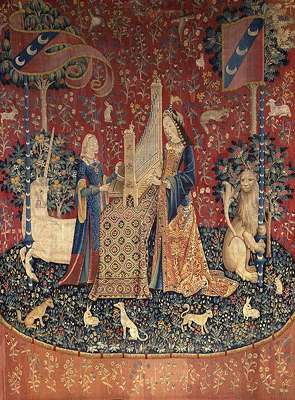
There are six tapestries in the series. Five hang side by side on a same larger curved wall in front of the only door. They are really huge, several meters wide and high. You see nothing but them when you enter the room. They depict the five senses: Taste, Sight, Touch, Smell, Hearing, in that order. Touch is situated in the middle, a very sensual picture where the Lady holds a standard in her right hand and the horn of the unicorn in her left one.

The Lady and the Unicorn — Smell
Smell (detail, click)
After you have looked at the five senses for a while, you turn round to the exit door, but then you have a view of the sixth tapestry, that has been hanging alone on the straight wall behind you from the beginning. In this tapestry, the Lady places her necklace into a case held out by her servant.  The Lion and the Unicorn are here, and many little animals. She will leave then soon though, and enter the tent behind her of which the door is wide open for her. 'A mon seul désir' ('To my only Desire'), an inscription on the tent says.

The Lady and the Unicorn — Hearing
Hearing (detail, click)

Nobody knows for sure what this tapestry means. I have the feeling that the Lady has experienced many things in her life already, using her five senses, and she has reached the end of this path now.

The wise, beautiful Lady, might have decided to renounce pleasures of the world. Or she knows she will pass soon perhaps. Whatever the reason, she now leaves her jewels forever, as a symbol of her physical life, before she enters the tent, as a symbol of her inner spirituality, a convent, or the Other World.

Noir Désir

Gagnants/Perdants by <em><u>Noir Désir</em>
Gagnants/Perdants by Noir Désir

Noir Désir became famous in 2001 with their song 'Le vent nous portera'. Yet the band was disrupted after singer Bertrand Cantat was jailed for the manslaughter of his girlfriend, actress Marie Trintignant after a violent row in a Lithuanian hotel in July 2003. He was sentenced to eight years imprisonment, but left jail last year after he had served half the sentence.

"Noir Désir died the same day as Marie", Cantat once said. Yet the band does not appear to be that dead, since they released on the Internet last Thursday, that everyone can download for free.

Le vent nous portera (Noir Désir)

For several months, I did not listen to 'Le vent nous portera' because I could not help thinking this voice belonged to a man who once beat his wife to death. I still have mixed feelings about it: the song exists anyway, and it is a great song.

Giorgio de Chirico — The Red Tower
Giorgio de Chirico
The Red Tower (1913)
The Barnes Foundation

When I was in Philadelphia lately, I visited , a fascinating place where hundreds (!) of chef-d'oeuvres are displayed. It owns a lot of Impressionist paintings especially. Also, many canvases by various painters who were not impressionists are exhibited, among which several pieces by .

I like many paintings by Chirico, in particular those he painted during his 'metaphysical' period. Yet the artist later joined the futurist movement 'Valori Plastici', then its 'Novecento' following, who both supported Mussolini's fascism. I sure dislike what were the ideas and behaviour of the individual. I still love many of his paintings anyway.

Another example: French writer , also a doctor in medicine. His first novel, 'Journey to the End of the Night' (Voyage au bout de la nuit) is among my favourite books ever. 'Death on the Instalment Plan' (Mort à crédit) is another great novel by him. His medical thesis about , who discovered the cause of puerperal fever and introduced hand washing in medicine, is at the same time a marvel of smartness and independence of mind, and splendid literature.

Yet Céline was a racist and anti-Semite, who shared many opinions with the Nazis. He wrote shameful pamphlets about the Jews before and during WWII. After the war, he was convicted a collaborator and imprisoned. I despise the man, I deeply admire several novels he wrote.

So... I still look at paintings by Chirico. I still read Céline. I still listen to music by Wagner. I may still listen to the songs by Bertrand Cantat also then. It does not mean I would shake the hand of the man, if it ever happened that I met him.

Le Lapin Agile

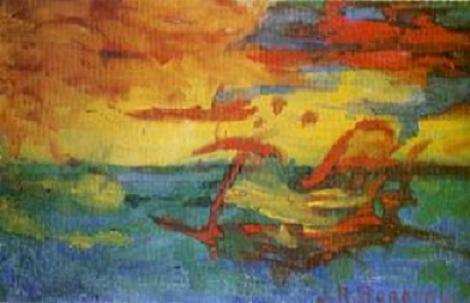
Joachim-Raphaël Boronali — Coucher de soleil sur l'Adriatique (Sunset on the Adriatic)
Joachim-Raphael BoronaliSunset on the Adriatic [Coucher de soleil sur l'Adriatique]

The painting on the left induced some hurly-burly when it was exhibited at the Salon des Indépendants in Paris in 1910. The canvas was signed by a person of obscure repute named Joachim-Raphael Boronali, who had prepared the picture's appearance by drafting a manifesto about a new, dissident futurist school, Excessivism.

ImageMany specialized critics who saw the painting in the show found the work 'very interesting'. It was sold twenty Golden Louis (400 French francs, about 1,800 current dollars). And yet, its author, who appears in the adjacent photo with his best friend, was not a painter at all.

There is a famous cabaret at 22 Rue des Saules in Montmartre, named Le Lapin Agile, where, in the 1900s-1910s, unknown people called Picasso, Utrillo, Modigliani, Braque, Derain, Dorgelès, Apollinaire or Max Jacob would meet, talk, joke, sing and drink together. The owner of the place was Frédéric Gérard, Le Père Frédé as everyone called him, who is the bearded man who appears in the photo above.

ImageThe cabaret had existed since 1860. It was originally called Le Cabaret des AssassinsCabaret of Murderers — until Andre Gill, a caricaturist, painted in 1875 the sign that was to suggest its permanent name: the picture of a humanized rabbit with a top-hat, who jumps out of a saucepan with a bottle of wine in his hand.
Residents soon called their neighbourhood night-club Le Lapin à GillGill's rabbit — a name that naturally evolved into Le Lapin AgileThe Agile Rabbit.

Cora VaucaireFrédé
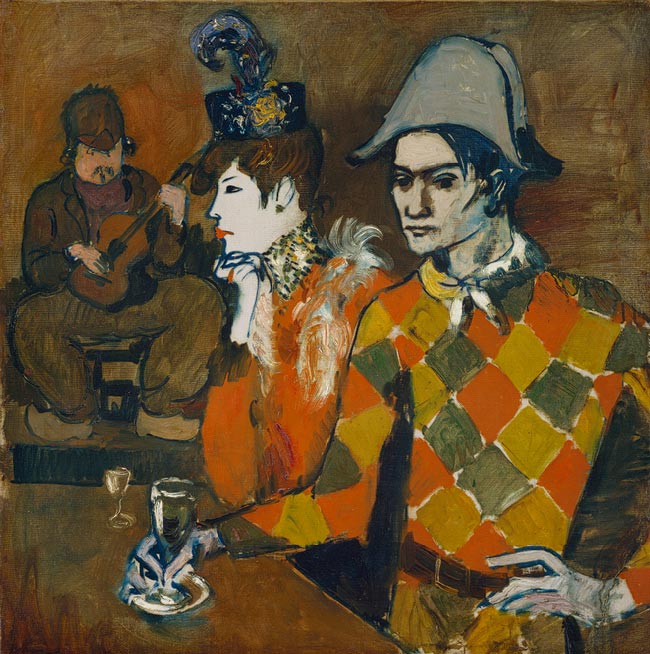
Pablo Picasso - Au Lapin Agile
Pablo PicassoAt the Lapin Agile
[Au Lapin Agile] 1905.
Oil on Canvas, 99 cm × 100 cm
Metropolitan Museum of Arts, New-York.

The cabaret still exists nowadays. It is still full of customers who come and listen to French songs dating back as far as the fifteenth century.

Frédéric Gérard— aka Frédé — the owner of the place shown with his donkey on the photo above, was a character. Songs have been written about him, and he is the man playing the guitar in the background, in the adjacent painting by .

In this painting, Picasso portrayed himself dressed as a Harlequin, accompanied by his model Germaine Pichot. According to the tale, Picasso once paid a lunch with this painting, that Frédé sold in 1912 for the equivalent of 20 dollars. In 1989, it was auctioned at Sotheby's for 41 million dollars.

Anyway, how about 'Joachim-Raphael Boronali'? Who hid under the nickname? You know it was not Picasso or any of the abovementioned artists since I wrote that the painter was portrayed in the photo displaying Frédé with his donkey. Yet the painter was not Frédé but... Lolo, the donkey!

The painting was a hoax by the writer Roland Dorgelès and a few friends, to make fun of art critics. They tied a brush to the tail of Lolo, which daubed a canvas with several colours in front of witnesses, official ones included. They coined the nickname Boronali because it is an anagram for Aliboron, as Jean de la Fontaine would call the donkey in his fables.

Image
Boronali in the process of creating his masterpiece
The painting is now permanently exhibited in a museum in Milly-La-Forêt, near Paris.

The Little Prince

There are few things about which I don't have any doubt, but here is one: by Antoine de Saint Exupéry is one of the greatest books ever.

I read Le Petit Prince — the original French title of the novella — for the first time when I was about eight, and I have read it again a lot of times since then... it is worth it, and also, this great book is a small book.

It is a children's story, yet it is also a philosophical tale, a poetical fable. The novella contains the best lessons of life, love and friendship you can read. Like Alice in Wonderland, it is a novel à tiroirs, with several levels of reading, in which everyone will find something different. Also, you will not find the same thing in it when you read it as a child, a teen or an adult, when you are young... or not that young any more.

To me [the fox said], you are still nothing more than a little boy who is just like a hundred thousand other little boys. And I have no need of you. And you, on your part, have no need of me. To you, I am nothing more than a fox like a hundred thousand other foxes. But if you tame me, then we shall need each other. To me, you will be unique in all the world. To you, I shall be unique in all the world [...] And then look: you see the grain-fields down yonder? I do not eat bread. Wheat is of no use to me. The wheat fields have nothing to say to me. And that is sad. But you have hair that is the color of gold. Think how wonderful that will be when you have tamed me! The grain, which is also golden, will bring me back the thought of you. And I shall love to listen to the wind in the wheat.
[...]
So the little prince tamed the fox. And when the hour of his departure drew near...
Ah said the fox, I shall cry.
It is your own fault, said the little prince. I never wished you any sort of harm; but you wanted me to tame you.
Yes, that is so, said the fox.
But now you are going to cry! said the little prince.
Yes, that is so, said the fox.
Then it has done you no good at all!
It has done me good, said the fox, because of the color of the wheat fields.
[...]
Goodbye, said the fox. And now here is my secret, a very simple secret: It is only with the heart that one can see rightly; what is essential is invisible to the eye.
What is essential is invisible to the eye, the little prince repeated, so that he would be sure to remember.
It is the time you have wasted for your rose that makes your rose so important.
It is the time I have wasted for my rose — said the little prince, so that he would be sure to remember.
Men have forgotten this truth, said the fox. But you must not forget it. You become responsible, forever, for what you have tamed. You are responsible for your rose...
I am responsible for my rose, the little prince repeated, so that he would be sure to remember.

If you haven't read the book yet, you have missed something... Yet you're also a lucky one, because it is a wonderful story to discover. You'll have no difficulty to find it in your native language, : Le Petit Prince is one of the most translated and published books ever.

Birdsong

There are two large bookstores in Paris where I will go several times a year and buy books in English: Brentano's, the American Bookstore in Paris and WHSmith in Paris, the English Bookshop. When I last went to Brentano's, I had my attention attracted to the title of a book: Birdsong, by Sebastian Faulks, an Englishman. I had never heard of it, although it was labelled as a bestseller. I flipped through a few pages: the book was about the First World War, and beautifully written. I bought it.

The book tells the story of a young Englishman who fights in France during the WWI, interspersed with scenes of the life of his granddaughter, Elizabeth, a young woman living in the 1970s, who travels to France to discover more about the life and dead of her grandfather.

As Elizabeth drives across empty fields, she notices a great arch in a field. She pulls over and has a closer look at it.

As she came up to the arch, Elizabeth saw with a start that it was written on. She went closer. She peered at the stone. There were names on it. Every grain of the surface had been carved with British names; their chiseled capitals rose from the level of her ankles to the height of the great arch itself; on every surface of every column as as far as her eye could see there were names teeming, reeling, over surfaces of yards, of hundred of yards, over furlongs of stone.

She moved through the space beneath the arch where the man was sweeping. She found the other pillars identically marked, their faces obliterated on all sides by the names that were carved on them.
Who are those, these...? She gestured with her hand.
These? The man with the brush sounded surprised. The lost.
Men who died in this battle?
No. The lost, the ones they did not find. The others are in the cemeteries.
These are just the... unfound?

She looked at the vault above her head and then around in panic at the endless writing, as though the surface of the sky had been papered in footnotes. When she could speak again, she said:
From the whole war?

The man shook his head.
Just these fields. He gestured with his arm.

Elizabeth went and sat on the steps on the other side of the monument. Beneath her was a formal garden with some rows of white headstones, each with a tended plant or flower at its base, each cleaned and beautiful in the weak winter sunlight.
Nobody told me. She ran her fingers with their red-painted nails back through her thick dark hair. My God, nobody told me.

Between 1914 and 1918, about 9 million people were killed, in Europe essentially: 2 million German, 1,300,000 Frenchmen, 750,000 British, 650,000 Italians... Beside the terrible loss of young men in every family — France lost about 10 percent of its working population in the conflict — the war changed the political map of Europe, and the world balance of power. Several European empires were dismantled. France and the UK, although the winners, were ruined. It was the very moment in history when Europe handed over to the USA as the world economical and political leader.

Camille "Ta Douleur"

Camille – Le Fil
Camille Dalmais, who goes by the stage name , is a French songwriter and singer unlike anyone: most of the sounds in her records come from the human body. Clicks, slaps, rubs, purr... and many more sounds, including her voice of course.

Ta douleur (Your pain) was the second song in Camille's second album Le fil (The Thread), released 2005.


CamilleTa douleur

Here are the French lyrics of the song and their translation into English. It is noteworthy that the word 'douleur' (pain) is feminine in French, which allows Camille a poetic licence: she speaks of pain as if it were a female... a female rival? Hence the use of 'she' instead of 'it' in the translation below, so that it renders the ambiguity of French lyrics... of which the meaning is probably obvious for their author only anyway.

Lève-toi, c'est décidé
Laisse moi te remplacer
Je vais prendre ta douleur

Doucement, sans faire de bruit
Comme on réveille la pluie
Je vais prendre ta douleur
Prendre ta douleur
Je vais prendre ta douleur

Elle lutte elle se débat
Mais ne résistera pas
Je vais bloquer l'ascenseur...
Prendre ta douleur
Je vais prendre ta douleur
Saboter l'interrupteur
Prendre ta douleur
Je vais prendre ta douleur

Mais c'est qui cette incrustée
Cet orage avant l'été
Sale chipie de petite soeur ?

Je vais tout lui confisquer
Ses fléchettes et son sifflet
J'vais lui donner la fessée...
Prendre ta douleur
Je vais prendre ta douleur
La virer de la récré
Prendre ta douleur
Je vais prendre ta douleur

Mais c'est qui cette héritière
Qui se baigne qui se terre
Dans l'eau tiède de tes reins ?
J'vais la priver de dessert
Lui faire mordre la poussière
De tous ceux qui n'ont plus faim...
Prendre ta douleur
Je vais prendre ta douleur
De tous ceux qui n'ont plus rien
Prendre ta douleur
Je vais prendre ta douleur

Dites moi que fout la science
A quand ce pont entre nos panses ?
Si tu as mal là où t'as peur
Tu n'as pas mal là où je pense !

Qu'est-ce-qu'elle veut cette connasse
Le beurre ou l'argent du beurre?
Que tu vives ou que tu meures ?
Faut qu'elle crève de bonheur
Ou qu'elle change de godasses
Faut qu'elle croule sous les fleurs
Change de couleur...
Je vais prendre ta douleur
Je vais jouer au docteur
Prendre ta douleur
Je vais prendre ta douleur

Dites moi que fout la science
A quand ce pont entre nos panses ?
Si tu as mal là où t'as peur
Tu n'as pas mal là où je chante !

Lève-toi lève-toi lève-toi
Elle a envie de toi ta douleur
Elle a envie de ttt ttt tt…

Get up, it's a done deal
Let me take your place
I'm going to take your pain

Gradually, without a noise
As one wakes up the rain
I'm going to take your pain
Take your pain
I'm going to take your pain

She fights, she struggles,
But she won't overcome
I am going to stop the lift...
Take your pain
I'm going to take your pain
Mess up the switch
Take your pain
I'm going to take your pain

Well, who is she, settled down,
Such a storm before summer
Such a brat little sister?

I'm going to seize her everything
Her darts and whistle
I am going to spank her…
Take your pain
I'm going to take your pain
Kick her out of the break
Take your pain
I'm going to take your pain

Well, who is that heiress,
Who has a bath, who goes to earth
In the warm water of your back?
I'm going to deprive her of dessert
Make her bite the dust
Of those who are not hungry any more...
Take your pain
I'm going to take your pain
Of those who don't have anything left
Take your pain
I'm going to take your pain

Tell me what the hell science is up to
When for a bridge between our bellies?
If you're aching where you're scared
You're not aching where I think!

What does she want, that bitch?
Your cake or she eats it?
You living or you dying?
She must be full of happiness
Or change her shoes
She must be snowed under with flowers
Change your colour…
I'm going to take your pain
I'm going to play at doctors
Take your pain
I'm going to take your pain

Tell me what the hell science is up to
When for a bridge between our bellies?
If you're aching where you're scared
You're not aching where I sing!

Get up get up get up
She wants you, your pain
She wants…

Eclipse

There was a lunar eclipse last night, you could see in Europe and Africa essentially. From about 9:30 pm onwards, the moon progressively took an unusual coppery colour, when every first light and sunset in the world focused on its surface.
A lunar eclipse occurs when the moon enters the Earth's shadow. One would think it looks darker, more greyish than usual. Yet, on the contrary, it turns red, because the atmosphere of the Earth of the Sun, and changes its colour.

The partial eclipse reached its peak shortly before midnight. Then the moon progressively returned to its usual paleness. It was time for me to go to bed, and read poetry by Charles Baudelaire again.

-:-:-:-:-:-:-:-

Tristesses de la lune
(Charles Baudelaire)

Tristesses de la lune

Ce soir, la lune rêve avec plus de paresse ;
Ainsi qu'une beauté, sur de nombreux coussins,
Qui d'une main distraite et légère caresse
Avant de s'endormir le contour de ses seins,

Sur le dos satiné des molles avalanches,
Mourante, elle se livre aux longues pâmoisons,
Et promène ses yeux sur les visions blanches
Qui montent dans l'azur comme des floraisons.

Quand parfois sur ce globe, en sa langueur oisive,
Elle laisse filer une larme furtive,
Un poète pieux, ennemi du sommeil,

Dans le creux de sa main prend cette larme pâle,
Aux reflets irisés comme un fragment d'opale,
Et la met dans son coeur loin des yeux du soleil.

Charles Baudelaire

Sorrow of the Moon

More drowsy dreams the moon tonight. She rests
Like a proud beauty on heaped cushions pressing,
With light and absent-minded touch caressing,
Before she sleeps, the contour of her breasts.

On satin-shimmering, downy avalanches
She dies from swoon to swoon in languid change,
And lets her eyes on snowy visions range
That in the azure rise like flowering branches.

When sometimes to this earth her languor calm
Lets streak a stealthy tear, a pious poet,
The enemy of sleep, in his cupped palm,

Takes this pale tear, of liquid opal spun
With rainbow lights, deep in his heart to stow it
Far from the staring eyeballs of the Sun.

Transl. Roy Campbell, Poems of Baudelaire
(New York: Pantheon Books, 1952)

La Bise

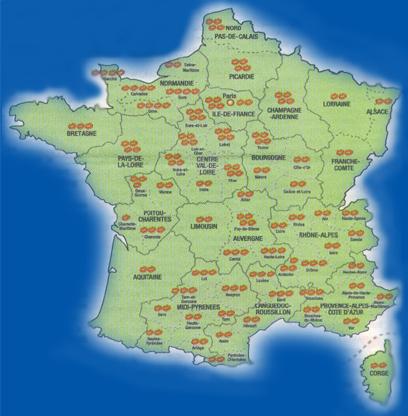
Kissing Customs Regional Distribution in France
More than one year ago, I wrote a in France, almost a national sport here. Yet it is way more interesting to know of La Bise (to be pronounced 'beez'), these quick kisses the French are used to exchanging all the time.

Careful here though: you'd better not mix up a French Kiss and a Bise. I am pretty sure you don't need an explanation about what a French kiss is, do you? Let's focus on the bise then.

Although a word in the singular, la bise refers to a couple of pecks on the checks given and received when you say hello or good bye. Men in France usually shake hands and don't kiss other men but close relatives such as father and son, or brothers. Women usually don't shake hands of other women they know. They kiss each other. Between a man and a woman, la bise is also the usual way to greet, as soon as you know the other one reasonably well. Male and female friends exchange la bise to say hello and good bye. At work, male and female colleagues will practice la bise also.

There is no standard French pattern for the number of kisses kissed in a bise. Some regions go for only one, others for three or four. Parisians once used to give four pecks, alternately put on each cheek, but modern speedy life did a lot of damage there also: it is usually made of two pecks only now. For your information, and because a scientific article such as the present one should supply detailed and accurate information to the reader, the map above displays French kissing habits among French regions. I found it somewhere on the web, but since there were a couple of errors, I amended it so that it depicts the state of the art in 2008 — isn't it mere professionalism?

Briefly said then, there is nothing suggestive in la bise, but socialization and friendship. Granted, friendship between a man an a woman is usually enlivened with just a , a flake of titillation. However, such a kiss is not at all intimate. It does not even matter if it is an air kiss, that doesn’t touch skin, or if it does.

In fact, being a Frenchman, I consider a bise as much less intimate than a hug. Just think about it: pressing your body against someone else's body... even when, say, you're a heterosexual man and the other person is male also? How weird.

Bastille Day

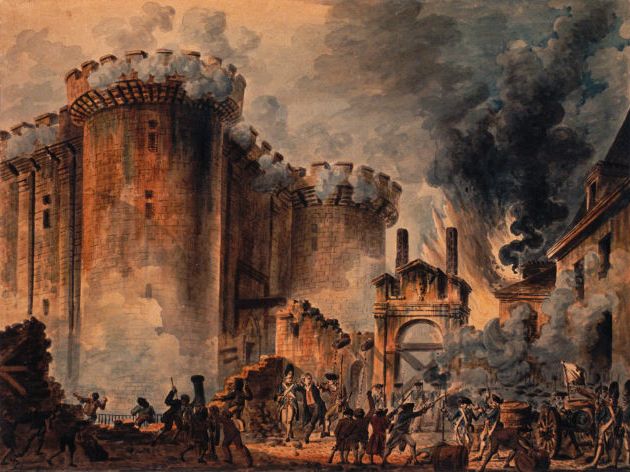
Jean-Pierre Houel — The Storming of the Bastille
July 14, 1789, by night. Louis XVI, King of France went asleep one hour ago in the Palace of Versailles, where Kings of France have resided since his ancestor Louis XIV, , made it the centre of its absolute power.

Every day, the King writes a few words in his diary. Today, he hunted for several hours as usual, so he wrote: Nothing...

His closer courtier, the Duke of La Rochefoucauld-Liancourt, has just been told about , the medieval fortress and prison in Paris. He decides to awaken the King, and breaks the news to him.

The Bastille? it has fallen? the King asks, half asleep still.

Yes, Your Majesty. A messenger just told me the prison has been taken by the people. They killed Governor de Launay and Provost Flesselles, and walked their heads on poles by the streets of Paris.

Aw, it is a rebellion! the King says.

Oh no, Sire, it is not a rebellion. It is a revolution

Firemen's Dance

Firemen's place
A lantern and the tricolour
before a fire station in Paris
Bonjour Monsieur ! the guy told me with a big smile while I was quietly walking in the boulevard. How about a couple of tickets?

Damn, I was lost in thought, I did not see him. A fireman, selling raffle tickets for the firemen's dance. Firemen have been everywhere in Paris for several weeks. I succeeded in steering clear of them until now, but I got nabbed at the end! No luck, definitely!

French people celebrate their national holiday, Bastille Day, on July 14. Le 14 Juillet, as they call it, commemorates the storming of the Bastille fortress on 14 July 1789, an event that marked the beginning of the French Revolution. Although the prison held few prisoners at the time, its storming has become a symbol of freedom and fight against oppression for the French.

The holiday symbolizes the birth of the Republic, whose motto is Liberté, Égalité, Fraternité (Freedom, Equality, Brotherhood). Firemen are undoubtedly a good illustration of the brotherhood part of the motto, all the more since the French are not that fond of other people who wear a uniform.

Bastille Day's festivities begin on the evening of July 13 with free dances organized in the streets of every town, and especially in every fire station — it is Le bal des pompiers, Firemen's Dance. Hence the tickets the guy wanted to sell me, for a tombola during the dance at his fire station. He'd got some nerve, don't you think? After all, if you decide to go to a fire station tonight, you'll see a lot of gorgeous women for sure, but they won't even look at you, interested as they will be in firemen only. And this, frankly speaking, is something I can hardly understand: these guys in uniform are young, strong, handsome, cheerful, and they save lives... so what?

So, how about a couple of raffle tickets? the fireman repeated.

Well, see, I answered hypocritically with a friendly smile, I'd better not buy any. My wife and daughter will be so glad to buy them by themselves, you know!

Related Posts Widget for Blogs by LinkWithin

Home

Atom
Feed
Timeless Music
The Magic Flute
by W. A. Mozart


Timeless Reading
Les Essais
by Michel de Montaigne