Showing posts with label traditions. Show all posts

Lily of the Valley

Lily of the valleyAlthough it was pretty early when I left home this morning, there were people on the sidewalks already, at every street corner. You may find it strange to hear that Frenchmen were awake early on the morning of a national holiday, especially on May Day: it is also Labour Day in France and many countries, a day where most people don't work then. There was good reason for it though: these people were vendors of lilies of the valley.

Lily of the valley, “le muguet”, is not any flower for the French. Although it is native to Japan, it became acclimated to Western Europe many centuries ago. In medieval France, it was considered the symbol of spring and nature's revival, and the emblem of a joyous, more-or-less pagan holiday, celebrating the return of nice weather and promises of spring's planting, and seeking Heaven's favour for harvests to come.

On May first, 1561, after he was given a sprig of Lily of the valley as a lucky charm, French King Charles IX decided he would give a sprig to every lady in his court on May 1st, every year from then on. A tradition was born. In France, is not permitted to sell things in the streets without a licence, but this is an exception: thanks to the nice tradition, everyone, not only florists, is allowed to sell lily of the valley in French streets on May Day.

Everywhere today, you will see people clutching their lily of the valley, to be offered to their wife, husband, girlfriend, boyfriend, parents, dinner host, boss, secretary, and so forth. As for me, I bought a couple of flowers this morning, and picked the sprig above on the internet for you. Happy May Day, and Good Luck!
[repost]

The Padlock Wall

Padlocks in Pécs, Hungary
On the Padlock Wall — Pécs, July 2007
If you ever go to the city of Pécs with your lover, don't forget to bring a padlock!
Several decades ago, a student left his padlock and its key on a grate in the center of this city of Southern Hungary, in a street close to the cathedral. It was his last day of school before summer holidays, and there was no need for him to bring such an old padlock back home.
A few days later, a couple of lovers saw the padlock on the grate. They engraved their names on another padlock, then locked it beside the first one. Other couples did the same. The tradition was born that lovers who lock a padlock to these grates get hitched forever themselves.
Thousands of padlocks are now locked on the grates of the padlock wall in Pécs. No doubt, it certainly means that the spell works.

La Bise

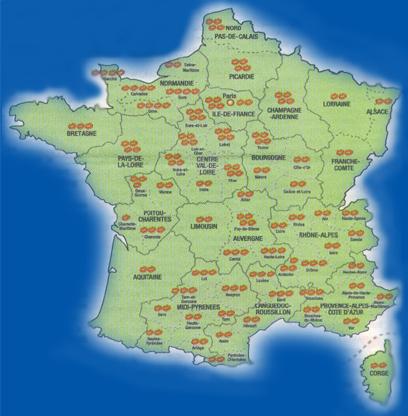
Kissing Customs Regional Distribution in France
More than one year ago, I wrote a in France, almost a national sport here. Yet it is way more interesting to know of La Bise (to be pronounced 'beez'), these quick kisses the French are used to exchanging all the time.

Careful here though: you'd better not mix up a French Kiss and a Bise. I am pretty sure you don't need an explanation about what a French kiss is, do you? Let's focus on the bise then.

Although a word in the singular, la bise refers to a couple of pecks on the checks given and received when you say hello or good bye. Men in France usually shake hands and don't kiss other men but close relatives such as father and son, or brothers. Women usually don't shake hands of other women they know. They kiss each other. Between a man and a woman, la bise is also the usual way to greet, as soon as you know the other one reasonably well. Male and female friends exchange la bise to say hello and good bye. At work, male and female colleagues will practice la bise also.

There is no standard French pattern for the number of kisses kissed in a bise. Some regions go for only one, others for three or four. Parisians once used to give four pecks, alternately put on each cheek, but modern speedy life did a lot of damage there also: it is usually made of two pecks only now. For your information, and because a scientific article such as the present one should supply detailed and accurate information to the reader, the map above displays French kissing habits among French regions. I found it somewhere on the web, but since there were a couple of errors, I amended it so that it depicts the state of the art in 2008 — isn't it mere professionalism?

Briefly said then, there is nothing suggestive in la bise, but socialization and friendship. Granted, friendship between a man an a woman is usually enlivened with just a , a flake of titillation. However, such a kiss is not at all intimate. It does not even matter if it is an air kiss, that doesn’t touch skin, or if it does.

In fact, being a Frenchman, I consider a bise as much less intimate than a hug. Just think about it: pressing your body against someone else's body... even when, say, you're a heterosexual man and the other person is male also? How weird.

Firemen's Dance

Firemen's place
A lantern and the tricolour
before a fire station in Paris
Bonjour Monsieur ! the guy told me with a big smile while I was quietly walking in the boulevard. How about a couple of tickets?

Damn, I was lost in thought, I did not see him. A fireman, selling raffle tickets for the firemen's dance. Firemen have been everywhere in Paris for several weeks. I succeeded in steering clear of them until now, but I got nabbed at the end! No luck, definitely!

French people celebrate their national holiday, Bastille Day, on July 14. Le 14 Juillet, as they call it, commemorates the storming of the Bastille fortress on 14 July 1789, an event that marked the beginning of the French Revolution. Although the prison held few prisoners at the time, its storming has become a symbol of freedom and fight against oppression for the French.

The holiday symbolizes the birth of the Republic, whose motto is Liberté, Égalité, Fraternité (Freedom, Equality, Brotherhood). Firemen are undoubtedly a good illustration of the brotherhood part of the motto, all the more since the French are not that fond of other people who wear a uniform.

Bastille Day's festivities begin on the evening of July 13 with free dances organized in the streets of every town, and especially in every fire station — it is Le bal des pompiers, Firemen's Dance. Hence the tickets the guy wanted to sell me, for a tombola during the dance at his fire station. He'd got some nerve, don't you think? After all, if you decide to go to a fire station tonight, you'll see a lot of gorgeous women for sure, but they won't even look at you, interested as they will be in firemen only. And this, frankly speaking, is something I can hardly understand: these guys in uniform are young, strong, handsome, cheerful, and they save lives... so what?

So, how about a couple of raffle tickets? the fireman repeated.

Well, see, I answered hypocritically with a friendly smile, I'd better not buy any. My wife and daughter will be so glad to buy them by themselves, you know!

The 'Fête de la Musique'

Fête de la Musique 2008 June 21, the day of the Summer solstice in the Northern hemisphere, falls on a Saturday this year. I expect there will be a lot of people in the streets this night then, to celebrate the Fête de la Musique, the World Music Day.

Fête de la musique means Festival of Music in French. Launched in 1982 in France, it is now held in more than one hundred countries all over the world. New cities join the festivities every year, the main newcomers in 2008 being Melbourne (Australia), Sacramento (USA), Erbil (Iraqi Kurdistan), Cebu (Philippines), Port-Moresby (Papua New Guinea), Hannover (Germany), Ostrava (Czech Republic), Málaga (Spain) and Québec (Canada). Several traditional festivals happening on solstice day, such as the and Saint John's Eve festival, now take part in the popular festival.

Fête de la Musique The purpose of the festival is to make all genres of music accessible to the public, with a multitude of free concerts everywhere, including places that are not usually used for concerts.

Officials say that more than 10,000 free concerts will be held in France today. Also, amateur musicians are encouraged to perform in the streets. The slogan Faites de la musique ! (Make music!) — which is pronounced the same as Fête de la Musique — is used to promote this goal in French speaking countries.

Fête de la Musique I'll probably spend most of next night strolling around in the Latin Quarter, listening to a musician, singer, or band after another one. Leaning on a wall at the corner of a street sometimes, sometimes seating on a bench in a public garden or at the terrace of a café, no doubt I'll hear the best and the worst: the festival is open to everybody, without discrimination to résumé, background, style and experience. Musicians only need to find a place where to put their gear, which in Paris means they'd better arrive early if they intend to play in a place where a lot of people walk through.

sings
Voi Che Sapete by W. A. Mozart

A good classical guitarist may come on right after a dreadful heavy metal band... or the contrary. You can leave the rap singer on the boulevard and get closer to the piano and mezzo-soprano performing Voi Che Sapete in a courtyard, if you are lucky enough to be in the right place at the right time. The unstructured nature of the festival is the basis of its success.

Evangelical

I am not a Protestant and I don't speak German, yet I went this morning to the Deutsche Evangelische Christuskirche (German Evangelical Church) in Paris, and listened to classical music by Johann Sebastian Bach and Georg Philipp Telemann. Great music.

I also learned a little about Protestantism, from a German friend was there. In particular, I learned how different the meaning of Evangelical is, whether you are in Europe or North America. I already knew there were many religious persuasions in Protestantism, but I confess I have not remembered everything about that.

Only I remember that, in North America, the word Evangelicalism refers to conservative Protestantism, more precisely supporters of revivalism, whereas in Europe, it simply means Protestantism. The German Evangelical Church where they sang Johann Sebastian Bach's cantata Herr Jesu Christ, whar' Mensh und Gott so beautifully this morning is Lutheran Church.

I loved the music. I loved the tapestry of John Evangelist taken from a painting of Albrecht Dürer that was hung up on a wall in the Church on this occasion. I loved also the modern stained glass window I photographied in there to be my shot of the day.

Related Posts Widget for Blogs by LinkWithin

Home

Atom
Feed
Timeless Music
The Magic Flute
by W. A. Mozart


Timeless Reading
Les Essais
by Michel de Montaigne