Showing posts with label funny. Show all posts

Memory Lapse

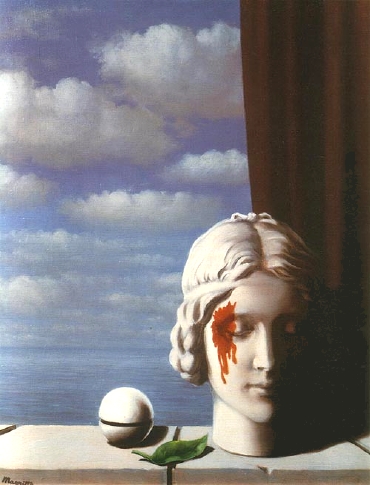
René Magritte — La Mémoire
La mémoire (Memory)
René Magritte, 1948
Oil on canvas, 59 x 49 cm

As I was taking an old lady to the exit door, the next patient in the waiting room rose from his chair and sneaked behind my back into the consultation room. No secretary in sight. I went back in, closed the door, and started wondering... I know I have seen this man before, but when? why? and what is his name?
— 'Please have a seat. How can I help you?' He put his coat on a chair, sat down on the other one, folded his arms, and said with determined voice:
— 'Doc, we have a problem: I am not doing better at all!'

I have a problem indeed, I thought: I don't have a clue about what on earth is his problem. I can't even put a name on his face!

— 'Oh, really?' I said, hopeful he would give some piece of information.
— 'Yes, Doc. I took the drug as you prescribed, yet it's still about the same!'
— 'Don't you feel any better?'
— 'No, not at all! It goes on just the same! I have waited for a couple of weeks as you told me, but it didn't stop. Then, here I am again!'

He was talking with such an assured tone that I could not tell him I didn't remember a thing of his story. If only I could remember his name, I'd have a quick look at his record...
— 'Did you bring your previous prescription?'
— (Rummaging through his pockets) 'Aw, I forgot it at home I am afraid. It's easy though: these are white pills, in a blue box. Well, it doesn't mind anyway, you wrote it down in my record'.
— (This guy is going to kill me) 'Of course, you're right. Tell me, when did you come and see me the last time?'
— 'Hmm, wait, well, it was a Friday, or maybe a Tuesday. Or was it a Wednesday? Well, in any case, it was four weeks ago! Five perhaps. Well, not more than six weeks ago, definitely".

As he was thinking about it, I tried to find his name in my agenda. Fortunately, I have only one consultation a week in this hospital, on Mondays. Not that week... Not that week either...YAY! Here it is, lost among more familiar names. He came three months ago, the day I had such a dreadful headache! Phew. Relieved at last, I took out his record and read it quickly. With a smile of contentment on my lips (that surprised him obviously), I said:
— 'So, you are not doing better? Well I never!'

Toilet Paper

Dollars
I found the roll of toilet paper displayed on the left in La Grande Épicerie du Bon Marché, a big department store close to my building. I could not help but buying it.

After my attention has been attracted on the topic, I could not help either but looking for up-to-date information about toilet paper. The funny thing is: I found a lot! Especially, several detailed articles about how people would manage, before paper, hence toilet paper, was invented, including a chapter of the novel by François Rabelais, Gargantua, published in 1534.

ImageFocusing on the design of toilet tissue in the 21st century though, I found out that there are dozens, even hundreds of designs: TP with euros, frogs, razor blades, funny tales, whatever. Then, of course, there are collectors for it.
If you are a Sudoku addict for instance, I have good news for you: you can now find Sudoku-printed toilet paper rolls. Hmm... Making reference to a previous entry, I wonder if the wrapping clearly stipulate: 'Don't fill in the grid after you used the paper?''

WARNING: the video below is in bad taste undoubtedly.
(Yet it is funny)


Sandy Toilet Tissue - For Men.

Le Lapin Agile

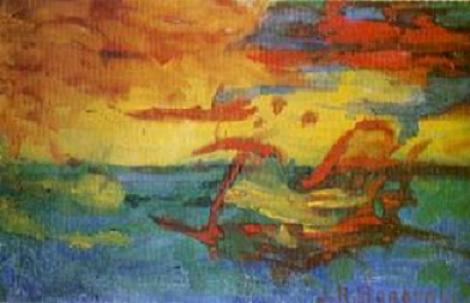
Joachim-Raphaël Boronali — Coucher de soleil sur l'Adriatique (Sunset on the Adriatic)
Joachim-Raphael Boronali — Sunset on the Adriatic [Coucher de soleil sur l'Adriatique]

The painting on the left induced some hurly-burly when it was exhibited at the Salon des Indépendants in Paris in 1910. The canvas was signed by a person of obscure repute named Joachim-Raphael Boronali, who had prepared the picture's appearance by drafting a manifesto about a new, dissident futurist school, Excessivism.

ImageMany specialized critics who saw the painting in the show found the work 'very interesting'. It was sold twenty Golden Louis (400 French francs, about 1,800 current dollars). And yet, its author, who appears in the adjacent photo with his best friend, was not a painter at all.

There is a famous cabaret at 22 Rue des Saules in Montmartre, named Le Lapin Agile, where, in the 1900s-1910s, unknown people called Picasso, Utrillo, Modigliani, Braque, Derain, Dorgelès, Apollinaire or Max Jacob would meet, talk, joke, sing and drink together. The owner of the place was Frédéric Gérard, Le Père Frédé as everyone called him, who is the bearded man who appears in the photo above.

ImageThe cabaret had existed since 1860. It was originally called Le Cabaret des Assassins — Cabaret of Murderers — until Andre Gill, a caricaturist, painted in 1875 the sign that was to suggest its permanent name: the picture of a humanized rabbit with a top-hat, who jumps out of a saucepan with a bottle of wine in his hand.
Residents soon called their neighbourhood night-club Le Lapin à Gill — Gill's rabbit — a name that naturally evolved into Le Lapin Agile — The Agile Rabbit.

Cora Vaucaire — Frédé
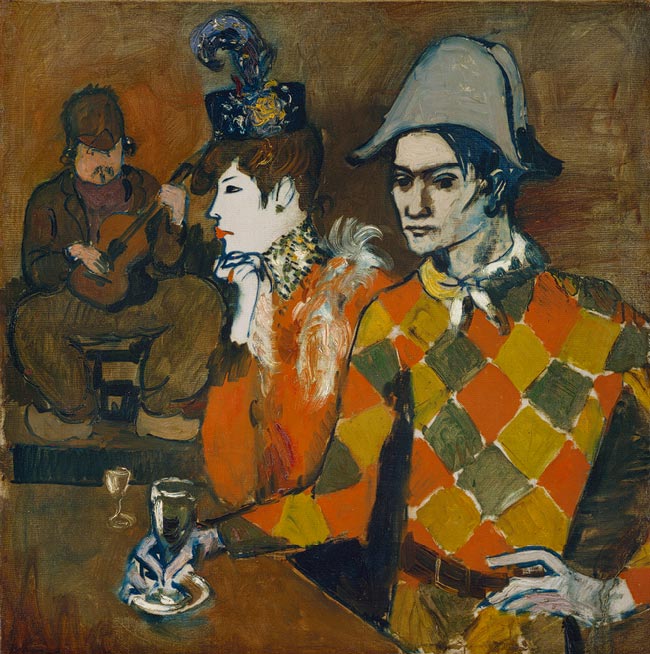
Pablo Picasso - Au Lapin Agile
Pablo Picasso— At the Lapin Agile
[Au Lapin Agile] 1905.
Oil on Canvas, 99 cm × 100 cm
Metropolitan Museum of Arts, New-York.

The cabaret still exists nowadays. It is still full of customers who come and listen to French songs dating back as far as the fifteenth century.

Frédéric Gérard— aka Frédé — the owner of the place shown with his donkey on the photo above, was a character. Songs have been written about him, and he is the man playing the guitar in the background, in the adjacent painting by .

In this painting, Picasso portrayed himself dressed as a Harlequin, accompanied by his model Germaine Pichot. According to the tale, Picasso once paid a lunch with this painting, that Frédé sold in 1912 for the equivalent of 20 dollars. In 1989, it was auctioned at Sotheby's for 41 million dollars.

Anyway, how about 'Joachim-Raphael Boronali'? Who hid under the nickname? You know it was not Picasso or any of the abovementioned artists since I wrote that the painter was portrayed in the photo displaying Frédé with his donkey. Yet the painter was not Frédé but... Lolo, the donkey!

The painting was a hoax by the writer Roland Dorgelès and a few friends, to make fun of art critics. They tied a brush to the tail of Lolo, which daubed a canvas with several colours in front of witnesses, official ones included. They coined the nickname Boronali because it is an anagram for Aliboron, as Jean de la Fontaine would call the donkey in his fables.

Image
Boronali in the process of creating his masterpiece
The painting is now permanently exhibited in a museum in Milly-La-Forêt, near Paris.

Happy Unbirthday!

Well, let's see...

(Checking my organizer) Today is October 23... nothing written here.

(Checking my address book) No, no one among my relatives. None of my friends either.

(Checking my memo board) Nope, no one actually. I knew I was not mistaken! Nobody I know has his birthday today!

Happy unbirthday, everyone! A very merry unbirthday to you! (yes, you)

La Bise

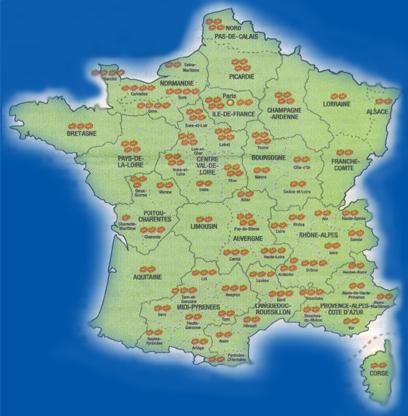
Kissing Customs Regional Distribution in France
More than one year ago, I wrote a in France, almost a national sport here. Yet it is way more interesting to know of La Bise (to be pronounced 'beez'), these quick kisses the French are used to exchanging all the time.

Careful here though: you'd better not mix up a French Kiss and a Bise. I am pretty sure you don't need an explanation about what a French kiss is, do you? Let's focus on the bise then.

Although a word in the singular, la bise refers to a couple of pecks on the checks given and received when you say hello or good bye. Men in France usually shake hands and don't kiss other men but close relatives such as father and son, or brothers. Women usually don't shake hands of other women they know. They kiss each other. Between a man and a woman, la bise is also the usual way to greet, as soon as you know the other one reasonably well. Male and female friends exchange la bise to say hello and good bye. At work, male and female colleagues will practice la bise also.

There is no standard French pattern for the number of kisses kissed in a bise. Some regions go for only one, others for three or four. Parisians once used to give four pecks, alternately put on each cheek, but modern speedy life did a lot of damage there also: it is usually made of two pecks only now. For your information, and because a scientific article such as the present one should supply detailed and accurate information to the reader, the map above displays French kissing habits among French regions. I found it somewhere on the web, but since there were a couple of errors, I amended it so that it depicts the state of the art in 2008 — isn't it mere professionalism?

Briefly said then, there is nothing suggestive in la bise, but socialization and friendship. Granted, friendship between a man an a woman is usually enlivened with just a , a flake of titillation. However, such a kiss is not at all intimate. It does not even matter if it is an air kiss, that doesn’t touch skin, or if it does.

In fact, being a Frenchman, I consider a bise as much less intimate than a hug. Just think about it: pressing your body against someone else's body... even when, say, you're a heterosexual man and the other person is male also? How weird.

I - Don't - Like - Spam!

When I opened my email box the other morning, there were a couple of job-related mails... and 37 spams! Granted, the latter got filtered by my spam firewall, but I waited for an important mail then, and was afraid of missing it, if it was considered a spam by mistake. Therefore, I explored the spam folder also. You know what? I don't like spam!

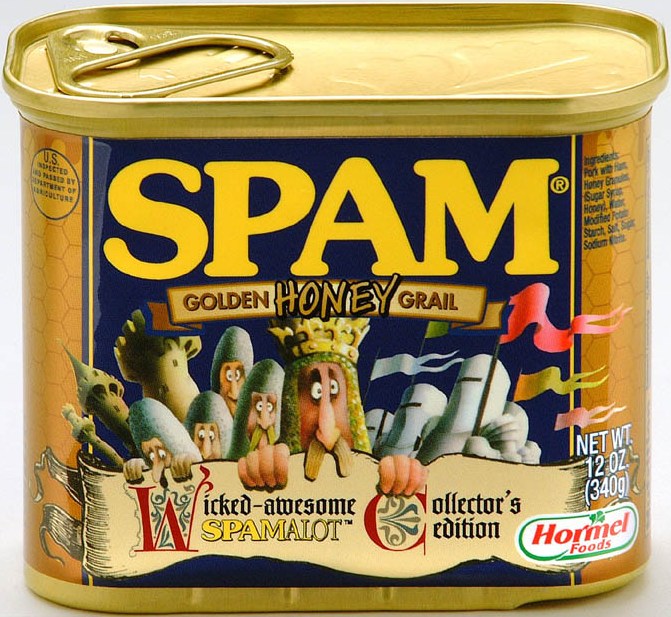
The word SPAM was coined in July, 1937 when Hormel foods, a company that processed a meat product called Hormel Spiced Ham, decided to change this name to a more memorable one. The precise meaning of the acronym is disputed though: SPAM may be the contraction of either Shoulder of Pork and hAM, Spiced Pork and hAM, or simply SPiced hAM — although malicious gossip would say it should rather be Specially Processed Artificial Meat or Spare Parts Already Minced.

During the WWII and following years, SPAM was among a few products excluded from food rationing in the United Kingdom, and the British grew heartily tired of it.
Several years later, the broadcast a sketch that parodied an advert for the canned meat: in a restaurant, a couple tries to order a breakfast. The lady (Graham Chapman in drag) dislikes spam, but every dish in the menu contains spam (egg and spam; egg, bacon and spam; egg, bacon, sausage and spam; etc.). A group of Vikings seated at a table starts chanting "SPAM, SPAM, SPAM..." and progressively jams every other talk in the restaurant, while John Cleese gets picked up by the police for Hungarian-accent-induced obscene words.

Monty Python: SPAM (1970)
This hilarious sketch became highly famous, as well as the Vikings' song. That's why, several years later, the phenomenon of marketers drowning out discourse by flooding email boxes with junk advertising messages was named spamming, recounting the repetitive and unwanted presence of SPAM in the sketch by the Monty Python.

Codex Seraphinianus

Codex Seraphinianus
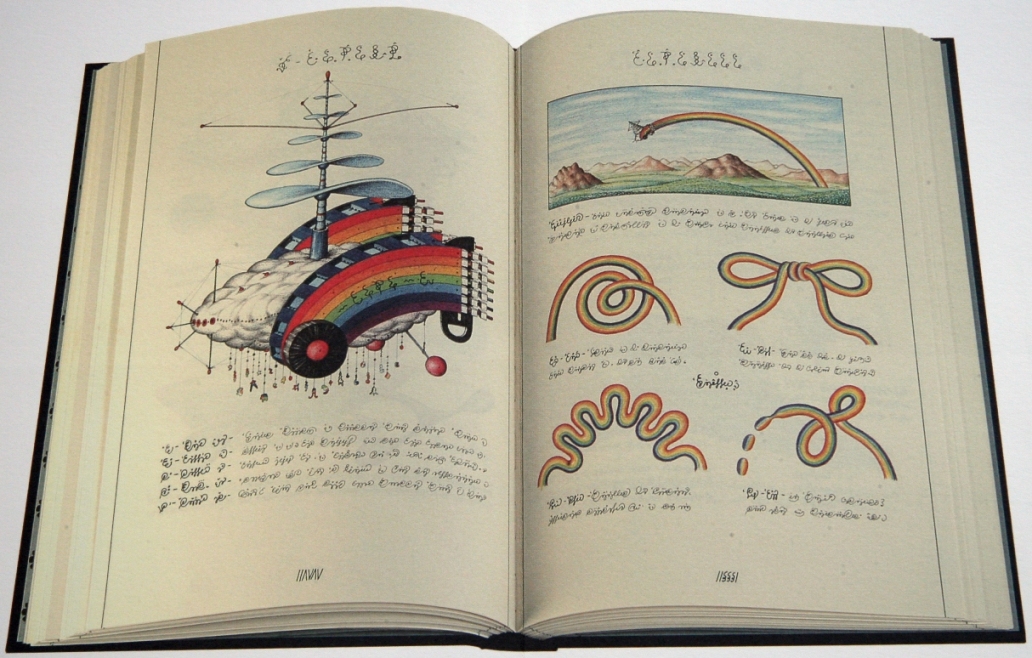
Codex Seraphinianus (Click to enlarge)
The book opposite is called Codex Seraphinianus, after Luigi Serafini, an Italian architect and graphic designer, who wrote and illuminated it in the 1970s. It is an encyclopedia guide that depicts and explains a totally fantastic world, where lovers transform into crocodiles and rainbows can be bow tied.
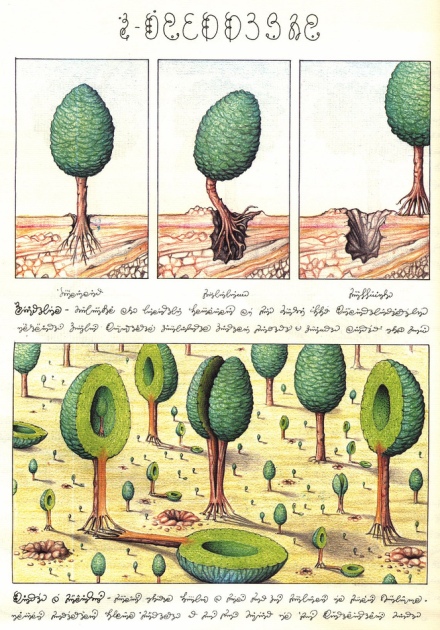
One page of the Codex (trees)
The Codex is well structured, as any encyclopedia would be. It is divided into eleven chapters with many brightly coloured illustrations. The first chapter deals with the flora of the alien world, the second one with its fauna, and so on.
As a whole, it is a coherent, constantly creative work. Writing is present throughout the book, in the paragraphs, tables of contents, captions of pictures. Only... you cannot read one word, because Serafini used a fluid cursive writing he has invented and nobody has been able to decipher.
We don't know in fact if the pretty curly squiggle we see all over the book is actually a writing, or... just squiggle. We only know that the number system in which page numbers are written does have a meaning: it has been cracked as being  base-21.
The Codex's Rosetta Stone
Every chapter of the Codex Seraphinianus is amazing but I love the eighth one especially. It depicts the history of the alien writing system used in the book, with the help of a Rosetta Stone... that is of little help because the languages displayed on the stone are not languages that we know, but a mysterious glyph language... and the 'usual' Codex language!
While I was skimming through the plates the other day, I felt as if I was going through a museum dedicated to some unknown civilisation.
Also, I was like a kid who cannot read yet: I had to rely on the pictures to understand the rules of such a foreign world and imagine what the text might tell. It made me think that babies may well feel about the same when they discover the incomprehensible world they have been suddenly thrown into.

You think English is Easy?

You Think English is Easy? OK. Therefore, you will appreciate the text that follows, I received by mail some time ago:

In what language do people recite at a play and play at a recital? Ship by truck and send cargo by ship? Have noses that run and feet that smell?

How can a slim chance and a fat chance be the same, while a wise man and a wise guy are opposites?

You have to marvel at the unique lunacy of a language in which your house can burn up as it burns down, in which you fill in a form by filling it out and in which an alarm goes off by going on.

Can you read these sentences right the first time?

  1. The bandage was wound around the wound.
  2. The farm was used to produce produce.
  3. The dump was so full that it had to refuse more refuse.
  4. We must polish the Polish furniture.
  5. He could lead if he would get the lead out.
  6. The soldier decided to desert his dessert in the desert. !
  7. Since there is no time like the present, he thought it was time
      to present the present
  8. A bass was painted on the head of the bass drum.
  9. When shot at, the dove dove into the bushes.
10. I did not object to the object.
11. The insurance was invalid for the invalid.
12. There was a row among the oarsmen about how to row .
13. They were too close to the door to close it.
14. The buck does funny things when the does are present.
15. A seamstress and a sewer fell down into a sewer line.
16. To help with planting, the farmer taught his sow to sow.
17. The wind was too strong to wind the sail.
18. Upon seeing the tear in the painting I shed a tear.
19. I had to subject the subject to a series of tests.
20. How can I intimate this to my most intimate friend?

English is a crazy language. There is no egg in eggplant, nor ham in hamburger; neither apple nor pine in pineapple. English muffins weren't invented in England or French fries in France. Sweetmeats are candies while sweetbreads, which aren't sweet, are meat. Quicksand can work slowly, boxing rings are square and a guinea pig is neither from Guinea nor is it a pig.

English was invented by people, not computers, and it reflects the creativity of the human race. Which, of course, is not a race at all.

Firemen's Dance

Firemen's place
A lantern and the tricolour
before a fire station in Paris
— Bonjour Monsieur ! the guy told me with a big smile while I was quietly walking in the boulevard. How about a couple of tickets?

Damn, I was lost in thought, I did not see him. A fireman, selling raffle tickets for the firemen's dance. Firemen have been everywhere in Paris for several weeks. I succeeded in steering clear of them until now, but I got nabbed at the end! No luck, definitely!

French people celebrate their national holiday, Bastille Day, on July 14. Le 14 Juillet, as they call it, commemorates the storming of the Bastille fortress on 14 July 1789, an event that marked the beginning of the French Revolution. Although the prison held few prisoners at the time, its storming has become a symbol of freedom and fight against oppression for the French.

The holiday symbolizes the birth of the Republic, whose motto is Liberté, Égalité, Fraternité (Freedom, Equality, Brotherhood). Firemen are undoubtedly a good illustration of the brotherhood part of the motto, all the more since the French are not that fond of other people who wear a uniform.

Bastille Day's festivities begin on the evening of July 13 with free dances organized in the streets of every town, and especially in every fire station — it is Le bal des pompiers, Firemen's Dance. Hence the tickets the guy wanted to sell me, for a tombola during the dance at his fire station. He'd got some nerve, don't you think? After all, if you decide to go to a fire station tonight, you'll see a lot of gorgeous women for sure, but they won't even look at you, interested as they will be in firemen only. And this, frankly speaking, is something I can hardly understand: these guys in uniform are young, strong, handsome, cheerful, and they save lives... so what?

— So, how about a couple of raffle tickets? the fireman repeated.

— Well, see, I answered hypocritically with a friendly smile, I'd better not buy any. My wife and daughter will be so glad to buy them by themselves, you know!

Billy's Car Hire


Billy's Car Hire
Mellieha, Malta — February 2007.

If you ever worried about how I manage with cars in Malta after you heard of my difficulty in driving on the left, please don't worry any more: I learned fast.

Call for Witnesses : Lost Elephants!

I read today an agonized call on the website of the SPA (Société protectrice des animaux, the French Society for the Prevention of Cruelty to Animals):

CALL FOR WITNESSES

The SPA is looking for 4 elephants that are part of the Big Foot Show. They were seen in Cavalaire-sur-Mer lately, and we need to find them! If you have any information, please call us immediately (+33 143 xxx xxx or the Internet).

Two and a half months after they made off, nowhere on the web I read news about the cute pets being found again... Therefore, if you ever see elephants on a road close to your place, especially in Europe or Middle East — I mean, elephants whose colour is grey, not pink — no need to go and see a doctor: you might have met the poor little things on their way back to native Kenya.

Losing their elephants... people are absent-minded sometimes, aren't they.

Don't dry your cellphone in a microwave owen!

My brother, who sells cosmetics on the international market, told me several times funny stories about warnings he must put on products his company markets in the USA, so as not to be sued.

For instance, soap packages should be labelled do not eat and eye liner pencils do not apply while driving. Apparently though, get a brain before use has not yet been displayed anywhere.

Quoting Bob Dorigo Jones, president of a US consumer watchdog called Michigan Lawsuit Abuse Watch (M-LAW): it used to be that if someone spilled coffee in their lap, they simply called themselves clumsy. Today, too many people are calling themselves an attorney. If I were silly enough to eat a soap, for sure I would never tell it anyone after! but some people dare everything, don't they... This sue first, ask questions later mentality has not only produced wacky warning labels. It has also increased the cost of products and services families use daily.

A couple of days ago, M-LAW declared the winners of their 10th annual Wacky Warning Label contest. Sometimes, it is hard to know whether the company is being outright stupid or if they are simply targeting the most brain dead dumb! This year, the winning label was found on a washing machine in a laundermat: Do not put people in washing machine, it displays. The second place award came from a personal watercraft that warns: Never use a lit match or open flame to check fuel level. The one I love most is the third award though: Don’t try to dry your phone in a microwave oven, a cellphone instructions leaflet warns.

Several warnings awarded in the previous years were quite brilliant also:
— On a baby stroller: Remove child before folding;
— On a blanket: Not to be used as protection from a tornado;
— On the handle of a household iron: Never iron clothes while they are being worn;
— On the package of a brass fishing lure with a three-pronged hook on the end: Harmful if swallowed (ouch);
— On a toilet bowl cleaning brush: Do not use orally (eww).

These are good pieces of advice definitely. Thank you, guys.

Nice to meet you

This is a magnet I bought yesterday afternoon, in the boutique of the Museum of Photographic Arts in San Diego where I am now. Two hours later, I met three Yahoo chat friends who live in this city. None of the nice girls I had dinner with was like this scary granny, in look or character — granted, it did not surprise me.

Meeting chat friends is a pleasant experience. I hardly understand why some people don't feel like it, or are scared of it.

The Coke and Mentos Experiment


This 3 minutes movie was released about two weeks ago. It displays The Extreme Diet Coke & Mentos Experiment #137. Incredible and funny, is it not? I read somewhere that Mentos company hired both guys for their next advertising campaign.

Since we are in a serious place here, it was but underhand lead-in for a lesson of physics and chemistry: how can little Mentos have such a tremendous effect on a peaceful bottles of Diet Coke? Everyone will agree on the premises: the carbon dioxide (CO2) compressed into the soda escapes so rapidly that the pressure pushes it out of the bottle. It's like shaking a bottle before you open it, but even more dramatic.

Several people theorized that a substance called gum arabic in the Mentos breaks the surface tension of the soda, allowing the CO2 bubbles to escape rapidly. This explanation doesn't completely work though, since several items that contain no gum arabic also cause soda to foam violently.

The primary cause appears to be physical, not chemical: when a liquid is supersaturated with gas, like soda is with CO2, gas is able to form bubbles on nucleation sites (that are places with high surface area in a very small volume, such as scratches on a surface or specks of dust).

Mentos seem to be loaded with nucleation sites: there are so many microscopic nooks and crannies on their surface that an incredible number of bubbles will form when you drop one in a bottle of soda. Since the Mentos are also heavy enough to sink, they react with the soda all the way to the bottom. The escaping bubbles quickly turn into a raging foam, and the pressure builds dramatically.

This mechanism is somewhat similar to the way people whose urine is supersaturated with uric acid or calcium crystals often develop kidney stones. Fortunately enough, crystals are not gas, which probably explains why people with kidney stones usually don't explode.

That's it, for today!

shadoks

Probably few people outside France and French-speaking countries ever heard of Claude Piéplu, who died a few days ago. In France though, he was famous as the unusual high-pitched voice of the narrator in the much-loved TV cartoon Les Shadoks, droll birdlike creatures from another planet, that made Piéplu a real star here.

Started as a sort of Peanuts-like characters, these outer-space bird-like creatures were the heroes of a French TV cartoon that turned into a cult-like phenomenon. Characterized by ruthlessness, stupidity and living on a two-dimensional planet, the Shadoks would constantly try to escape their rivals the Gibis, sorts of intelligent guinea pigs wearing bowler hats, whose names had a lot to do with the initials of that country across the Channel.

Speaking a special language, the Shadoks could only use four syllables: ga, bu, zo, meuh (pronounced as: gah, büh, zoh, möh). Absurdity and fake logic permeated their world, with adages such as: “Why do simple when one can do complicated?” and “When one tries continuously, one ends up succeeding. Therefore, the more you fail, the more chances you have to be successful”.

These features have become a inherent part of French way of thinking and sometimes very special sense of humour.

Related Posts Widget for Blogs by LinkWithin

Home

Atom
Feed
Timeless Music
The Magic Flute
by W. A. Mozart


Timeless Reading
Les Essais
by Michel de Montaigne