Showing posts with label flowers. Show all posts

Lily of the Valley

Lily of the valleyAlthough it was pretty early when I left home this morning, there were people on the sidewalks already, at every street corner. You may find it strange to hear that Frenchmen were awake early on the morning of a national holiday, especially on May Day: it is also Labour Day in France and many countries, a day where most people don't work then. There was good reason for it though: these people were vendors of lilies of the valley.

Lily of the valley, “le muguet”, is not any flower for the French. Although it is native to Japan, it became acclimated to Western Europe many centuries ago. In medieval France, it was considered the symbol of spring and nature's revival, and the emblem of a joyous, more-or-less pagan holiday, celebrating the return of nice weather and promises of spring's planting, and seeking Heaven's favour for harvests to come.

On May first, 1561, after he was given a sprig of Lily of the valley as a lucky charm, French King Charles IX decided he would give a sprig to every lady in his court on May 1st, every year from then on. A tradition was born. In France, is not permitted to sell things in the streets without a licence, but this is an exception: thanks to the nice tradition, everyone, not only florists, is allowed to sell lily of the valley in French streets on May Day.

Everywhere today, you will see people clutching their lily of the valley, to be offered to their wife, husband, girlfriend, boyfriend, parents, dinner host, boss, secretary, and so forth. As for me, I bought a couple of flowers this morning, and picked the sprig above on the internet for you. Happy May Day, and Good Luck!
[repost]
The Lady and the Unicorn

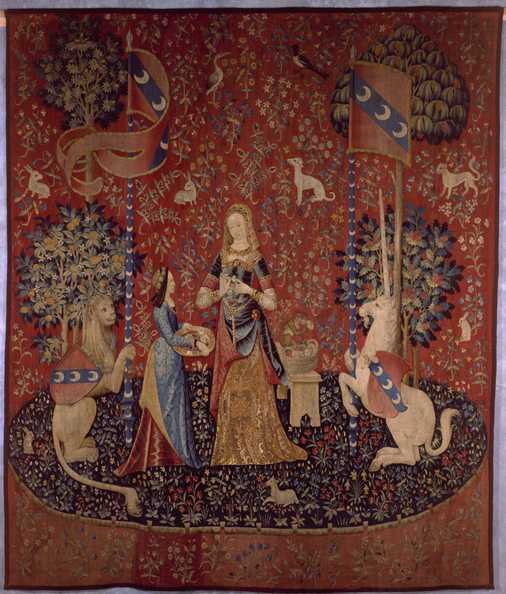
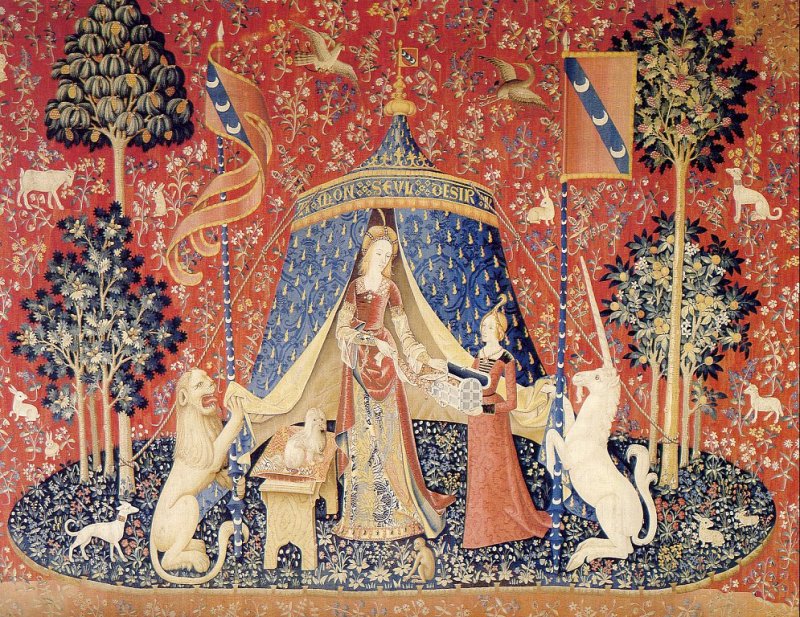
A mon seul désir
The Lady and the Unicorn — To my only desire.
Cluny Museum of Middle Ages, Paris.

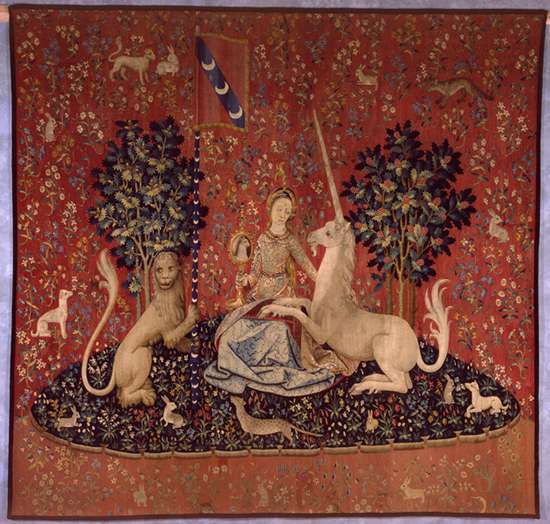
The Hôtel de Cluny, in the Quartier Latin (the Latin Quarter) in Paris, was built in the 14th and 15th century. It is a beautiful structure that combines Gothic and Renaissance architecture. It is worth seeing as a building then, yet essentially it is the French Museum of the Middle-Ages. It houses many early Medieval sculptures, wonderful illuminated manuscript, and an important tapestry collection, that includes one of the greatest works of art of the whole Middle Ages, the famous series of tapestries named 'La dame à la licorne' — 'The Lady and the Unicorn'.

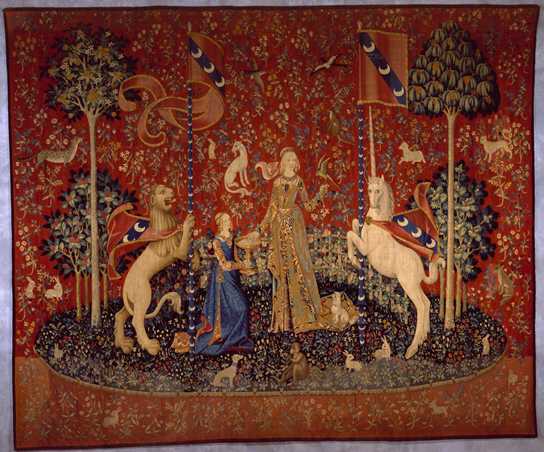
The Lady and the Unicorn — Taste
Taste (detail)
Click for the whole image

The Lady and the Unicorn
by John Renbourn

I went there again yesterday, for the tenth time maybe, because they have just opened new rooms to the public, dedicated to art and life in the Middle-Ages. Also, I wanted to see the red tapestries again, a few months after I went to the Cloisters in New-York and watched the green series of Unicorn tapestries they hold there [This series was the topic of the last blog I published on Yahoo. I might post an emended version of it here some day].

The Lady and the Unicorn — Sight
Sight (detail, click)

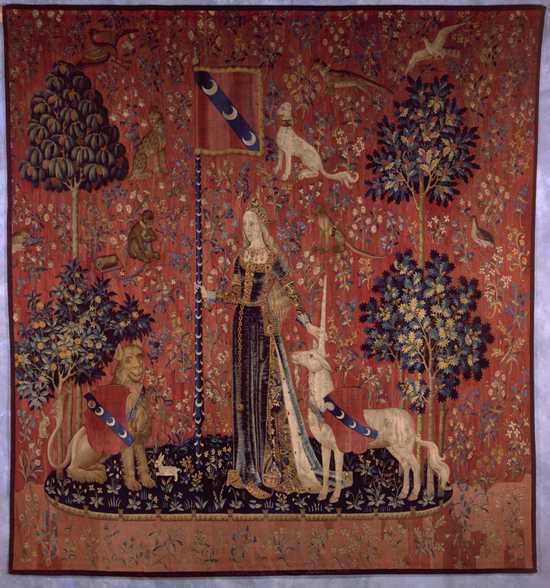
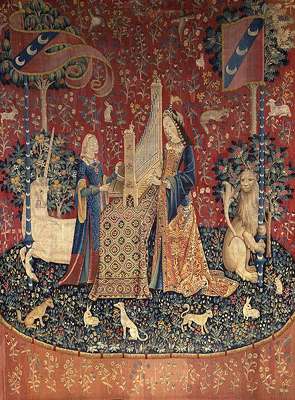
Both series are dated back to the 15th century. They are so-called 'Tapisseries mille fleurs' ('Thousand flowers tapestries'), named that way because they contain thousands of details, flowers and small animals especially.

While the Unicorn is the main character of the green tapestries held in New-York, that tell the story of the Hunt of the Unicorn, the Lady is the centre of the red tapestries displayed in Cluny Museum. My eyes this morning remain filled with visions of the beautiful, enigmatic Lady.

The Lady and the Unicorn — Touch
Touch (detail, click)
There are six tapestries in the series. Five hang side by side on a same larger curved wall in front of the only door. They are really huge, several meters wide and high. You see nothing but them when you enter the room. They depict the five senses: Taste, Sight, Touch, Smell, Hearing, in that order. Touch is situated in the middle, a very sensual picture where the Lady holds a standard in her right hand and the horn of the unicorn in her left one.

The Lady and the Unicorn — Smell
Smell (detail, click)
After you have looked at the five senses for a while, you turn round to the exit door, but then you have a view of the sixth tapestry, that has been hanging alone on the straight wall behind you from the beginning. In this tapestry, the Lady places her necklace into a case held out by her servant.  The Lion and the Unicorn are here, and many little animals. She will leave then soon though, and enter the tent behind her of which the door is wide open for her. 'A mon seul désir' ('To my only Desire'), an inscription on the tent says.

The Lady and the Unicorn — Hearing
Hearing (detail, click)

Nobody knows for sure what this tapestry means. I have the feeling that the Lady has experienced many things in her life already, using her five senses, and she has reached the end of this path now.

The wise, beautiful Lady, might have decided to renounce pleasures of the world. Or she knows she will pass soon perhaps. Whatever the reason, she now leaves her jewels forever, as a symbol of her physical life, before she enters the tent, as a symbol of her inner spirituality, a convent, or the Other World.

Flower of Scotland

The Saltire flag of Scotland
(The Highlander, a Scottish Pub in Paris)

I arrived in Scotland two days ago, for a 9-day vacation trip in the country of and . News from the Castles and Highlands to come then, and from Nessie also perhaps, who knows?

Scotland is not an independent country anymore, therefore it does not have a national anthem. Yet a few songs are used instead, that convey Scottish will to differentiate themselves from the rest of Great Britain.

It is especially the case of Flower of Scotland, the beautiful, patriotic song by . Resolutely directed at the English, the song celebrates Robert the Bruce's victory against the troops of King Edward II at in 1314.

O Flower of Scotland
When we sill see
Your like again
That fought and died for,
Your wee bit Hill and Glen
And stood against him, Proud Edward's army
And sent him homeward
Tae think again.

In particular, Scots break into Flower of Scotland at the Highland Games — sometimes — and before a match by the Scottish national rugby team — always.

Edinburgh, 17 March 1990. Scotland previously defeated Wales, Ireland and France in the Five Nations Championship. Today, in Murrayfield Stadium, the last match in this championship is about to start, against the auld enemy and hot favourite, England, undefeated also. Victory in the Championship, and a Grand Slam, are at stake.

ImagePlayers are on the field. Five minutes ago, while the English team ran into the Stadium as usual, David Sole, who captains the Scots, deliberately walked his men onto the pitch, in a slow, belligerent march, to deafening cheering of the home crowd.

English against Scots. Hundred years of conflicting history. Furthermore, British Prime Minister Margaret Thatcher has experimented the Community Charge (aka Poll Tax) for one year in Scotland only, leading to massive disobedience, and riots to come shortly in the whole country.

Scotland vs England — 17 March 1990

Both teams are lined up in front of the VIP stand. Fifteen English players bravely sing God Save the Queen as strong as they can, while TV cameras slowly pass in review the staring faces of every Scot player fixed in a provocative silence. For the first time in their history, they don't sing the anthem.

Then, David Sole turns his head toward the musicians, and bagpipes start playing, while the Scottish team and whole home crowd — 50,000 souls — all together launch with fire into Flower of Scotland.

Needless to stay, Scots won the match and the Grand Slam. On that day, they just could not lose.

Related Posts Widget for Blogs by LinkWithin

Home

Atom
Feed
Timeless Music
The Magic Flute
by W. A. Mozart


Timeless Reading
Les Essais
by Michel de Montaigne