Showing posts with label cartoons. Show all posts

Happy Unbirthday!

Well, let's see...

(Checking my organizer) Today is October 23... nothing written here.

(Checking my address book) No, no one among my relatives. None of my friends either.

(Checking my memo board) Nope, no one actually. I knew I was not mistaken! Nobody I know has his birthday today!

Happy unbirthday, everyone! A very merry unbirthday to you! (yes, you)

Destino

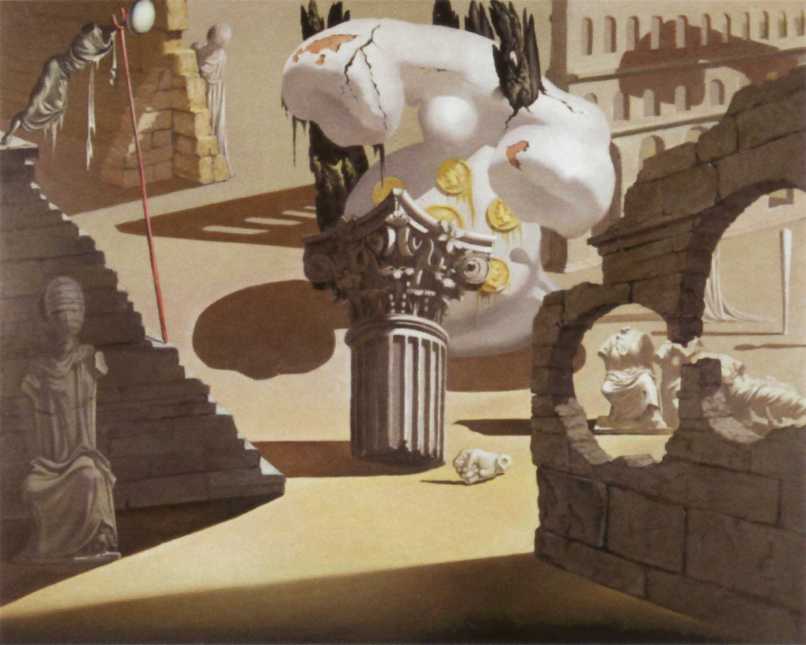
Destino — White telephone and ruins
(1946, Oil on plywood, 60.6× 47.9 cm)

Although it is hard to imagine two more widely separated artists, Salvador Dalí and Walt Disney admired one another.

Dalí made no secret of his interest in Disney: as soon as in 1937 he wrote to his friend, the French Surrealist André Breton: I have come to Hollywood and am in touch with the three great American surrealists — the Marx Brothers, Cecil B. DeMille and Walt Disney.

On his side, Disney loved to have contemporary artists involved in his films, although relationship with them was sometimes stormy.

More than sixty years ago then, the idea was born of a short film collaboration between Salvador Dalí and Walt Disney. Disney probably made the suggestion to Dalí when the latter was in Hollywood in 1945, working on Alfred Hitchcock's film Spellbound. Dalí worked on the storyboard in the Disney Studios from February to April 1946. The film was originally planned to combine real footage and animation and tell the story of the ill-starred love of a ballerina and a baseball player. It was called Destino, after a ballad by the Mexican Armando Domínguez which was to accompany it. However, Disney Studios could not complete the film for financial reasons... at least during the lifetime of the two men.

More than a hundred paintings and drawings had survived though. This material enabled the Disney Studios, in 2003, to make a six minute film directed by Walt's nephew Roy Disney and the French artist Dominique Monfery. I watched it several months ago — several times in a row — in the Galeries Nationales du Grand Palais in Paris, at an exhibition entitled Il était une fois Walt Disney (Once upon the time, Walt Disney), that surprisingly connected Disney's original drawings to occidental artworks that inspired them, from Gothic Middle-Age to Surrealism. The whole film is not online, but here is an excerpt found on YouTube:

Destino (2003)

The six-minute short movie is a digest of Dali's imagery, without much of a spot to speak of, but deserts, telephones and ruins, melting clocks and ants, all morphing from one to the other. It is like a last message from Dalí, long after he passed through the looking glass himself.
Satan met his lover, at last!

Saddam and his lover
What was usually displayed in South Park
could well be true now, don't you think?
It was not a surprise the Iraqi prime minister, Nuri al-Maliki, was glad with Saddam's execution. Same with Iran, two decades after a war with about two millions Iranians killed. No surprise either that many Muslims were shocked he was killed on the day of Eid el-Kbir.

George Bush said yesterday that Saddam's execution was an important milestone on Iraq's course to becoming a democracy... It appears quite strange to a European, since there are few democratic countries that still enforce death penalty! (see previous blog entry) It has been outlawed in all European countries, usually for decades. Then no surprise again that official reactions in Europe were similar to the German one: There are no doubts whatsoever about Saddam's crimes. But we are opposed to the death penalty, no matter where it is used. EU Commissionner Louis Michel even said: You don't fight barbarism with acts that I deem as barbaric.

Fully agreed: murdering a murderer puts you down to his level. Also, I cannot help but being worried the trial undoubtedly failed to satisfy international fair standards. Quoting Amnesty International:

Saddam Hussein's trial [...] was a deeply flawed affair. Political interference undermined the independence and impartiality of the court, causing the first presiding judge to resign and blocking the appointment of another. The court did not take measures to protect witnesses and defence lawyers, three of whom were assassinated during the course of the trial. Saddam Hussein was denied access to legal counsel for the first year after his arrest. The appeal process was obviously conducted in haste and failed to rectify any of the flaws of the first trial.

Therefore, this hasty killing will be seen by many as nothing else than victor's justice. Most probably, it will not help things to go better in Iraq, just the contrary.

That's it, for today!

shadoks

Probably few people outside France and French-speaking countries ever heard of Claude Piéplu, who died a few days ago. In France though, he was famous as the unusual high-pitched voice of the narrator in the much-loved TV cartoon Les Shadoks, droll birdlike creatures from another planet, that made Piéplu a real star here.

Started as a sort of Peanuts-like characters, these outer-space bird-like creatures were the heroes of a French TV cartoon that turned into a cult-like phenomenon. Characterized by ruthlessness, stupidity and living on a two-dimensional planet, the Shadoks would constantly try to escape their rivals the Gibis, sorts of intelligent guinea pigs wearing bowler hats, whose names had a lot to do with the initials of that country across the Channel.

Speaking a special language, the Shadoks could only use four syllables: ga, bu, zo, meuh (pronounced as: gah, büh, zoh, möh). Absurdity and fake logic permeated their world, with adages such as: “Why do simple when one can do complicated?” and “When one tries continuously, one ends up succeeding. Therefore, the more you fail, the more chances you have to be successful”.

These features have become a inherent part of French way of thinking and sometimes very special sense of humour.

Related Posts Widget for Blogs by LinkWithin

Home

Atom
Feed
Timeless Music
The Magic Flute
by W. A. Mozart


Timeless Reading
Les Essais
by Michel de Montaigne