Showing posts with label sculpture. Show all posts

Art in San Diego

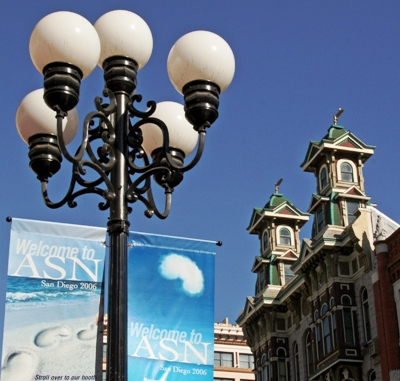
Building in Gaslamp
The twin-towered Louis Bank of Commerce
The annual conference of the ASN, , was held in San Diego two weeks ago.

There was a lot of interesting stuff for a nephrologist there. No topic for this blog though. Rather than blogging about work, I will rather show photos taken while I strolled around in the city's streets and museums, either on the day before the Convention began this year, either during a previous stay in 2006, when another ASN Renal Week was held there.

Architecture. There are beautiful buildings in San Diego. In Gaslamp quarter especially, many houses are remarkable. The twin-towered building above is located at 837 Fifth Avenue. Its top floor used to be a house of prostitution and the first floor an Oyster Bar where operated for a time.

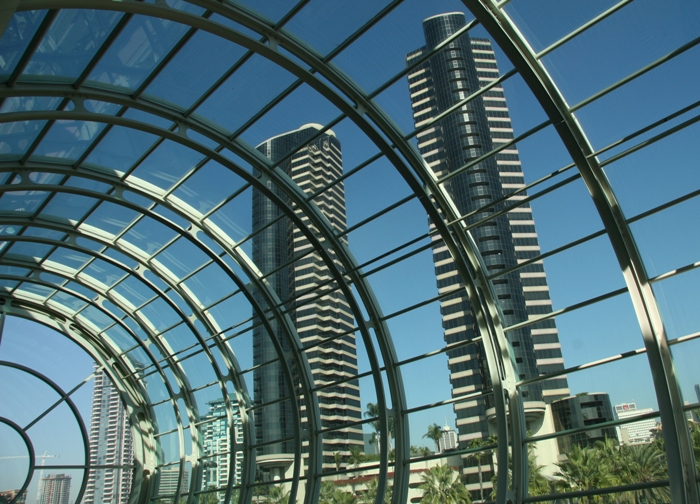
Inside the Convention Center
From inside the Convention Centre
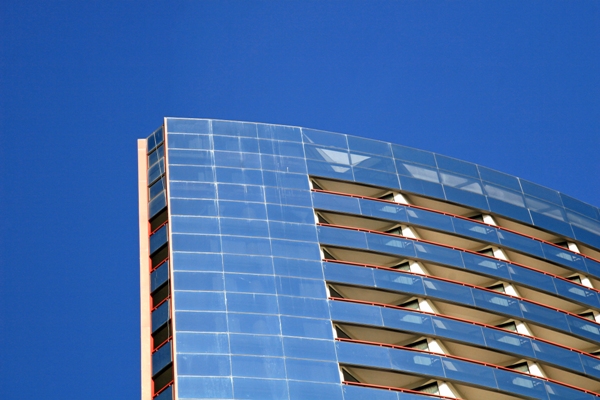
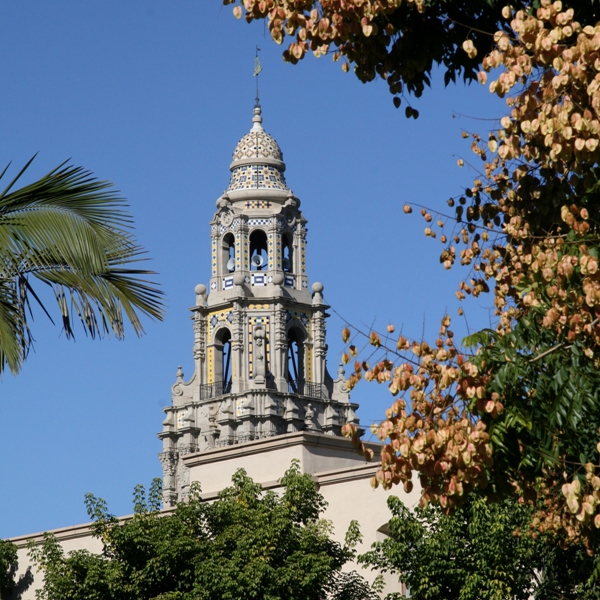
The Convention Centre itself is beautiful work, and many skyscrapers are beautiful as well. In Balboa Park on the contrary, buildings are essentially 20th century pitiful attempts to reproduce Spanish mostly, Tuscan sometimes, buildings of the baroque style... with stucco. The California Tower of the Museum of Man is nice though.
Marriott Hotel, San Diego
              Marriott Hotel
California Tower
California Tower
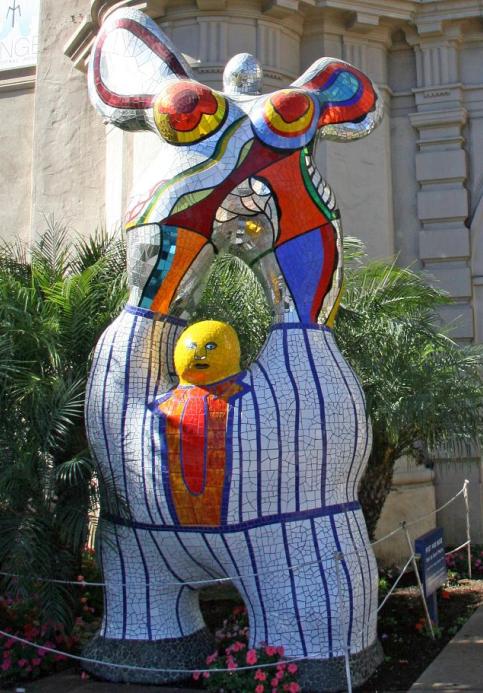
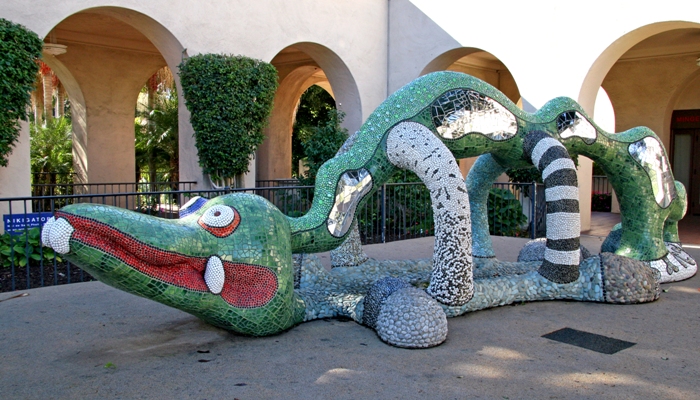
Sculpture. French sculptor lived in San Diego from 1994 to 2002. She had solvent-related emphysema, and enjoyed the paradise weather of the area. Yet it did not prevent her from dying of pulmonary failure.

Two sculptures by her are exhibited in Balboa Park, in front of the : Poet/Muse and Nikigator. Children love the latter especially, some kind of dragon they are often brave enough to sit astride.
Poet and Muse — Niki de Saint-Phalle
Poet and Muse
Nikigator — Niki de Saint-Phalle
      Nikigator
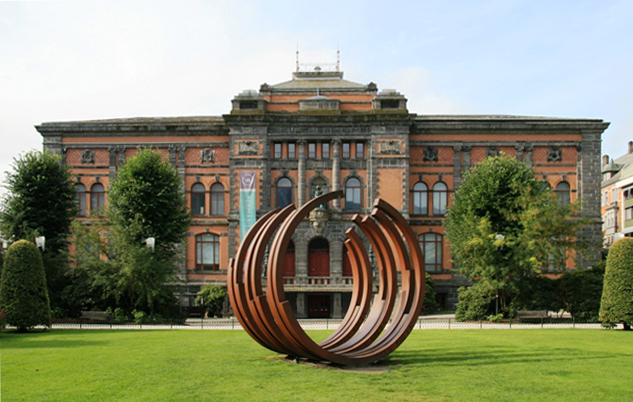
Bernar Venet's Arcs in Bergen (2006)
Bergen (2006)
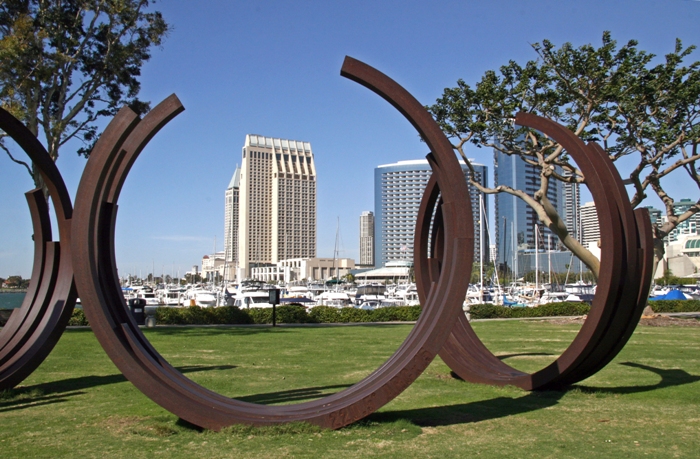
Bernar Venet's Arcs in San Diego (2009)
San Diego (2009)
Another French Sculptor, , was much in evidence in several places in the city, although temporarily only. You know what? I believe this guy is following me: everywhere I go, I see his iron arcs.

When I had vacation in Norway in 2006, they were exhibited in Bergen. When I attended the annual conference of the French Society of Nephrology in Bordeaux two years ago, they were exhibited there. And at present they are exhibited in San Diego too!

Sorry Bernar, but you'll have to resign yourself: I will never buy any, my kitchen is too small.

Painting. Close to the Mingei Museum in Balboa Park, the displayed artworks by Picasso and Miró especially, in a temporary exhibition. I liked a couple, essentially a drawing by Picasso of a Minotaur stroking a sleeping woman. There was an exhibition of Calder Jewelry too. I don't like Calder's mobiles that much. I didn't like his massive earrings, tiaras and necklace either.

Anyway, the main reason why I went to Balboa park was the Museum of Art permanent exhibition, with several Renaissance paintings I had been longing for three years to see again. There are paintings by Rogier Van Der Weyden, Giotto, Titian, and others, Flemish and Italian. Here come a few words about my three favourite.
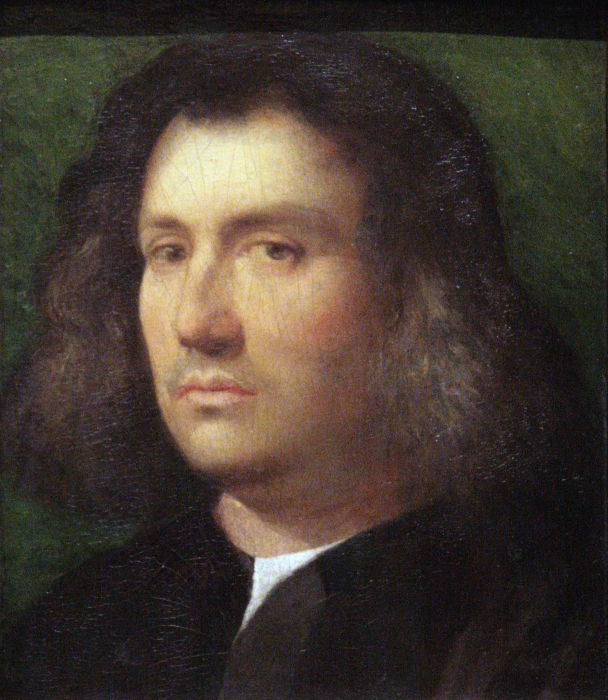
Giorgione — Portrait of a Man
Oil on panel, 1506

Portrait of a Man, by Giorgione.
This painting is one of the greatest Renaissance portraits in my opinion. The composition is closely cropped around the head of the sitter. The setting or props often used at the time to animate portraits are absent, yet the man's turning gaze and ambiguous expression make the portrait wholly engaging and alive.

Giorgione was friend of Titian (who finished his Sleeping Venus after his early death, a painting that foreshadowed my beloved Venus of Urbino — see a ). He was unprecedented in his ability to describe warm flesh and soft hair. Quoting , Giorgione's 'modern manner' sought to paint 'living and natural things', several years before arrived on the Italian scene.

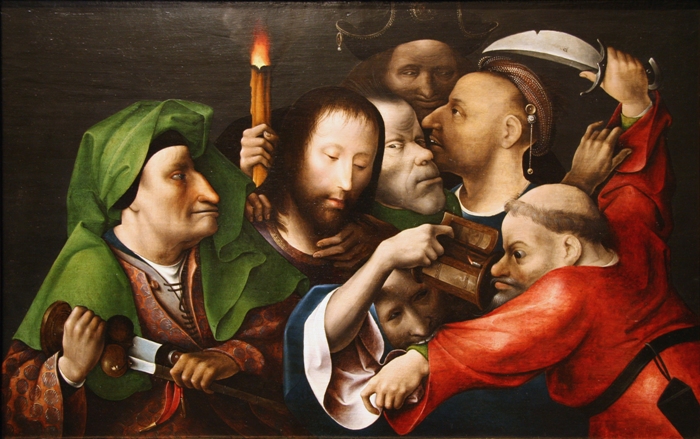
Hyeronimus Bosch — Arrest of Christ
Hieronymus Bosch — Arrest of Christ
Oil on panel, ca. 1516

The Arrest of Christ, by H. Bosch.
The painting depicts Jesus's arrest outside of Gethsemane. To the right, Peter raises a sword in defence of Jesus. He has just cut the ear from the High Priest's servant, who bites his arm and thrusts a lantern in his face. The grotesque figures of his tormenters contrast with the serene image of Jesus himself.

I love the way Bosch, in this painting, distorts the characters into something like caricature. Can you believe this was painted 500 years ago?
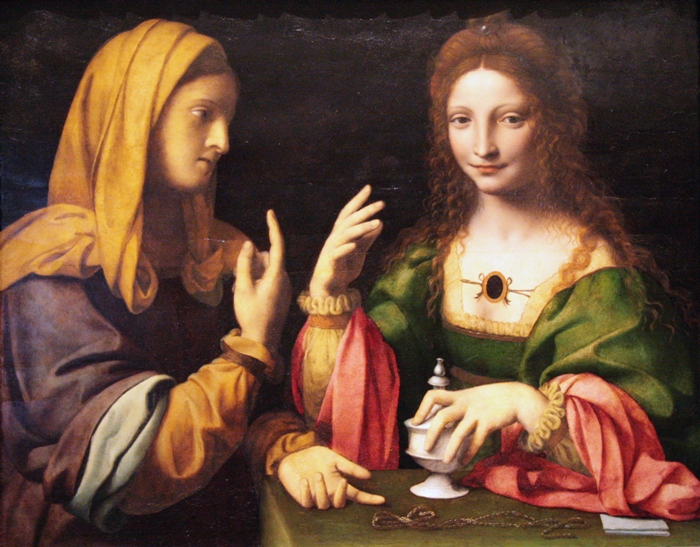
Bernardino Luini — The Conversion of the Magdalene
B. Luini — The Conversion of the Magdalene
Oil on panel, ca. 1520

The Conversion of the Magdalene,
by Bernardino Luini.
This is the moment when Mary Magdalene, the attractive and fashionable woman on the right, decides to put aside her finery (like the necklace on the table) and old life, and follow Jesus, like her sister Martha (on the left) previously. She holds an unguent jar, a symbol of her act of anointing Jesus's feet.

Bernardino Luini was among Leonardo da Vinci's closest followers in Milan. One can find a lot of Leonardo typical features in this painting: the characteristic figure types especially, with the mysterious, seductive smile of Magdalene, and the distinctive gesturing hands that animate the narrative.

So... after one day in the streets and museums of the city, I had my eyes and camera full of pictures. It was just time to go to the Convention Centre and attend the Conference.

The Statues of Liberty

The Statue of Liberty in Ellis Island, New-York
The Statue of Liberty — Ellis Island, New-York.
The Statue of Liberty, whose actual name is Liberty Enlightening the World, has stood in Ellis Island in New-York for more than 120 years: aimed at commemorating the 100th anniversary of the Declaration of Independence of the Thirteen Colonies in 1776, it arrived at New-York in 1886.
The Statue was the work of French sculptor Frédéric Bartholdi, with engineering help from Gustave Eiffel, and a present from the people of France to the people of the United States, dedicated to the friendship established between the two countries during the American war of independence.
The Statue of Liberty in the Jardins du Luxembourg, Paris
The Statue of Liberty.
Jardins du Luxembourg, Paris.
There are a lot of everywhere around the world, but Paris is probably the only city that gets two. First, a small Statue de la Liberté stands in Les Jardins du Luxembourg (Luxembourg Gardens), a nice park in the centre of Paris, behind the French Senate on the left bank of the Seine River.

Les jardins du Luxembourg are in two basic parts. The organized part is a typical Jardin à la française, with straight dusty paths bordered with trees and playgrounds; there are also tennis courses, and pony rides, a marionette theatre, food kiosks and open-air cafes, and a big round fountain basin where you can rent sailboats and float them in... with the other ten-year-olds.
The wild part of Le Luxembourg is quite different. It is wilder, with deep bushes, many flowers, a fruit garden, beehives, and many statues, including this tiny model of the Statue of Liberty. In fact, it is not a replica, but the original bronze model of the statue. Frédéric Bartholdi used it as a pattern to have the New-York statue built, about 15 years later. He gave it to the city of Paris for the 1900's Universal Exhibition.

The Statue of Liberty in the Ile aux Cygnes, Paris
The Statue of Liberty.
Ile aux Cygnes, Paris.
There is another Statue de la Liberté in Paris. It stands in the Ile aux cygnes (Swans Island), near Grenelle Bridge on the Seine River. This statue is a copy. It was given by the city of New-York to the city of Paris in 1889. It faces west, towards its 'sister' in New York Harbour, which was erected a few years earlier and looks east, to the old world across the Atlantic Ocean.
To Auguste Bartholdi [...] America, with its democratic ideals and Republican government, was already enlightened, Barry Moreno, a librarian at the Statue of Liberty National Monument, once wrote. Europe, still full of czars and emperors, was not. Sadly, things have changed; enlightenment now appears a feature of countries on this side of the Atlantic rather. Yet hopefully, it will reappear in the U.S.A., with time...
Anyway. Happy July 4 to all the U.S. Americans!

Ingrid Betancourt freed
Postscript : I could not imagine when I wrote this blog that would arrive in Paris this afternoon, after she was rescued by Colombian forces on Wednesday.
Over the years of Ingrid Betancourt’s captivity in the Colombian jungle (almost six and a half year), France championed the Colombian-French politician and anti-corrupt activist as a symbol of endurance, holding rallies, marches and other events to draw attention to her plight.
Large posters bearing her face hang from the entrances of hundreds of French city and town halls, including in Paris, and on the summit of Mont-Blanc in the Alps. The posters are now crossed by the word LIBRE! (free!), at last.
Today was undoubtedly a great day to publish a blog about Liberty.

Mad Cows

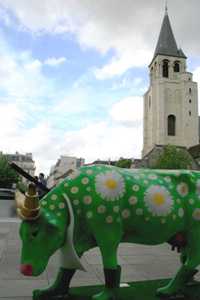
A Mad Cow before Saint-Germain-des-Prés Church (Paris, May 2006)

A couple of days ago, about 150 cows in fibre glass invaded the pavement of Paris. You can see them everywhere now, from the Avenue des Champs-Élysées to the Place de la Bastille.

It is supposed to be an art exhibition called Vach'Art, that is the Cow-Parade's French version. Yet it doesn't fool me: these are undoubtedly mad cows! Some believe they are Harry Potter, other ones that René Magritte is their farmer! I tell you, these cows are crazy!

I took the shot opposite yesterday evening. This green cow is named Le goût du naturel (Taste for Naturalness), whereas one can wonder how grazing in such a place could be natural, don't you think?

Well, after all, maybe it knows the church behind it, and the neighbourhood, are called Saint-Germain-des-Prés, which means Saint Germain in the fields...

Related Posts Widget for Blogs by LinkWithin

Home

Atom
Feed
Timeless Music
The Magic Flute
by W. A. Mozart


Timeless Reading
Les Essais
by Michel de Montaigne