Showing posts with label ethics. Show all posts

Ethnicity

Dying Gaul
Leonardo da Vinci – Vitruvian Man (ca. 1492)
Ink on paper. 34,4 × 25,5 cm
Gallerie dell'Accademia, Venice.
I don't usually blog about my occupation and readings as a nephrologist. Yet I'll make an exception with the present blog, that deals with a topic I have discussed for years with colleagues from the USA: the concept of 'human races'.

I read an article today in the medical review Kidney International that expresses a feeling shared by many European doctors: discomfort at seeing the word 'race' used with such a light heart in the international medical literature in English.

The average people will not use the term 'race' in Europe as they commonly do in the USA. In the mind of everyone, for obvious historical reasons, the notion of 'human races' is closely linked to racism, slavery, and the Shoah.

In medical literature though, particularly in articles from the United States, the word is still of current use.

Kidney International

I was very pleased then to read an editorial by Eberhard Ritz from Heidelberg and Sarala Naicker from Johannesburg, entitled "Race: A call to change nomenclature", in which the authors provide strong argumentation for making a systematic change in all scientific communications from 'race' to 'ethnicity'. 
             [Kidney Int 2009; 76: 807-808. doi:10.1038/ki.2009.356]

Here are some lines of their article:

In scientific meetings and literature, the term ‘race’ is still widely used to characterize the genetic background of specific cohorts. This term has become completely anachronistic with modern genetic insights and should therefore be abandoned.
[...]
It makes no sense to categorize individuals according to skin colour — the density of the skin melanocortin receptor, likely selected to provide protection against skin damage induced by ultraviolet light, bears little relation to the diversity of the genetic codes of respective individuals. Dark skin is seen in populations as diverse as African populations and Australian Aboriginals, the latter of whom have a quite different genetic background.

The use of terms that refer to distinguishing traits such as skin colour, body shape, and hair texture leads the scientific community to magnify differences and ignore similarities between groups of people. Also, these traits are no more accurate in making distinctions between human groups than any other genetically inherited characteristics. We are an extremely homogenous species genetically; all humans today are 99.9% genetically identical. 
[...]
The concept of ethnicity is related to the Greek concept of ethnos, which refers to the people of a nation or tribe, and ethnikos, which stands for national. Hence, ethnicity refers to the ethnic quality or affiliation of a group, which is normally characterized in terms of culture.
[...]
The International Society of Nephrology is a global professional society of nephrologists and renal research scientists with a multicultural and multiethnic constituency. Its goals include the development of nephrology and prevention of chronic kidney disease through education, training, research, and public awareness in both the developing and the developed world. In view of the above facts, the executive council of our society finds it is appropriate to use the term
‘ethnicity’ rather than ‘race’ in our scientific communications.

Some will think this is nothing but political correctness. I disagree. Words matter. Besides, it certainly is not merely coincidental that the article was written by citizens of Germany and South Africa, two countries where History has shown that 'race' is not an innocent word.
Panem et Circenses

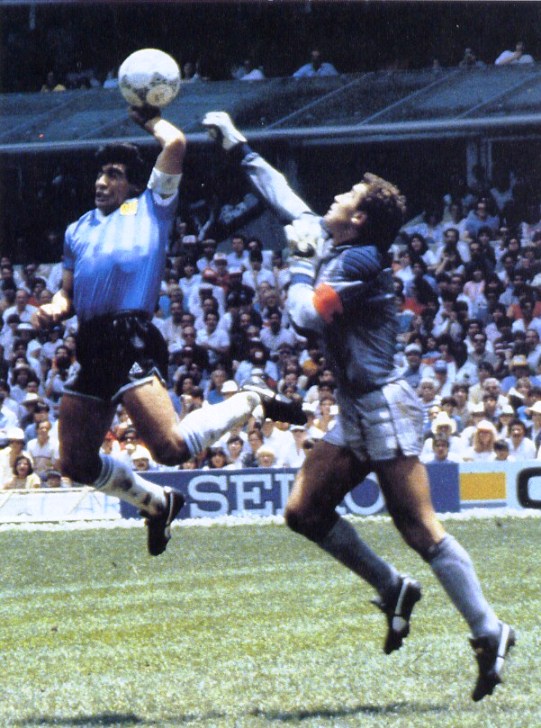
Maradona cheats
Diego Maradona illegally sticks the ball with his left hand in the .
Maradona was not penalised for the cheat, called The Hand of God Goal. He was later awarded the golden ball for best player in the tournament.
I'd certainly rather write about what I love than about what I dislike, but it will not be possible today because, according to the , this blog has to deal with number eleven…. From Brazil to England, from France to Korea, this number immediately conjures up one thing only: football, because eleven is the number of players in a team.

When I was a child, I would play football in the playground during the breaks, as every boy does. It is just normal that children play. Later, I played handball (as a goalkeeper, my thumbs remember it well), then rugby that I loved. Sport as a recreational activity is great thing. Playing in teams is an experience besides the sport itself: it has you learn to socialize, and respect people. Theoretically.

Professional football appears to be just the opposite of this theory. Granted, beautiful play may happen. Dribbles by Zinedine Zidane were pure art sometimes. Yet Zidane was also the man who head butted an Italian player, Marco Materazzi, in the final of the 2006 FIFA World Cup ( dealt with it), probably as an over-reaction to racist callings.

In my eyes, this event summed up professional football: it includes manoeuvre and pretension, racism, insults, and violence. The hidden part of the iceberg is of the same kind: doping, cheats, refereeing 'errors' and corruption, and that's not all.

Such flaws are inherent to many professional sports nowadays, not only football. The reason is always the same: money. It's especially obvious in football though, because it is by far the most popular sport in the world.

eleven
    [BbN #11]
Famous football players are millionaires who usually grew up in poverty. Their success makes young poor people dream of a better future. Also, people don't think of economical issues when they look at a match.

Nothing new here. 'Panem et Circenses', the Roman emperors would already say, 2000 years ago, about what a leader should provide to the masses to have them remain quiet: bread and games.

Being the First, at any Price

Le Maillot Jaune [The Yellow Jersey]
Le Maillot Jaune

It is in the very nature of sport that competitors do as much as they can to win. For an athlete though, searching for the first place should not apply to the results of the competition only, but dignity, human excellence, and fair-play as well.

In other words, 'being the first at any price' is not defensible. There's a gap between being the first, thanks to your efforts, perseverance and biological aptitudes, and winning because you cheated.

Many people think that 'the end justifies the means' though. According to this logic, being the first is not the main goal in itself. It is a way to get honours, please a government, make money, and have many other people around make money also.

When I was a child, the punctuated July. I would spent hours watching it on TV. I undoubtedly learned a lot of French geography by writing down every stage, with distances, intermediate towns, passes to get over, etc. I would read every day in the local newspaper about the day's winner and the jersey holders: the white, spotted, green, and of course, Le Maillot Jaune.

Tom Simpson dies — Mont Ventoux, July 13, 1967
Tom Simpson
Mont Ventoux, July 13, 1967
And then... on July 13, 1967, died climbing Mont Ventoux. Millions people saw it . I did. "Heat exhaustion" they say. That's right, blame the heat... Even the child I was at the time understood it could not be related to heat only. We heard later that Simpson's autopsy found amphetamines and alcohol in his blood. Police also discovered amphetamine tablets in the pocket of his jersey and in a team support car.

As year passed, we heard of steroids, androgens, the 'pot belge', erythropoietin, and so on. We learned that, besides training, willpower, capacity for overcoming pain, that are still necessary in a crazy competition that aims at putting back the limits of human resistance to pain and effort, doping substances were and are still essential.

Richard Virenque, Marco Pantani, Jan Ullrich, Bjarne Riis, Floyd Landis… and . Dozens of cheats and liars who had sworn for years they were 'clean', until they were convicted of doping, and then cried and apologized. Many cyclists have not been caught yet, or have miraculously been put in the clear, scientifically guilty but not guilty on juridical grounds… What a farce.

Anyway. A lot of people still love the Tour de France… people outside France especially. Among the people who watch Le Tour on the French roads every year in July, there are a lot of fans from all over the world, bikers or not, who come to France especially to see it. Good for them.

Yet, as for me and millions of French people, I don't follow the Tour de France any more. I watch the News of the Tour sometimes though. Not because I want to hear about who won the stage or who leads the race. Only, I am a little interested in hearing which cheats will be unmasked this time.

[BbN: #1]

Noir Désir

Gagnants/Perdants by <em><u>Noir Désir</em>
Gagnants/Perdants by Noir Désir

Noir Désir became famous in 2001 with their song 'Le vent nous portera'. Yet the band was disrupted after singer Bertrand Cantat was jailed for the manslaughter of his girlfriend, actress Marie Trintignant after a violent row in a Lithuanian hotel in July 2003. He was sentenced to eight years imprisonment, but left jail last year after he had served half the sentence.

"Noir Désir died the same day as Marie", Cantat once said. Yet the band does not appear to be that dead, since they released on the Internet last Thursday, that everyone can download for free.

Le vent nous portera (Noir Désir)

For several months, I did not listen to 'Le vent nous portera' because I could not help thinking this voice belonged to a man who once beat his wife to death. I still have mixed feelings about it: the song exists anyway, and it is a great song.

Giorgio de Chirico — The Red Tower
Giorgio de Chirico
The Red Tower (1913)
The Barnes Foundation

When I was in Philadelphia lately, I visited , a fascinating place where hundreds (!) of chef-d'oeuvres are displayed. It owns a lot of Impressionist paintings especially. Also, many canvases by various painters who were not impressionists are exhibited, among which several pieces by .

I like many paintings by Chirico, in particular those he painted during his 'metaphysical' period. Yet the artist later joined the futurist movement 'Valori Plastici', then its 'Novecento' following, who both supported Mussolini's fascism. I sure dislike what were the ideas and behaviour of the individual. I still love many of his paintings anyway.

Another example: French writer , also a doctor in medicine. His first novel, 'Journey to the End of the Night' (Voyage au bout de la nuit) is among my favourite books ever. 'Death on the Instalment Plan' (Mort à crédit) is another great novel by him. His medical thesis about , who discovered the cause of puerperal fever and introduced hand washing in medicine, is at the same time a marvel of smartness and independence of mind, and splendid literature.

Yet Céline was a racist and anti-Semite, who shared many opinions with the Nazis. He wrote shameful pamphlets about the Jews before and during WWII. After the war, he was convicted a collaborator and imprisoned. I despise the man, I deeply admire several novels he wrote.

So... I still look at paintings by Chirico. I still read Céline. I still listen to music by Wagner. I may still listen to the songs by Bertrand Cantat also then. It does not mean I would shake the hand of the man, if it ever happened that I met him.

Will they dare?

I have a confession to make: when I wrote a of US citizens when they elect a new President, several months ago, I felt like most people I know: that we just simply could not trust the US people any more. Seriously, how could anyone keep confidence in people who were blind enough, and that deliberately forgetful of 'American values', to elect again a character such as Georges W. Bush as their President in 2004?
I was quite sure at the time that, whoever the Democratic candidate would be, he would not be elected, especially because John McCain is not a far rightist neocon, as G.W. Bush is, but a respectable conservative politician.

Economically, it will not necessary be good news for the Europeans if Barack Obama is elected, especially because he will probably increase U.S. protectionism. Yet I do believe it will be a good thing for the people of that country. On the economical and social grounds first: the failure of the Republicans here is obvious. Also, for the image of a country that has essentially shown its worst facets for several years.

Today, a few days before the election to be held on November 4, Barack Obama leads in the polls by several percent. It is certainly not as much a landslide as in polls conducted elsewhere in the world though, and nobody knows how many people will not vote Obama at the end because "he is not like us". Yet Obama still leads in the polls, and early-voting Democrats are outnumbering Republicans in most sites.

I will be in Philadelphia next week, a direct onlooker of this huge event. Will U.S. citizens dare to elect him? If they do, hats off.

Microcredit

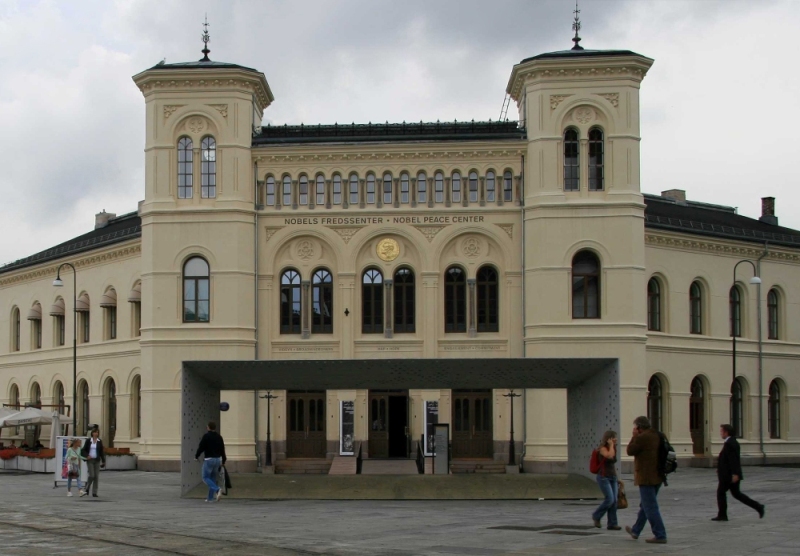
The Nobel Peace Centre in Oslo
The Nobel Peace Centre in Oslo - August 2006

Sufia Begum lived in Jobra, a village in Bangladesh where she wove bamboo stools for a living. In 1974, a professor of economics visited the village with students, and asked her how much she earned. She replied that she contractually had to sell the stools back to the man who had sold him bamboos, and because she never had money enough to buy bamboos, she borrowed it from a middleman. Her net income, after deduction of the interest, was about $0.02 per stool.

The following day, the professor did a survey in Jobra with his students. They found out that 42 families in the village were in the same predicament. Altogether, the 42 families owed the usurer a total of... $27. The professor gave them $27 and explained they would then be able to buy their own materials, cut out the middleman, and pay him back some day, whenever they could. They all paid him back, day by day, over a year.

Image The idea of microcredit was born from this spur-of-the-moment generosity. It then grew into a full-fledged business concept that came to fruition with the founding of the Grameen Bank in 1983 ('Grameen' means 'Village' in Bengalese). In the years since, the bank has lent $5.72 billion to more than 6 million Bangladeshis. Worldwide, microcredit financing has now helped some 17 million people.

The professor was called Muhammad Yunus. Here comes an excerpt from his lecture when he was awarded the .

Poverty is a Threat to Peace [...]
The new millennium began with a great global dream. World leaders gathered at the United Nations in 2000 and adopted, among others, a historic goal to reduce poverty by half by 2015. Never in human history had such a bold goal been adopted by the entire world in one voice, one that specified time and size. But then came September 11 and the Iraq war, and suddenly the world became derailed from the pursuit of this dream, with the attention of world leaders shifting from the war on poverty to the war on terrorism. Till now over $ 530 billion has been spent on the war in Iraq by the USA alone. I believe terrorism cannot be won over by military action. [...] I believe that putting resources into improving the lives of the poor people is a better strategy than spending it on guns.

The funny thing here: warmongers in the USA or elsewhere cannot say this guy is naive or inexperienced. It is just the contrary: he is not a dogmatic, and knows what he is talking about.

Sadako

Crane Origami
"I will write peace on your wings
and you will fly all over the world"
"Suppose Germany had developed two bombs before we had any bombs. And suppose Germany had dropped one bomb, say, on Rochester and the other on Buffalo, and then having run out of bombs it would have lost the war. Can anyone doubt that we would then have defined the dropping of atomic bombs on cities as a war crime, and that we would have sentenced the Germans who were guilty of this crime to death at Nuremberg and hanged them? "
Leo Szilard,
father of the US atomic bomb.

I was chatting the other day with a US friend about the trip I had in New-York a few months ago. As it happens often when you chat, our conversation turned, from , the movie by Woody Allen at the time, to the and atomic bombs. I was very surprised when he genuinely said that the atomic bombs dropped on Hiroshima and Nagasaki were "good things" because they actually "saved lives".

ImageAlthough I know it is the way the whole story is usually told and taught in the USA, I wondered how a smart and articulate guy could seriously think that killing more than 200,000 civilians "actually saved lives". The whole bloody fighting in the Pacific killed about 40,000 US soldiers 'only'... When the US President Harry S. Truman ordered to drop Little Boy on Hiroshima on August 6, 1945, then Fat Man over Nagasaki three days later, the point was certainly not about saving lives then, but saving lives of US soldiers, at the expense of much more lives of foreign civilians.

Little Boy and Fat Man had killed about 140,000 people in Hiroshima and 80,000 in Nagasaki by the end of 1945, of which about half within the first days after the bombings. Several ten thousands more people died from radiation-induced diseases in the following years. In both cities, the overwhelming majority of casualties were civilians. These are to date the only nuclear bombings in history. Yet, as the historian and Pulitzer prize winner Gary Wills wrote once: "Only the winners decide what were war crimes".

Sadako Sasaki lived in Hiroshima. She was two year-old when the first nuclear bomb was dropped on her city. Although she lived close to ground zero, she was not harmed. Nine years later, she was a healthy 11 year-old girl practicing running. After the end of a race, she fainted, was hospitalised and diagnosed radiation-induced leukaemia.

ImageThere's a legend in Japan, the country of origami. It says that if you can fold a thousand , the Gods will make your first wish become true. Sadako decided she would fold one thousand origami and wish to be cured. She folded 654 cranes before she died, in October, 1955. Yet, she was buried with one thousand paper cranes, because her classmates had finished her uncompleted vow.

After her death, her friends and schoolmates raised funds to build a memorial to her and all of the children who had died from the effects of the atomic bomb. In 1958, a statue of Sadako holding a golden crane was unveiled in the Hiroshima Peace Memorial. At its base a plaque reads: "This is our cry. This is our prayer. Peace in the world." Every year, on August 6, the statue is decorated with thousands of paper cranes sent by children from all over the world.

Torture

Algerian prisoners — Algiers, 1960

The following takes place 50 years ago, when France was still an imperialist country with colonies.

During the Algerian War [1954-1962], the French essentially fought the Algerian National Liberation Front (FLN), engaged in violent acts of guerrilla warfare, bombings and assassinations.

At the time, the French military denied using torture, or rarely admitted it but justified it with claims that they were leading an operation of peace against terrorism by the FLN. Later though, several high-ranked officers aknowlegded there was generalized torture by the French military, following orders of the politicians in charge of the country.

No one shall be subjected to torture or to cruel, inhuman or degrading treatment or punishment.
(Universal Declaration of Human Rights. Article 5)
The social-democratic government of Prime Minister Guy Mollet had given a free hand to the occupying forces in Algeria to carry out torture. In June 1956, the National Assembly accepted Mollet's proposal to set aside individual freedoms in Algeria and permit the gendarmes and soldiers stationed there to use what was officially called extended questioning, coercive measures or special treatment.

Because FLN fighters were not looked upon as enemy forces but terrorists, The French Republic did not consider its military tied by the Geneva Conventions, France had signed several years earlier. Detainees were thus not granted prisoner of war status. On the contrary, since they were looked upon as terrorists, they were deprived of the rights that are legally entitled to belligerents during a war.

Image
Shortly said, torture was an integral part of France's war policy in Algeria. Part of the daily practice included mass rapes, submerging victims in freezing water or excrement, and repeated use of electric shocks. Even in the Algerian hinterland, where there was no electricity, electric shock torture was carried out using the so-called Gégène, using the generation system intended to radio stations.

Yet when the use of torture became public knowledge in France, support for the war in Algeria quickly dwindled. After the French military won the battle of Algiers, French Président Charles de Gaulle decided the French should leave Algeria and give it back to the Algerians — which was the only possible solution, for that matter. In a March 1962 referendum, almost 90 percent of voters in mainland France backed the Évian Accords that ended the hostilities and gave Algeria its independence.

At least 400,000 Algerians were killed during the war — some say one million. In 2008, after several decades, many dramas and slaughters, Algeria still is not really a democratic country.

$icko

Sicko A Study of Sexuality and Health among Older Adults in the United States was the title of an interesting article published two weeks ago in the New England Journal of Medicine.

You probably heard of this study, that was reported at great length in the media all over the world. The paper concluded that many older adults are sexually active. Okay. Nothing that surprising or brand new here, yet interesting to know.

Only, there was another great article published in the very same issue of the New England Journal of Medicine that received much less attention from the media. Its title was Healing Our Sicko Health Care System, by Jacob S. Hacker, Ph.D. The article dealt with the last movie by Michael Moore bearing this name in a level-headed way, not at all hagiographic of a movie of which the limitations were underscored. Quoting its first paragraphs:

ImageThere is a scene in Sicko — Michael Moore's controversial new film about U.S. health care — that captures both the power and the limits of Moore's cinematic polemic.

A mother is speaking about her 18-month-old daughter, Mychelle, who became ill one evening with vomiting, diarrhoea, and a high fever. At the nearest emergency room, Mychelle is treated by a physician who suspects, rightly, that she has a life-threatening bacterial infection. But rather than give her antibiotics, the doctor calls her insurer, whose physician-gatekeeper tells him that Mychelle is not covered at the hospital and must be taken to another facility. The doctor repeatedly says that Mychelle needs care, and he is repeatedly told that she must be transferred first. Finally, nearly 3 hours after arriving at the hospital, wracked by seizures, Mychelle is taken to the approved facility. She dies 15 minutes later.

As Mychelle's mother, Dawnelle Keys, recounts this awful sequence of events, a swing hangs empty in the background. Even if we had not witnessed multiple tragedies already — a woman seriously injured in a car crash whose insurer denies payment because she doesn't obtain "prior authorization" to visit the emergency room, an elderly couple who move into their daughter's storage room because they cannot afford their medicine, an uninsured man forced to choose which of his two fingers to have reattached after an accident — we'd know how the story ends.

And yet, when the moment comes, and Dawnelle Keys's voice cracks as she describes losing her daughter, the effect is still devastating. We can't but wonder how our rich, powerful country can let so many citizens face such unnecessary pain and loss. How could a government "of, by, and for the people" fail so miserably to protect the people from such vast and preventable tragedies?

ImageIndeed. I have heard so many stories of the same kind from chat friends living in the United States. Each time, I feel sorry... and angry too, probably because I am a doc myself, and I live in Europe. It seems surreal to see such failure in the richest and more powerful country in the world, while the right to be treated has been a fundamental right in European countries for decades.

A few years ago, USA was ranked 37th in the World Health Organization's ranking of the world's health systems, and at the same time, about $5 billion a month are spent in Iraq? There must be an error somewhere.

Satan met his lover, at last!

Saddam and his lover
What was usually displayed in South Park
could well be true now, don't you think?
It was not a surprise the Iraqi prime minister, Nuri al-Maliki, was glad with Saddam's execution. Same with Iran, two decades after a war with about two millions Iranians killed. No surprise either that many Muslims were shocked he was killed on the day of Eid el-Kbir.

George Bush said yesterday that Saddam's execution was an important milestone on Iraq's course to becoming a democracy... It appears quite strange to a European, since there are few democratic countries that still enforce death penalty! (see previous blog entry) It has been outlawed in all European countries, usually for decades. Then no surprise again that official reactions in Europe were similar to the German one: There are no doubts whatsoever about Saddam's crimes. But we are opposed to the death penalty, no matter where it is used. EU Commissionner Louis Michel even said: You don't fight barbarism with acts that I deem as barbaric.

Fully agreed: murdering a murderer puts you down to his level. Also, I cannot help but being worried the trial undoubtedly failed to satisfy international fair standards. Quoting Amnesty International:

Saddam Hussein's trial [...] was a deeply flawed affair. Political interference undermined the independence and impartiality of the court, causing the first presiding judge to resign and blocking the appointment of another. The court did not take measures to protect witnesses and defence lawyers, three of whom were assassinated during the course of the trial. Saddam Hussein was denied access to legal counsel for the first year after his arrest. The appeal process was obviously conducted in haste and failed to rectify any of the flaws of the first trial.

Therefore, this hasty killing will be seen by many as nothing else than victor's justice. Most probably, it will not help things to go better in Iraq, just the contrary.

USA — The Lethal Injection Controversy

A physician, as a member of a profession dedicated to preserving life when there is hope of doing so, should not be a participant in a legally authorized execution.

Code of Ethics of the
American Medical Association


Doctors should not be in the job of killing. Those who do participate in this barbaric act are shameful examples of how a profession has allowed its values to be corrupted by state violence.

Editorial
The Lancet, 16 April 2005.

Lethal injection, now the most common way people are legally killed in the USA, is supposed to be humane, and thus not in violation of the Eighth Amendment of the Constitution of the United States, that proscribes cruel and unusual punishment.

It takes place the following way: the condemned person is strapped to a gurney. Two intravenous lines are inserted and kept open with saline solution. The injection team then administers first, sodium thiopental (a barbiturate) to induce anaesthesia, then pancuronium bromide (a curare) to cause paralysis, and last a bolus of potassium chloride to induce cardiac arrest. 

It may seem to be, say... “clean”. However, a study published in the Lancet in 2005 found that despite a theoretically lethal dose of barbiturate, 21 of 49 executed US inmates had postmortem thiopental concentrations consistent with consciousness. In addition, records from San Quentin prison revealed that 6 among 13 inmates executed by lethal injection in California continued to breathe until after pancuronium had been injected.

In other words, people executed that way are probably conscious sometimes. Of course, because they are paralysed, no one knows if they die awake but paralysed, unable to move, breathe, and scream, when potassium burns through their veins. For the record, 19 US states, including Texas, prohibit the use of neuromuscular blocking agents (aka curares) to kill... animals.

Relying on the study above, a judge in California ruled out in 2006 that, in order to avoid excessive pain which would violate the 8th Amendment of the US Constitution, the state can execute a prisoner, but must either rely solely on thiopental, or else have a qualified individual confirm unconsciousness before the injection of pancuronium and potassium chloride. As a result, Californian officials have had to postpone executions after they were unable to find any medical personnel willing to participate.

Similar constitutional challenges have effectively put executions on hold in several US states, until what is usually called now the lethal injection controversy is resolved.

Death Penalty

Death Chamber

In 2006, the death penalty has not been routinely applied in any democratic country, but the United States of America. It still exists in Japan and India, yet executions are rare there (one in India in 2004, none since then). Philippines abolished the death penalty for all crimes in June 2006.

Death penalty is forbidden in all countries inside the European Union. Its abolition is even a mandatory criterion for application.

According to Amnesty International, at least 2,148 people were executed in 22 countries in 2005, among whom 1,770 people  in China. True figures are probably much higher thoug, since Chinese statistics on death penalty are classified as a state secret. Iran executed at least 94 people, and Saudi Arabia at least 86. There were 60 executions in the USA, bringing the total to 1004 executed in this country since the use of the death penalty was resumed in 1977.

International treaties prohibit to sentence to death or execute people under 18 years old at the time of the crime. Most countries whose laws still provide for the death penalty specifically exclude the execution of child offenders. Since 1990 however, eight countries executed young people: China, Congo (DR), Iran, Nigeria, Pakistan, Saudi Arabia, USA and Yemen. China, Pakistan USA and Yemen have now changed their law and raised the minimum age for the death penalty to 18. Yet the USA and Iran have each executed more child offenders than the other six countries combined.

Scientific studies have consistently failed to find convincing evidence that the death penalty deters crime more effectively than other punishments. Statistics show that abolition does not have harmful effect on the curve of crime; for instance, in Canada where death penalty was abolished in 1976, the homicide rate per 100,000 population fell from 3.09 in 1975, to 2.41 in 1980, and 1.73 in 2003.

The persistence of death penalty is not that surprising in countries such as China, Saudi Arabia or Iran, that are not democracies. It is a stain for the USA. Death penalty is not only barbaric, it is unfair. Whether you receive the death penalty in the USA depends not so much on what you have done, but:

— where you committed your crime: the use of the death penalty not only varies from state to state (12 US states have no death penalty) but from jurisdiction to jurisdiction within a state.
— what colour your skin is: repeated studies have shown a pattern of racial discrimination in the administration of the sentence. For example, among the 205 people executed for inter-racial murders in the USA, 193 were black defendants charged with killing a white person, while only 12 were white defendants charged with killing a black individual.
— and how much money you have: 90% of defendants are too poor to hire their own lawyer, so most rely on overworked court-appointed lawyers.

Proved lack of efficiency as a deterrent, unfairness, knowlegde that innocent people were killed, and 'simply' untenable notion of legal murder of individuals by a state on an ethical point of view: isn't it enough?

Taxonomy

Zidane So, 2006 football world cup is finished now. The final ended in a France 1 - 1 Italy draw and Italy won the championship after a penalty kick shootout. It was the last match of Zinedine Zidane, one among the best football players ever. Too bad his last appearance in a stadium has been stained with bad behavior: headbutting Marco Materazzi in the chest was not an error, it was a shame. Granted, he over-reacted to (most likely racist) callings from that guy but, as a professional, he should not give such an "example" to the million young people who were looking at him and admire him all over the world. One will say: he is a man after all. Well, sure, but manners maketh man.

The very notion of racist calling against 'Zizou', as he is usually called, is interesting though. It recalled me what I have been told several times about him lately, as a Frenchman myself, from people with Arabic and/or Muslim culture I was chatting with.

They frequently said:
— You are probably very proud of ZZ as a Frenchman, aren't you? In my country, we are very proud of him, since he is an Arab/a Muslim.

The first time I was told this, I was amazed: Zidane is a Frenchman for sure, and a famous one, but I had never thought of him as being Muslim and/or Arab. This might appear strange in countries where communautarism is normal view of society but, in the French traditional secular way, religions and ethnic origins are not considered noteworthy features, but among far rightists.

A French President or Prime Minister would never mention God(s) in a speech, for instance. Asking someone you are not very close to, what religion he practices might be considered indicative of intolerant tendencies. In secular France, it is forbidden by the Law to ask about ethnicity, religion, or sexual preferences in any official interview, even more to register it. The very notion of "human races", which is not a biological, but segregational criterion, is not used, and French black people are not called 'African French'... but Frenchmen.

Zidane was born and raised in Marseilles, a big city in Southern France, on the Mediterranean coast. He speaks French with typical Marseilles' lilting accent, like characters in Marcel Pagnol and Robert Guédiguian's movies. His parents were born in Algeria, that was a French "province" at that time — a colony actually. Smaïl Zidane, his father, came to metropolitan France in 1952, ten years before the country became independent, and he remained here thereafter. Briefly said, Zidane family is a French family with Algerian roots. Like Canada, Australia or the USA, France has always been a land of immigration, with people coming from Italy, Poland, Armenia, Hungary, Spain, Portugal, Morocco, Tunisia, Algeria, etc. Whatever their roots, they are now Frenchmen.

Well, OK, he is a Frenchman actually but he is an Arab Frenchman. I am proud of him because he is an Arab, like me.

Hmmm... no, sorry, again, Zidane is not an Arab. His family was originating from an Algerian village called Boukhelifa, near Béjaïa, in Kabylie. His ancestors and family were not Arabs but Kabyles. People in Algeria are not all Arabs. There are about ten million Kabyles also, whose ancestors had been living there for long time when the land was settled by Arabs. Kabyles are part of Berber people, remembered for their insubordination to the power of Roman Empire, two millenaries ago. They speak the Kabyle variety of Berber (Tamazight language). As Zidane himself, Kabyles often have light skin, hair and eye colour.

It is interesting, I did not know there were not only Arabs in Algeria. So, OK, Zidane is a Frenchman with Kabyle ancestry. I will support him anyway, because I like him and he is a Muslim, as I am.

Yes, Zinedine Zidane is a Frenchman with Kabyle roots, as Édith Piaf and Isabelle Adjani, and many others. As for being a muslim or not, I just did not know before chat friends told me so. He could be indeed, since his family was originating from a place where main religion is Sunni Islam, and Zinedine and Yazid (his other name) are Muslim names. Does it mean he is a Muslim? Not more than me bearing a Christian name necessarily means I am a Christian myself, after all. Checking on the Internet, I found that he answered a couple of time to journalists that he has Muslim culture but does not practice. Who cares anyway, this is individual matter only.

Related Posts Widget for Blogs by LinkWithin

Home

Atom
Feed
Timeless Music
The Magic Flute
by W. A. Mozart


Timeless Reading
Les Essais
by Michel de Montaigne