Showing posts with label film. Show all posts

Otto e Mezzo

I thought I had something so simple to say. Something useful to everybody. A film that could help bury forever all those dead things we carry within ourselves. Instead, I'm the one without the courage to bury anything at all. When did I go wrong?
I really have nothing to say, but I want to say it all the same.
Guido, in 8½ by F. Fellini)
The present blog certainly comes as a joke, located as it is between 8 and 9 in the Blogging by Numbers series of blogs I have been unwinding for several weeks. Yet 8½ by was a movie that remains worth seeing, almost half a century later, far from the usual hyped-up blockbusters now released every week. Also, the music by Nino Rota is justly famous.
The movie depicts the crisis of a creative mind, the despondency of an artist who doesn't succeed in creating any more.
    [BbN #8.5]
Guido, played by Marcello Mastroianni — and a transparent alter ego of Fellini himself — has lost inspiration. He is overwhelmed by an uncontrolled flood of dreams, fantasies, and hallucinations.
From this movie on, Federico Fellini took up a style of Realistic Fantasy, where extravagance is more real than reality, filled up with humanity, fantasizing and imagination.

Blogging by Numbers

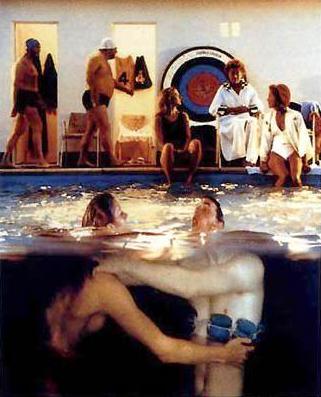
Drowning by Numbers Poster
1988 Poster of Drowning by Numbers
by Peter Greenaway
(With number 44 in the background)
In his 1988 movie 'Drowning by Numbers', British Director tells the strange story of three women belonging to three generations in a same family, who bear the same name and cause their husbands to drown, one in a bath, one in the sea, one in a swimming-pool.

The result is a fascinating, intriguing, weird black comedy. The local coroner is drawn into a plot to disguise the murders. As the plot progresses, his son explains the rules of various games played by the characters as if they were ancient traditions, while the numbers 1 to 100 successively appear in ascending order, either seen in the background or spoken by the characters.

Fear of Drowning by Numbers
Most of the games played in the film were invented for its purpose, using rules that are so complex that Greenaway later published a whole book dedicated to explaining them, entitled 'Fear of Drowning by Numbers'. That a whole book was needed to explain rules of a movie built all around constraints reminded me of the works by members, especially 'La Vie Mode d'Emploi' (Life: A User Manual) by .

, the Ouvroir de Littérature Potentielle (Workshop of Potential Literature), is a group of writers and mathematicians who seek to create literary works using constrained writing techniques. They use constraints as a means of triggering their ideas and inspiration.
Quand tout est permis, rien n'est possible.
If everything is allowed, nothing is possible. ()
Georges Perec especially, certainly the most famous OuLiPo member with Raymond Queneau and , wrote the best part of his work using lipograms, palindromes and various kinds of constrained writing. His masterly book, 'La Vie Mode d'Emploi' (Life: A User Manual) is a complex (patch)work built according to a complex plan of constraints.

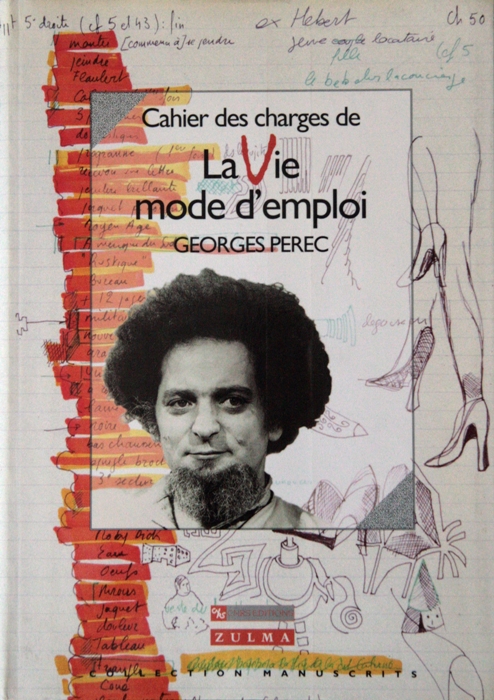
Cahier des charges de La Vie Mode d'Emploi
This fascinating book tells the lives and thoughts of the inhabitants of a fictitious building in Paris. Although it is a book that can be read and enjoyed without being concerned with the constraints, one quickly discovers that there are complicated games going on all over the place, and try to find the constraints like a detective. You will only find a small part of them anyway: here also, a whole dedicated book had to been published, that contains their inventory.

Unlike 'Fear of Drowning by numbers' though, the 'Cahier des charges de La Vie Mode d'Emploi' — the title means 'Specifications of Life: a User Manual', yet the book has not been translated into English — has not been published by its author, but exegetes after he died.

I have blogged using constraints myself in a couple of occasions, for fun and as a help at times of lack of inspiration. I assigned myself the thematic constraint 'Write about the 5 senses and Paris' once. It ended up in five blogs about , , , , and . Another time, it was 'Use the names of at least 10 movies by Alfred Hitchcock'. I am not sure anyone noticed the titles hidden despite several clues, but I enjoyed writing it.

Numbers
From now on, I will obey the constraint 'Write blogs on topics one can associate with successive ascending numbers'. Hopefully, this constraint will stimulate my imagination. We'll see until what number I succeed in following the rule, be it agreed that I will probably interpolate 'normal' blogs between the 'blogs by numbers' sometimes, in particular in response to a special event or for an anniversary.

Historic Pictures

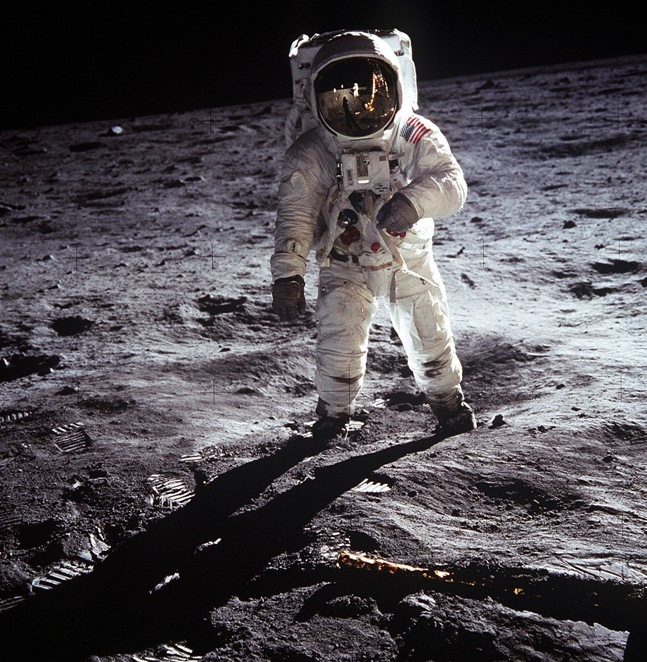
Buzz Aldrin on the Moon

Several years ago, I was given a book entitled Chronique du vingtième siècle (The 20th Century Saga), edited by newspaper.

It is a huge book (1350 pages, A4 size) that contains excerpts of most relevant articles published in French newspapers in the 20th century. 'Sarajevo: Archduke shot dead' (June, 1914); 'Lindbergh flies over the Atlantic' (May, 1927); 'Paris is now free' (August, 1944); 'Explorers on the Moon' (July, 1969), and so on.

You have a strange feeling when you read articles written many decades ago, on the very day historic events happened. They fill in a gap between personal experience and what you have been told. Obviously, the journalists who wrote the articles could not know about a future that is part of a well-known past for present readers. Yet, paradoxically, such a lack of knowledge adds a lot. When an event happened long time ago, before you were born, or able to understand it, you see it as a piece of History; almost an abstraction. On the opposite, when you can remember a event, how you heard of it, what you thought about it at the time, it is part of *your* history. Quite not the same.

Churchill, Roosevelt and Stalin in Yalta

When you read articles in such a book, you feel as if this gap has been filled in. Past events become more real, because you hear about them happening 'live'. Furthermore, beside words, you see pictures, some of which are known throughout the world: Churchill, Roosevelt and Stalin in Yalta. Edwin 'Buzz' Aldrin on the moon, photographed by Neil Armstrong who appears also as a reflection on the visor of Aldrin's helmet. Vietnamese girl , badly burnt, running down a road after a Napalm attack...

'Napalm Girl' by Nick Ut

It works with articles, it works with photos. It works also with films. I remember the year 1989 very well: resistance and demonstrations in communist countries, protesters in Tiananmen Square, the . The youngest cannot remember how hopeful we Westerners felt at the time, and how sad and angry after the massacre  in Beijing. Yet, thanks to the movie below — that I have displayed — they can feel the same as we did, 20 years ago exactly, when the desperate action of the testified about what the courage of a unique human being can be.

The Unknown Rebel

Persepolis

Persepolis by Marianne Satrapi
Marjane Satrapi is an Iranian/French graphic novelist. She was born in 1969 in Rasht, in the North of Iran, and now lives and works in Paris. She became famous because of her critically acclaimed autobiographical graphic novels Persepolis, which describe her childhood and adolescence in Iran and Europe.

Persepolis graphic novels were adapted by herself and Vincent Parronaud into an essentially black-and-white animated film bearing the same name. The movie was called 'islamophobe' and 'anti-iranian' by the Iranian President Mahmoud Ahmadinejad, thus it is not allowed for broadcast in Iran. Yet it is not a political movie. It deals with life in the real world. It is a work of poetry for all of us to delight in.

Image
When the movie starts, Marjane is a child. She lives in Tehran, in a progressive family involved with the socialist movements. She attends the Lycée Français in Tehran, and witnesses the growing oppression of civil liberties and the everyday-life consequences of Iranian politics. Then comes the Iranian revolution, the fall of the Shah, and the regime of Ayatollah Khomeini. After days of elation, disillusion follows quickly. Political opponents are put in jail again, many are executed, and islamist rules are imposed. Then the Iran-Iraq war starts. At the age of 14, her parents send Marjane to Vienna, Austria, to flee the Iranian regime. She discovers Europe, boys, and loneliness. She comes back to Iran.

The movie relates with realism and humour Marjane's years of hardship, she shared with million young Iranians of the time: overnight obligation to wear a veil, search for forbidden pirated audio cassettes, secret parties with friends where you dance and drink alcohol despite police raids.

Persepolis was awarded the Special Jury Prize in Cannes Film Festival in May 2007. Last Year, it was given the Better First Movie Award in the Cesar Award, the National film award for France. It also competed in Hollywood for the Oscar, as a nominee for best animated film, but had no chance against Disney's blockbuster Ratatouille.


Persepolis Trailer


Persepolis is a simple story told by simple means. It consists essentially of a series of monochrome drawings, their bold black lines washed with nuances of gray. Its flat, stylized depiction of the world — the streets and buildings of Tehran and Vienna in particular — turns geography into poetry. Yet it is good to be reminded that animation is rooted not in any particular technique, but in the impulse to bring static images to life.

Happy Unbirthday!

Well, let's see...

(Checking my organizer) Today is October 23... nothing written here.

(Checking my address book) No, no one among my relatives. None of my friends either.

(Checking my memo board) Nope, no one actually. I knew I was not mistaken! Nobody I know has his birthday today!

Happy unbirthday, everyone! A very merry unbirthday to you! (yes, you)

Riddle: A Hint of a Hitch

The Obelisk at the Place de la Concorde, Paris
The Place de la Concorde in Paris

Our paths crossed on that day. You were ravishing, smooth blonde hair and preppy look. The light strip of a pearl necklace, above your peach-coloured cashmere sweater, was slightly iridescent in the first beams of this sunny morning of spring. I had the shadow of a doubt: weren't you notorious, Rebecca... something?

Under the pelisse on the back seat (mornings were still a little chilly), caught in a glimpse through the rear window of your tiny Parisian car, I could make out your mother's Grace Kelly purse, near the birds-patterned Carré Hermès you had left there, skilfully undone. Everything in your appearance indicated this special sense of sophistication passed down through several generations of strong economic power. I felt spellbound.

ImageThere was a frenzy of traffic on the Place de la Concorde. Young and innocent, you did not yield to me — I was just the wrong man at the wrong place. I confess I had the ghost of a frown, barely the mark of minor annoyance. A beautiful manicured hand with a fine golden ring and a topaz let go of the blond wood steering wheel. You gave me the finger.

People who still believe in elegance and refinement never drove a car.

Destino

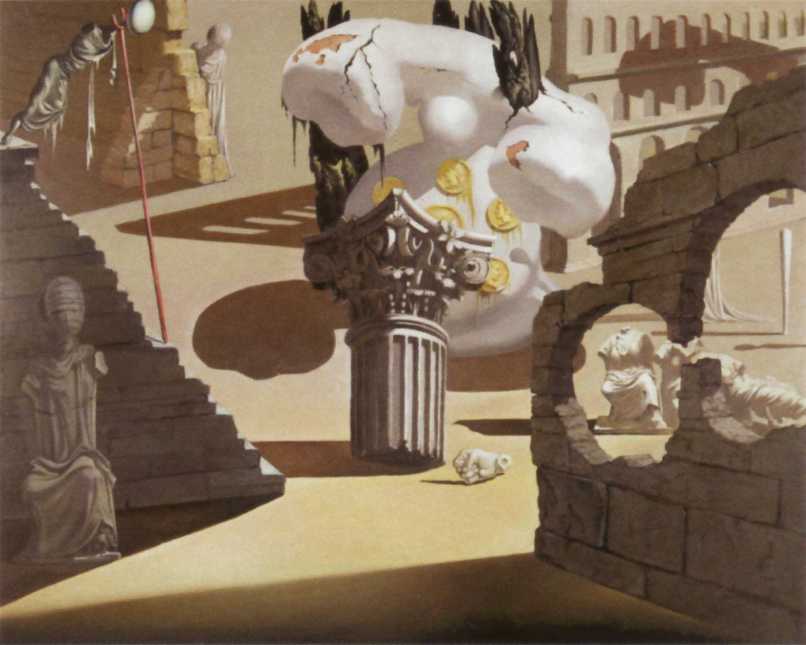
Destino — White telephone and ruins
(1946, Oil on plywood, 60.6× 47.9 cm)

Although it is hard to imagine two more widely separated artists, Salvador Dalí and Walt Disney admired one another.

Dalí made no secret of his interest in Disney: as soon as in 1937 he wrote to his friend, the French Surrealist André Breton: I have come to Hollywood and am in touch with the three great American surrealists — the Marx Brothers, Cecil B. DeMille and Walt Disney.

On his side, Disney loved to have contemporary artists involved in his films, although relationship with them was sometimes stormy.

More than sixty years ago then, the idea was born of a short film collaboration between Salvador Dalí and Walt Disney. Disney probably made the suggestion to Dalí when the latter was in Hollywood in 1945, working on Alfred Hitchcock's film Spellbound. Dalí worked on the storyboard in the Disney Studios from February to April 1946. The film was originally planned to combine real footage and animation and tell the story of the ill-starred love of a ballerina and a baseball player. It was called Destino, after a ballad by the Mexican Armando Domínguez which was to accompany it. However, Disney Studios could not complete the film for financial reasons... at least during the lifetime of the two men.

More than a hundred paintings and drawings had survived though. This material enabled the Disney Studios, in 2003, to make a six minute film directed by Walt's nephew Roy Disney and the French artist Dominique Monfery. I watched it several months ago — several times in a row — in the Galeries Nationales du Grand Palais in Paris, at an exhibition entitled Il était une fois Walt Disney (Once upon the time, Walt Disney), that surprisingly connected Disney's original drawings to occidental artworks that inspired them, from Gothic Middle-Age to Surrealism. The whole film is not online, but here is an excerpt found on YouTube:

Destino (2003)

The six-minute short movie is a digest of Dali's imagery, without much of a spot to speak of, but deserts, telephones and ruins, melting clocks and ants, all morphing from one to the other. It is like a last message from Dalí, long after he passed through the looking glass himself.

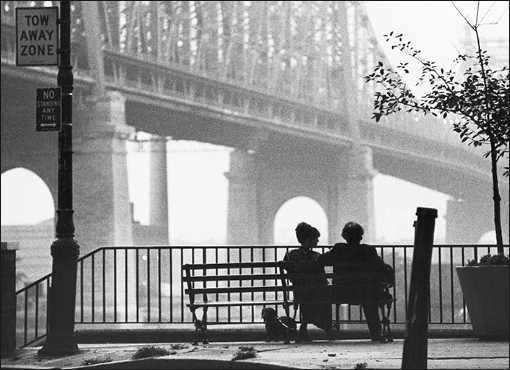
Queensboro Bridge

Manhattan by Woody Allen (1979)
"Fifty-five seconds. That's the time Woody Allen needed, in 1979, to make this place — in his dear Upper Side, by the East River — one of the most famous places in the world. A pilgrimage as much necessary to lovers than Venice [...] This sequence is made in the image of Woody's Manhattan: it's a dream, a fantasy. One more time, artifice created the reality of art."
(Pierre Murat)

Simon & Garfunkel – The 59th Street Bridge Song (Feelin' Groovy)
Every week on Wednesday, I will receive Telerama, a French culture magazine to which I subscribe. I have not received this week's issue of the magazine though, because I left home before mail distribution yesterday for a one-week trip to New-York City. However, I found out what is the main topic of this week's issue of the magazine when I reached Charles de Gaulle airport: the cover coincidentally ran New-York, 24 hours in the life of a city. Of course, I bought it and read it in the plane.

I translated into English a few sentences of an article by Pierre Murat about New-York and the cinema, that was illustrated with the iconic photo above, part of the famous sequence in Woody Allen's movie Manhattan.

Queensboro bridge, Upper East side, Manhattan
Queensboro bridge.
Upper East side, Manhattan — April 2008

Woody Allen is considered one of the main US film directors by the French – whereas I've been told he is not acknowledged as such in his country – and I love Manhattan particularly.

I have wanted for years to be in this place, in the same way people from elsewhere may long to go and see the banks of the Seine River. Because of the movie by Woody Allen, because of the song by Simon and Garfunkel also. So, a couple of hours after the plane landed only, I was at the Eastern end of the 59th Street in Sutton Place Park and was gazing at the Queensboro Bridge.

It was 10 am in Paris when my plane took off yesterday. It was about 5 pm in New-York on the same day when I took the picture on the right. A dramatic scene shift in a few hours from Amélie by Jean-Pierre Jeunet to Manhattan by Woody Allen, sort of.

$icko

Sicko A Study of Sexuality and Health among Older Adults in the United States was the title of an interesting article published two weeks ago in the New England Journal of Medicine.

You probably heard of this study, that was reported at great length in the media all over the world. The paper concluded that many older adults are sexually active. Okay. Nothing that surprising or brand new here, yet interesting to know.

Only, there was another great article published in the very same issue of the New England Journal of Medicine that received much less attention from the media. Its title was Healing Our Sicko Health Care System, by Jacob S. Hacker, Ph.D. The article dealt with the last movie by Michael Moore bearing this name in a level-headed way, not at all hagiographic of a movie of which the limitations were underscored. Quoting its first paragraphs:

ImageThere is a scene in Sicko — Michael Moore's controversial new film about U.S. health care — that captures both the power and the limits of Moore's cinematic polemic.

A mother is speaking about her 18-month-old daughter, Mychelle, who became ill one evening with vomiting, diarrhoea, and a high fever. At the nearest emergency room, Mychelle is treated by a physician who suspects, rightly, that she has a life-threatening bacterial infection. But rather than give her antibiotics, the doctor calls her insurer, whose physician-gatekeeper tells him that Mychelle is not covered at the hospital and must be taken to another facility. The doctor repeatedly says that Mychelle needs care, and he is repeatedly told that she must be transferred first. Finally, nearly 3 hours after arriving at the hospital, wracked by seizures, Mychelle is taken to the approved facility. She dies 15 minutes later.

As Mychelle's mother, Dawnelle Keys, recounts this awful sequence of events, a swing hangs empty in the background. Even if we had not witnessed multiple tragedies already — a woman seriously injured in a car crash whose insurer denies payment because she doesn't obtain "prior authorization" to visit the emergency room, an elderly couple who move into their daughter's storage room because they cannot afford their medicine, an uninsured man forced to choose which of his two fingers to have reattached after an accident — we'd know how the story ends.

And yet, when the moment comes, and Dawnelle Keys's voice cracks as she describes losing her daughter, the effect is still devastating. We can't but wonder how our rich, powerful country can let so many citizens face such unnecessary pain and loss. How could a government "of, by, and for the people" fail so miserably to protect the people from such vast and preventable tragedies?

ImageIndeed. I have heard so many stories of the same kind from chat friends living in the United States. Each time, I feel sorry... and angry too, probably because I am a doc myself, and I live in Europe. It seems surreal to see such failure in the richest and more powerful country in the world, while the right to be treated has been a fundamental right in European countries for decades.

A few years ago, USA was ranked 37th in the World Health Organization's ranking of the world's health systems, and at the same time, about $5 billion a month are spent in Iraq? There must be an error somewhere.

The Air is on Fire

David Lynch — This man was shot 0.9502 seconds ago.

David Lynch: This man was shot 0.9502 seconds ago.


The Air is on Fire was the name of an exhibition dedicated to David Lynch, I attended a couple of weeks ago at the Fondation Cartier pour l'Art Contemporain in Paris.

ImageDavid Lynch is essentially known as a filmmaker (Elephant Man, Blue Velvet, Lost Highway, Mulholland Drive, Twin Peaks etc.) with unorthodox narrative and visual style. He is also a painter, a photographer, a video artist. The exhibition brought together the various forms of expression he has employed since 1960, installed in an environment he designed, complemented by a series of concerts and projections he created.

David Lynch's universe is unique, dark, often violent, usually with a disconcerting touch of humour though. His static work develops the line of thought outlined in his movies — or maybe it is the opposite. It calls to mind fantasies of his youth, torments of his adult life.

ImageThat said, I found the show as disturbing as Lynch's movies. It made me feel ill at ease on several occasions. Yet I was feeling all the time I was watching at a huge artistic event.

The first part of the exhibition displayed Lynch's paintings, installed by himself. Steel gantries with curtains (that seem directly borrowed from Mulholland Drive or Twin Peaks) supported unframed canvas on which Lynch had glued various things (dolls' heads, clothes, glass eyes, knifes...) that were mixed into the paint afterwards. The paintings often showed scenes of rape and murder that associated violence and irony, the loneliness of people portrayed there reminding me of Francis Bacon's suffering figures sometimes.

ImageSeveral dozens of small pictorial pieces were presented in another room, without a title or a date. These were rough sketches and notes hastily put down on restaurant headed notepapers, paper handkerchiefs, matchboxes, visit cards, etc. These pieces are not decipherable in an objective way, yet they give away Lynch's obsessions and inside thoughts, as a journey deep into the inconscient of the artist.

Lynch's first short films were shown on the lower floor of the building, in a small projection room. Some of them dated back the 1970's, in which you could see the temptation of gore, as well as attempts at blurring significance of events and disclosing only one distorted side of the reality.

ImageOne hundred photographs or so were displayed, that looked like illustrations of his movies: femmes fatales, banal places with stifling atmosphere, and loneliness always. I loved several of them, probably I will write a specific blog about them some day.

Image At the end of the exhibition, a series called Distorted Nudes was displayed: these are digital images Lynch made using old erotic photographs as initial material, that have obvious analogy with the work of the Surrealists. Here also, you could see Lynch's belief that reality is not univocal, that any "normality" probably hides a monstrous reality.

The Air is on Fire is due to end tomorrow. Then, unless you planned to come to Paris this week-end, I strongly suggest you explore its website [click here], that contains several videos, including a tour of the show with David Lynch himself.

That's it, for today!

shadoks

Probably few people outside France and French-speaking countries ever heard of Claude Piéplu, who died a few days ago. In France though, he was famous as the unusual high-pitched voice of the narrator in the much-loved TV cartoon Les Shadoks, droll birdlike creatures from another planet, that made Piéplu a real star here.

Started as a sort of Peanuts-like characters, these outer-space bird-like creatures were the heroes of a French TV cartoon that turned into a cult-like phenomenon. Characterized by ruthlessness, stupidity and living on a two-dimensional planet, the Shadoks would constantly try to escape their rivals the Gibis, sorts of intelligent guinea pigs wearing bowler hats, whose names had a lot to do with the initials of that country across the Channel.

Speaking a special language, the Shadoks could only use four syllables: ga, bu, zo, meuh (pronounced as: gah, büh, zoh, möh). Absurdity and fake logic permeated their world, with adages such as: “Why do simple when one can do complicated?” and “When one tries continuously, one ends up succeeding. Therefore, the more you fail, the more chances you have to be successful”.

These features have become a inherent part of French way of thinking and sometimes very special sense of humour.

Related Posts Widget for Blogs by LinkWithin

Home

Atom
Feed
Timeless Music
The Magic Flute
by W. A. Mozart


Timeless Reading
Les Essais
by Michel de Montaigne