Showing posts with label riddles. Show all posts

A Void

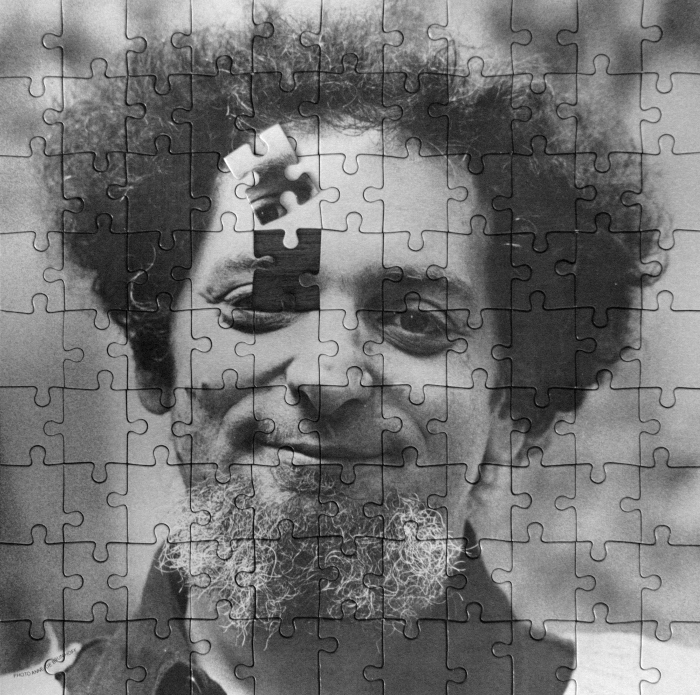
Georges Perec Jigsaw
Georges Perec's portrait as a jigsaw puzzle
Puzzle pour un portrait de Georges Perec
La Poésie dans un jardin — Festival d'Avignon 1988

Born in Paris in 1936, was the only son of two recent Jewish immigrants from Poland, Icek and Cyrla Peretz. His father volunteered for French Army during World War II, and was killed in 1940. His mother was deported by the Nazis and died in Auschwitz in 1943.

Georges survived because his mother had previously sent him by train to a little town in the Alps mountains, where relatives took charge of him. They had him baptized Catholic and his name frenchified to Perec. They adopted him formally after the war.

Disappearance of his parents when he was a child, disappearance of his Jewish roots, there is nothing so surprising that Perec was haunted by absence, loss, erasing, disappearance. “I have no memory of childhood” are the first words of his novel , an admission that he remembers almost nothing of his early life as a Jew in Nazi-occupied France.

In 1969, Georges Perec published a novel named La disparition, a phrase that means ‘the disappearance’ in English. A word for word translation of the title into English had to be replaced by A Void (Gilbert Adair) or A Vanishing (Ian Monk) though, because the letter E appears three times in ‘the disappearance’, and the whole novel  is a 300 pages written without ever using a E.

La disparition tells the story of the disappearance of a man, whose name is Anton Voyl (in French) or Vowl (in English), in a strange world from which an enigmatic part five of 26 has disappeared as well.

La disparition
It implicitly talks of its own lipogrammatic limitation, starting with the name of the missing person — Voyelle in French, Vowel in English, after the E's have been lost. Characters in the novel work out what is missing, but they risk fatal injury if their though gets too close to that taboo “circular symbol with a horizontal bar across it”.

The constraint that underlies the story induces endless tricks and distortions of language, and describes how a world can be built that fills that void. Besides the amazing lexicographic feats of writing a whole novel with zero occurrence of the most frequent letter in French and English though, the silent disappearance of the letter is a metaphor of loss, and suffering it causes.

In French, E is the only vowel in père [father] and mère [mother], and sans E [without E] sounds very much like sans eux [without them]. Furthermore, since the name Georges Perec is full of E's, the disappearance of the letter also ensures the author's own disappearance.

The absence of a sign is always the sign of an absence, and the absence of the E in A Void announces a broader, cannily coded discourse on loss, catastrophe, and mourning […] Each "void" in the novel is abundantly furnished with meaning, and each points toward the existential void that Perec grappled with throughout his youth and early adulthood. A strange and compelling parable of survival becomes apparent in the novel, too, if one is willing to reflect on the struggles of a Holocaust orphan trying to make sense out of absence, and those of a young writer who has chosen to do without the letter that is the beginning and end of 'écriture' [writing].     —

-:-:-:-:-

Postscript: When I challenged myself with the Blogging by numbers constraint, I decided the first entry in the series would be related to Number 0 — not 1 — and dedicated to A Void. It seemed fair enough because the very idea of the constraint was inspired in particular by the works of Georges Perec and Oulipo.

I did not know though that another void was just about to occur, when my I had my laptop fell from a table three weeks ago and its hard drive broke. Another aching void and a lot of work to do again, because I had not performed any save for a month or so. Anyway, I am back now.

[BbN: #0]

Blogging by Numbers

Drowning by Numbers Poster
1988 Poster of Drowning by Numbers
by Peter Greenaway
(With number 44 in the background)
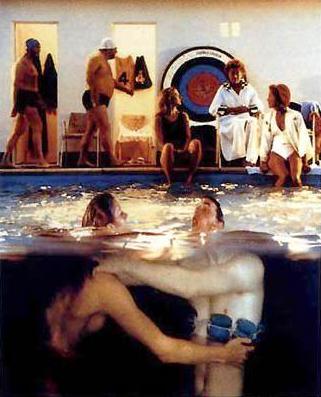
In his 1988 movie 'Drowning by Numbers', British Director tells the strange story of three women belonging to three generations in a same family, who bear the same name and cause their husbands to drown, one in a bath, one in the sea, one in a swimming-pool.

The result is a fascinating, intriguing, weird black comedy. The local coroner is drawn into a plot to disguise the murders. As the plot progresses, his son explains the rules of various games played by the characters as if they were ancient traditions, while the numbers 1 to 100 successively appear in ascending order, either seen in the background or spoken by the characters.

Fear of Drowning by Numbers
Most of the games played in the film were invented for its purpose, using rules that are so complex that Greenaway later published a whole book dedicated to explaining them, entitled 'Fear of Drowning by Numbers'. That a whole book was needed to explain rules of a movie built all around constraints reminded me of the works by members, especially 'La Vie Mode d'Emploi' (Life: A User Manual) by .

, the Ouvroir de Littérature Potentielle (Workshop of Potential Literature), is a group of writers and mathematicians who seek to create literary works using constrained writing techniques. They use constraints as a means of triggering their ideas and inspiration.
Quand tout est permis, rien n'est possible.
If everything is allowed, nothing is possible. ()
Georges Perec especially, certainly the most famous OuLiPo member with Raymond Queneau and , wrote the best part of his work using lipograms, palindromes and various kinds of constrained writing. His masterly book, 'La Vie Mode d'Emploi' (Life: A User Manual) is a complex (patch)work built according to a complex plan of constraints.

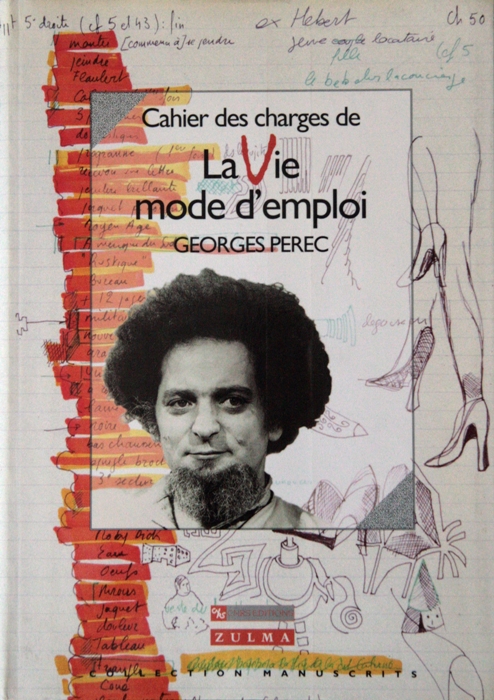
Cahier des charges de La Vie Mode d'Emploi
This fascinating book tells the lives and thoughts of the inhabitants of a fictitious building in Paris. Although it is a book that can be read and enjoyed without being concerned with the constraints, one quickly discovers that there are complicated games going on all over the place, and try to find the constraints like a detective. You will only find a small part of them anyway: here also, a whole dedicated book had to been published, that contains their inventory.

Unlike 'Fear of Drowning by numbers' though, the 'Cahier des charges de La Vie Mode d'Emploi' — the title means 'Specifications of Life: a User Manual', yet the book has not been translated into English — has not been published by its author, but exegetes after he died.

I have blogged using constraints myself in a couple of occasions, for fun and as a help at times of lack of inspiration. I assigned myself the thematic constraint 'Write about the 5 senses and Paris' once. It ended up in five blogs about , , , , and . Another time, it was 'Use the names of at least 10 movies by Alfred Hitchcock'. I am not sure anyone noticed the titles hidden despite several clues, but I enjoyed writing it.

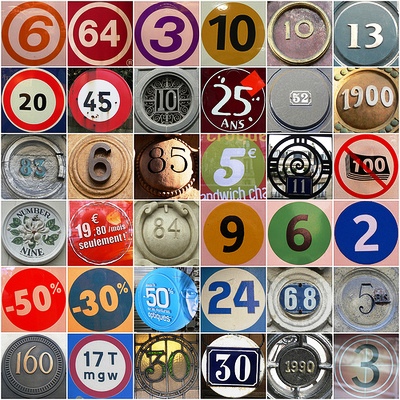
Numbers
From now on, I will obey the constraint 'Write blogs on topics one can associate with successive ascending numbers'. Hopefully, this constraint will stimulate my imagination. We'll see until what number I succeed in following the rule, be it agreed that I will probably interpolate 'normal' blogs between the 'blogs by numbers' sometimes, in particular in response to a special event or for an anniversary.

Riddle: A Hint of a Hitch

The Obelisk at the Place de la Concorde, Paris
The Place de la Concorde in Paris

Our paths crossed on that day. You were ravishing, smooth blonde hair and preppy look. The light strip of a pearl necklace, above your peach-coloured cashmere sweater, was slightly iridescent in the first beams of this sunny morning of spring. I had the shadow of a doubt: weren't you notorious, Rebecca... something?

Under the pelisse on the back seat (mornings were still a little chilly), caught in a glimpse through the rear window of your tiny Parisian car, I could make out your mother's Grace Kelly purse, near the birds-patterned Carré Hermès you had left there, skilfully undone. Everything in your appearance indicated this special sense of sophistication passed down through several generations of strong economic power. I felt spellbound.

ImageThere was a frenzy of traffic on the Place de la Concorde. Young and innocent, you did not yield to me — I was just the wrong man at the wrong place. I confess I had the ghost of a frown, barely the mark of minor annoyance. A beautiful manicured hand with a fine golden ring and a topaz let go of the blond wood steering wheel. You gave me the finger.

People who still believe in elegance and refinement never drove a car.

Related Posts Widget for Blogs by LinkWithin

Home

Atom
Feed
Timeless Music
The Magic Flute
by W. A. Mozart


Timeless Reading
Les Essais
by Michel de Montaigne