Showing posts with label architecture. Show all posts

Art in San Diego

Building in Gaslamp
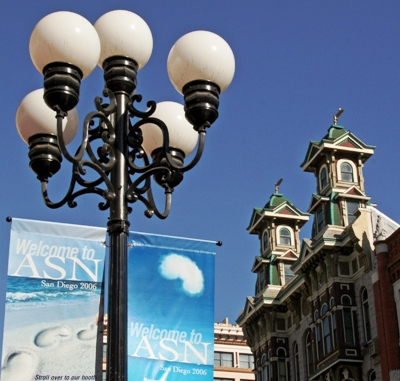
The twin-towered Louis Bank of Commerce
The annual conference of the ASN, , was held in San Diego two weeks ago.

There was a lot of interesting stuff for a nephrologist there. No topic for this blog though. Rather than blogging about work, I will rather show photos taken while I strolled around in the city's streets and museums, either on the day before the Convention began this year, either during a previous stay in 2006, when another ASN Renal Week was held there.

Architecture. There are beautiful buildings in San Diego. In Gaslamp quarter especially, many houses are remarkable. The twin-towered building above is located at 837 Fifth Avenue. Its top floor used to be a house of prostitution and the first floor an Oyster Bar where operated for a time.

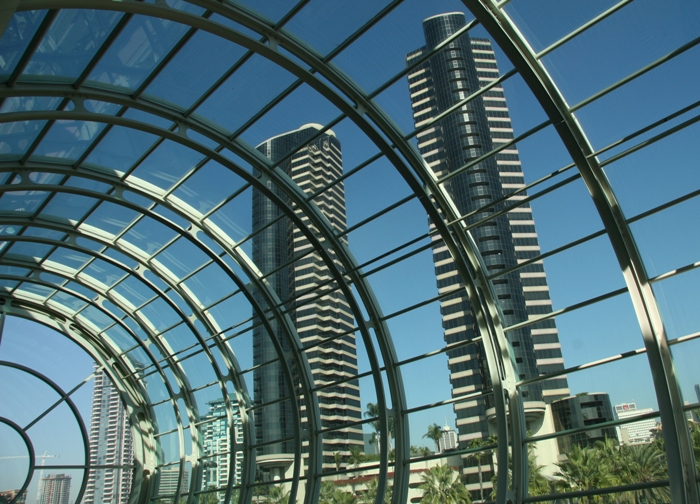
Inside the Convention Center
From inside the Convention Centre
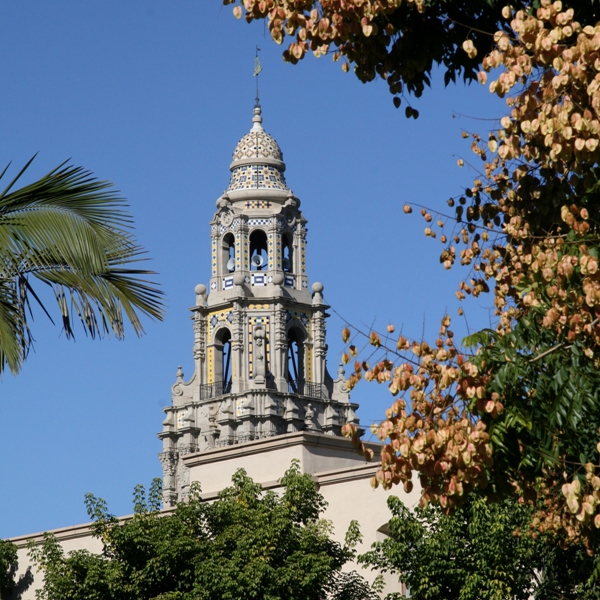
The Convention Centre itself is beautiful work, and many skyscrapers are beautiful as well. In Balboa Park on the contrary, buildings are essentially 20th century pitiful attempts to reproduce Spanish mostly, Tuscan sometimes, buildings of the baroque style... with stucco. The California Tower of the Museum of Man is nice though.
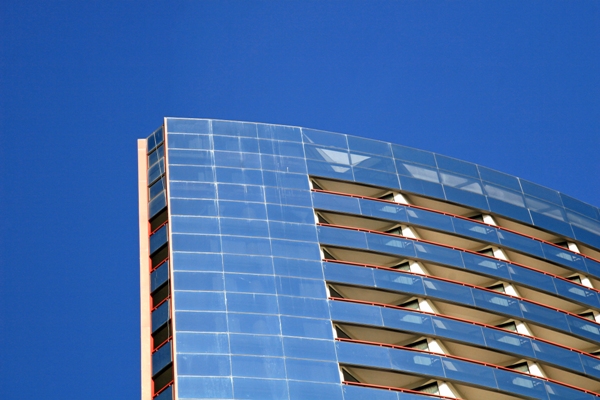
Marriott Hotel, San Diego
              Marriott Hotel
California Tower
California Tower
Sculpture. French sculptor lived in San Diego from 1994 to 2002. She had solvent-related emphysema, and enjoyed the paradise weather of the area. Yet it did not prevent her from dying of pulmonary failure.

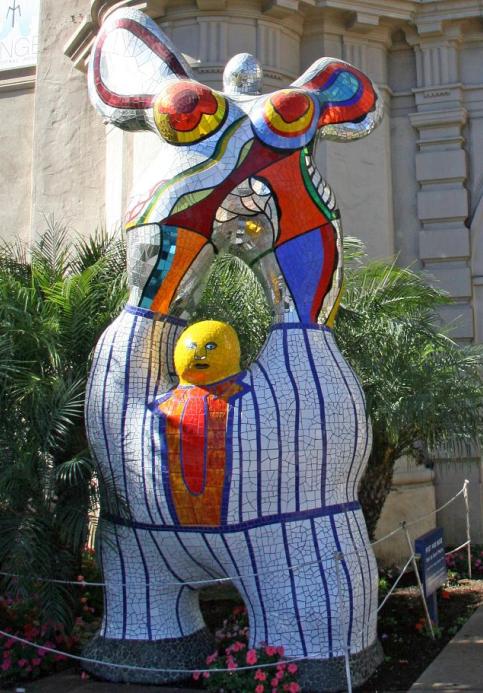
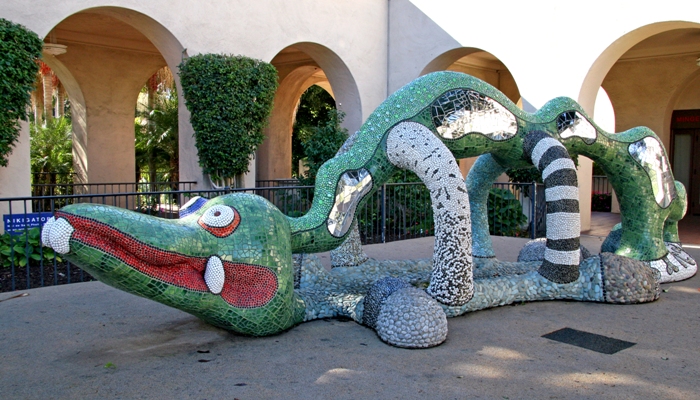
Two sculptures by her are exhibited in Balboa Park, in front of the : Poet/Muse and Nikigator. Children love the latter especially, some kind of dragon they are often brave enough to sit astride.
Poet and Muse — Niki de Saint-Phalle
Poet and Muse
Nikigator — Niki de Saint-Phalle
      Nikigator
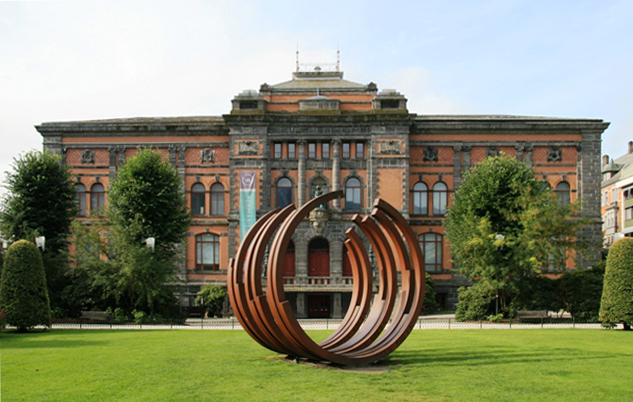
Bernar Venet's Arcs in Bergen (2006)
Bergen (2006)
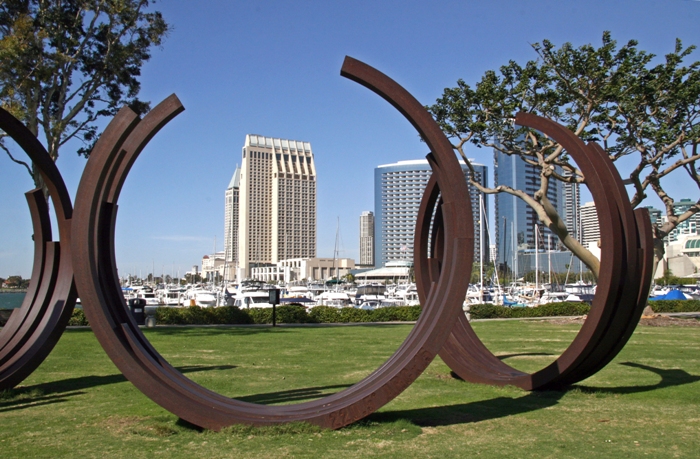
Bernar Venet's Arcs in San Diego (2009)
San Diego (2009)
Another French Sculptor, , was much in evidence in several places in the city, although temporarily only. You know what? I believe this guy is following me: everywhere I go, I see his iron arcs.

When I had vacation in Norway in 2006, they were exhibited in Bergen. When I attended the annual conference of the French Society of Nephrology in Bordeaux two years ago, they were exhibited there. And at present they are exhibited in San Diego too!

Sorry Bernar, but you'll have to resign yourself: I will never buy any, my kitchen is too small.

Painting. Close to the Mingei Museum in Balboa Park, the displayed artworks by Picasso and Miró especially, in a temporary exhibition. I liked a couple, essentially a drawing by Picasso of a Minotaur stroking a sleeping woman. There was an exhibition of Calder Jewelry too. I don't like Calder's mobiles that much. I didn't like his massive earrings, tiaras and necklace either.

Anyway, the main reason why I went to Balboa park was the Museum of Art permanent exhibition, with several Renaissance paintings I had been longing for three years to see again. There are paintings by Rogier Van Der Weyden, Giotto, Titian, and others, Flemish and Italian. Here come a few words about my three favourite.
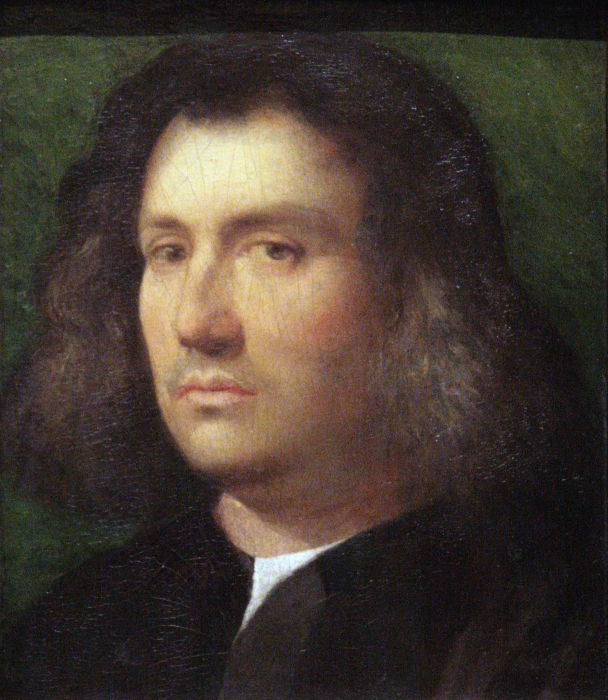
Giorgione — Portrait of a Man
Oil on panel, 1506

Portrait of a Man, by Giorgione.
This painting is one of the greatest Renaissance portraits in my opinion. The composition is closely cropped around the head of the sitter. The setting or props often used at the time to animate portraits are absent, yet the man's turning gaze and ambiguous expression make the portrait wholly engaging and alive.

Giorgione was friend of Titian (who finished his Sleeping Venus after his early death, a painting that foreshadowed my beloved Venus of Urbino — see a ). He was unprecedented in his ability to describe warm flesh and soft hair. Quoting , Giorgione's 'modern manner' sought to paint 'living and natural things', several years before arrived on the Italian scene.

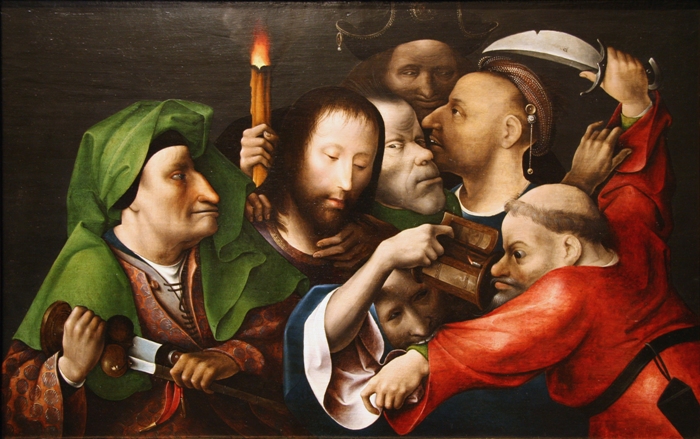
Hyeronimus Bosch — Arrest of Christ
Hieronymus Bosch — Arrest of Christ
Oil on panel, ca. 1516

The Arrest of Christ, by H. Bosch.
The painting depicts Jesus's arrest outside of Gethsemane. To the right, Peter raises a sword in defence of Jesus. He has just cut the ear from the High Priest's servant, who bites his arm and thrusts a lantern in his face. The grotesque figures of his tormenters contrast with the serene image of Jesus himself.

I love the way Bosch, in this painting, distorts the characters into something like caricature. Can you believe this was painted 500 years ago?
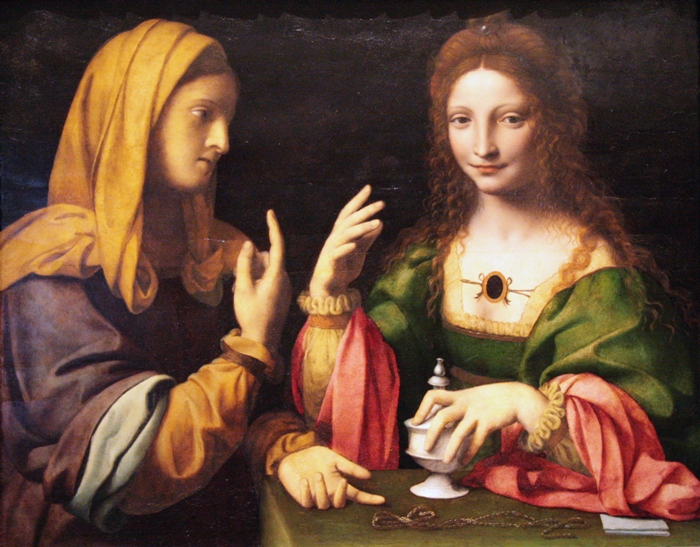
Bernardino Luini — The Conversion of the Magdalene
B. Luini — The Conversion of the Magdalene
Oil on panel, ca. 1520

The Conversion of the Magdalene,
by Bernardino Luini.
This is the moment when Mary Magdalene, the attractive and fashionable woman on the right, decides to put aside her finery (like the necklace on the table) and old life, and follow Jesus, like her sister Martha (on the left) previously. She holds an unguent jar, a symbol of her act of anointing Jesus's feet.

Bernardino Luini was among Leonardo da Vinci's closest followers in Milan. One can find a lot of Leonardo typical features in this painting: the characteristic figure types especially, with the mysterious, seductive smile of Magdalene, and the distinctive gesturing hands that animate the narrative.

So... after one day in the streets and museums of the city, I had my eyes and camera full of pictures. It was just time to go to the Convention Centre and attend the Conference.
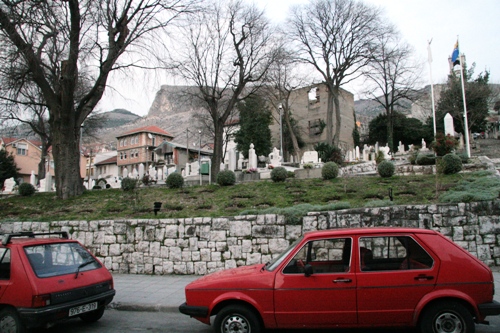
Mostar

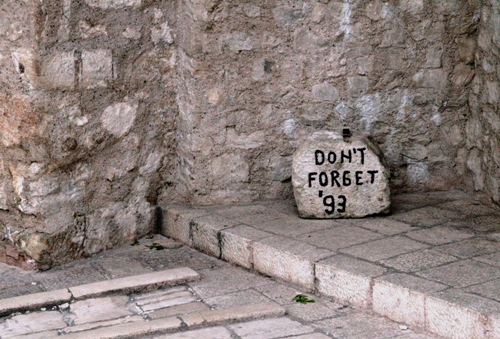
A graveyard in the city of Mostar
A graveyard inside Mostar — March 14, 2009

There are many little parks in the city, with grass and trees. Anywhere else, such places of greenery would be called 'public gardens'. Not in East-Mostar though, because there are tombs between the trees. Dozens of tombs.

Each tomb is engraved : it displays a name, a date of birth, a date of death: 1993 usually. Thousands of people died during the civil war in Mostar, and graveyards seem to have replaced public gardens.

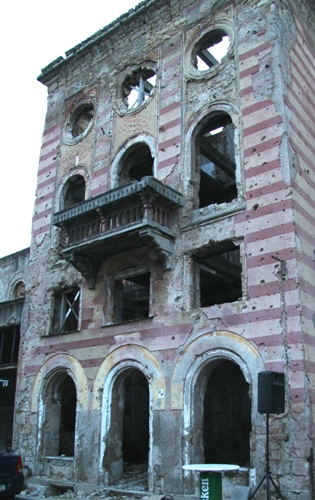
A ruin in Mostar
A ruin in Mostar

The war in Bosnia ended fourteen years ago but you can still see it everywhere. The streets and avenues are lined with destroyed buildings, dangerous ruins of which the fronts are riddled with holes of bullets and shrapnel. There is a same poster everywhere, that warns people against going into the ruins, children against playing there.

Constructions are coming on slowly in Mostar apparently. They are rebuilding, but you can guess that money is lacking.

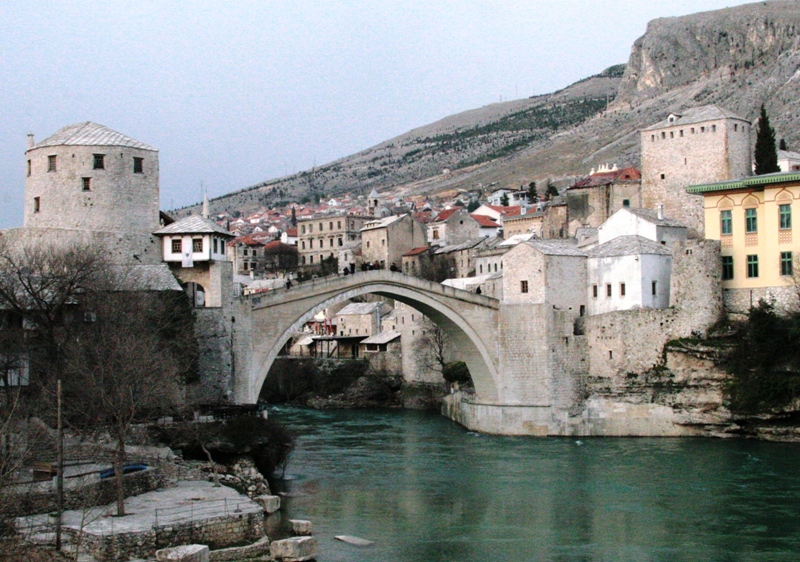
Stari Most, the Old Bridge after which Mostar was named, was the symbol of the city, and a chef-d'oeuvre of Ottoman architecture. It was commissioned by Suleiman the Magnificent to Mimar Hajruddin, a pupil of Sinan, "the father of classic Ottoman architecture".

On Stari Most, close to the right bank

Built in 1566, Stari Most consisted of a single 30 metres long hump-backed arch that stood more than 20 metres above the green waters of the Neretva River. It had withstood all sorts of calamities, invasions, wars, and even earthquakes.

Nevertheless, it was destroyed when Croats and Bosnians, who used yet to be allies against the Serbs during the civil war in Bosnia (1992-1995), fought during one year in Mostar. On November 9, 1993, the Old Bridge was destroyed by the artillery of the HVO Croatian forces, allegedly to stop Bosnian troops, in reality for its symbolic value as an Ottoman piece of art and a link between communities.

Mostar — Stari Most
Stari Most, the Old Bridge — March 14, 2009.

Under the aegis of the UNESCO, and thanks to a loan from the World Bank and grants from donor countries, the Old Bridge was rebuilt for the very same reason: as a symbol of peace and tolerance.

After two years of scientific and archeological research, it was rebuilt in 2004 exactly as it was, using identical blocks of white stones found in nearby quarries and according to traditional methods, using quoins, cramps and dowels. It is now listed as a World Heritage Site.

Saint-Germain-des-Prés

The Steeple of Saint-Germain-des-Prés
The steeple of Saint-Germain-des-Prés (Paris - May 2006)

Taking photos of monuments and places in Paris is often discouraging: wherever you go for a stroll in the city, you see hundreds of postcards on display, whose pictures are identical or (most often) better than yours. Nevertheless, I've never seen something similar to the pic above, of which I must admit I am quite proud. It is the steeple of Saint-Germain-des-Prés, Paris' oldest church, seen between the bronze slabs of a fountain situated on the opposite sidewalk of the Boulevard Saint-Germain.

Image Home to a number of famous cafés, such as Les Deux Magots and Le Café de Flore, where artists, writers and philosophers would meet, Saint-Germain-des-Prés area used to be the centre of gravity for the surrealists painters and writers (André Breton especially) in the 1920s and 1930s, then the headquarters of existentialists Jean-Paul Sartre and Simone de Beauvoir in the 1950s and 1960s. The area is much older though: the first parts of the church were built as an abbey in the 6th century.

There is a fountain in front of the church, in the Place du Québec, at the crossing of Boulevard Saint-Germain, Rue de Rennes and Rue Bonaparte (see Wikimapia location).

ImageIt's a modern fountain, the work of a Québecois artist named Guillaume Daudelin. More than an ordinary fountain, it is a sculpture, given in 1984 as an hommage from Quebec to the city of Paris. It is called L'Embâcle, which means Ice Jam (that is, obstruction of a river bed with blocks of ices). There is no gap between the sidewalk's large paving stones and the fountain's four slabs of bronze, so that the pavement seems lifted up by the water that sprays through it.

Image L'Embâcle beautifully conjures up break-up of ice in Québec when springs arrives at last. It is famous because of its artistic value, and functional originality as well. Among kids, it is well known also... as the best slide in the neighbourhood!

The day I took the photo on top of this entry was my lucky day: the fountain had been switched off because the weather was cold. No spray any more, no water inside, only little puddles on the ground. I could sneak into the fountain as a housebreaker, kneel down in there, and steal a couple of shots.

A New Shape for the Eiffel Tower?

Eiffel Tower — New shape
Built between 1887 and 1889 as the entrance arch for the Exposition Universelle, a World's Fair marking the centennial celebration of the French Revolution, the Eiffel Tower has become a global icon of France, and one of the most recognizable structures in the world.

It wight have a new look next year though, in time for its 120th anniversary: Serero Architects of Paris recently won an open competition to redesign its public viewing platform and reception areas. According to the new plan, the top floor plate of the tower would be extended by grafting a high performance carbon Kevlar structure on it.

A spokesperson for Serero explained that the plan to restructure the top of the tower aims to increase the quality of access. I would be useful indeed, because the average waiting times for the tower's elevators currently run at more than an hour at peak times.

New Top of the Eiffel Tower
The New Top
The design is already causing controversy. Some think it would be pleasant to see the Old Lady with a new appearance. On the opposite, critics question the wisdom of tinkering with the famous silhouette and spending money on upgrading a tourist attraction which attracts 6.9 million visitors a year. Others wonder if this is something else than a promotion campaign for the architect team... It would not be the first time that the Eiffel Tower is used for promoting a hoax.

Barcelona — Casa Batlló

Batlló
Casa Batlló — Barcelona, June 2007

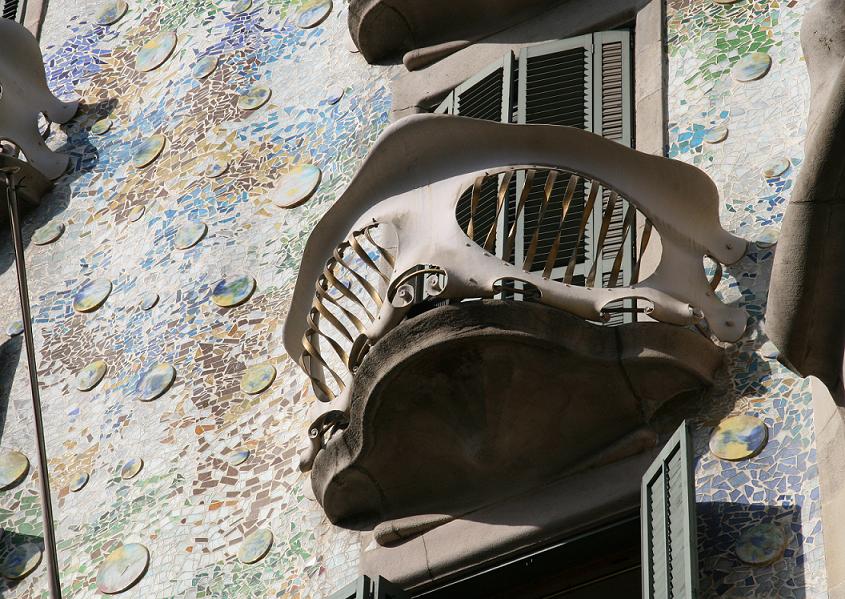
It is not surprising that when it was being built, people started to call it "Casa dels ossos" (House of Bones) : the entire facade of the Casa Batlló looks as if it is covered with bones, skulls, shoulder blades or hip bones, in the form of bone coloured balconies, as well as real visions of shinbones and fibulas on the lower part.

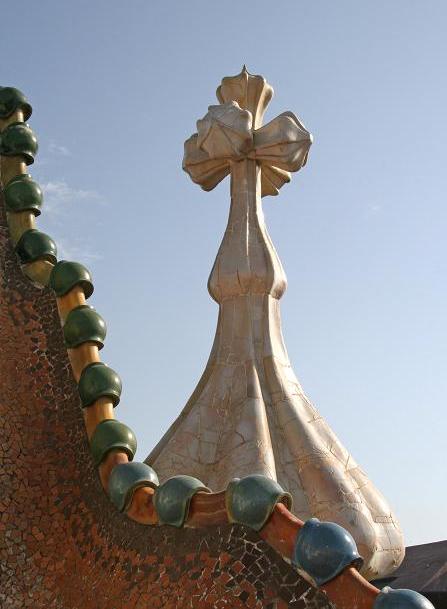
A little round turret on the top, crowned with a four-armed cross, looks like a huge sword thrust into a roof similar to a dragon's back.

Obviously, the tradition of Sant Jordi (Saint George, who killed the dragon), very popular in Catalonia, inspired Gaudí here, as it did in several occasions elsewhere also.

Yet you can see many things rather than a killed dragon and the bones of his victims in the outside of the Casa Batlló. You can see a representation of Venice carnival, with masks, confetti and arrays of colours. Or some kind of a vertical lake, with water reflections, water plants and underwater caves. And finally, all and none of these, but abstract shapes and forms designed for their own sake and in a coherent interaction. In any case, the facade has nothing to do with the natural properties of stone with which the house has been built, and this is typical feature of buildings by Gaudí.

Image
A balcony

His life's work, the Church of the Sagrada Familia — not finished yet, more than 120 years after the building started — is also an explosion of life where plants, animals, human beings and saints palpitate through the stone.

La Casa Batlló was called after the name of its owner, who commissioned Gaudí to tear down the old apartment building and reconstruct a new one. Not only Gaudí conceived the building as an architect, but as a project manager and a foreman. He gave directly orders to the workmen on the scaffolding, telling them exactly where to put each coloured piece.

When I arrived there last Sunday, it was 9:00 am exactly. They were just opening the gates. The night before had been sleepless for many Barcelonians, because of San Juan celebrations. There was still little people in the streets and no tourist had reached the place yet. I was alone. For about 10 minutes, the Casa Batlló was mine.

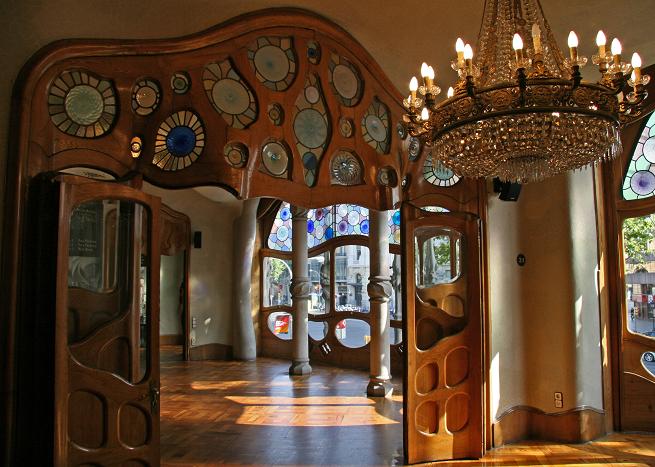
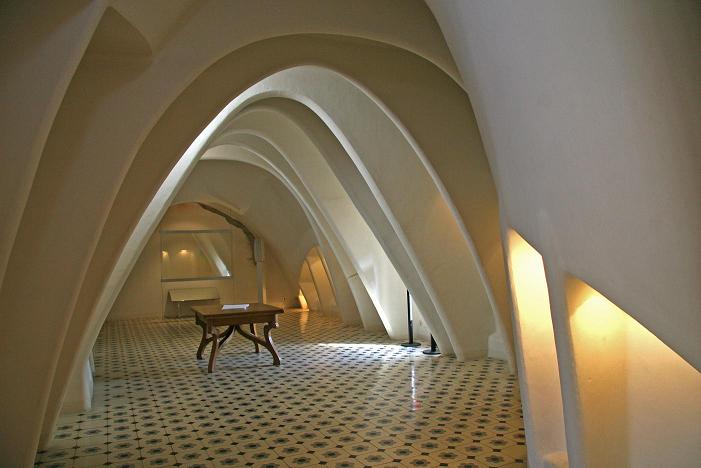
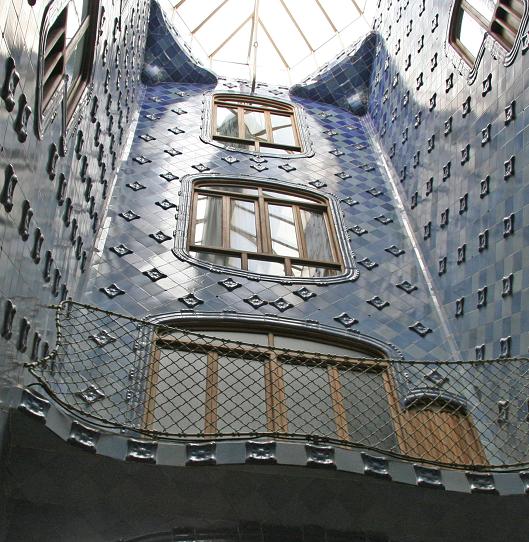
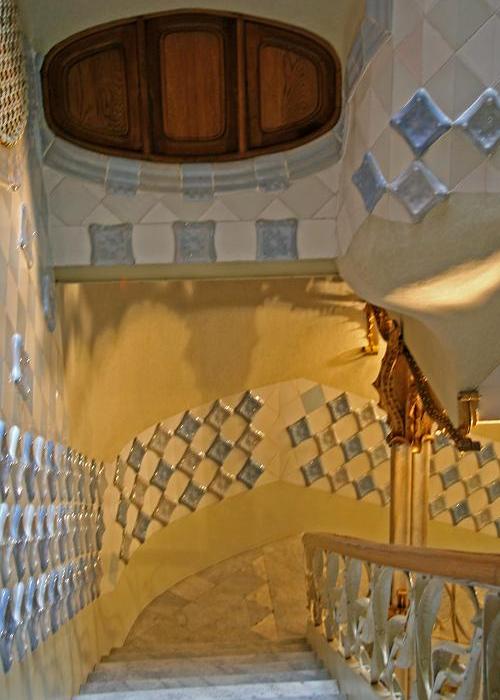
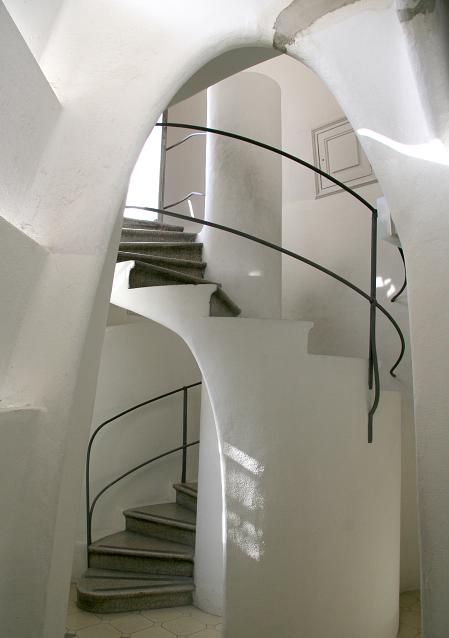
This house is more than a building, it is a myth of art.The windows provide natural light everywhere inside, even to the most interior rooms and stairs, and every nook, every detail contains a surprise. Here come a couple of pictures I took in there. You'll find much more, and better ones, on its dedicated website.

Image
Main room on the first floor
Image
Room on the last floor

Image
The light shaft

Image
Stairs
Image
Stairs to the roof
Image
Cross on the roof

Related Posts Widget for Blogs by LinkWithin

Home

Atom
Feed
Timeless Music
The Magic Flute
by W. A. Mozart


Timeless Reading
Les Essais
by Michel de Montaigne