Showing posts with label animals. Show all posts

The Lady and the Unicorn

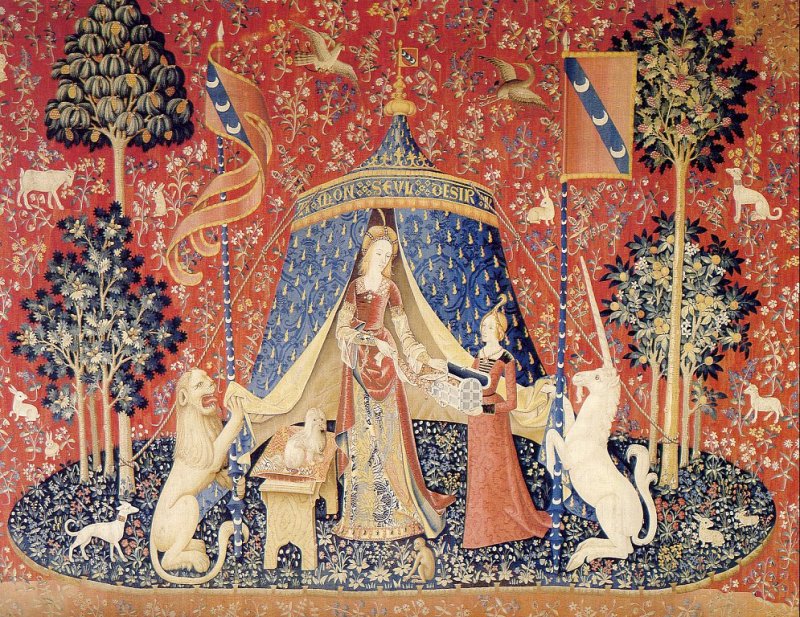
A mon seul désir
The Lady and the Unicorn — To my only desire.
Cluny Museum of Middle Ages, Paris.

The Hôtel de Cluny, in the Quartier Latin (the Latin Quarter) in Paris, was built in the 14th and 15th century. It is a beautiful structure that combines Gothic and Renaissance architecture. It is worth seeing as a building then, yet essentially it is the French Museum of the Middle-Ages. It houses many early Medieval sculptures, wonderful illuminated manuscript, and an important tapestry collection, that includes one of the greatest works of art of the whole Middle Ages, the famous series of tapestries named 'La dame à la licorne' — 'The Lady and the Unicorn'.
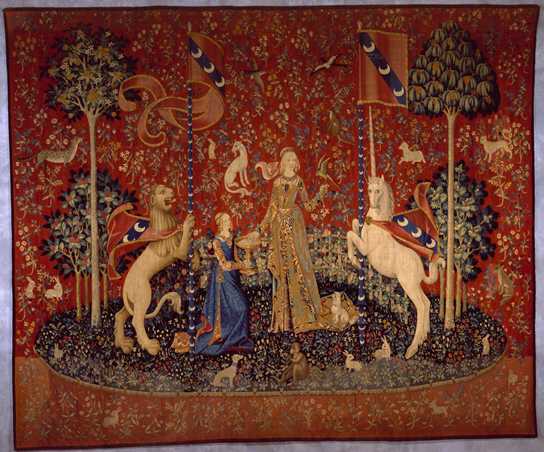
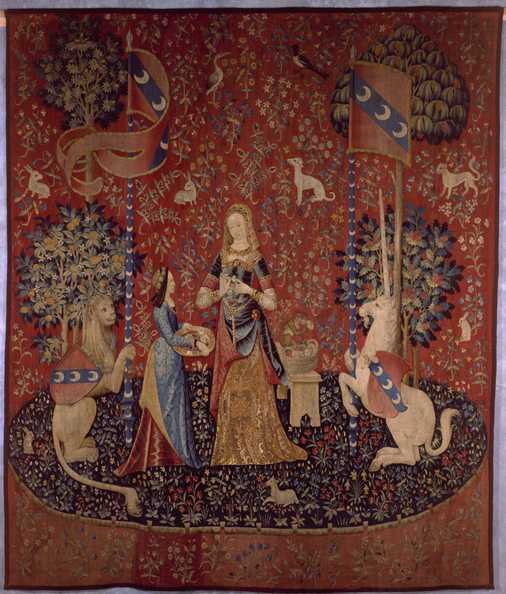
The Lady and the Unicorn — Taste
Taste (detail)
Click for the whole image

The Lady and the Unicorn
by John Renbourn

I went there again yesterday, for the tenth time maybe, because they have just opened new rooms to the public, dedicated to art and life in the Middle-Ages. Also, I wanted to see the red tapestries again, a few months after I went to the Cloisters in New-York and watched the green series of Unicorn tapestries they hold there [This series was the topic of the last blog I published on Yahoo. I might post an emended version of it here some day].
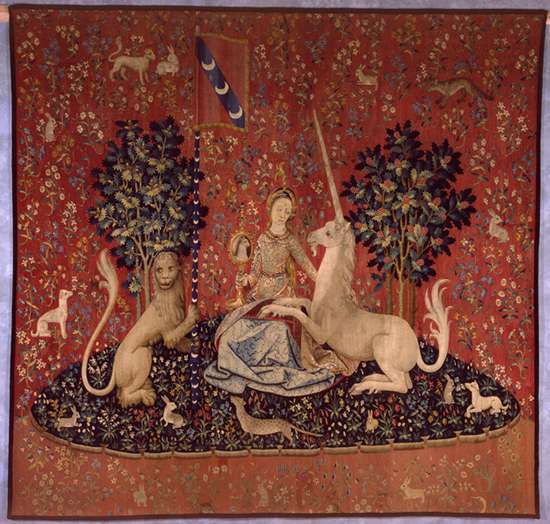
The Lady and the Unicorn — Sight
Sight (detail, click)

Both series are dated back to the 15th century. They are so-called 'Tapisseries mille fleurs' ('Thousand flowers tapestries'), named that way because they contain thousands of details, flowers and small animals especially.

While the Unicorn is the main character of the green tapestries held in New-York, that tell the story of the Hunt of the Unicorn, the Lady is the centre of the red tapestries displayed in Cluny Museum. My eyes this morning remain filled with visions of the beautiful, enigmatic Lady.
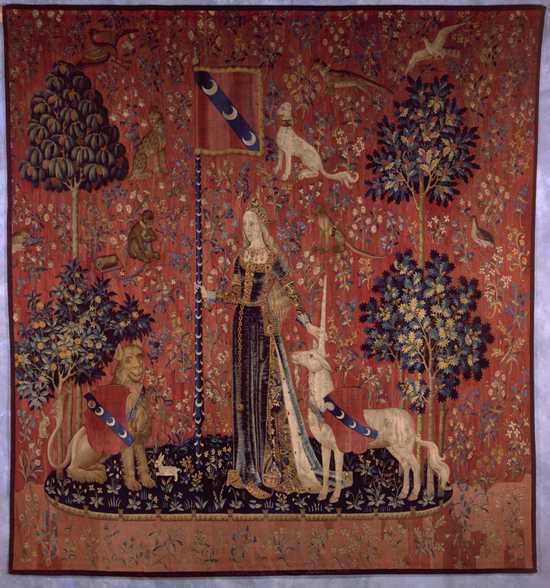
The Lady and the Unicorn — Touch
Touch (detail, click)
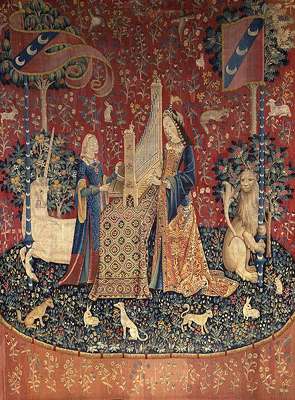
There are six tapestries in the series. Five hang side by side on a same larger curved wall in front of the only door. They are really huge, several meters wide and high. You see nothing but them when you enter the room. They depict the five senses: Taste, Sight, Touch, Smell, Hearing, in that order. Touch is situated in the middle, a very sensual picture where the Lady holds a standard in her right hand and the horn of the unicorn in her left one.

The Lady and the Unicorn — Smell
Smell (detail, click)
After you have looked at the five senses for a while, you turn round to the exit door, but then you have a view of the sixth tapestry, that has been hanging alone on the straight wall behind you from the beginning. In this tapestry, the Lady places her necklace into a case held out by her servant.  The Lion and the Unicorn are here, and many little animals. She will leave then soon though, and enter the tent behind her of which the door is wide open for her. 'A mon seul désir' ('To my only Desire'), an inscription on the tent says.

The Lady and the Unicorn — Hearing
Hearing (detail, click)

Nobody knows for sure what this tapestry means. I have the feeling that the Lady has experienced many things in her life already, using her five senses, and she has reached the end of this path now.

The wise, beautiful Lady, might have decided to renounce pleasures of the world. Or she knows she will pass soon perhaps. Whatever the reason, she now leaves her jewels forever, as a symbol of her physical life, before she enters the tent, as a symbol of her inner spirituality, a convent, or the Other World.
Le Lapin Agile

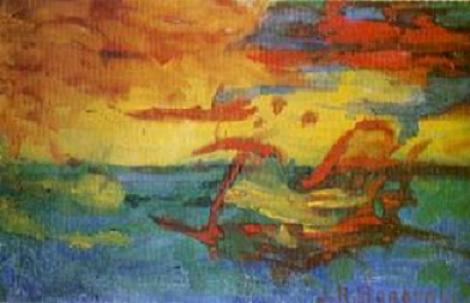
Joachim-Raphaël Boronali — Coucher de soleil sur l'Adriatique (Sunset on the Adriatic)
Joachim-Raphael Boronali — Sunset on the Adriatic [Coucher de soleil sur l'Adriatique]

The painting on the left induced some hurly-burly when it was exhibited at the Salon des Indépendants in Paris in 1910. The canvas was signed by a person of obscure repute named Joachim-Raphael Boronali, who had prepared the picture's appearance by drafting a manifesto about a new, dissident futurist school, Excessivism.

ImageMany specialized critics who saw the painting in the show found the work 'very interesting'. It was sold twenty Golden Louis (400 French francs, about 1,800 current dollars). And yet, its author, who appears in the adjacent photo with his best friend, was not a painter at all.

There is a famous cabaret at 22 Rue des Saules in Montmartre, named Le Lapin Agile, where, in the 1900s-1910s, unknown people called Picasso, Utrillo, Modigliani, Braque, Derain, Dorgelès, Apollinaire or Max Jacob would meet, talk, joke, sing and drink together. The owner of the place was Frédéric Gérard, Le Père Frédé as everyone called him, who is the bearded man who appears in the photo above.

ImageThe cabaret had existed since 1860. It was originally called Le Cabaret des Assassins — Cabaret of Murderers — until Andre Gill, a caricaturist, painted in 1875 the sign that was to suggest its permanent name: the picture of a humanized rabbit with a top-hat, who jumps out of a saucepan with a bottle of wine in his hand.
Residents soon called their neighbourhood night-club Le Lapin à Gill — Gill's rabbit — a name that naturally evolved into Le Lapin Agile — The Agile Rabbit.

Cora Vaucaire — Frédé
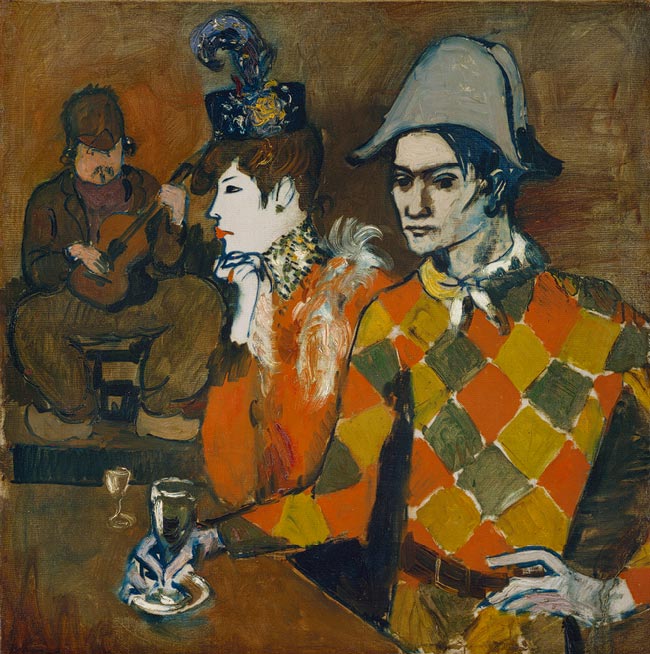
Pablo Picasso - Au Lapin Agile
Pablo Picasso— At the Lapin Agile
[Au Lapin Agile] 1905.
Oil on Canvas, 99 cm × 100 cm
Metropolitan Museum of Arts, New-York.

The cabaret still exists nowadays. It is still full of customers who come and listen to French songs dating back as far as the fifteenth century.

Frédéric Gérard— aka Frédé — the owner of the place shown with his donkey on the photo above, was a character. Songs have been written about him, and he is the man playing the guitar in the background, in the adjacent painting by .

In this painting, Picasso portrayed himself dressed as a Harlequin, accompanied by his model Germaine Pichot. According to the tale, Picasso once paid a lunch with this painting, that Frédé sold in 1912 for the equivalent of 20 dollars. In 1989, it was auctioned at Sotheby's for 41 million dollars.

Anyway, how about 'Joachim-Raphael Boronali'? Who hid under the nickname? You know it was not Picasso or any of the abovementioned artists since I wrote that the painter was portrayed in the photo displaying Frédé with his donkey. Yet the painter was not Frédé but... Lolo, the donkey!

The painting was a hoax by the writer Roland Dorgelès and a few friends, to make fun of art critics. They tied a brush to the tail of Lolo, which daubed a canvas with several colours in front of witnesses, official ones included. They coined the nickname Boronali because it is an anagram for Aliboron, as Jean de la Fontaine would call the donkey in his fables.

Image
Boronali in the process of creating his masterpiece
The painting is now permanently exhibited in a museum in Milly-La-Forêt, near Paris.

Wildlife Photographer of the Year

1997 One Earth Award - Angela Scott
Angela Scott  from Kenya won the One Earth Award 
in the 2007Wildlife Photographer of the Year competition.

The captain of our Russian icebreaker wedged his ship against the ice in Antarctica’s Amundsen Sea, so we could step off [...] A single emperor appeared out of the whiteness and headed towards the ship. It was completely unafraid and curious about the other two-legged-creatures wandering about on the ice. [...] We were probably the first humans it had ever seen. The picture I took is a statement on our world, its wild inhabitants and the nature of humans. (Angela Scott)

Elephant Creation by Ben Osborne
The Wildlife Photographer of the Year competition has been running since 1964 under the patronage of the British Natural History Museum and BBC Wildlife Magazine.

It is also sponsored by Shell now — oil companies try hard to restore their image, don't they. Have a look at the awarded pictures anyhow: about 20 awards in different categories, and several other great pictures, as the photo just above, by Ben Osborne, who was the overall winner of the contest.

The Thorn Humans

Image Recommended accompanying music:
 
[When the War is Over by J.J. Cale & Eric Clapton]

Seeking on the Internet yesterday after last news in Iraq, I unexpectedly found : despite the ongoing conflict across the country, no bird species has gone extinct in the Mesopotamian marshes — that used to be among the most biodiverse regions in the Middle-East — since the last assessments were conducted in the 1970s.

A Field Guide to the Birds of Iraq was even published recently, the authors of which proudly state that it "covers the 387 bird species that have been recorded in Iraq", being the "first comprehensive, fully illustrated field guide to the birds of an Arabic speaking country and first field guide of its kind for Iraq".

Granted, several US soldiers are killed in Iraq every day. Granted again, several hundred thousand Iraqi civilians died because of the war that began 3 years ago, and bombs still kill dozens of men, women and children every day or so. It made me think that is a great pity that they are not Buddhists or Hindus, instead of Christians and Muslims. If they were, they could be reincarnated as birds! Hopefully, they would live and breed then, despite the noise of bombs.

Cats

Cats having lunch in Malta
Two cats having lunch in Mdina — Malta, Feb 2007.

They take up residence under a car in Rabat. You find them lying on low walls overhanging Grand Harbour in Valletta. They thread their way through fishing boats turned upside down on the quays in Senglea...

Wherever you  stroll around in Malta, you meet cats.

Many males are russet, many females are tricolour. They're usually alone in the streets, sometimes grouped together in the parks. People feed them. In Valetta's streets, you can see small boxes or plates at many doors, with leftovers, catfood, water or milk. In Lower Baracca gardens, dinner time is impressive when some inhabitants come and bring food to twenty or so multicoloured cats. They don't fight. They share. They have time.

Malta in this respect reminds me of Venice, Greek islands or Provençal villages: cats seem to be the real masters here. Lenient masters actually, who put up with humans as long as they don't move too near, and serve them well. I believe they enjoy living in such beautiful locations, although they pretend to overlook gorgeous sceneries with supreme indifference. They know they are part of the beauty and peacefulness of the place, their native beauty holding their own against ephemeral human constructions.

Call for Witnesses : Lost Elephants!

I read today an agonized call on the website of the SPA (Société protectrice des animaux, the French Society for the Prevention of Cruelty to Animals):

CALL FOR WITNESSES

The SPA is looking for 4 elephants that are part of the Big Foot Show. They were seen in Cavalaire-sur-Mer lately, and we need to find them! If you have any information, please call us immediately (+33 143 xxx xxx or the Internet).

Two and a half months after they made off, nowhere on the web I read news about the cute pets being found again... Therefore, if you ever see elephants on a road close to your place, especially in Europe or Middle East — I mean, elephants whose colour is grey, not pink — no need to go and see a doctor: you might have met the poor little things on their way back to native Kenya.

Losing their elephants... people are absent-minded sometimes, aren't they.

That's it, for today!

shadoks

Probably few people outside France and French-speaking countries ever heard of Claude Piéplu, who died a few days ago. In France though, he was famous as the unusual high-pitched voice of the narrator in the much-loved TV cartoon Les Shadoks, droll birdlike creatures from another planet, that made Piéplu a real star here.

Started as a sort of Peanuts-like characters, these outer-space bird-like creatures were the heroes of a French TV cartoon that turned into a cult-like phenomenon. Characterized by ruthlessness, stupidity and living on a two-dimensional planet, the Shadoks would constantly try to escape their rivals the Gibis, sorts of intelligent guinea pigs wearing bowler hats, whose names had a lot to do with the initials of that country across the Channel.

Speaking a special language, the Shadoks could only use four syllables: ga, bu, zo, meuh (pronounced as: gah, büh, zoh, möh). Absurdity and fake logic permeated their world, with adages such as: “Why do simple when one can do complicated?” and “When one tries continuously, one ends up succeeding. Therefore, the more you fail, the more chances you have to be successful”.

These features have become a inherent part of French way of thinking and sometimes very special sense of humour.

Mad Cows

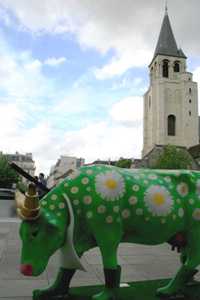
A Mad Cow before Saint-Germain-des-Prés Church (Paris, May 2006)

A couple of days ago, about 150 cows in fibre glass invaded the pavement of Paris. You can see them everywhere now, from the Avenue des Champs-Élysées to the Place de la Bastille.

It is supposed to be an art exhibition called Vach'Art, that is the Cow-Parade's French version. Yet it doesn't fool me: these are undoubtedly mad cows! Some believe they are Harry Potter, other ones that René Magritte is their farmer! I tell you, these cows are crazy!

I took the shot opposite yesterday evening. This green cow is named Le goût du naturel (Taste for Naturalness), whereas one can wonder how grazing in such a place could be natural, don't you think?

Well, after all, maybe it knows the church behind it, and the neighbourhood, are called Saint-Germain-des-Prés, which means Saint Germain in the fields...

Related Posts Widget for Blogs by LinkWithin

Home

Atom
Feed
Timeless Music
The Magic Flute
by W. A. Mozart


Timeless Reading
Les Essais
by Michel de Montaigne