Showing posts with label UK. Show all posts

Panem et Circenses

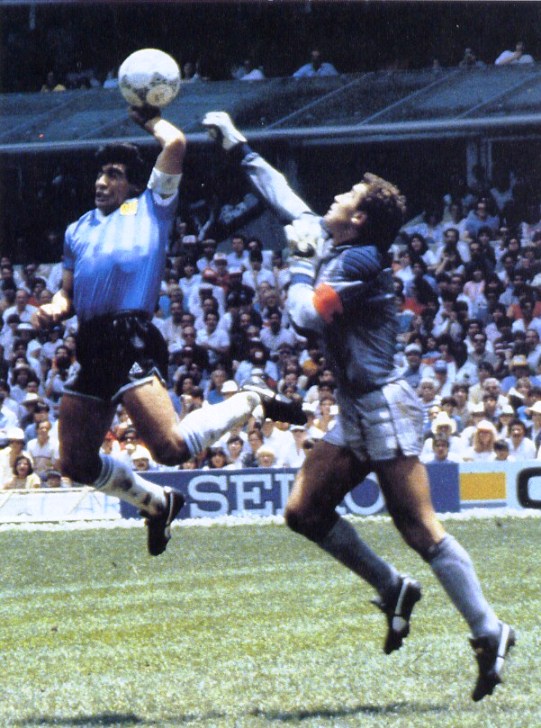
Maradona cheats
Diego Maradona illegally sticks the ball with his left hand in the .
Maradona was not penalised for the cheat, called The Hand of God Goal. He was later awarded the golden ball for best player in the tournament.
I'd certainly rather write about what I love than about what I dislike, but it will not be possible today because, according to the , this blog has to deal with number eleven…. From Brazil to England, from France to Korea, this number immediately conjures up one thing only: football, because eleven is the number of players in a team.

When I was a child, I would play football in the playground during the breaks, as every boy does. It is just normal that children play. Later, I played handball (as a goalkeeper, my thumbs remember it well), then rugby that I loved. Sport as a recreational activity is great thing. Playing in teams is an experience besides the sport itself: it has you learn to socialize, and respect people. Theoretically.

Professional football appears to be just the opposite of this theory. Granted, beautiful play may happen. Dribbles by Zinedine Zidane were pure art sometimes. Yet Zidane was also the man who head butted an Italian player, Marco Materazzi, in the final of the 2006 FIFA World Cup ( dealt with it), probably as an over-reaction to racist callings.

In my eyes, this event summed up professional football: it includes manoeuvre and pretension, racism, insults, and violence. The hidden part of the iceberg is of the same kind: doping, cheats, refereeing 'errors' and corruption, and that's not all.

Such flaws are inherent to many professional sports nowadays, not only football. The reason is always the same: money. It's especially obvious in football though, because it is by far the most popular sport in the world.

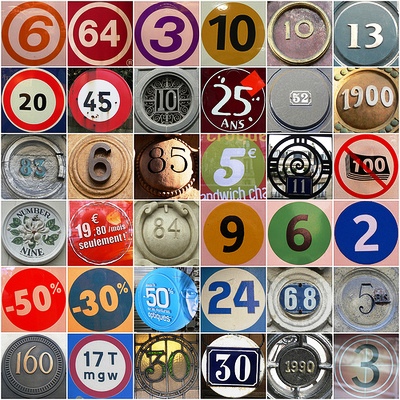
eleven
    [BbN #11]
Famous football players are millionaires who usually grew up in poverty. Their success makes young poor people dream of a better future. Also, people don't think of economical issues when they look at a match.

Nothing new here. 'Panem et Circenses', the Roman emperors would already say, 2000 years ago, about what a leader should provide to the masses to have them remain quiet: bread and games.

Scrambled Eggs

Let it Be
John, Paul, Ringo and George
(Cover of Let it Be – 1970)

Paul McCartney had only just woke up in his room in London, one morning in 1964, when he hurried to the piano and turned on a tape recorder. During the night, he had dreamed of a melody he did not want to let slip into the recesses of his mind.

In order not to lose it then, he played it with temporary lyrics inspired by the breakfast he was just about to take with his girlfriend: 'Scrambled Eggs… Oh, baby, you've got so lovely legs'.

The music was here, the whole of its melody so precisely composed that McCartney was not sure at first it was truly a creation of his own. He feared it might be involuntary plagiarism, that he subconsciously remembered a music composed by someone else. 'For about a month', he told later, 'I went round to people in the music business and asked them whether they had ever heard it before. Eventually it became like handing something in to the police. I thought if no-one claimed it after a few weeks then I could have it.'

was as its peaks at the time. The group of four boys from Liverpool — whose name was a pun made of The Beetles (one among their many first names, and a tribute to Buddy Holly's group The Crickets) and 'to beat' — had turned into the world's most famous band in the history of popular music in the 20th century. Even, first dissensions had appeared, that would make the band break in 1970.

In 1964 though, would always sing together. John Lennon and Paul McCartney composed most of the songs, they would always sign together — Lennon/McCartney. It was the case also with Scrambled Eggs when McCartney succeeded at last to add real lyrics to the music composed during his sleep. Yet, for the first time, the song was not sung by the whole Beatles but Paul alone, accompanying himself on an acoustic guitar, with a string quartet on the background.

Yesterday has become one of the world's most popular songs ever, with more than 3,000 recorded versions. In a poll of  British music experts and listeners in 1999, it was even voted the best song of the 20th century. I do love the song, but I somewhat regret it has not remained an Ode to Scrambled Eggs, just for the sake of fun and originality.

[BbN #4]

Blogging by Numbers

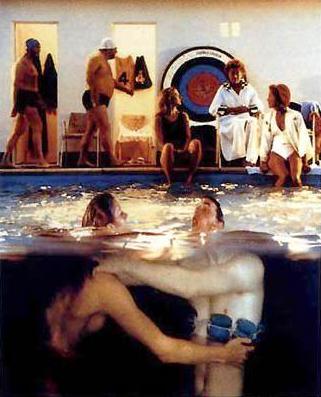
Drowning by Numbers Poster
1988 Poster of Drowning by Numbers
by Peter Greenaway
(With number 44 in the background)
In his 1988 movie 'Drowning by Numbers', British Director tells the strange story of three women belonging to three generations in a same family, who bear the same name and cause their husbands to drown, one in a bath, one in the sea, one in a swimming-pool.

The result is a fascinating, intriguing, weird black comedy. The local coroner is drawn into a plot to disguise the murders. As the plot progresses, his son explains the rules of various games played by the characters as if they were ancient traditions, while the numbers 1 to 100 successively appear in ascending order, either seen in the background or spoken by the characters.

Fear of Drowning by Numbers
Most of the games played in the film were invented for its purpose, using rules that are so complex that Greenaway later published a whole book dedicated to explaining them, entitled 'Fear of Drowning by Numbers'. That a whole book was needed to explain rules of a movie built all around constraints reminded me of the works by members, especially 'La Vie Mode d'Emploi' (Life: A User Manual) by .

, the Ouvroir de Littérature Potentielle (Workshop of Potential Literature), is a group of writers and mathematicians who seek to create literary works using constrained writing techniques. They use constraints as a means of triggering their ideas and inspiration.
Quand tout est permis, rien n'est possible.
If everything is allowed, nothing is possible. ()
Georges Perec especially, certainly the most famous OuLiPo member with Raymond Queneau and , wrote the best part of his work using lipograms, palindromes and various kinds of constrained writing. His masterly book, 'La Vie Mode d'Emploi' (Life: A User Manual) is a complex (patch)work built according to a complex plan of constraints.

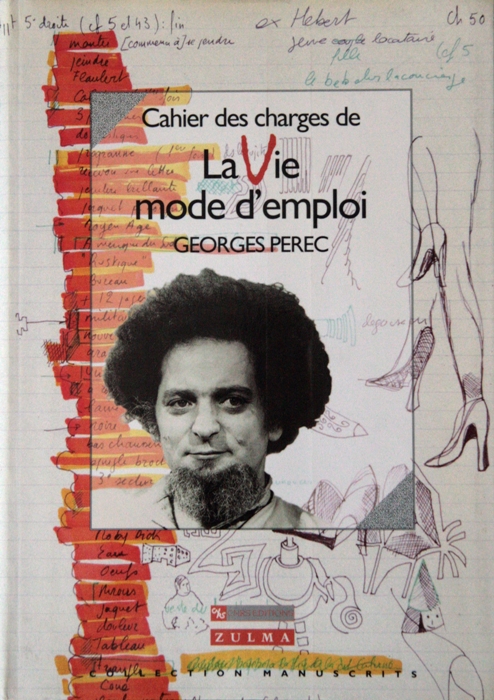
Cahier des charges de La Vie Mode d'Emploi
This fascinating book tells the lives and thoughts of the inhabitants of a fictitious building in Paris. Although it is a book that can be read and enjoyed without being concerned with the constraints, one quickly discovers that there are complicated games going on all over the place, and try to find the constraints like a detective. You will only find a small part of them anyway: here also, a whole dedicated book had to been published, that contains their inventory.

Unlike 'Fear of Drowning by numbers' though, the 'Cahier des charges de La Vie Mode d'Emploi' — the title means 'Specifications of Life: a User Manual', yet the book has not been translated into English — has not been published by its author, but exegetes after he died.

I have blogged using constraints myself in a couple of occasions, for fun and as a help at times of lack of inspiration. I assigned myself the thematic constraint 'Write about the 5 senses and Paris' once. It ended up in five blogs about , , , , and . Another time, it was 'Use the names of at least 10 movies by Alfred Hitchcock'. I am not sure anyone noticed the titles hidden despite several clues, but I enjoyed writing it.

Numbers
From now on, I will obey the constraint 'Write blogs on topics one can associate with successive ascending numbers'. Hopefully, this constraint will stimulate my imagination. We'll see until what number I succeed in following the rule, be it agreed that I will probably interpolate 'normal' blogs between the 'blogs by numbers' sometimes, in particular in response to a special event or for an anniversary.

Birdsong

There are two large bookstores in Paris where I will go several times a year and buy books in English: Brentano's, the American Bookstore in Paris and WHSmith in Paris, the English Bookshop. When I last went to Brentano's, I had my attention attracted to the title of a book: Birdsong, by Sebastian Faulks, an Englishman. I had never heard of it, although it was labelled as a bestseller. I flipped through a few pages: the book was about the First World War, and beautifully written. I bought it.
The book tells the story of a young Englishman who fights in France during the WWI, interspersed with scenes of the life of his granddaughter, Elizabeth, a young woman living in the 1970s, who travels to France to discover more about the life and dead of her grandfather.

As Elizabeth drives across empty fields, she notices a great arch in a field. She pulls over and has a closer look at it.

As she came up to the arch, Elizabeth saw with a start that it was written on. She went closer. She peered at the stone. There were names on it. Every grain of the surface had been carved with British names; their chiseled capitals rose from the level of her ankles to the height of the great arch itself; on every surface of every column as as far as her eye could see there were names teeming, reeling, over surfaces of yards, of hundred of yards, over furlongs of stone.

She moved through the space beneath the arch where the man was sweeping. She found the other pillars identically marked, their faces obliterated on all sides by the names that were carved on them.
Who are those, these...? She gestured with her hand.
These? The man with the brush sounded surprised. The lost.
Men who died in this battle?
No. The lost, the ones they did not find. The others are in the cemeteries.
These are just the... unfound?

She looked at the vault above her head and then around in panic at the endless writing, as though the surface of the sky had been papered in footnotes. When she could speak again, she said:
From the whole war?

The man shook his head.
Just these fields. He gestured with his arm.

Elizabeth went and sat on the steps on the other side of the monument. Beneath her was a formal garden with some rows of white headstones, each with a tended plant or flower at its base, each cleaned and beautiful in the weak winter sunlight.
Nobody told me. She ran her fingers with their red-painted nails back through her thick dark hair. My God, nobody told me.

Between 1914 and 1918, about 9 million people were killed, in Europe essentially: 2 million German, 1,300,000 Frenchmen, 750,000 British, 650,000 Italians... Beside the terrible loss of young men in every family — France lost about 10 percent of its working population in the conflict — the war changed the political map of Europe, and the world balance of power. Several European empires were dismantled. France and the UK, although the winners, were ruined. It was the very moment in history when Europe handed over to the USA as the world economical and political leader.

I - Don't - Like - Spam!

When I opened my email box the other morning, there were a couple of job-related mails... and 37 spams! Granted, the latter got filtered by my spam firewall, but I waited for an important mail then, and was afraid of missing it, if it was considered a spam by mistake. Therefore, I explored the spam folder also. You know what? I don't like spam!

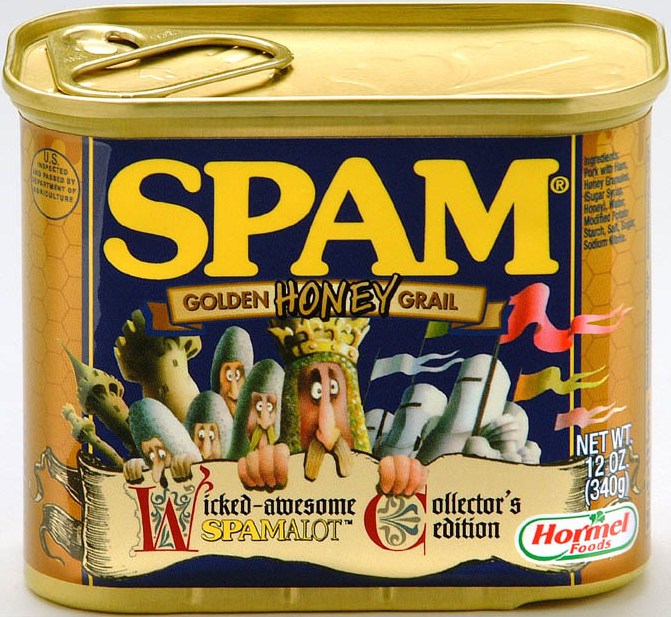
The word SPAM was coined in July, 1937 when Hormel foods, a company that processed a meat product called Hormel Spiced Ham, decided to change this name to a more memorable one. The precise meaning of the acronym is disputed though: SPAM may be the contraction of either Shoulder of Pork and hAM, Spiced Pork and hAM, or simply SPiced hAM — although malicious gossip would say it should rather be Specially Processed Artificial Meat or Spare Parts Already Minced.

During the WWII and following years, SPAM was among a few products excluded from food rationing in the United Kingdom, and the British grew heartily tired of it.

Several years later, the broadcast a sketch that parodied an advert for the canned meat: in a restaurant, a couple tries to order a breakfast. The lady (Graham Chapman in drag) dislikes spam, but every dish in the menu contains spam (egg and spam; egg, bacon and spam; egg, bacon, sausage and spam; etc.). A group of Vikings seated at a table starts chanting "SPAM, SPAM, SPAM..." and progressively jams every other talk in the restaurant, while John Cleese gets picked up by the police for Hungarian-accent-induced obscene words.

Monty Python: SPAM (1970)
This hilarious sketch became highly famous, as well as the Vikings' song. That's why, several years later, the phenomenon of marketers drowning out discourse by flooding email boxes with junk advertising messages was named spamming, recounting the repetitive and unwanted presence of SPAM in the sketch by the Monty Python.

Flower of Scotland

The Saltire flag of Scotland
(The Highlander, a Scottish Pub in Paris)

I arrived in Scotland two days ago, for a 9-day vacation trip in the country of and . News from the Castles and Highlands to come then, and from Nessie also perhaps, who knows?

Scotland is not an independent country anymore, therefore it does not have a national anthem. Yet a few songs are used instead, that convey Scottish will to differentiate themselves from the rest of Great Britain.

It is especially the case of Flower of Scotland, the beautiful, patriotic song by . Resolutely directed at the English, the song celebrates Robert the Bruce's victory against the troops of King Edward II at in 1314.

O Flower of Scotland
When we sill see
Your like again
That fought and died for,
Your wee bit Hill and Glen
And stood against him, Proud Edward's army
And sent him homeward
Tae think again.

In particular, Scots break into Flower of Scotland at the Highland Games — sometimes — and before a match by the Scottish national rugby team — always.

Edinburgh, 17 March 1990. Scotland previously defeated Wales, Ireland and France in the Five Nations Championship. Today, in Murrayfield Stadium, the last match in this championship is about to start, against the auld enemy and hot favourite, England, undefeated also. Victory in the Championship, and a Grand Slam, are at stake.

ImagePlayers are on the field. Five minutes ago, while the English team ran into the Stadium as usual, David Sole, who captains the Scots, deliberately walked his men onto the pitch, in a slow, belligerent march, to deafening cheering of the home crowd.

English against Scots. Hundred years of conflicting history. Furthermore, British Prime Minister Margaret Thatcher has experimented the Community Charge (aka Poll Tax) for one year in Scotland only, leading to massive disobedience, and riots to come shortly in the whole country.

Scotland vs England — 17 March 1990

Both teams are lined up in front of the VIP stand. Fifteen English players bravely sing God Save the Queen as strong as they can, while TV cameras slowly pass in review the staring faces of every Scot player fixed in a provocative silence. For the first time in their history, they don't sing the anthem.

Then, David Sole turns his head toward the musicians, and bagpipes start playing, while the Scottish team and whole home crowd — 50,000 souls — all together launch with fire into Flower of Scotland.

Needless to stay, Scots won the match and the Grand Slam. On that day, they just could not lose.

When I'm Sixty-Four

Sargent Pepper's
The Beatles — Sgt Pepper's  Lonely Hearts Club Band

When I'm sixty four was written by Paul McCartney, who sings it on Beatles' album Sgt. Pepper's Lonely Hearts Club Band, released 1967.

Paul McCartney turns 64 today.


When I get older losing my hair,
Many years from now.
Will you still be sending me a valentine
Birthday greetings bottle of wine?

If I'd been out till quarter to three
Would you lock the door?
Will you still need me, will you still feed me,
When I'm sixty-four?

You'll be older too,
And if you say the word,
I could stay with you.

I could be handy, mending a fuse
When your lights have gone.
You can knit a sweater by the fireside
Sunday mornings go for a ride,

Doing the garden, digging the weeds,
Who could ask for more.
Will you still need me, will you still feed me,
When I'm sixty-four?

Every summer we can rent a cottage,
In the Isle of Wight, if it's not too dear
We shall scrimp and save
Grandchildren on your knee
Vera ,Chuck & Dave.

Send me a postcard, drop me a line,
Stating point of view
Indicate precisely what you mean to say
Yours sincerely, wasting away

Give me your answer, fill in a form
Mine for evermore
Will you still need me, will you still feed me,
When I'm sixty-four?

Related Posts Widget for Blogs by LinkWithin

Home

Atom
Feed
Timeless Music
The Magic Flute
by W. A. Mozart


Timeless Reading
Les Essais
by Michel de Montaigne