Showing posts with label religion. Show all posts

Thirteen at the Table

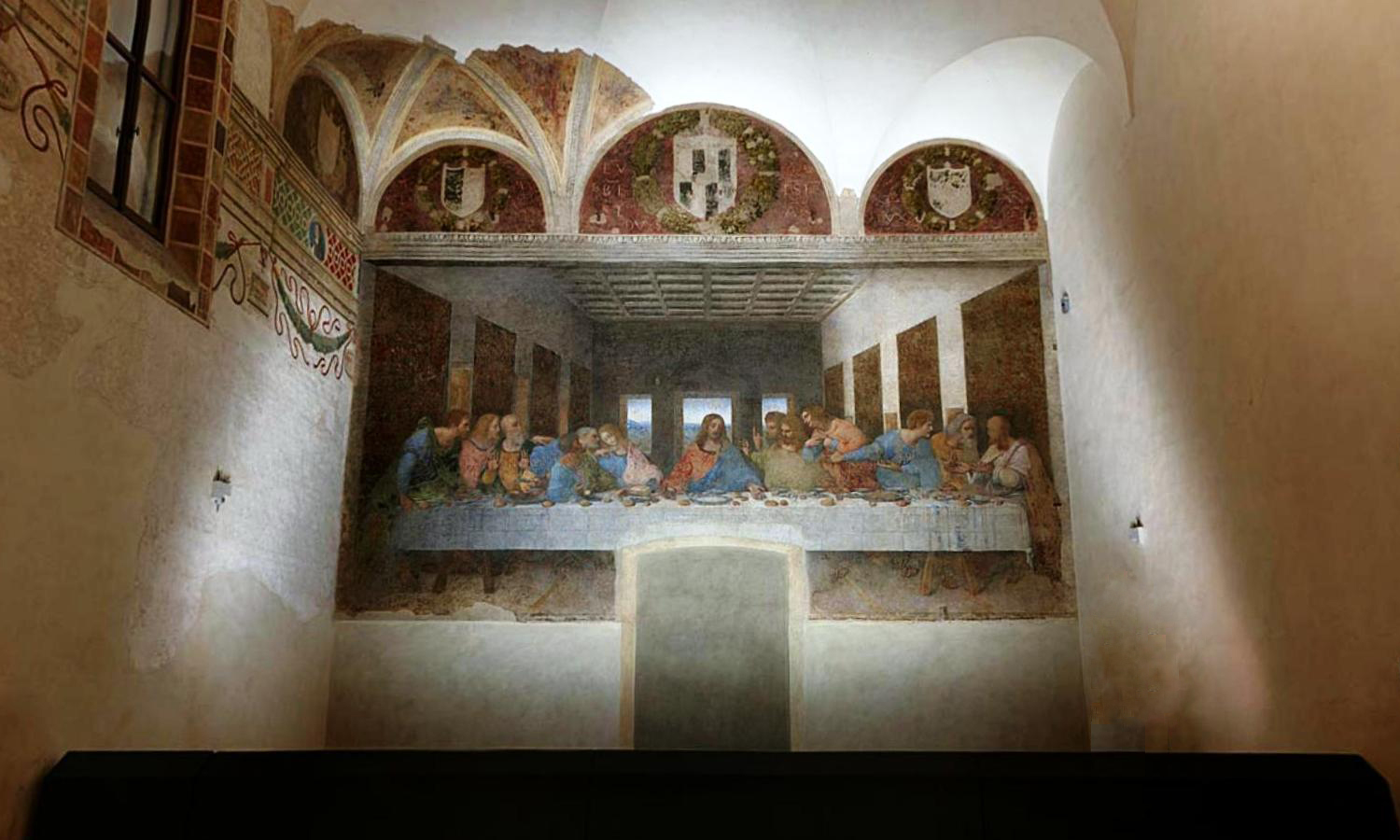
Leonardo's Last Supper
Il Cenacolo (The Last Supper)
by Leonardo Da Vinci (1495-1498)
Refectory of Santa Maria delle Grazie (Milan).

Last may, I went to Italy twice. I spent five days of vacation in Florence, then attended a Conference in Milan. Due to lack of time, I wrote only, and .

I do love Italy, and Italians. There is a lightness, a Joie de Vivre in the air of most Italian towns, you will hardly find anywhere else. Also, Art is everywhere.

In Florence first, then in Milan, I was stunned by frescoes. There's always a difference between looking at a reproduction and seeing an artwork for real. named this specificity of artwork, which is unique, linked to a special place, and part of history.
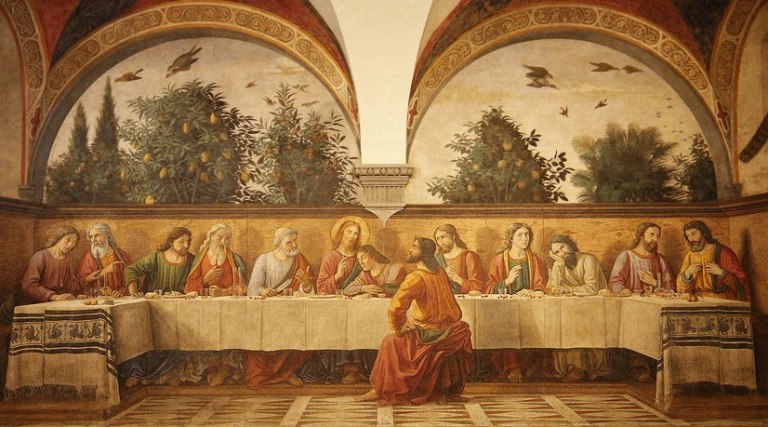
Il Cenacolo by Ghirlandaio
Il Cenacolo by Ghirlandaio (1448)

Frescoes certainly have an aura, because they are part of the place on which they were painted. Also, frescoes are impressive because they are very large. Characters painted are taller than you sometimes. You may feel as if you were a witness of the scene.

It was the case in particular in — the city with 70 museums — with frescoes by Filipino Lippi and Domenico Ghirlandaio, in and the , famous for the great Last Supper fresco, Ghirlandaio painted in 1488.
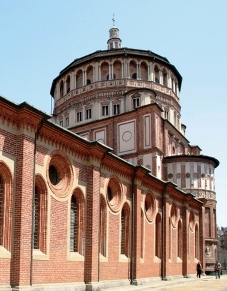
Santa Maria Delle Grazie (Milan)

It was the case also in in Milan, a red brick church and monastery built in the 15th century where Leonardo da Vinci painted his Last Supper, Il Cenacolo, in the refectory of the monastery from 1495 to 1498.

Because it was a long-term work, Leonardo did not paint on wet plaster but on a dry wall. Strictly speaking, the painting is not a fresco then. It is a mural painting. Unfortunately, because of the method used, the work deteriorated quickly and its restoration has been a never-ending task.

If you want to see the painting, you must book in advance, and arrive on time. You will then be admitted among a small group of visitors (around 25 people), one group at a time, every 15 minutes. You must go through a double entrance door first, for sake of constant temperature and humidity. You wait there a few minutes, then you enter the refectory at last.
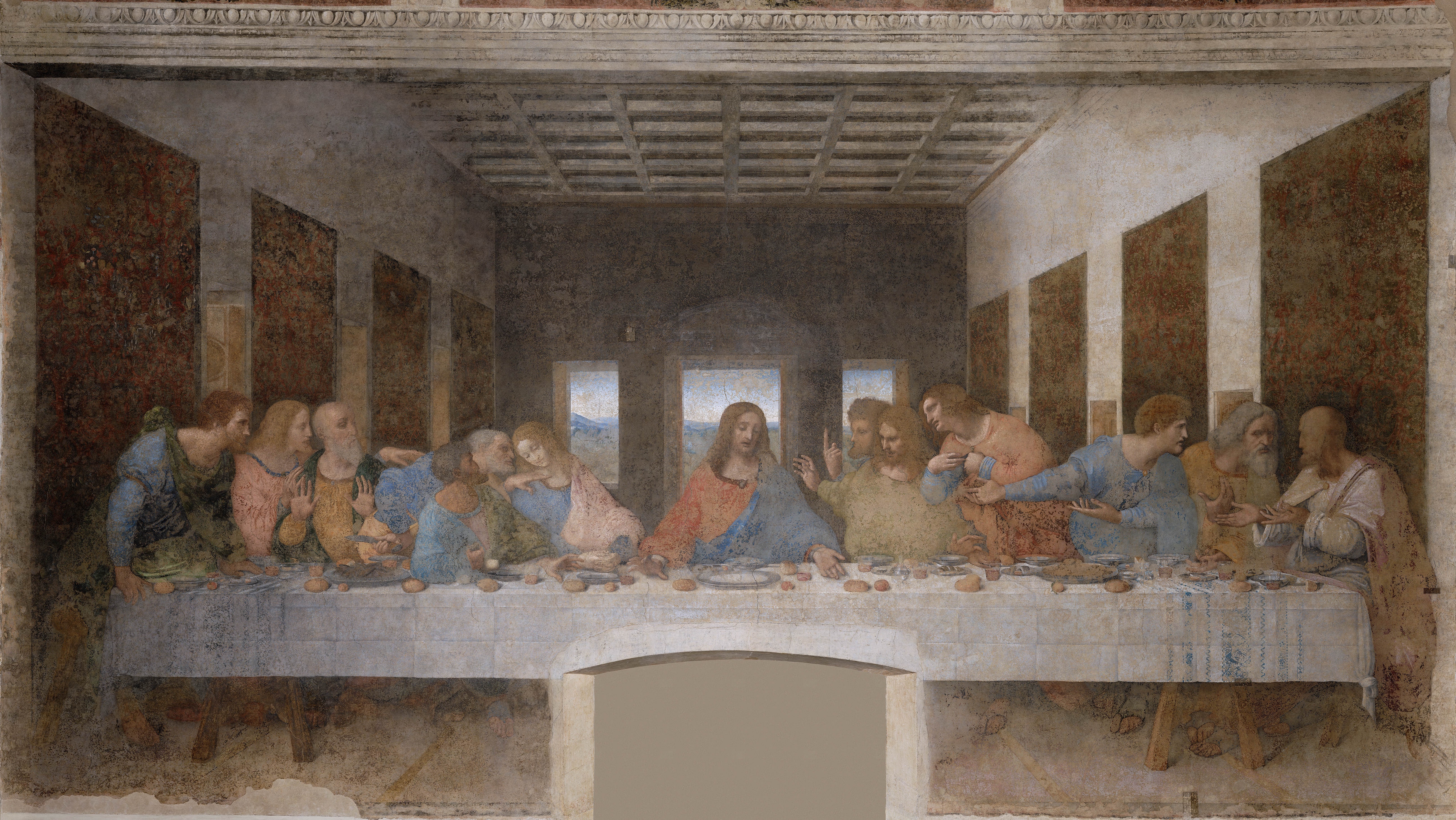
Il Cenacolo
The Last Supper by Leonardo da Vinci (click on the picture for a larger scale)
Here it is, painted on the wall on the right side of the refectory. Awesome, huge — about nine meters wide — painted with a perspective that continues the walls of the refectory

The characters are approximately life-sized, a little taller. Although the work is damaged,you feel as if you were there, standing at about eight meters from the table. All 13 character are in front of you, on the same side of the table. Unlike Ghirlandaio and others, Leonardo did not paint Judas apart from his colleagues.

Perspective

Jesus has just announced that one of those sitting at the table will betray him. The twelve apostles react with various degrees of shock, denial, and anger.

Jesus is in the middle of the painting. Precisely in the middle. In fact, a small hole in his right temple was used by Leonardo to help define the vanishing point of the whole perspective of the painting. Around him, on his right and left sides, the apostles are grouped in four groups of three, and each of the three figures in each group reacts its own way.
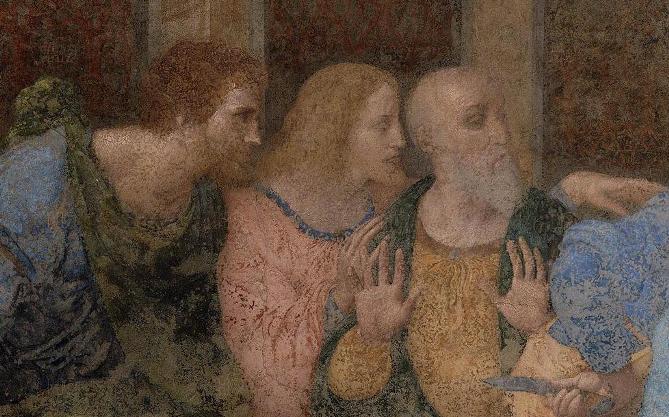
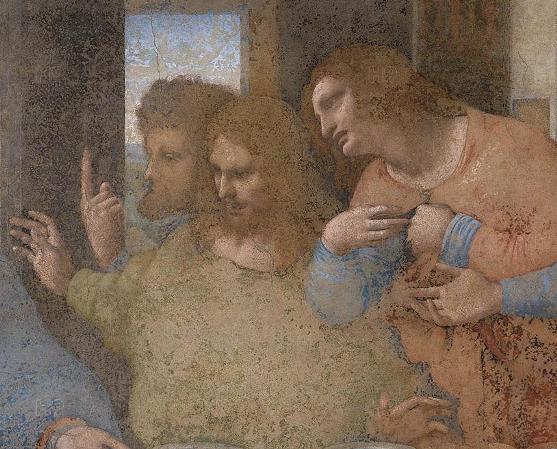
Bartholomew, James the Younger and Andrew
On the left side,  Bartholomew, James the Younger and Andrew appear stunned by Jesus’ declaration. They look at him with stupefaction. Andrew raises his hands before him in a gesture of horror and incredulity — yet an apostle can hardly be incredulous, can he ?


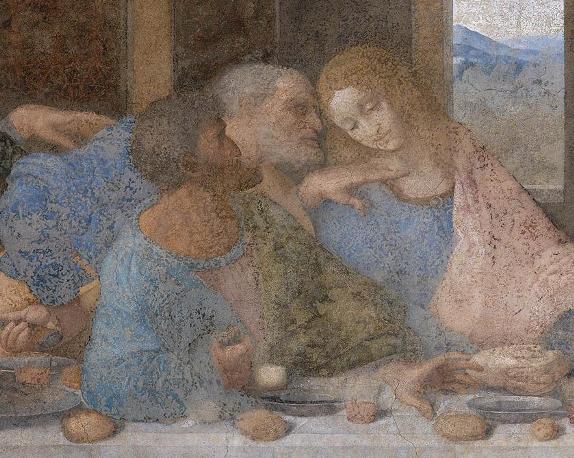
Peter, Judas and John

In the second group, a knife in hand, Peter is ready to punish the traitor. He leans towards John, the boyish, almost feminine apostle seated beside Jesus: "Ask the Master, John! Who is it?" He pushes Judas forward, who holds a purse with thirty pieces of silver inside.
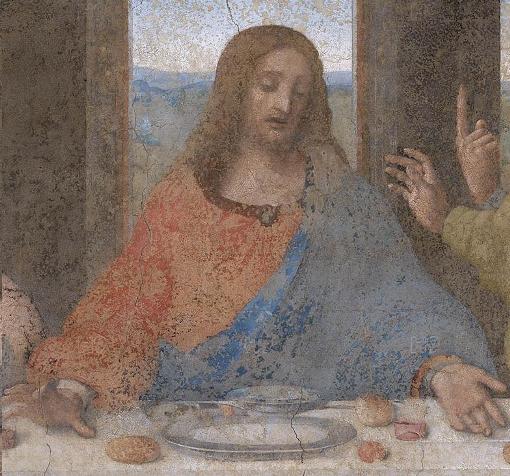
Jesus

Thomas, James the Elder and Philip

On Jesus left-hand side, Thomas, James the Elder and Philip are assuring Jesus of their obedience. James the Elder expresses his indignation, and we can almost hear Philip protesting his loyalty: "You know me, Master, you know I did not do that".
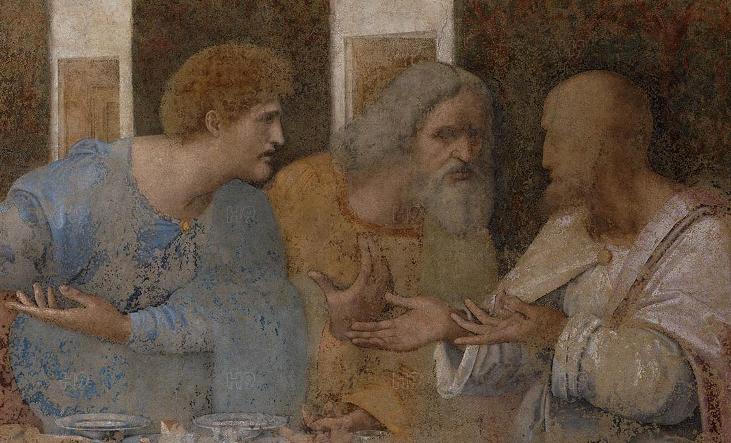
Matthew, Jude Thaddeus and Simon

The last group on the right is made up of Matthew, Jude Thaddeus and Simon. They are involved in an animated discussion, and don't look at Jesus. "One of us? How is it possible?" Matthews asks Simon, while Jude Thaddeus seems to be about to clap his hands in a "didn't I tell you?"

-:-:-:-:-:-

13
    [BbN #13]

Note: You cannot fully appreciate such a masterpiece in less than 15 minutes. There's so little time, you must hurry, you can hardly have a look at every character. It is frustrating. If you ever go to Santa Maria delle Grazie and see The Last Supper by Leonardo, here is my advice then: book for it twice, half an hour apart. I will do that, the next time I go to Milan.

Persepolis

Persepolis by Marianne Satrapi
Marjane Satrapi is an Iranian/French graphic novelist. She was born in 1969 in Rasht, in the North of Iran, and now lives and works in Paris. She became famous because of her critically acclaimed autobiographical graphic novels Persepolis, which describe her childhood and adolescence in Iran and Europe.

Persepolis graphic novels were adapted by herself and Vincent Parronaud into an essentially black-and-white animated film bearing the same name. The movie was called 'islamophobe' and 'anti-iranian' by the Iranian President Mahmoud Ahmadinejad, thus it is not allowed for broadcast in Iran. Yet it is not a political movie. It deals with life in the real world. It is a work of poetry for all of us to delight in.

Image
When the movie starts, Marjane is a child. She lives in Tehran, in a progressive family involved with the socialist movements. She attends the Lycée Français in Tehran, and witnesses the growing oppression of civil liberties and the everyday-life consequences of Iranian politics. Then comes the Iranian revolution, the fall of the Shah, and the regime of Ayatollah Khomeini. After days of elation, disillusion follows quickly. Political opponents are put in jail again, many are executed, and islamist rules are imposed. Then the Iran-Iraq war starts. At the age of 14, her parents send Marjane to Vienna, Austria, to flee the Iranian regime. She discovers Europe, boys, and loneliness. She comes back to Iran.

The movie relates with realism and humour Marjane's years of hardship, she shared with million young Iranians of the time: overnight obligation to wear a veil, search for forbidden pirated audio cassettes, secret parties with friends where you dance and drink alcohol despite police raids.

Persepolis was awarded the Special Jury Prize in Cannes Film Festival in May 2007. Last Year, it was given the Better First Movie Award in the Cesar Award, the National film award for France. It also competed in Hollywood for the Oscar, as a nominee for best animated film, but had no chance against Disney's blockbuster Ratatouille.


Persepolis Trailer


Persepolis is a simple story told by simple means. It consists essentially of a series of monochrome drawings, their bold black lines washed with nuances of gray. Its flat, stylized depiction of the world — the streets and buildings of Tehran and Vienna in particular — turns geography into poetry. Yet it is good to be reminded that animation is rooted not in any particular technique, but in the impulse to bring static images to life.

Mostar

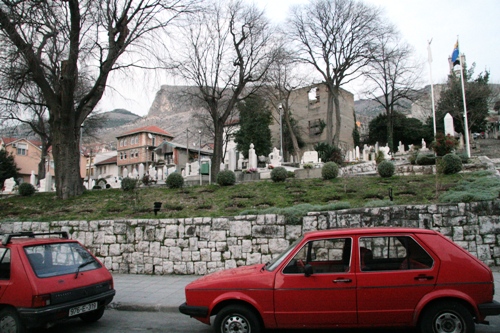
A graveyard in the city of Mostar
A graveyard inside Mostar — March 14, 2009

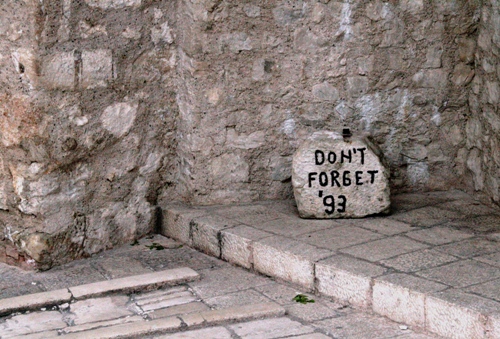
There are many little parks in the city, with grass and trees. Anywhere else, such places of greenery would be called 'public gardens'. Not in East-Mostar though, because there are tombs between the trees. Dozens of tombs.

Each tomb is engraved : it displays a name, a date of birth, a date of death: 1993 usually. Thousands of people died during the civil war in Mostar, and graveyards seem to have replaced public gardens.

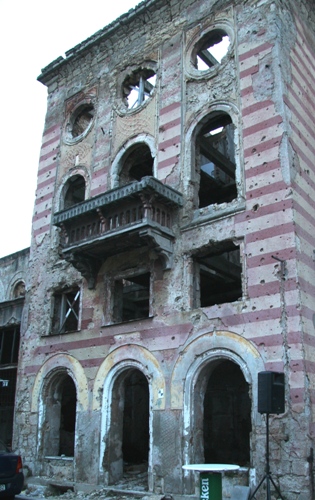
A ruin in Mostar
A ruin in Mostar

The war in Bosnia ended fourteen years ago but you can still see it everywhere. The streets and avenues are lined with destroyed buildings, dangerous ruins of which the fronts are riddled with holes of bullets and shrapnel. There is a same poster everywhere, that warns people against going into the ruins, children against playing there.

Constructions are coming on slowly in Mostar apparently. They are rebuilding, but you can guess that money is lacking.

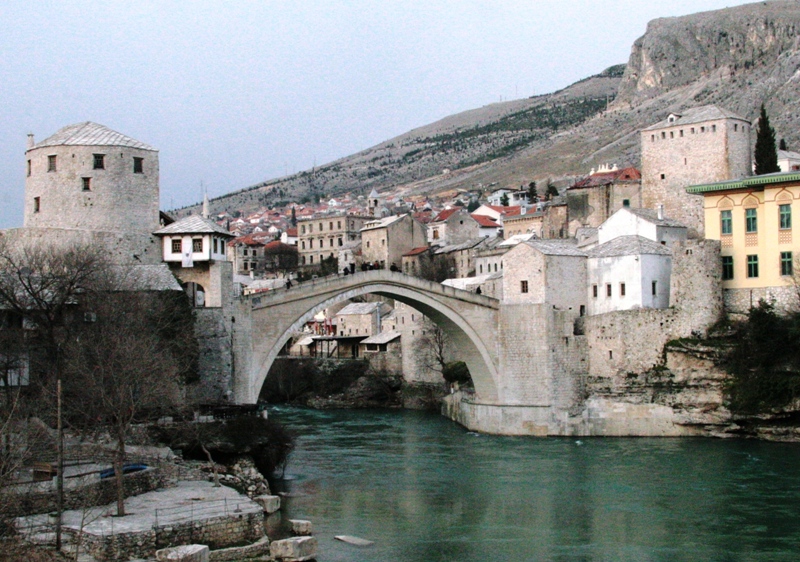
Stari Most, the Old Bridge after which Mostar was named, was the symbol of the city, and a chef-d'oeuvre of Ottoman architecture. It was commissioned by Suleiman the Magnificent to Mimar Hajruddin, a pupil of Sinan, "the father of classic Ottoman architecture".

On Stari Most, close to the right bank

Built in 1566, Stari Most consisted of a single 30 metres long hump-backed arch that stood more than 20 metres above the green waters of the Neretva River. It had withstood all sorts of calamities, invasions, wars, and even earthquakes.

Nevertheless, it was destroyed when Croats and Bosnians, who used yet to be allies against the Serbs during the civil war in Bosnia (1992-1995), fought during one year in Mostar. On November 9, 1993, the Old Bridge was destroyed by the artillery of the HVO Croatian forces, allegedly to stop Bosnian troops, in reality for its symbolic value as an Ottoman piece of art and a link between communities.

Mostar — Stari Most
Stari Most, the Old Bridge — March 14, 2009.

Under the aegis of the UNESCO, and thanks to a loan from the World Bank and grants from donor countries, the Old Bridge was rebuilt for the very same reason: as a symbol of peace and tolerance.

After two years of scientific and archeological research, it was rebuilt in 2004 exactly as it was, using identical blocks of white stones found in nearby quarries and according to traditional methods, using quoins, cramps and dowels. It is now listed as a World Heritage Site.

Truth

Pharaoh Seti I offers Maat
Pharaoh Seti I  offers to the Gods
an image of Maat, the Egyptian Goddess of Truth and Justice.
(Musée du Louvre, Paris)

Ding-dong. The doorbell. Saturday afternoon, 3:00 pm, I am on my bed, reading unenthusiastically a medical article, on the edge of a little nap.

Ding dong. Hmm, this is the doorbell indeed. The guys outside did not use the interphone first. Maybe a neighbour from another step? All right, let's go and see...

Yikes. They are two people on my doorstep. One man and one woman. Pale. Thin. They have not greeted me yet, but they already smile, with some disquieting benevolence. He has a thin goatee, dark eyes and white teeth. She swept her whole being into her suave sky blue eyes. She has no body. She is only a gaze of disembodied and icy goodness.

I know who they are, and they know I know. They don't really care, they have a mission. He begins to talk, while she sharpens her gaze on me, slightly tilting her head. I feel as if I were Mowgli in Disney's The Jungle Book, when he meets the python for the first time. I am unwilling to let religious freaks hypnotise me that easily though.

— "We call in on you to make you know the Truth", he says, while pulling out a coloured leaflet from a black attaché-case. The Truth. Oh well. Learning the Truth isn't on my agenda for today. I planned to read and rest a little but — to tell the truth — I don't feel like learning the Truth this afternoon.

— "Well, sorry but I am quite busy right now".

— "You know, we need a five minute talk only", she says. Her lips smile, her eyes remain impassible. Does she blink sometimes? "God loves you. You must hear the Truth!"

— "No, thanks. No talk. No Truth. Not today".

Under the goatie, two thin lips make the ghost of a tense smile. In the blue eyes, the storm remains under control. Such shades of pardon for my short-sighted incomprehension will make me lose my temper soon. I feel it, and they see it. He puts his leaflet back into his briefcase, whose zipping means both the loss of my soul and the saving of my nap. Truth is going away. I already love the untruthful nap I am going to take.

Evangelical

I am not a Protestant and I don't speak German, yet I went this morning to the Deutsche Evangelische Christuskirche (German Evangelical Church) in Paris, and listened to classical music by Johann Sebastian Bach and Georg Philipp Telemann. Great music.

I also learned a little about Protestantism, from a German friend was there. In particular, I learned how different the meaning of Evangelical is, whether you are in Europe or North America. I already knew there were many religious persuasions in Protestantism, but I confess I have not remembered everything about that.

Only I remember that, in North America, the word Evangelicalism refers to conservative Protestantism, more precisely supporters of revivalism, whereas in Europe, it simply means Protestantism. The German Evangelical Church where they sang Johann Sebastian Bach's cantata Herr Jesu Christ, whar' Mensh und Gott so beautifully this morning is Lutheran Church.

I loved the music. I loved the tapestry of John Evangelist taken from a painting of Albrecht Dürer that was hung up on a wall in the Church on this occasion. I loved also the modern stained glass window I photographied in there to be my shot of the day.

Related Posts Widget for Blogs by LinkWithin

Home

Atom
Feed
Timeless Music
The Magic Flute
by W. A. Mozart


Timeless Reading
Les Essais
by Michel de Montaigne