Showing posts with label books. Show all posts

A Void

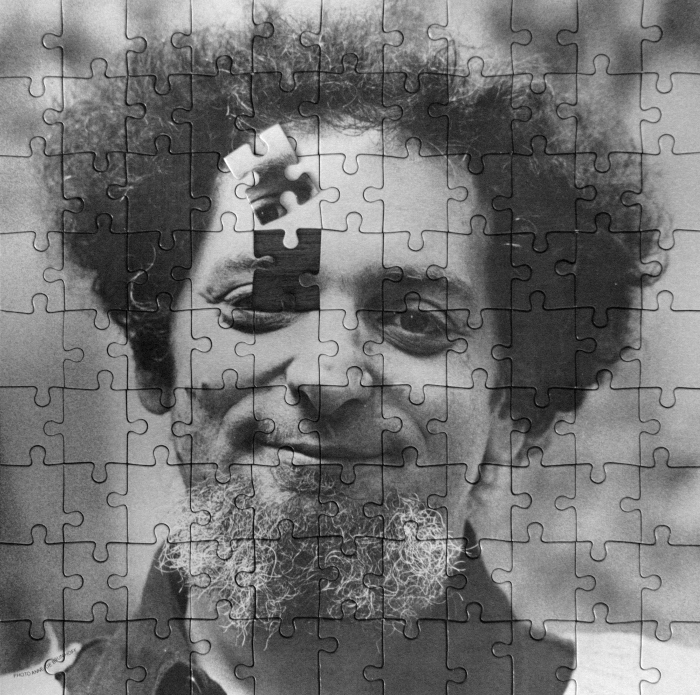
Georges Perec Jigsaw
Georges Perec's portrait as a jigsaw puzzle
Puzzle pour un portrait de Georges Perec
La Poésie dans un jardin — Festival d'Avignon 1988

Born in Paris in 1936, was the only son of two recent Jewish immigrants from Poland, Icek and Cyrla Peretz. His father volunteered for French Army during World War II, and was killed in 1940. His mother was deported by the Nazis and died in Auschwitz in 1943.

Georges survived because his mother had previously sent him by train to a little town in the Alps mountains, where relatives took charge of him. They had him baptized Catholic and his name frenchified to Perec. They adopted him formally after the war.

Disappearance of his parents when he was a child, disappearance of his Jewish roots, there is nothing so surprising that Perec was haunted by absence, loss, erasing, disappearance. “I have no memory of childhood” are the first words of his novel , an admission that he remembers almost nothing of his early life as a Jew in Nazi-occupied France.

In 1969, Georges Perec published a novel named La disparition, a phrase that means ‘the disappearance’ in English. A word for word translation of the title into English had to be replaced by A Void (Gilbert Adair) or A Vanishing (Ian Monk) though, because the letter E appears three times in ‘the disappearance’, and the whole novel  is a 300 pages written without ever using a E.

La disparition tells the story of the disappearance of a man, whose name is Anton Voyl (in French) or Vowl (in English), in a strange world from which an enigmatic part five of 26 has disappeared as well.

La disparition
It implicitly talks of its own lipogrammatic limitation, starting with the name of the missing person — Voyelle in French, Vowel in English, after the E's have been lost. Characters in the novel work out what is missing, but they risk fatal injury if their though gets too close to that taboo “circular symbol with a horizontal bar across it”.

The constraint that underlies the story induces endless tricks and distortions of language, and describes how a world can be built that fills that void. Besides the amazing lexicographic feats of writing a whole novel with zero occurrence of the most frequent letter in French and English though, the silent disappearance of the letter is a metaphor of loss, and suffering it causes.

In French, E is the only vowel in père [father] and mère [mother], and sans E [without E] sounds very much like sans eux [without them]. Furthermore, since the name Georges Perec is full of E's, the disappearance of the letter also ensures the author's own disappearance.

The absence of a sign is always the sign of an absence, and the absence of the E in A Void announces a broader, cannily coded discourse on loss, catastrophe, and mourning […] Each "void" in the novel is abundantly furnished with meaning, and each points toward the existential void that Perec grappled with throughout his youth and early adulthood. A strange and compelling parable of survival becomes apparent in the novel, too, if one is willing to reflect on the struggles of a Holocaust orphan trying to make sense out of absence, and those of a young writer who has chosen to do without the letter that is the beginning and end of 'écriture' [writing].     —

-:-:-:-:-

Postscript: When I challenged myself with the Blogging by numbers constraint, I decided the first entry in the series would be related to Number 0 — not 1 — and dedicated to A Void. It seemed fair enough because the very idea of the constraint was inspired in particular by the works of Georges Perec and Oulipo.

I did not know though that another void was just about to occur, when my I had my laptop fell from a table three weeks ago and its hard drive broke. Another aching void and a lot of work to do again, because I had not performed any save for a month or so. Anyway, I am back now.

[BbN: #0]

Blogging by Numbers

Drowning by Numbers Poster
1988 Poster of Drowning by Numbers
by Peter Greenaway
(With number 44 in the background)
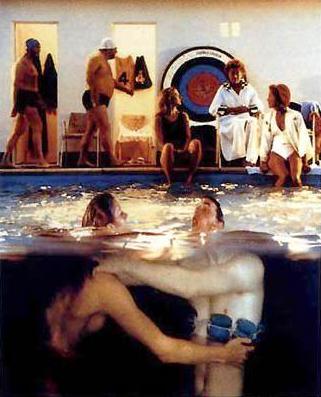
In his 1988 movie 'Drowning by Numbers', British Director tells the strange story of three women belonging to three generations in a same family, who bear the same name and cause their husbands to drown, one in a bath, one in the sea, one in a swimming-pool.

The result is a fascinating, intriguing, weird black comedy. The local coroner is drawn into a plot to disguise the murders. As the plot progresses, his son explains the rules of various games played by the characters as if they were ancient traditions, while the numbers 1 to 100 successively appear in ascending order, either seen in the background or spoken by the characters.

Fear of Drowning by Numbers
Most of the games played in the film were invented for its purpose, using rules that are so complex that Greenaway later published a whole book dedicated to explaining them, entitled 'Fear of Drowning by Numbers'. That a whole book was needed to explain rules of a movie built all around constraints reminded me of the works by members, especially 'La Vie Mode d'Emploi' (Life: A User Manual) by .

, the Ouvroir de Littérature Potentielle (Workshop of Potential Literature), is a group of writers and mathematicians who seek to create literary works using constrained writing techniques. They use constraints as a means of triggering their ideas and inspiration.
Quand tout est permis, rien n'est possible.
If everything is allowed, nothing is possible. ()
Georges Perec especially, certainly the most famous OuLiPo member with Raymond Queneau and , wrote the best part of his work using lipograms, palindromes and various kinds of constrained writing. His masterly book, 'La Vie Mode d'Emploi' (Life: A User Manual) is a complex (patch)work built according to a complex plan of constraints.

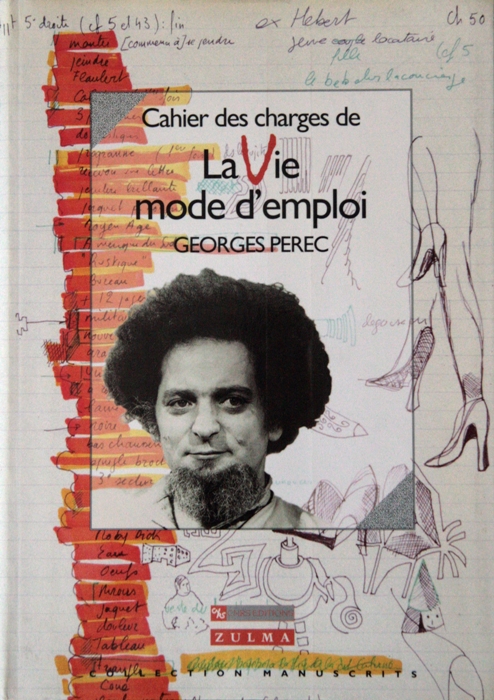
Cahier des charges de La Vie Mode d'Emploi
This fascinating book tells the lives and thoughts of the inhabitants of a fictitious building in Paris. Although it is a book that can be read and enjoyed without being concerned with the constraints, one quickly discovers that there are complicated games going on all over the place, and try to find the constraints like a detective. You will only find a small part of them anyway: here also, a whole dedicated book had to been published, that contains their inventory.

Unlike 'Fear of Drowning by numbers' though, the 'Cahier des charges de La Vie Mode d'Emploi' — the title means 'Specifications of Life: a User Manual', yet the book has not been translated into English — has not been published by its author, but exegetes after he died.

I have blogged using constraints myself in a couple of occasions, for fun and as a help at times of lack of inspiration. I assigned myself the thematic constraint 'Write about the 5 senses and Paris' once. It ended up in five blogs about , , , , and . Another time, it was 'Use the names of at least 10 movies by Alfred Hitchcock'. I am not sure anyone noticed the titles hidden despite several clues, but I enjoyed writing it.

Numbers
From now on, I will obey the constraint 'Write blogs on topics one can associate with successive ascending numbers'. Hopefully, this constraint will stimulate my imagination. We'll see until what number I succeed in following the rule, be it agreed that I will probably interpolate 'normal' blogs between the 'blogs by numbers' sometimes, in particular in response to a special event or for an anniversary.

Willem Kolff, The Dutch Tinkerer

The 1944 version of the Kolff's rotating drum artificial kidney
The 1944 version of the Kolff'
rotating drum artificial kidney
Willem (Pim) Kolff died a few weeks ago. You probably did not hear about it: he was not a pop singer, a famous actor or a professional football player, he was only a scientist whose work has been credited for saving millions of lives.
Granted, he was almost 98 year-old — it comes with no surprise when such an elderly person dies — and he was not unrecognised: Dr Kolff received many international awards, including the Lasker Award for Clinical Medical research, when he was... 91, probably because he was never given the Nobel Prize, which is a shame. Yet his death went almost unknown, especially by most of the people with end-stage renal failure who live thanks to his great first invention: the dialysis machine.
J. Stewart Cameron - History of the treatment of renal failure by dialysis
As a young doctor in Groningen in the Netherlands in the end-1930s, Willem Kolff witnessed the miserable, painful death of a 22-year-old man from kidney failure. He had to tell his mother that his only son was going to die, and there was nothing he could do. "If I only could find a way to remove toxic waste products from the poor guy's blood, I would save him", he thought. He then devoted himself to research on creating such a machine.
When Pim Kolff was a child, he was tinkering about all the time, so much so that his father arranged for him to have lessons with a carpenter on Saturdays afternoons. As an adult, he remained a handyman. He conducted his first experiments with sausage skins filled with blood and urea, that he put into a bath of salt water. Urea passed through the membrane from the blood to the salt water: the concept of using dialysis for building an artificial kidney was born.
It was only in 1941 though, when the Netherlands were under German occupation, that he succeeded in developing a prototype machine. Kolff had left Groningen in 1940, on the day a Dutch Nazi replaced his former Jewish professor as head of his department, and worked in a small hospital in Kampen, on the Zuiderzee (now called the Ijsselmeer).
Willem J. Kolff
Willem Kolff
Materials were in short supply at the time, and almost everything was requisitioned by the Germans. Kolff build his prototype with metal pieces from a downed fighter plane, a wooden drum, the cooling system from an old Ford, and 40 meters of sausage casings (later, he would also use orange juice cans and a washing machine).
The cellophane casings were wrapped around the drum and set into a salt solution. The patient's blood was drawn from a wrist artery and fed into the casings. The drum was rotated, removing impurities, and the Ford motor pumped back the blood into the patient.
In 1945, after 15 deaths and many modifications and improvements, the dialysis machine saved a patient for the first time. Ironically, it was a woman in a coma due to renal failure who had been imprisoned as a Nazi collaborator. After eleven hours of treatment, she awoke from coma, and lived seven more years. Hundreds of thousands of people now undergo dialysis several times a week.
Before he invented the kidney dialysis machine, Willem Kolff created the first blood blank in Europe, during the German bombings on The Hague in May 1940.

"If a man can grow a heart,
he can build it" 
Willem J. Kolff (1911-2009)
After he emigrated to the USA in the 1950s, he improved his dialysis machine, that was used worldwide for almost twenty years. He developed heart-lung machines used to oxygenate blood during cardiac surgery. In the 1970s, he was the leader of a team that developed the artificial heart. He was also involved in the development of artificial eyes, ears and limbs.

Mindless Eating

[The discussion born from the comments about the recent blog 'Eating together' made me think of several old blogs of mine about food, that disappeared when I deleted my other blog on Yahoo! 360. This post was published in May 2007]
-:-:-:-:-:-:-:-:-
Pop-Corn
I was in a bookstore in Chicago several months ago, looking for medical books, when I happened to glance through a little book called Mindless Eating, by Brian Wansink, a professor at Cornell University, NY. The experiments depicted in the book were clever, and often funny.


I remembered of it yesterday when I came upon an article by David Leonhardt in the International Herald Tribune (The Herald is an international newspaper in English, based in Paris, that combines the resources of its own correspondents throughout the world with those of The New York Times). Leonhardt began his article by telling about an experiment I especially remembered because the idea of eating lots of stale popcorn almost made me sick when I was in this bookstore in Chicago.

Image Mr. Wansink gave away five-day-old popcorn — “stale enough to squeak when it was eaten,” he wrote — to moviegoers one day at a theatre in the Chicago suburbs. The crux of the experiment lay in the size of the buckets that held the popcorn. Some people got merely big buckets, while others received truly enormous ones. Both sizes held more popcorn than a typical person could finish.
 
Yet when the Wansink research team weighed the buckets after the movie, there was a huge difference in the amounts the two groups ate. Those with the bigger buckets inhaled 53 percent more on average, suggesting that a lot of stale popcorn is somehow more appealing than a little stale popcorn.
 
Over the years, Mr. Wansink has done similar experiments with everything from different-size dinner plates to bottomless bowls of tomato soup that are secretly connected to a tube underneath a restaurant table. His overarching conclusion is that our decisions about eating often have little to do with how hungry we are. Instead, we rely on cues like the size of a popcorn bucket — or the way we organize our refrigerator — to tell us how much to eat. These cues can add 200 calories a day to our diet, but the only way we’ll notice we are overeating is that our pants will eventually get too tight.
 
The scariest part is that most of us think we are immune to these hidden persuaders. When the moviegoers were told about the popcorn experiment afterward, most of them scoffed at the idea that their bucket size had any effect on them.

Stendhal Syndrome

Tomb of Galileo Galilei — Basilica Santa Croce, Florence
The tomb of Galileo Galilei
by Giovanni Battista Foggini
Basilica Santa Croce, Florence.
Henri-Marie Beyle, better known by his pen name, Stendhal, is the author of several famous novels, among which Le Rouge et le Noir (The Red and the Black) and La Chartreuse de Parme (The Charterhouse of Parma). He was also a lover of arts. In 1817,  aged 33, he had a long trip in Italy. He related afterwards, in his book "Rome, Naples et Florence", that he was quickly overwhelmed by the rich legacy of art and history of the country.

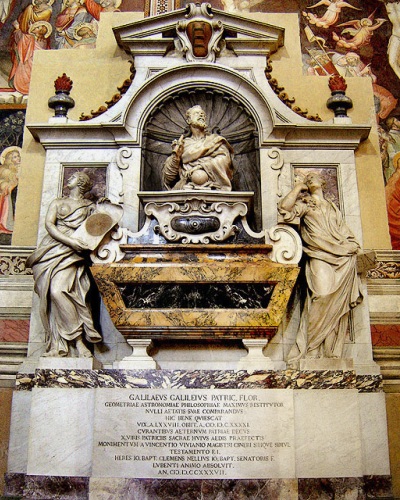
The day he visited the Basilica of Santa Croce in Florence, a monument that houses the tombs of Machiavelli, Michelangelo, and Galileo, and with famous frescoes by Giotto on the ceilings, he was overcome with emotion:

I was in a sort of ecstasy, from the idea of being in Florence, close to the great men whose tombs I had seen. Absorbed in the contemplation of sublime beauty, [...] I reached the point where one encounters celestial sensations. [...] I had palpitations of the heart [...] Life was drained from me. I walked with the fear of falling.

Stendhal wrote then the first description of what is now called Stendhal Syndrome, a psychosomatic phenomenon that may include dizziness, increased heart rate and palpitations, chest pain, sometimes loss of self-conscience, confusion or even hallucinations. Some people will get depressed, others will go from exaltation and feeling of omnipotence to panic attacks and fear of death.

About ten cases of the Stendhal syndrome are reported every year in Italy, among people who have gazed at works such as the David by Michelangelo or The Birth of Venus by Botticelli. It is not a specific 'Italian art disease' though: it can occur whenever people who have been eagerly expecting an emotion for a long time finally feel it, in the deepest way. It can happen in front of a special place, when you gaze at a painting or a landscape, or even when you look at the face of the beloved one, the day you have succeeded at last to have a date with her/him...  Look out then!

The Little Prince

There are few things about which I don't have any doubt, but here is one: by Antoine de Saint Exupéry is one of the greatest books ever.

I read Le Petit Prince — the original French title of the novella — for the first time when I was about eight, and I have read it again a lot of times since then... it is worth it, and also, this great book is a small book.

It is a children's story, yet it is also a philosophical tale, a poetical fable. The novella contains the best lessons of life, love and friendship you can read. Like Alice in Wonderland, it is a novel à tiroirs, with several levels of reading, in which everyone will find something different. Also, you will not find the same thing in it when you read it as a child, a teen or an adult, when you are young... or not that young any more.

To me [the fox said], you are still nothing more than a little boy who is just like a hundred thousand other little boys. And I have no need of you. And you, on your part, have no need of me. To you, I am nothing more than a fox like a hundred thousand other foxes. But if you tame me, then we shall need each other. To me, you will be unique in all the world. To you, I shall be unique in all the world [...] And then look: you see the grain-fields down yonder? I do not eat bread. Wheat is of no use to me. The wheat fields have nothing to say to me. And that is sad. But you have hair that is the color of gold. Think how wonderful that will be when you have tamed me! The grain, which is also golden, will bring me back the thought of you. And I shall love to listen to the wind in the wheat.
[...]
So the little prince tamed the fox. And when the hour of his departure drew near...
Ah said the fox, I shall cry.
It is your own fault, said the little prince. I never wished you any sort of harm; but you wanted me to tame you.
Yes, that is so, said the fox.
But now you are going to cry! said the little prince.
Yes, that is so, said the fox.
Then it has done you no good at all!
It has done me good, said the fox, because of the color of the wheat fields.
[...]
Goodbye, said the fox. And now here is my secret, a very simple secret: It is only with the heart that one can see rightly; what is essential is invisible to the eye.
What is essential is invisible to the eye, the little prince repeated, so that he would be sure to remember.
It is the time you have wasted for your rose that makes your rose so important.
It is the time I have wasted for my rose — said the little prince, so that he would be sure to remember.
Men have forgotten this truth, said the fox. But you must not forget it. You become responsible, forever, for what you have tamed. You are responsible for your rose...
I am responsible for my rose, the little prince repeated, so that he would be sure to remember.

If you haven't read the book yet, you have missed something... Yet you're also a lucky one, because it is a wonderful story to discover. You'll have no difficulty to find it in your native language, : Le Petit Prince is one of the most translated and published books ever.

Birdsong

There are two large bookstores in Paris where I will go several times a year and buy books in English: Brentano's, the American Bookstore in Paris and WHSmith in Paris, the English Bookshop. When I last went to Brentano's, I had my attention attracted to the title of a book: Birdsong, by Sebastian Faulks, an Englishman. I had never heard of it, although it was labelled as a bestseller. I flipped through a few pages: the book was about the First World War, and beautifully written. I bought it.
The book tells the story of a young Englishman who fights in France during the WWI, interspersed with scenes of the life of his granddaughter, Elizabeth, a young woman living in the 1970s, who travels to France to discover more about the life and dead of her grandfather.

As Elizabeth drives across empty fields, she notices a great arch in a field. She pulls over and has a closer look at it.

As she came up to the arch, Elizabeth saw with a start that it was written on. She went closer. She peered at the stone. There were names on it. Every grain of the surface had been carved with British names; their chiseled capitals rose from the level of her ankles to the height of the great arch itself; on every surface of every column as as far as her eye could see there were names teeming, reeling, over surfaces of yards, of hundred of yards, over furlongs of stone.

She moved through the space beneath the arch where the man was sweeping. She found the other pillars identically marked, their faces obliterated on all sides by the names that were carved on them.
Who are those, these...? She gestured with her hand.
These? The man with the brush sounded surprised. The lost.
Men who died in this battle?
No. The lost, the ones they did not find. The others are in the cemeteries.
These are just the... unfound?

She looked at the vault above her head and then around in panic at the endless writing, as though the surface of the sky had been papered in footnotes. When she could speak again, she said:
From the whole war?

The man shook his head.
Just these fields. He gestured with his arm.

Elizabeth went and sat on the steps on the other side of the monument. Beneath her was a formal garden with some rows of white headstones, each with a tended plant or flower at its base, each cleaned and beautiful in the weak winter sunlight.
Nobody told me. She ran her fingers with their red-painted nails back through her thick dark hair. My God, nobody told me.

Between 1914 and 1918, about 9 million people were killed, in Europe essentially: 2 million German, 1,300,000 Frenchmen, 750,000 British, 650,000 Italians... Beside the terrible loss of young men in every family — France lost about 10 percent of its working population in the conflict — the war changed the political map of Europe, and the world balance of power. Several European empires were dismantled. France and the UK, although the winners, were ruined. It was the very moment in history when Europe handed over to the USA as the world economical and political leader.

Codex Seraphinianus

Codex Seraphinianus
Codex Seraphinianus (Click to enlarge)
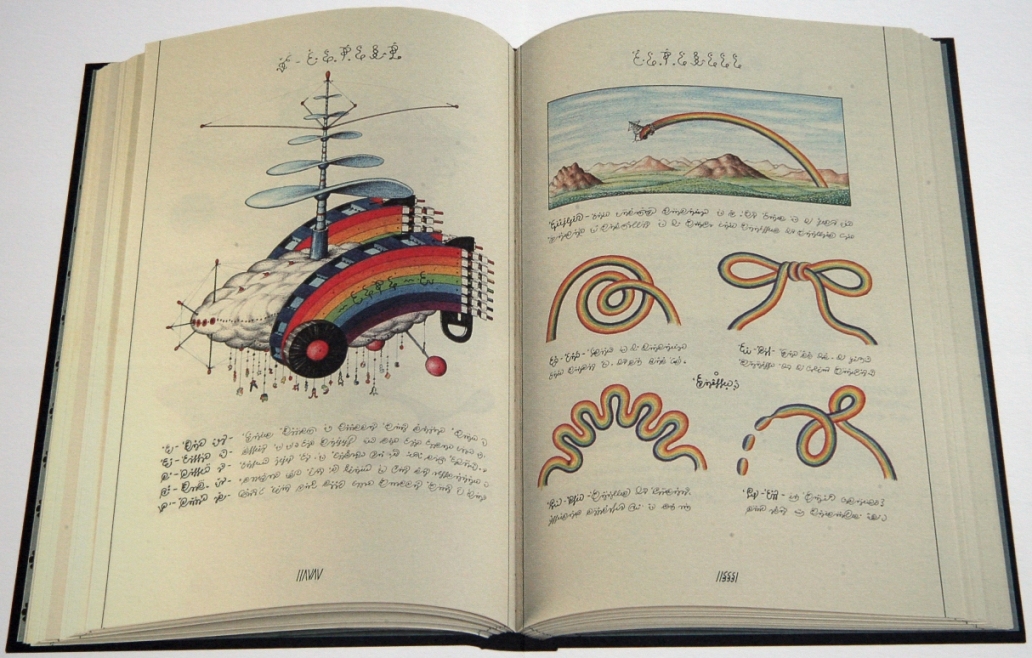
The book opposite is called Codex Seraphinianus, after Luigi Serafini, an Italian architect and graphic designer, who wrote and illuminated it in the 1970s. It is an encyclopedia guide that depicts and explains a totally fantastic world, where lovers transform into crocodiles and rainbows can be bow tied.
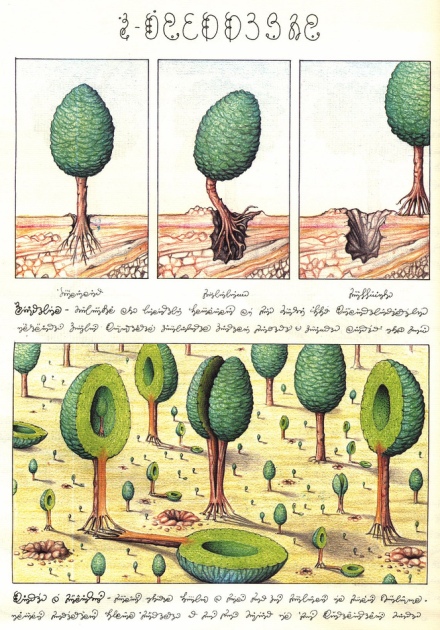
One page of the Codex (trees)
The Codex is well structured, as any encyclopedia would be. It is divided into eleven chapters with many brightly coloured illustrations. The first chapter deals with the flora of the alien world, the second one with its fauna, and so on.
As a whole, it is a coherent, constantly creative work. Writing is present throughout the book, in the paragraphs, tables of contents, captions of pictures. Only... you cannot read one word, because Serafini used a fluid cursive writing he has invented and nobody has been able to decipher.
We don't know in fact if the pretty curly squiggle we see all over the book is actually a writing, or... just squiggle. We only know that the number system in which page numbers are written does have a meaning: it has been cracked as being  base-21.
The Codex's Rosetta Stone
Every chapter of the Codex Seraphinianus is amazing but I love the eighth one especially. It depicts the history of the alien writing system used in the book, with the help of a Rosetta Stone... that is of little help because the languages displayed on the stone are not languages that we know, but a mysterious glyph language... and the 'usual' Codex language!
While I was skimming through the plates the other day, I felt as if I was going through a museum dedicated to some unknown civilisation.
Also, I was like a kid who cannot read yet: I had to rely on the pictures to understand the rules of such a foreign world and imagine what the text might tell. It made me think that babies may well feel about the same when they discover the incomprehensible world they have been suddenly thrown into.

Beautiful Losers


Famous Blue Raincoat [Leonard Cohen]
Leonard Cohen
Beautiful Losers was written outside, on a table set among the rocks, weeds and daisies, behind my house on Hydra, an island in the Aegean Sea. I lived there many years ago. It was a blazing hot summer. I never covered my head. What you have in your hands is more of a sunstroke than a book.
Leonard Cohen
Leonard Cohen writes Beautiful Losers on Hydra island in the mid-1960s.

Beautiful Losers, the second novel by Leonard Cohen after The Favourite Game — and the last, up to now was considered a scandalous book when it was published in 1966. A critic even described it as the most revolting book ever written in Canada, because it contained obscenities in several paragraphs.

Beautiful Losers The book's main character, a man who is never named, is a scholar doing research on the first Native American once canonized as a Christian Saint, Kateri TekakwithaThe Lily of the Mohawks. It broods over his research the memory of his dead Native wife, Edith, and their dead male lover and all-knowing mentor, he calls by his initial only, F. History, sex, politics, religion, and poetry, merge into an intricate dance of power relationships in which nothing can be taken for granted, except the beauty of loss.

More than 40 years later, the novel is now a classic. It is certainly excessive in more than one place, yet it is a novel of another level than the simple provocation by a young author of the . Although Cohen was not a Beatnik himself, the novel placed him from the start with the best authors of the time, Allen Ginsberg, Jack Kerouac and Gregory Corso.

Songs of Love and HateAfter Beautiful Losers, Leonard Cohen stopped writing novels though, and pursued his famous career as a poet, songwriter and singer.

His third album, Songs of Love and Hate, in 1971, included in particular the awesome, yet frightening, Avalanche and Joan of Arc and, ranking high in my favourite songs, Famous Blue Raincoat. The love triangle Leonard Cohen is calling up in this song cannot but be reminiscent of Beautiful Losers.

The Thorn Humans

Image Recommended accompanying music:
 
[When the War is Over by J.J. Cale & Eric Clapton]

Seeking on the Internet yesterday after last news in Iraq, I unexpectedly found : despite the ongoing conflict across the country, no bird species has gone extinct in the Mesopotamian marshes — that used to be among the most biodiverse regions in the Middle-East — since the last assessments were conducted in the 1970s.

A Field Guide to the Birds of Iraq was even published recently, the authors of which proudly state that it "covers the 387 bird species that have been recorded in Iraq", being the "first comprehensive, fully illustrated field guide to the birds of an Arabic speaking country and first field guide of its kind for Iraq".

Granted, several US soldiers are killed in Iraq every day. Granted again, several hundred thousand Iraqi civilians died because of the war that began 3 years ago, and bombs still kill dozens of men, women and children every day or so. It made me think that is a great pity that they are not Buddhists or Hindus, instead of Christians and Muslims. If they were, they could be reincarnated as birds! Hopefully, they would live and breed then, despite the noise of bombs.
Related Posts Widget for Blogs by LinkWithin

Home

Atom
Feed
Timeless Music
The Magic Flute
by W. A. Mozart


Timeless Reading
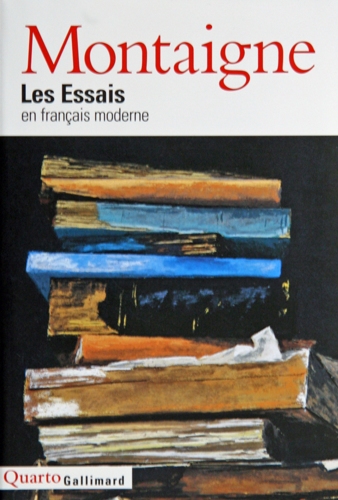
Les Essais
by Michel de Montaigne