Showing posts with label love. Show all posts

2 Lovers —> 1 Couple

— 2A — At the beginning

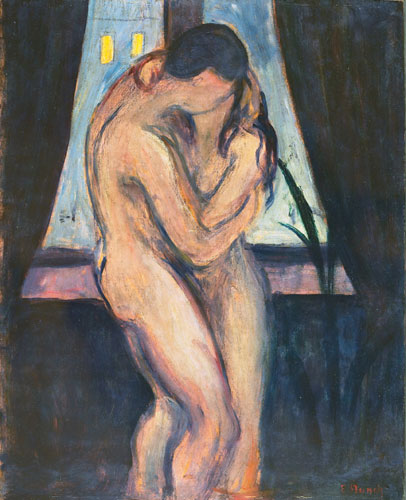
The Kiss by Edvard Munch
Kyss [The Kiss] by Edvard Munch (ca. 1895)
Oil on wood, 38.7 x 32.5 cm — Munch-museet, Oslo.

Önceleyin [At First] by Cemal Süreya

Önce bir ellerin vardı
Yalnızlığımla benim aramda
Sonra birden kapılar açılıverdi
Ardına kadar,
Sonra yüzün onun ardından
Gözlerın
Dudakların
Sonra her şey çıkıp geldi.
At first there were your hands
Between me and my loneliness
Then the doors opened
Suddenly all through,
Then your face,
Your eyes,
Your lips
Then everything came up.
Bir korkusuzluk aldı yürüdü çevremizde
Sen çıkardın utancını
Duvara astın
Ben masanın üstüne kodum kuralları
Her şey işte böyle oldu önce.
A fearlessness surrounded us
You took off your embarrassment
And hang it on the wall
I left the rules on the table
Everything happened this way at first.

-:-:-:-:-:-

— 2B — I Don't Want to Be a Couple
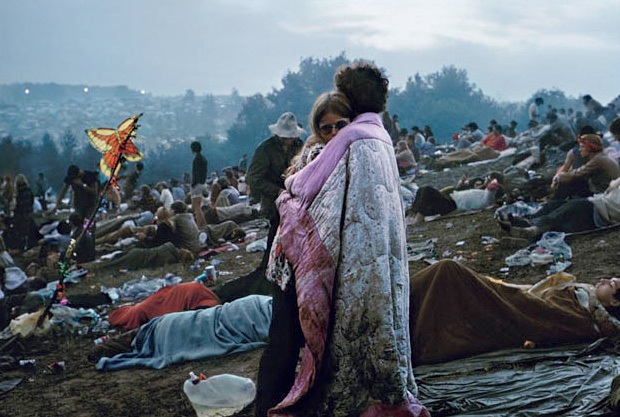
Woodstock by Burk Uzzle
Woodstock  by (1969)
[This photo has become famous as the cover of the first Woodstock album]

I don't want to be a couple.
Couples are stupid.
Couple kiss all the time.
Couple moan.
Couple fight.

I want to kiss you when I want.
I want to leave you when I want.
I want to come back when I want.
I want to be free.

I don't want to spoil everything.
I don't want to be a couple.

-:-:-:-:-:-

— 2C — Looking Together in the Same Direction
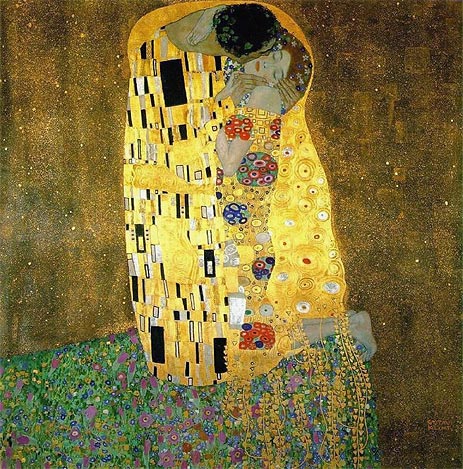
The Kuss by Gustav Klimt
Der Kuss [The Kiss] by Gustav Klimt (1907)
Oil and Gold Leaf on canva
s, 180 x 180 cm
Osterreichische Galerie, Vienna
Years pass.

S'aimer, ce n'est pas se regarder l'un l'autre, c'est regarder ensemble dans la même direction.
[Loving is not looking at each other, it's looking together in the same direction.]
 
in Terre des Hommes [Wind, Sand and Stars]

-:-:-:-:-:-

— 2D — Old Lovers


La chanson des vieux amants [Song of Old Lovers] by

[...] But finally, finally,
It took us a lot of talent
To be old without being adult.

Oh my love
My sweet, my tender, my marvellous love
From bright dawn until the end of day,
I still love you, you know,
I love you.

And more the time marches on
The more time torments us.
But isn't it the worst trap
For lovers to live in peace?

Two of Hearts
[BbN: #2]

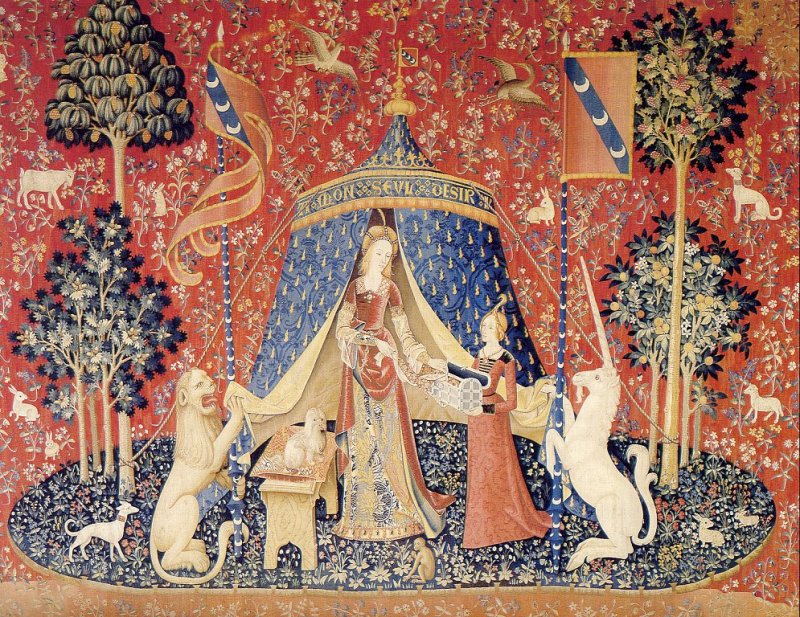
The Lady and the Unicorn

A mon seul désir
The Lady and the Unicorn — To my only desire.
Cluny Museum of Middle Ages, Paris.

The Hôtel de Cluny, in the Quartier Latin (the Latin Quarter) in Paris, was built in the 14th and 15th century. It is a beautiful structure that combines Gothic and Renaissance architecture. It is worth seeing as a building then, yet essentially it is the French Museum of the Middle-Ages. It houses many early Medieval sculptures, wonderful illuminated manuscript, and an important tapestry collection, that includes one of the greatest works of art of the whole Middle Ages, the famous series of tapestries named 'La dame à la licorne''The Lady and the Unicorn'.

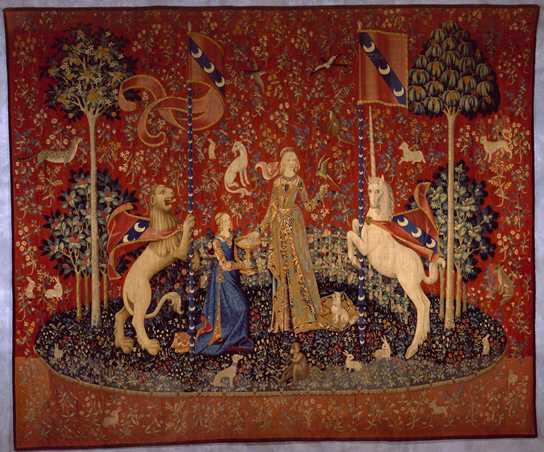
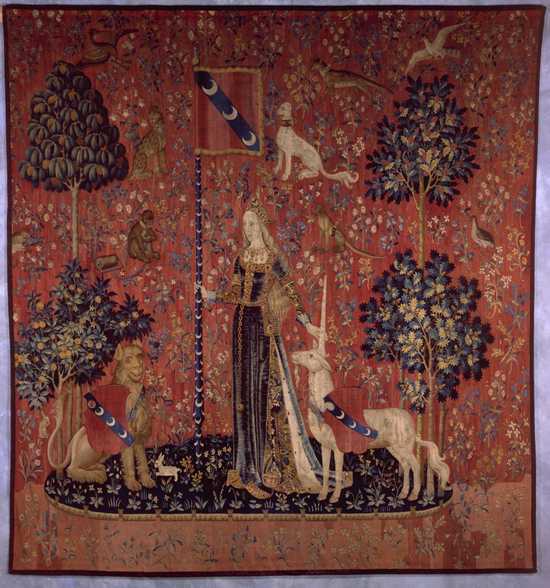
The Lady and the Unicorn — Taste
Taste (detail)
Click for the whole image

The Lady and the Unicorn
by John Renbourn

I went there again yesterday, for the tenth time maybe, because they have just opened new rooms to the public, dedicated to art and life in the Middle-Ages. Also, I wanted to see the red tapestries again, a few months after I went to the Cloisters in New-York and watched the green series of Unicorn tapestries they hold there [This series was the topic of the last blog I published on Yahoo. I might post an emended version of it here some day].

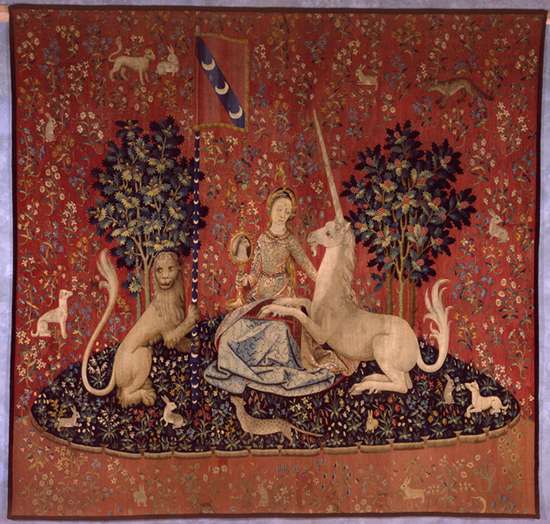
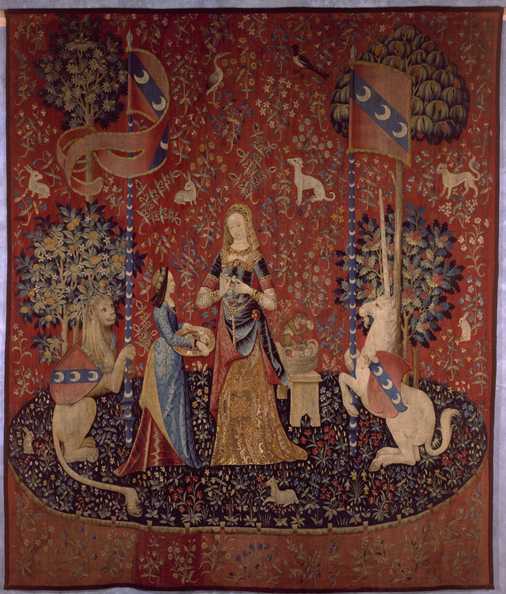
The Lady and the Unicorn — Sight
Sight (detail, click)

Both series are dated back to the 15th century. They are so-called 'Tapisseries mille fleurs' ('Thousand flowers tapestries'), named that way because they contain thousands of details, flowers and small animals especially.

While the Unicorn is the main character of the green tapestries held in New-York, that tell the story of the Hunt of the Unicorn, the Lady is the centre of the red tapestries displayed in Cluny Museum. My eyes this morning remain filled with visions of the beautiful, enigmatic Lady.

The Lady and the Unicorn — Touch
Touch (detail, click)
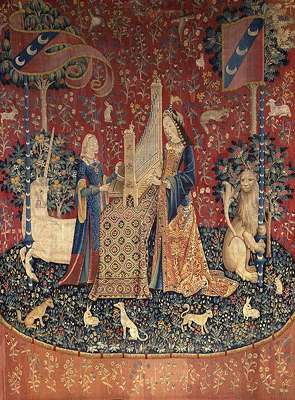
There are six tapestries in the series. Five hang side by side on a same larger curved wall in front of the only door. They are really huge, several meters wide and high. You see nothing but them when you enter the room. They depict the five senses: Taste, Sight, Touch, Smell, Hearing, in that order. Touch is situated in the middle, a very sensual picture where the Lady holds a standard in her right hand and the horn of the unicorn in her left one.

The Lady and the Unicorn — Smell
Smell (detail, click)
After you have looked at the five senses for a while, you turn round to the exit door, but then you have a view of the sixth tapestry, that has been hanging alone on the straight wall behind you from the beginning. In this tapestry, the Lady places her necklace into a case held out by her servant.  The Lion and the Unicorn are here, and many little animals. She will leave then soon though, and enter the tent behind her of which the door is wide open for her. 'A mon seul désir' ('To my only Desire'), an inscription on the tent says.

The Lady and the Unicorn — Hearing
Hearing (detail, click)

Nobody knows for sure what this tapestry means. I have the feeling that the Lady has experienced many things in her life already, using her five senses, and she has reached the end of this path now.

The wise, beautiful Lady, might have decided to renounce pleasures of the world. Or she knows she will pass soon perhaps. Whatever the reason, she now leaves her jewels forever, as a symbol of her physical life, before she enters the tent, as a symbol of her inner spirituality, a convent, or the Other World.

The Little Prince

There are few things about which I don't have any doubt, but here is one: by Antoine de Saint Exupéry is one of the greatest books ever.
I read Le Petit Prince — the original French title of the novella — for the first time when I was about eight, and I have read it again a lot of times since then... it is worth it, and also, this great book is a small book.

It is a children's story, yet it is also a philosophical tale, a poetical fable. The novella contains the best lessons of life, love and friendship you can read. Like Alice in Wonderland, it is a novel à tiroirs, with several levels of reading, in which everyone will find something different. Also, you will not find the same thing in it when you read it as a child, a teen or an adult, when you are young... or not that young any more.

To me [the fox said], you are still nothing more than a little boy who is just like a hundred thousand other little boys. And I have no need of you. And you, on your part, have no need of me. To you, I am nothing more than a fox like a hundred thousand other foxes. But if you tame me, then we shall need each other. To me, you will be unique in all the world. To you, I shall be unique in all the world [...] And then look: you see the grain-fields down yonder? I do not eat bread. Wheat is of no use to me. The wheat fields have nothing to say to me. And that is sad. But you have hair that is the color of gold. Think how wonderful that will be when you have tamed me! The grain, which is also golden, will bring me back the thought of you. And I shall love to listen to the wind in the wheat.
[...]
So the little prince tamed the fox. And when the hour of his departure drew near...
Ah said the fox, I shall cry.
It is your own fault, said the little prince. I never wished you any sort of harm; but you wanted me to tame you.
Yes, that is so, said the fox.
But now you are going to cry! said the little prince.
Yes, that is so, said the fox.
Then it has done you no good at all!
It has done me good, said the fox, because of the color of the wheat fields.
[...]
Goodbye, said the fox. And now here is my secret, a very simple secret: It is only with the heart that one can see rightly; what is essential is invisible to the eye.
What is essential is invisible to the eye, the little prince repeated, so that he would be sure to remember.
It is the time you have wasted for your rose that makes your rose so important.
It is the time I have wasted for my rose — said the little prince, so that he would be sure to remember.
Men have forgotten this truth, said the fox. But you must not forget it. You become responsible, forever, for what you have tamed. You are responsible for your rose...
I am responsible for my rose, the little prince repeated, so that he would be sure to remember.

If you haven't read the book yet, you have missed something... Yet you're also a lucky one, because it is a wonderful story to discover. You'll have no difficulty to find it in your native language, : Le Petit Prince is one of the most translated and published books ever.

Seeking Freud in Fragonard

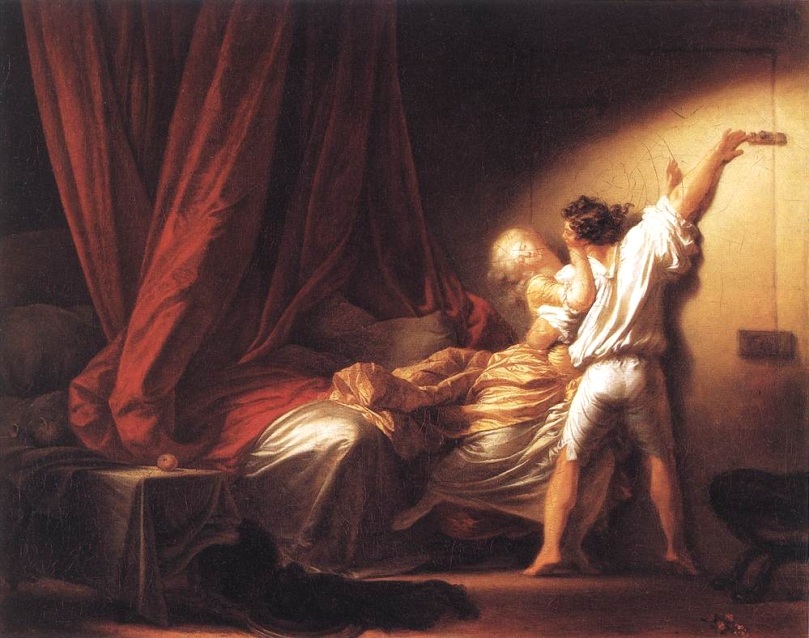
Fragonard Le Verrou (The Bolt)
Jean-Honoré Fragonard - The Bolt (Le Verrou)
Oil on canvas 73 x 93 cm, ca. 1778.
Musée du Louvre, Paris.

Although he painted in several styles including neoclassicism, Jean-Honoré Fragonard is particularly famous as a rococo painter, because he painted several remarkable ribald, suggestive paintings, according to what was in the mood among her aristocratic patrons at the end of the 18th century, before the French Revolution occurred.

The Bolt (Le verrou), one of the most famous canvases by Fragonard, is a beautiful piece of art that is worth a analytical explanation... in every meaning of the word.

The painting is split by a diagonal, from the upper right to bottom left. On the well-lit right side, a man embraces a woman, while he pushes to the bolt of the door with the fingertips of his right hand. The woman seems half-fainting and resisting him mildly. Yet we all know that what must happen will happen. Hmm... 'will happen?' Why such untidiness on the darker left side then? A rumpled bed, scattered pillows, a hanging down canopy... how can there be so much disorder in a room where nothing has yet happened?

A specialist of paintings by Fragonard once wrote "On the right side, there is a couple; on the left side, there is nothing". Such a nothing is about half the painting though. Daniel Arasse, a French Art historian, rightly wrote in a fantastic book entitled Histoires de Peintures (Tales of Paintings) that much of the meaning of this canvas lies precisely in this nothing.

The Bolt — Detail

At first sight, there does not appear to be any real topic in the left part of the painting indeed, but drapes and folds. With a closer look though, you will see that the pillows are strangely put up as tips. In the canopy, a red material comes slightly unfastened, a slit sinking into the darkness. And the bed's corner, in the foreground, is covered by a sheet whose material is the same as the woman's dress. Look better: this corner is a knee. The knee of a widely open leg, a pair of breasts, a female sex above them, all allude to what is just going to happen. It refers to the man's fantasy and desire. The nothing on the left half of the painting is actually the thing.

Or... perhaps I am totally wrong? What do you think? Perhaps there is nothing to see there, but a rumpled bed? This is the whole ambiguity of art: you see (you can see, you want to see...) or you don't. Nobody can tell who is 'right' and who is 'wrong' if we disagree, but it does not matter anyway: when you look at a piece of art, it is not the meaning you see in it — or not — that is important, but how much the work appealed to you and gave rise to emotion.

The Padlock Wall

Padlocks in Pécs, Hungary
On the Padlock Wall — Pécs, July 2007
If you ever go to the city of Pécs with your lover, don't forget to bring a padlock!
Several decades ago, a student left his padlock and its key on a grate in the center of this city of Southern Hungary, in a street close to the cathedral. It was his last day of school before summer holidays, and there was no need for him to bring such an old padlock back home.
A few days later, a couple of lovers saw the padlock on the grate. They engraved their names on another padlock, then locked it beside the first one. Other couples did the same. The tradition was born that lovers who lock a padlock to these grates get hitched forever themselves.
Thousands of padlocks are now locked on the grates of the padlock wall in Pécs. No doubt, it certainly means that the spell works.

Danae

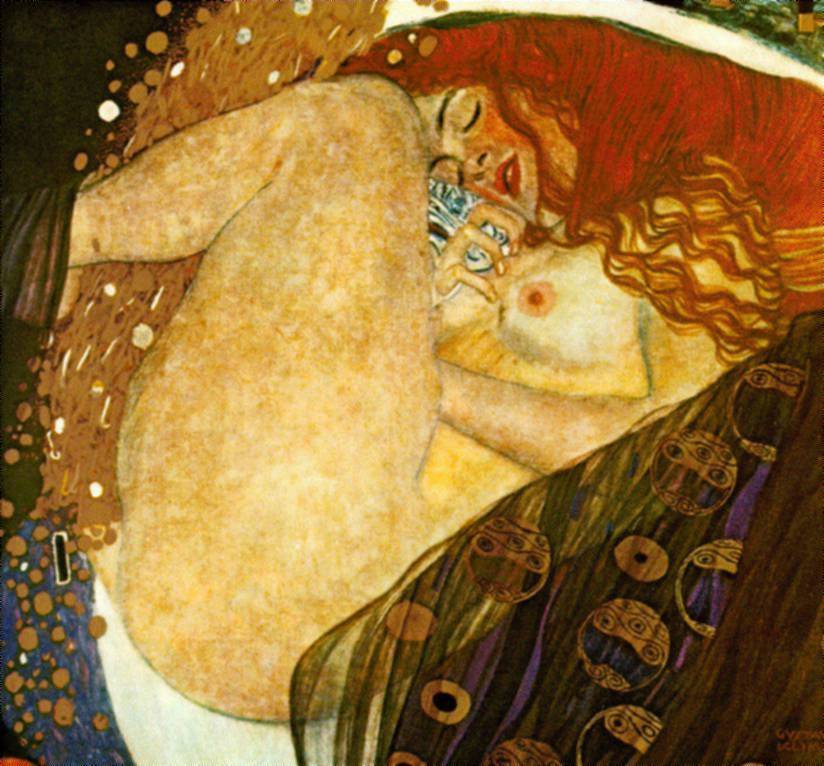
Danae (Gustav Klimt, 1906-1908)
Oil on Canvas, 77 x 83 cm

Several months ago, I went to a great painting exhibition at the in Paris, entitled Vienna 1900.

The exhibition focused on four major figures of the Austrian Secession (Austrian term for Art Nouveau), between 1897 and 1918: , , and .

Shortly said, although I am not that enthusiastic over Kokoschka's paintings, it was among the best exhibitions I have ever seen, that showed how the distinctive treatment of space and perspective by these artists marked a revolution in pictorial language.

It was also an opportunity to see one of the most famous paintings by Klimt, Danae, which is usually part of a private collection in Austria. I have always loved this canvas, one of the most erotic paintings I know, that used a mythological subject as the pretext for a depiction of female pleasure.

According to Greek mythology, Danae was only daughter of Acrisius, king of Argos. After the oracle prophesied to Acrisius that his grandson would kill him, he locked Danae in a tower where nobody could enter.

Zeus however, the leader of all Gods, felt in love for the beautiful king's daughter. Despite every precaution taken, he felt upon the sleeping Danae as a golden shower, and she conceived Perseus. Several years later, Perseus would kill Medusa, rescue Andromeda from a sea monster, and kill Acrisius as predicted, by accident in an athletic contest, when the wind sweeps away his javelin.

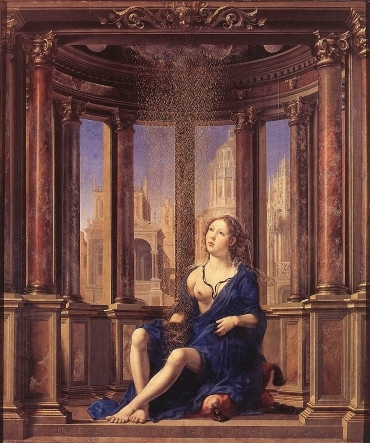
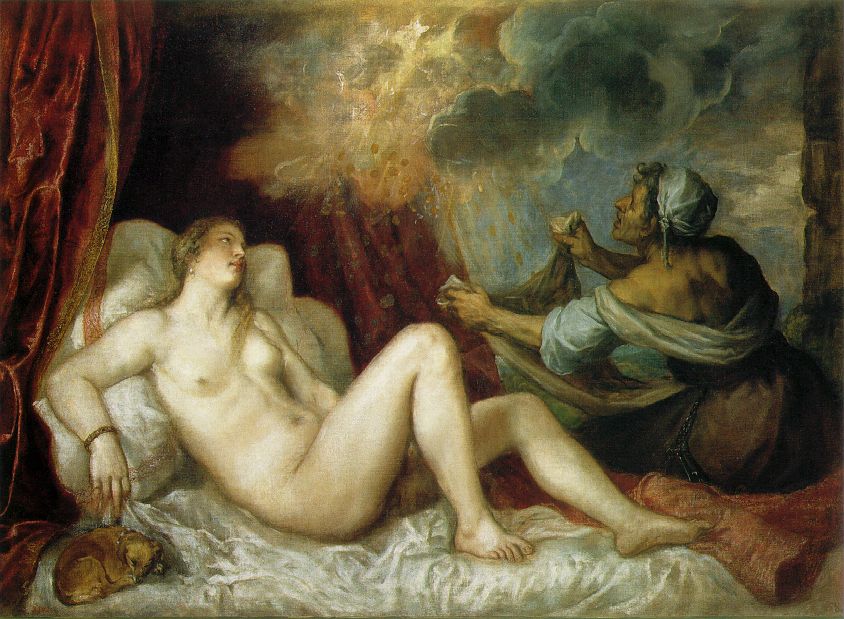
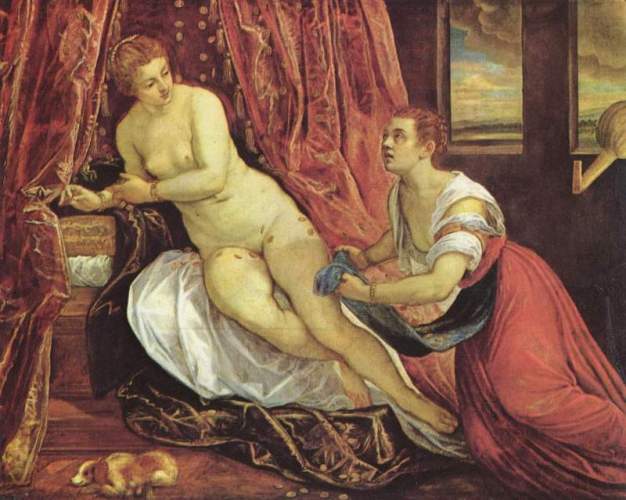
The very moment when Zeus, as a golden shower, seeds Danae, had inspired many artists previously, from anonymous Greek artists...

Danae — Greek bell-shaped crater

Danae and the Shower of Gold (ca 450 BC)
Bell-shaped crater,
— Paris.

to Jan Gossart aka Jan Mabuse...

Danae (Jan Gossart aka Mabuse, 1527)
— Munich.

Titian...

Danae and the Shower of Gold (Titian, 1554)
— Madrid.

Tintoretto...

Danae (Tintoretto, ca 1554)
— Lyon.

... and many more.

Klimt painted Danae in 1906-1908, at the acme of his so-called Golden Period. At the time, he would use genuine gold leaf together with paint in his canvases! In Danae, the gold he used as a tool was not only associated with the colour, but the theme of the painting itself.

Klimt selected precisely the moment at which the golden shower falls between the legs of the sleeping Danae. He did not make use of any narrative scenery, yet he succeeded in fixing the erotic moment through the curves of the contoured form, the flowing streams of the ornament, the gossamer black veil revealing the woman's body, and the selection of an unusual view. The nude body itself becomes part of the formal composition.

Besides the mythological story, Klimt displayed on Danae the availability of the woman, concentrating on the representation of female orgasm. The red-haired woman here is not a Greek princess but the universal symbol of seductive femininity.

Related Posts Widget for Blogs by LinkWithin

Home

Atom
Feed
Timeless Music
The Magic Flute
by W. A. Mozart


Timeless Reading
Les Essais
by Michel de Montaigne