Showing posts with label politics. Show all posts

Historic Pictures

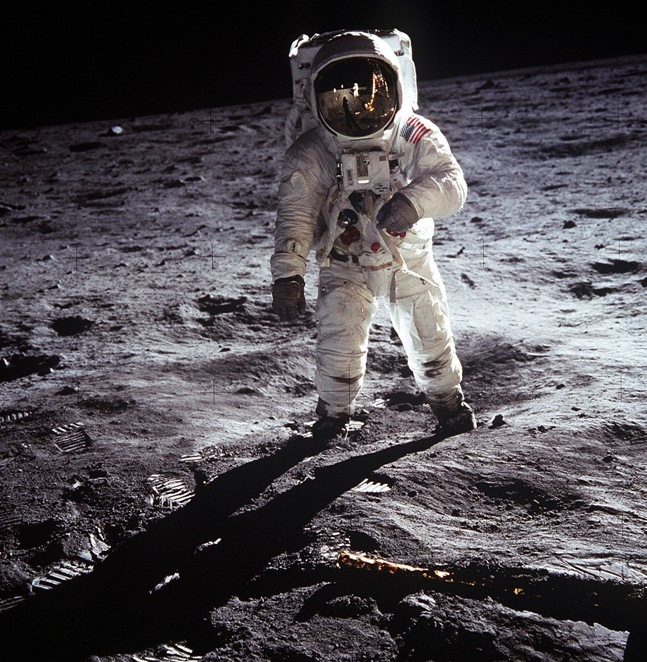
Buzz Aldrin on the Moon

Several years ago, I was given a book entitled Chronique du vingtième siècle (The 20th Century Saga), edited by newspaper.

It is a huge book (1350 pages, A4 size) that contains excerpts of most relevant articles published in French newspapers in the 20th century. 'Sarajevo: Archduke shot dead' (June, 1914); 'Lindbergh flies over the Atlantic' (May, 1927); 'Paris is now free' (August, 1944); 'Explorers on the Moon' (July, 1969), and so on.

You have a strange feeling when you read articles written many decades ago, on the very day historic events happened. They fill in a gap between personal experience and what you have been told. Obviously, the journalists who wrote the articles could not know about a future that is part of a well-known past for present readers. Yet, paradoxically, such a lack of knowledge adds a lot. When an event happened long time ago, before you were born, or able to understand it, you see it as a piece of History; almost an abstraction. On the opposite, when you can remember a event, how you heard of it, what you thought about it at the time, it is part of *your* history. Quite not the same.

Churchill, Roosevelt and Stalin in Yalta

When you read articles in such a book, you feel as if this gap has been filled in. Past events become more real, because you hear about them happening 'live'. Furthermore, beside words, you see pictures, some of which are known throughout the world: Churchill, Roosevelt and Stalin in Yalta. Edwin 'Buzz' Aldrin on the moon, photographed by Neil Armstrong who appears also as a reflection on the visor of Aldrin's helmet. Vietnamese girl , badly burnt, running down a road after a Napalm attack...

'Napalm Girl' by Nick Ut

It works with articles, it works with photos. It works also with films. I remember the year 1989 very well: resistance and demonstrations in communist countries, protesters in Tiananmen Square, the . The youngest cannot remember how hopeful we Westerners felt at the time, and how sad and angry after the massacre  in Beijing. Yet, thanks to the movie below — that I have displayed — they can feel the same as we did, 20 years ago exactly, when the desperate action of the testified about what the courage of a unique human being can be.

The Unknown Rebel

Persepolis

Persepolis by Marianne Satrapi
Marjane Satrapi is an Iranian/French graphic novelist. She was born in 1969 in Rasht, in the North of Iran, and now lives and works in Paris. She became famous because of her critically acclaimed autobiographical graphic novels Persepolis, which describe her childhood and adolescence in Iran and Europe.

Persepolis graphic novels were adapted by herself and Vincent Parronaud into an essentially black-and-white animated film bearing the same name. The movie was called 'islamophobe' and 'anti-iranian' by the Iranian President Mahmoud Ahmadinejad, thus it is not allowed for broadcast in Iran. Yet it is not a political movie. It deals with life in the real world. It is a work of poetry for all of us to delight in.

Image
When the movie starts, Marjane is a child. She lives in Tehran, in a progressive family involved with the socialist movements. She attends the Lycée Français in Tehran, and witnesses the growing oppression of civil liberties and the everyday-life consequences of Iranian politics. Then comes the Iranian revolution, the fall of the Shah, and the regime of Ayatollah Khomeini. After days of elation, disillusion follows quickly. Political opponents are put in jail again, many are executed, and islamist rules are imposed. Then the Iran-Iraq war starts. At the age of 14, her parents send Marjane to Vienna, Austria, to flee the Iranian regime. She discovers Europe, boys, and loneliness. She comes back to Iran.

The movie relates with realism and humour Marjane's years of hardship, she shared with million young Iranians of the time: overnight obligation to wear a veil, search for forbidden pirated audio cassettes, secret parties with friends where you dance and drink alcohol despite police raids.

Persepolis was awarded the Special Jury Prize in Cannes Film Festival in May 2007. Last Year, it was given the Better First Movie Award in the Cesar Award, the National film award for France. It also competed in Hollywood for the Oscar, as a nominee for best animated film, but had no chance against Disney's blockbuster Ratatouille.


Persepolis Trailer


Persepolis is a simple story told by simple means. It consists essentially of a series of monochrome drawings, their bold black lines washed with nuances of gray. Its flat, stylized depiction of the world — the streets and buildings of Tehran and Vienna in particular — turns geography into poetry. Yet it is good to be reminded that animation is rooted not in any particular technique, but in the impulse to bring static images to life.

¡Commandante!

Ernesto <em>'Che'</em> Guevara by Alberto Korda
Guerillero Heroico
by Alberto Korda (1960)

Fifty years ago, on January 1st, 1959, Cuba's dictator Fulgencio Batista fled Havana's Presidential Palace — where he had just hosted a New Year party — to the Dominican Republic, giving up power to the revolution headed by Fidel Castro, in which Ernesto 'Che' Guevara had taken a big part.

Everybody knows the portrait on the left side: 'El Che' stares into the middle distance with fiery resolve, military beret perched on his head, leather jacket zipped up to his neck, hair blown by the wind. Taken in 1960 by Alberto Korda, a Cuban photographer, this picture is one of the most widely reproduced images in the history of photography. It has been endlessly reproduced on posters, T-shirts and so on, and has remained remarkably durable as a symbol of revolution and youthful rebellion.

Hasta Siempre by Carlos Puebla
(Soledad Bravo
singing)

Such a romantic view of the character is somewhat odd when you know that, after Fidel Castro took the power in Cuba,  Ernesto Guevara was the supreme prosecutor of suspected war criminals from the regime of Batista and oversaw without leniency trials and executions of many people.

Yet 'El Che' became a romantic hero, an icon of freedom and fight against oppression, when he decided to leave the comfort of Cuba where he was a minister, and try to export revolution to other countries: Congo-Kinshasa first, then Bolivia. He even gained a Christ-like stature at the end, when he was captured in Bolivia in October 1967 in a military operation supported by US Special forces, and summarily executed.

Image

Alberto Korda never earned any royalties from his famous photograph, although the portrait was declined in hundreds of reproductions.

The original picture (on the left) is usually reframed so that El Che appears alone on it. Very often, it is turned into a high contrast black and white picture that is especially found on tee-shirts. The high-contrast version of the portrait was also used in an artistic way in a pop-art serigraphy in colours, an imitation of a famous serigraphy by Andy Warhol featuring Marilyn Monroe.

Image Image

ImageVery often too, the picture is used in a way that would make El Che turn in his grave: "The revolutionary struggle of the cherries was squashed as they were trapped between two layers of chocolate", reads the copy on this ice-cream's wrapper. "May their memory live on in your mouth".

Poor Che... Taken over by Capitalism, at the end.

Welcome back, America!

Joy in Philadelphia — Barack Obama has just been elected the 44th President of the United States
Philadelphia, Wednesday 5 November 2008, 2 am.
Barack Obama has just been elected the 44th President of the United States.

I arrived at Philadelphia yesterday evening, and went to bed early. At 1 am, I was awoken by car horns and hundreds of people crying out in joy in the streets. You cannot stay in your bed in such a historic day... I put my clothes back on, and went outside again with my camera.

People in the streets now are excited and happy. They congratulate each other, they laugh, they shout and dance. Whites and blacks, a lot of black people. You can feel joy and hope in the air.

People will have to come back down to earth, their problems will not disappear in the twinkling of an eye, but this night is their night. Enjoy, folks. We're glad too. You've made the choice of courage and hope. Welcome back, America!

Will they dare?

I have a confession to make: when I wrote a of US citizens when they elect a new President, several months ago, I felt like most people I know: that we just simply could not trust the US people any more. Seriously, how could anyone keep confidence in people who were blind enough, and that deliberately forgetful of 'American values', to elect again a character such as Georges W. Bush as their President in 2004?
I was quite sure at the time that, whoever the Democratic candidate would be, he would not be elected, especially because John McCain is not a far rightist neocon, as G.W. Bush is, but a respectable conservative politician.

Economically, it will not necessary be good news for the Europeans if Barack Obama is elected, especially because he will probably increase U.S. protectionism. Yet I do believe it will be a good thing for the people of that country. On the economical and social grounds first: the failure of the Republicans here is obvious. Also, for the image of a country that has essentially shown its worst facets for several years.

Today, a few days before the election to be held on November 4, Barack Obama leads in the polls by several percent. It is certainly not as much a landslide as in polls conducted elsewhere in the world though, and nobody knows how many people will not vote Obama at the end because "he is not like us". Yet Obama still leads in the polls, and early-voting Democrats are outnumbering Republicans in most sites.

I will be in Philadelphia next week, a direct onlooker of this huge event. Will U.S. citizens dare to elect him? If they do, hats off.

Microcredit

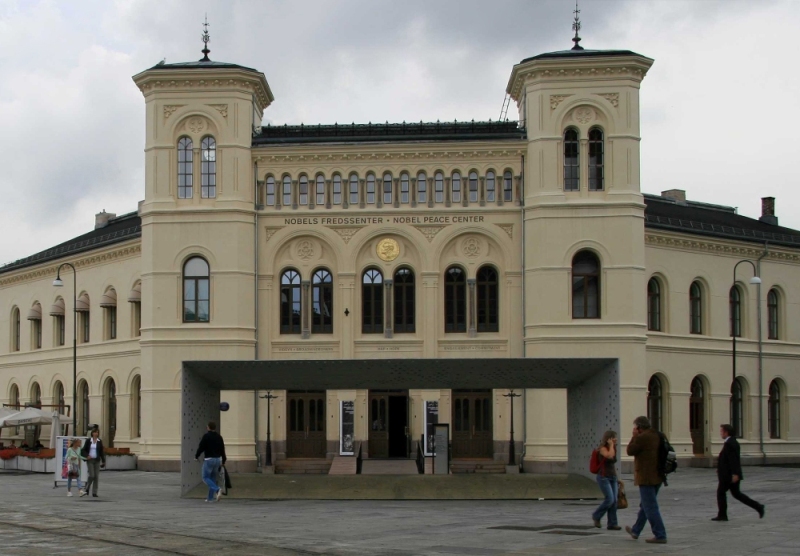
The Nobel Peace Centre in Oslo
The Nobel Peace Centre in Oslo - August 2006

Sufia Begum lived in Jobra, a village in Bangladesh where she wove bamboo stools for a living. In 1974, a professor of economics visited the village with students, and asked her how much she earned. She replied that she contractually had to sell the stools back to the man who had sold him bamboos, and because she never had money enough to buy bamboos, she borrowed it from a middleman. Her net income, after deduction of the interest, was about $0.02 per stool.

The following day, the professor did a survey in Jobra with his students. They found out that 42 families in the village were in the same predicament. Altogether, the 42 families owed the usurer a total of... $27. The professor gave them $27 and explained they would then be able to buy their own materials, cut out the middleman, and pay him back some day, whenever they could. They all paid him back, day by day, over a year.

Image The idea of microcredit was born from this spur-of-the-moment generosity. It then grew into a full-fledged business concept that came to fruition with the founding of the Grameen Bank in 1983 ('Grameen' means 'Village' in Bengalese). In the years since, the bank has lent $5.72 billion to more than 6 million Bangladeshis. Worldwide, microcredit financing has now helped some 17 million people.

The professor was called Muhammad Yunus. Here comes an excerpt from his lecture when he was awarded the .

Poverty is a Threat to Peace [...]
The new millennium began with a great global dream. World leaders gathered at the United Nations in 2000 and adopted, among others, a historic goal to reduce poverty by half by 2015. Never in human history had such a bold goal been adopted by the entire world in one voice, one that specified time and size. But then came September 11 and the Iraq war, and suddenly the world became derailed from the pursuit of this dream, with the attention of world leaders shifting from the war on poverty to the war on terrorism. Till now over $ 530 billion has been spent on the war in Iraq by the USA alone. I believe terrorism cannot be won over by military action. [...] I believe that putting resources into improving the lives of the poor people is a better strategy than spending it on guns.

The funny thing here: warmongers in the USA or elsewhere cannot say this guy is naive or inexperienced. It is just the contrary: he is not a dogmatic, and knows what he is talking about.

Flower of Scotland

The Saltire flag of Scotland
(The Highlander, a Scottish Pub in Paris)

I arrived in Scotland two days ago, for a 9-day vacation trip in the country of and . News from the Castles and Highlands to come then, and from Nessie also perhaps, who knows?

Scotland is not an independent country anymore, therefore it does not have a national anthem. Yet a few songs are used instead, that convey Scottish will to differentiate themselves from the rest of Great Britain.

It is especially the case of Flower of Scotland, the beautiful, patriotic song by . Resolutely directed at the English, the song celebrates Robert the Bruce's victory against the troops of King Edward II at in 1314.

O Flower of Scotland
When we sill see
Your like again
That fought and died for,
Your wee bit Hill and Glen
And stood against him, Proud Edward's army
And sent him homeward
Tae think again.

In particular, Scots break into Flower of Scotland at the Highland Games — sometimes — and before a match by the Scottish national rugby team — always.

Edinburgh, 17 March 1990. Scotland previously defeated Wales, Ireland and France in the Five Nations Championship. Today, in Murrayfield Stadium, the last match in this championship is about to start, against the auld enemy and hot favourite, England, undefeated also. Victory in the Championship, and a Grand Slam, are at stake.

ImagePlayers are on the field. Five minutes ago, while the English team ran into the Stadium as usual, David Sole, who captains the Scots, deliberately walked his men onto the pitch, in a slow, belligerent march, to deafening cheering of the home crowd.

English against Scots. Hundred years of conflicting history. Furthermore, British Prime Minister Margaret Thatcher has experimented the Community Charge (aka Poll Tax) for one year in Scotland only, leading to massive disobedience, and riots to come shortly in the whole country.

Scotland vs England — 17 March 1990

Both teams are lined up in front of the VIP stand. Fifteen English players bravely sing God Save the Queen as strong as they can, while TV cameras slowly pass in review the staring faces of every Scot player fixed in a provocative silence. For the first time in their history, they don't sing the anthem.

Then, David Sole turns his head toward the musicians, and bagpipes start playing, while the Scottish team and whole home crowd — 50,000 souls — all together launch with fire into Flower of Scotland.

Needless to stay, Scots won the match and the Grand Slam. On that day, they just could not lose.

Homeless

Homeless

I took this picture several months ago, in a street close to my apartment. Lost in a sweet inebriated state, these homeless persons were friendly, and agreed gladly to be photographed.

When I took the photo, I found it funny that in Paris, even homeless winos would drink wine in stemmed glasses.

I took the photo, put the file into my computer... and did not show it to anyone. I felt ill at ease because I realized afterwards that it was not funny. According to a counting published lately, there are approximately 86,000 homeless people in France, a country with about 65 million inhabitants, of which at least 15,000 are in Paris. One can guess there are even more in reality though. Many hide because of bad weather, fear, or shame.

According to another study, 112 homeless people died in France from February to October, 2005. Their mean age was 49, while life expectancy of men and women in the country is 77 and 84 years, respectively. The youngest one was 31 year-old, half people were under 50. Twenty-one died a violent death: 8 murders, 7 blazes, 6 falls.

As a doctor myself, and although I rarely receive homeless people as patients, I know these persons often suffer chronic diseases. Their main illnesses are related to undernourishment (lack of vitamin C and calcium essentially): infections, anaemia, bleeding, neurological and cardiovascular disorders, bone fractures. They can be treated for free thanks to universal health coverage, but most of them are outside any network of socialization, and they don't know. Then, chronic diseases such as diabetes and high blood pressure are not diagnosed or treated. Furthermore, homeless people often have heavy consumption of tobacco and alcohol, that induce cardiovascular diseases, cirrhosis and cancers.

No, after all, this pic is not that funny.

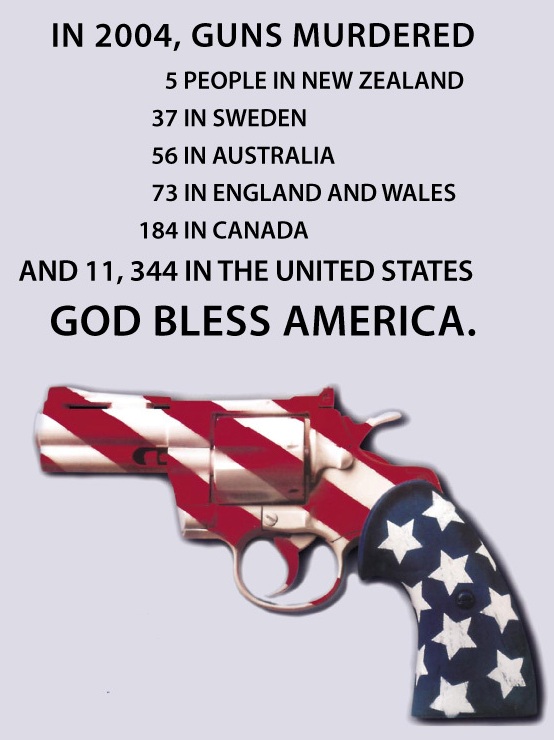
Guns in the USA (follow-up)

Why don't we do away with the court system and go back to the Old West? You have a gun and I have a gun, and we'll settle it in the streets if that's they're thinking. We think we're such an improved society... The rest of the world is laughing at us.

— Chicago Mayor Richard Daley.

The Mayor of Chicago responded here to a recent statement by the of the United States of America that the Firearms Control Regulations Act of 1975 is unconstitutional, and handguns may not be banned by the District of Columbia. The Supreme Court enacted that the District's ban on handgun possession in the home violates the of the U.S. Constitution's Bill of Rights.

The Second Amendment states: A well regulated Militia, being necessary to the security of a free State, the right of the people to keep and bear Arms, shall not be infringed. As you can imagine, it's a very old stuff: it was enacted in 1791, shortly after the war of independence against the British. More than two centuries have passed, but it has not been modified.

A few months ago, about several articles published in the , where they showed that guns are a main Public Health issue in the United States, with tens thousands casualties a year. Unfortunately, it seems things will not change before a long time in that country.

In fact, Mayor Daley, most of the people in the civilized world are not laughing at the U.S.A. They are astounded rather, and sometimes scared.

The Unknown Rebel

The unknown rebel
Beijing — June 1989.

During several weeks in the spring of 1989, hundreds of thousands of students gathered together in continuous peaceful protests in several cities throughout China, against the policies of their government.

On June 4th, 1989, the Chinese State ordered an end to the demonstrations that had been taking place on Tiananmen square in Beijing. Infantry and tanks were deployed against the unarmed people. Several hundreds were killed, thousands perhaps. 19 years later, and a few weeks before the Olympic Games are held in Beijing, about 130 persons are still imprisoned in China because they dared protest in 1989.

On the day after Tiananmen slaughter, a single man shocked the world, when he stood alone before a line of tanks and made them stop and turn off their motors.
The Unknown Rebel

Nobody knows who this man was. Nobody knows if he could make it at the end. Maybe he is one of the 130 people still imprisoned since 1989. Yet this anonymous, ordinary person, with shopping bags in both hands, has become an example of human courage and struggle for freedom. He is an icon of the 20th century.

(Repost of a blog published on the same day last year
on Yahoo 360°, with a few changes)

Global Responsibility

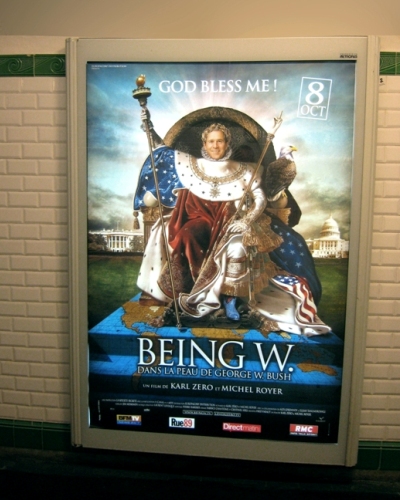
Karl Zero's 'Being W.' Poster Movie
A poster of Karl Zero's movie 'Being W.'
in a metro corridor in Paris
U.S.Americans will elect their new president on November 4, 2008. Although the total U.S. population (around 300 million) is only 2,2% of the whole world population, elections in this country are the most important in the world. First, because the U.S.A. has remained the sole military superpower after U.S.S.R. collapsed; secondly, because it has the world's largest economy, if you don't take the European Union as a single entity.

Georges W. Bush, the most controversial U.S. President for decades, to say the least, has been in charge for eight years. His time is almost over at last, phew. The next U.S. President will hardly do worse than him, but who will that be? Hillary Clinton? John McCain? Barack Obama? People all around the world are very concerned with this question, that raises a paradox: they cannot vote in the U.S. election obviously, even though its consequences — in as crude terms as life and death — will be more important for many of them, in the Middle East especially, than for U.S. citizens.

It is fairly understandable that U.S. citizens vote according to personal and internal reasons essentially. It is the same in every country. Yet not every country has a commitment in world's affairs and an army like the U.S.A. has. It is a pity then that many U.S. people are little interested in international politics, and often ill-informed about countries, people, and cultures abroad... 97 percent of the world, that is.

U.S. citizens should not hide their head in the sand: fairly or not, their votes carry a global responsibility. The choice they will make at the end of the year is of overwhelming importance for people all over the world — these 6 billion+ people that will not vote on November 4, 2008.

$icko

Sicko A Study of Sexuality and Health among Older Adults in the United States was the title of an interesting article published two weeks ago in the New England Journal of Medicine.

You probably heard of this study, that was reported at great length in the media all over the world. The paper concluded that many older adults are sexually active. Okay. Nothing that surprising or brand new here, yet interesting to know.

Only, there was another great article published in the very same issue of the New England Journal of Medicine that received much less attention from the media. Its title was Healing Our Sicko Health Care System, by Jacob S. Hacker, Ph.D. The article dealt with the last movie by Michael Moore bearing this name in a level-headed way, not at all hagiographic of a movie of which the limitations were underscored. Quoting its first paragraphs:

ImageThere is a scene in Sicko — Michael Moore's controversial new film about U.S. health care — that captures both the power and the limits of Moore's cinematic polemic.

A mother is speaking about her 18-month-old daughter, Mychelle, who became ill one evening with vomiting, diarrhoea, and a high fever. At the nearest emergency room, Mychelle is treated by a physician who suspects, rightly, that she has a life-threatening bacterial infection. But rather than give her antibiotics, the doctor calls her insurer, whose physician-gatekeeper tells him that Mychelle is not covered at the hospital and must be taken to another facility. The doctor repeatedly says that Mychelle needs care, and he is repeatedly told that she must be transferred first. Finally, nearly 3 hours after arriving at the hospital, wracked by seizures, Mychelle is taken to the approved facility. She dies 15 minutes later.

As Mychelle's mother, Dawnelle Keys, recounts this awful sequence of events, a swing hangs empty in the background. Even if we had not witnessed multiple tragedies already — a woman seriously injured in a car crash whose insurer denies payment because she doesn't obtain "prior authorization" to visit the emergency room, an elderly couple who move into their daughter's storage room because they cannot afford their medicine, an uninsured man forced to choose which of his two fingers to have reattached after an accident — we'd know how the story ends.

And yet, when the moment comes, and Dawnelle Keys's voice cracks as she describes losing her daughter, the effect is still devastating. We can't but wonder how our rich, powerful country can let so many citizens face such unnecessary pain and loss. How could a government "of, by, and for the people" fail so miserably to protect the people from such vast and preventable tragedies?

ImageIndeed. I have heard so many stories of the same kind from chat friends living in the United States. Each time, I feel sorry... and angry too, probably because I am a doc myself, and I live in Europe. It seems surreal to see such failure in the richest and more powerful country in the world, while the right to be treated has been a fundamental right in European countries for decades.

A few years ago, USA was ranked 37th in the World Health Organization's ranking of the world's health systems, and at the same time, about $5 billion a month are spent in Iraq? There must be an error somewhere.

Rostropovich

Mstislav Rostropovich at the Berlin Wall — November 11, 1989
Mstislav Rostropovich plays at the Berlin Wall — November 11, 1989

Mstislav Leopoldovich Rostropovich died today in Moskow, a few days after his 80th birthday. He was not only one of the best cellists ever, but a symbol of freedom and resistance to communist dictatorship.

Farewell, Slava.


M. Rostropovich plays Bach Cello Suite N°1

Terrorism works

Why so? — San Diego, November 2006

Has Osama Bin Laden heard about the recent decision by US congress to legalize torture – ooops, “coercive interrogation”, pardon my French... — in some Pakistani cave or in the Heaven of Allah?

Actually, it does not mind. Wherever he is, dead or alive, the greatest instigator of international terrorism just won another victory, because this the very reason of terrorists' strategy: inducing their ennemy to forget their own principles and show a hideous face that, in return, justifies violence.

After the invasion on Iraq based on fake reasons, and prisoners kept in Guantanamo jails for years without a trial or even an accusation, now comes the official disregard of ... where is the USA going with George W. Bush and its administration? Do they still know what the word ethics mean?

It seems now the present most powerful democracy is on the road to decline of human rights and sorry renouncement of proclamed values. It is a distressing evidence that terrorism does work.

Death Penalty

Death Chamber

In 2006, the death penalty has not been routinely applied in any democratic country, but the United States of America. It still exists in Japan and India, yet executions are rare there (one in India in 2004, none since then). Philippines abolished the death penalty for all crimes in June 2006.

Death penalty is forbidden in all countries inside the European Union. Its abolition is even a mandatory criterion for application.

According to Amnesty International, at least 2,148 people were executed in 22 countries in 2005, among whom 1,770 people  in China. True figures are probably much higher thoug, since Chinese statistics on death penalty are classified as a state secret. Iran executed at least 94 people, and Saudi Arabia at least 86. There were 60 executions in the USA, bringing the total to 1004 executed in this country since the use of the death penalty was resumed in 1977.

International treaties prohibit to sentence to death or execute people under 18 years old at the time of the crime. Most countries whose laws still provide for the death penalty specifically exclude the execution of child offenders. Since 1990 however, eight countries executed young people: China, Congo (DR), Iran, Nigeria, Pakistan, Saudi Arabia, USA and Yemen. China, Pakistan USA and Yemen have now changed their law and raised the minimum age for the death penalty to 18. Yet the USA and Iran have each executed more child offenders than the other six countries combined.

Scientific studies have consistently failed to find convincing evidence that the death penalty deters crime more effectively than other punishments. Statistics show that abolition does not have harmful effect on the curve of crime; for instance, in Canada where death penalty was abolished in 1976, the homicide rate per 100,000 population fell from 3.09 in 1975, to 2.41 in 1980, and 1.73 in 2003.

The persistence of death penalty is not that surprising in countries such as China, Saudi Arabia or Iran, that are not democracies. It is a stain for the USA. Death penalty is not only barbaric, it is unfair. Whether you receive the death penalty in the USA depends not so much on what you have done, but:

— where you committed your crime: the use of the death penalty not only varies from state to state (12 US states have no death penalty) but from jurisdiction to jurisdiction within a state.
— what colour your skin is: repeated studies have shown a pattern of racial discrimination in the administration of the sentence. For example, among the 205 people executed for inter-racial murders in the USA, 193 were black defendants charged with killing a white person, while only 12 were white defendants charged with killing a black individual.
— and how much money you have: 90% of defendants are too poor to hire their own lawyer, so most rely on overworked court-appointed lawyers.

Proved lack of efficiency as a deterrent, unfairness, knowlegde that innocent people were killed, and 'simply' untenable notion of legal murder of individuals by a state on an ethical point of view: isn't it enough?

Related Posts Widget for Blogs by LinkWithin

Home

Atom
Feed
Timeless Music
The Magic Flute
by W. A. Mozart


Timeless Reading
Les Essais
by Michel de Montaigne