I - Don't - Like - Spam!

When I opened my email box the other morning, there were a couple of job-related mails... and 37 spams! Granted, the latter got filtered by my spam firewall, but I waited for an important mail then, and was afraid of missing it, if it was considered a spam by mistake. Therefore, I explored the spam folder also. You know what? I don't like spam!

The word SPAM was coined in July, 1937 when Hormel foods, a company that processed a meat product called Hormel Spiced Ham, decided to change this name to a more memorable one. The precise meaning of the acronym is disputed though: SPAM may be the contraction of either Shoulder of Pork and hAM, Spiced Pork and hAM, or simply SPiced hAM — although malicious gossip would say it should rather be Specially Processed Artificial Meat or Spare Parts Already Minced.

During the WWII and following years, SPAM was among a few products excluded from food rationing in the United Kingdom, and the British grew heartily tired of it.

Several years later, the broadcast a sketch that parodied an advert for the canned meat: in a restaurant, a couple tries to order a breakfast. The lady (Graham Chapman in drag) dislikes spam, but every dish in the menu contains spam (egg and spam; egg, bacon and spam; egg, bacon, sausage and spam; etc.). A group of Vikings seated at a table starts chanting "SPAM, SPAM, SPAM..." and progressively jams every other talk in the restaurant, while John Cleese gets picked up by the police for Hungarian-accent-induced obscene words.

Monty Python: SPAM (1970)
This hilarious sketch became highly famous, as well as the Vikings' song. That's why, several years later, the phenomenon of marketers drowning out discourse by flooding email boxes with junk advertising messages was named spamming, recounting the repetitive and unwanted presence of SPAM in the sketch by the Monty Python.

Codex Seraphinianus

Codex Seraphinianus
Codex Seraphinianus (Click to enlarge)
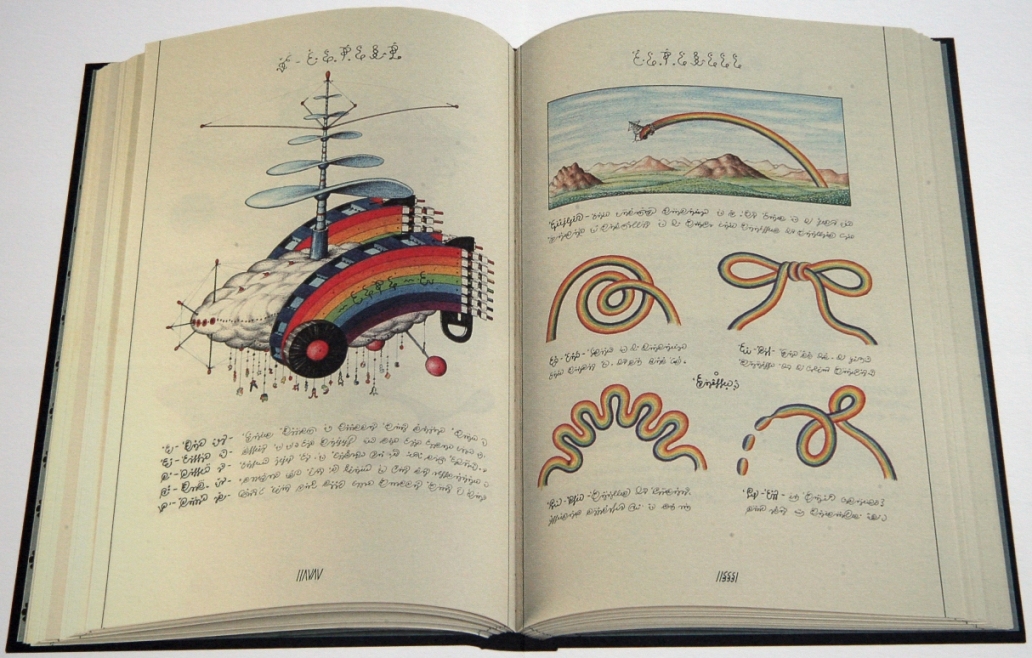
The book opposite is called Codex Seraphinianus, after Luigi Serafini, an Italian architect and graphic designer, who wrote and illuminated it in the 1970s. It is an encyclopedia guide that depicts and explains a totally fantastic world, where lovers transform into crocodiles and rainbows can be bow tied.
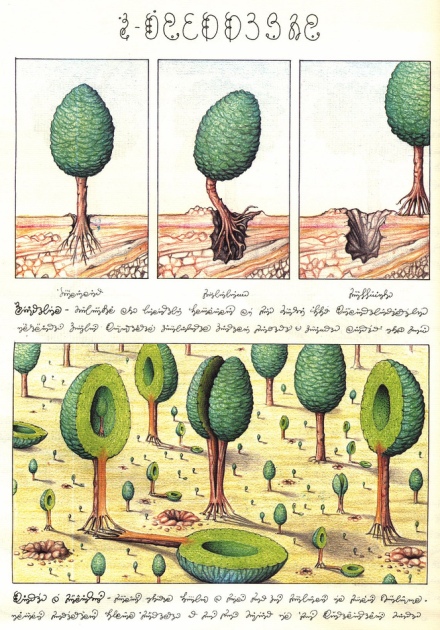
One page of the Codex (trees)
The Codex is well structured, as any encyclopedia would be. It is divided into eleven chapters with many brightly coloured illustrations. The first chapter deals with the flora of the alien world, the second one with its fauna, and so on.
As a whole, it is a coherent, constantly creative work. Writing is present throughout the book, in the paragraphs, tables of contents, captions of pictures. Only... you cannot read one word, because Serafini used a fluid cursive writing he has invented and nobody has been able to decipher.
We don't know in fact if the pretty curly squiggle we see all over the book is actually a writing, or... just squiggle. We only know that the number system in which page numbers are written does have a meaning: it has been cracked as being  base-21.
The Codex's Rosetta Stone
Every chapter of the Codex Seraphinianus is amazing but I love the eighth one especially. It depicts the history of the alien writing system used in the book, with the help of a Rosetta Stone... that is of little help because the languages displayed on the stone are not languages that we know, but a mysterious glyph language... and the 'usual' Codex language!
While I was skimming through the plates the other day, I felt as if I was going through a museum dedicated to some unknown civilisation.
Also, I was like a kid who cannot read yet: I had to rely on the pictures to understand the rules of such a foreign world and imagine what the text might tell. It made me think that babies may well feel about the same when they discover the incomprehensible world they have been suddenly thrown into.

I Love Paris

Paris, rue de Sèvres — May 2006.

I live in Paris. Paris is the capital of France. Twenty centuries ago, when France was called Gaul, Paris was called Lutetia. Gaulish people living in Lutetia were called the Parisii Tribe, hence the name later given to the city.

Like a lot of cities, Paris has been built on the banks of a river, and on a couple of small islands between the banks. This river is called the Seine river. It is my river, with gorgeous views and marvelous light. The left bank (la rive gauche) is where I live now, and will always rather have a stroll. The right bank (la rive droite) is where I work, and lived for long time in the past. I have a lot of memories in both areas.

I don't know every street in Paris for sure, but always know approximately where they are. I could hardly get lost in Paris, even on purpose. When I take the metro, I always know what direction I should take. I can explain to a taxi driver the way I want him to go. I know where the train stations are. I know the buses routes reasonably well. Also, I have a lot of landmarks here. A café, a monument, a park, a church... Paris is the place where I belong.

I love to stroll in my city. At random often. Sometimes, I take the metro or the first bus that stops where I happen to be, and get out of it later as the mood takes me. At other times on the contrary, I follow a well-prepared itinerary. At other times again I walk with constraints, such as "take the 1st street on the left, then the 2nd on the right, then the 3rd on the left, and so on" or any other silly rule I imagine on the moment.

It may sound crazy, but it is efficient: when you do this, you cannot but have another sight of places you think you know well. You discover small streets, tiny places or public gardens. You walk this usual street in the opposite direction, and it looks different. You reach by chance a place where you have not been for years. You remember friends who would live in this street long time ago, or see again the café where you once awaited that ravishing brunette who never came to the date.

Munch

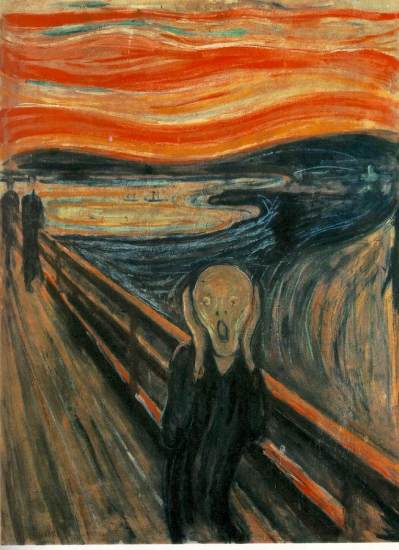
Edvard Munch — The Scream
The Scream (1893)
Oil, tempera, and pastel on cardboard. 91 × 73.5 cm — Nasjonalgalleriet, Oslo
Two years ago, during a holiday trip in Norway (I wrote a about it at the time) I had the opportunity to go to several museums in Oslo and see paintings by Edvard Munch (1863-1944), a national celebrity there and a painter I love.
The (National Gallery) owns about sixty paintings by him, from his early years up to 1920, and the (Munch Museum) owns most of the work of his later years, that Munch bequeathed to the city of Oslo.
Munch would often perform several versions of his works, including what is probably his most famous painting, The Scream (Skrik). The Nasjonalgalleriet holds one of two painted versions, displayed opposite. The Munch-museet holds the other painted version and one pastel. Another pastel is privately owned. Munch also made a lithograph of the image.
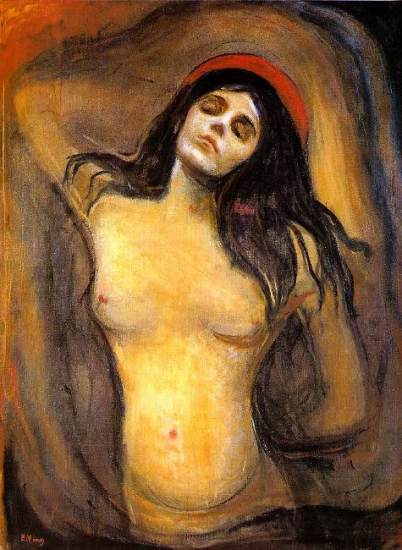
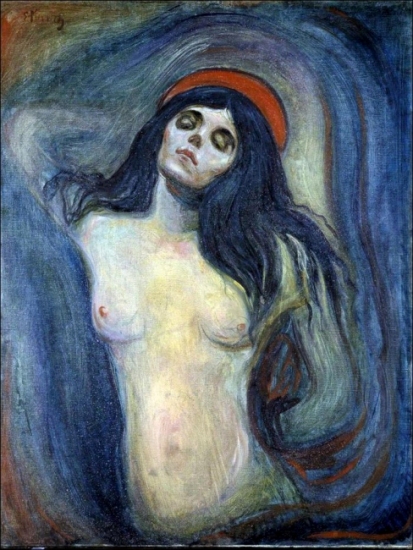
I found it very interesting so see different versions of a same painting displayed at the same time in these museums. Differences are sometimes big between works that look similar at first sight. Beside The Scream, it is the case with another famous painting by Munch, Madonna. This canvas is essentially the erotic depiction of a beautiful young woman who sleeps — or is perhaps swooning in an orgasm — with her black hair let down and her body laid bare. It is a painting I love for several reasons — including the fact that the model reminds me of a friend I had once.
Edvard Munch — Madonna
Madonna (1894-1895)
Oil on canvas — Nasjonalgalleriet.
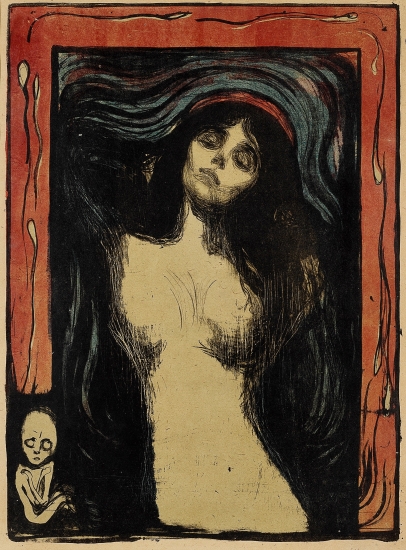
Madonna (1893-1894)
Oil on canvas — Munch-museet.
When I was in Oslo in August 2006, I saw the 1894-1895 version of Madonna (above on the left side) in the Nasjonalgalleriet. The warm tones of this version of the painting make the sensuality greater than in the version owned by the Munch-museet (above on the right), where cold tones stand out.

Edvard Munch — Madonna (lithograph)
Madonna (1895)
Lithograph — Munch-museet.
I could not see the latter though, because it had been stolen from the Munch-museet two years earlier, together with their version of The Scream. Both paintings were recovered in 2006, a few days after I left the country (coincidence only, I swear!). They and are now presented together in the Munch Museum.
Munch made a Madonna lithograph in 1895, that I saw in the Nasjonalgalleriet too. The expression of sexuality of the model is increased in this work, and spermatozoid-like motives are included in the frame (which is painted and part of the picture, in the Art Nouveau style). Sexuality here is closely associated with darkness and death though. An unborn fetus in the lower left corner of the picture introduces the notion of an abortion.
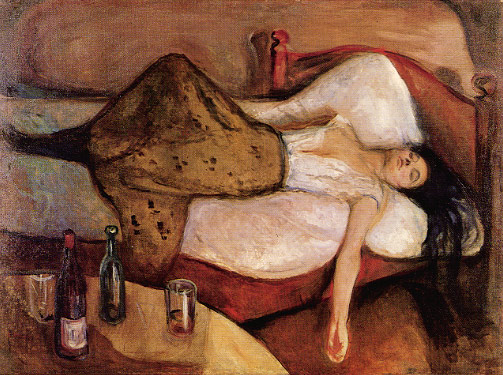
Nobody knows who the character portrayed in Madonna was, yet you can imagine there was a close relationship between Munch and her: the same woman was portrayed, in 1894-1895 also, in another painting by Munch named The Day After (Dagen Derpå).
Edvard Munch — The Day After
The Day After (1894-1895)
Oil on canvas — Nasjonalgalleriet.
It is the morning probably. The title of the painting implies that something big happened the day before. A young woman lies on a bed, upon the sheets. Her bed? not sure. She is still dressed, but her blouse is open on her breasts.
Two bottles and two glasses on a table indicate that she was not alone until little time before. You cannot see anyone else on the room though. Either she is alone, which means a man abandoned his prey after having obtained what he wanted... either Edvard Munch himself is looking at the scene, and you see it through his eyes. You don't know what hapenned, yet you feel sorry for this girl. As a man, you almost feel like apologizing.

Richard Avedon at Le Jeu de Paume

Richard Avedon talking with a model of his In the American West series

A portrait is not a likeness. The moment an emotion or fact is transformed into a photograph it is no longer a fact but an opinion.
There is no such thing as inaccuracy in a photograph. All photographs are accurate. None of them is the truth.
(Richard Avedon)

Take a large sheet of white paper, approximately 2 meters high and 2.5 meters wide. Fix it on a wall, somewhere in the shade. Put your photographic chamber on its tripod in front of this screen, at about 2 meters.

When your settings are finished, don’t look in the viewfinder any more. Stand beside the camera and have a relaxed face to face chat with the model you’re going to take the picture, without any equipment getting in your way. If you’re talented, your name is .

Charles Chaplin — His last day in America, 1957
Charles Chaplin
His last day in America, 1957
I must acknowledge I was somewhat prejudiced against the work of Richard Avedon: I knew him as a fashion photographer only… and fashion is not my cup of tea. I did not know the other sides of his work until recently, when I read articles about the exhibit now held in Le Musée du Jeu de Paume in Paris, where they said he didn’t take fashion photos only, but also portraits.

Clarence Lippard, drifter - Interstate 80, Sparks, Nevada - August 29, 1983
Clarence Lippard, drifter.
Interstate 80, Sparks, Nevada
August 29, 1983

I went to the exhibition earlier this week, and discovered how huge a photographer I had missed for many years. Besides the fashion pictures, I saw awesome portraits of celebrities: Anna Magnani just out of bed, Henry Kissinger scared by the camera, Karen Blixen sparkling with mischievousness, Charles Chaplin making fun of McCarthyism, Marylin Monroe touching and fragile…

Sandra Bennett, twelve years old — Rocky Ford, Colorado, 1980
Sandra Bennett, 12 year old
Rocky Ford, Colorado, 1980
Essentially, in two dedicated rooms, were exhibited about 30 portraits of middle class and poor Americans from the 17 western states, taken at the beginning of the 1980s, part of his In the American West series.

These are large portraits in black and white, about 1.50 meter high and 1.20 meter wide, that hang side by side on black walls, in shadowy light. Bare introverted faces of workers, children, women, old people, looking you straight in the eye, that bear an intense but subjacent emotional power.

Red Owens, oil field worker — Velma, Oklahoma - December 6, 1980
Red Owens, oil field worker.
Velma, Oklahoma
December 6, 1980
Faces, good looking or not, and so many marks on them… scars, freckles, oil marks, coal marks.

Roberto Lopez, oil field worker - Lyons, Texas - September 28, 1980
Roberto Lopez, oil field worker.
Lyons, Texas
September 28, 1980

Such photos immortalize their models. Many people will never forget these faces, that were anonymous once, in the same way they will not forget the untameable will shown in the piercing look of the by Stephen McCurry.

Even though a photo cannot show but the surface of a body or face, pictures by Richard Avedon and other great portraitists reveal the deepest part of the soul of their models, their character, sadness, strength, despair, fear, loneliness. A great exhibition, about a great photographer.

Related Posts Widget for Blogs by LinkWithin

Home

Atom
Feed
Timeless Music
The Magic Flute
by W. A. Mozart


Timeless Reading
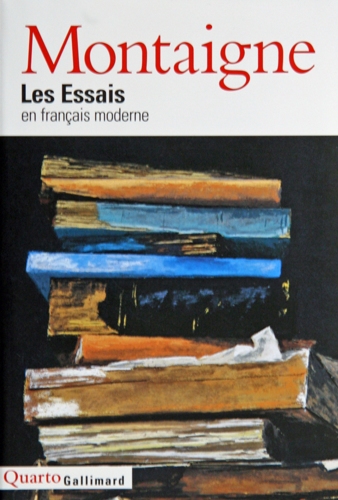
Les Essais
by Michel de Montaigne