Loss

I had the following talk once, with a friend who does not work in the medical field:

— As a kidney physician, you are in charge of a lot patients on dialysis, and see many people with terrible diseases. It must be tough. I admire doctors, I could never be one of them. I could not endure the death of a patient, it would depress me so much!
 
— It may take a toll, yes. With experience however, we physicians learn not to feel too guilty when a patient of ours die. If we did our best in conscience, we try to think we did the best.
 
— But this cannot be true every time... I know I would keep on believing that I could have done better.
 
— Oh yes, it happens. Sometimes I feel guilty because I was not able to do more. Sometimes, I think I should have managed the situation otherwise. It happens. Most often though, I know it was not possible to prevent the evolution. At least I helped for a while hopefully...

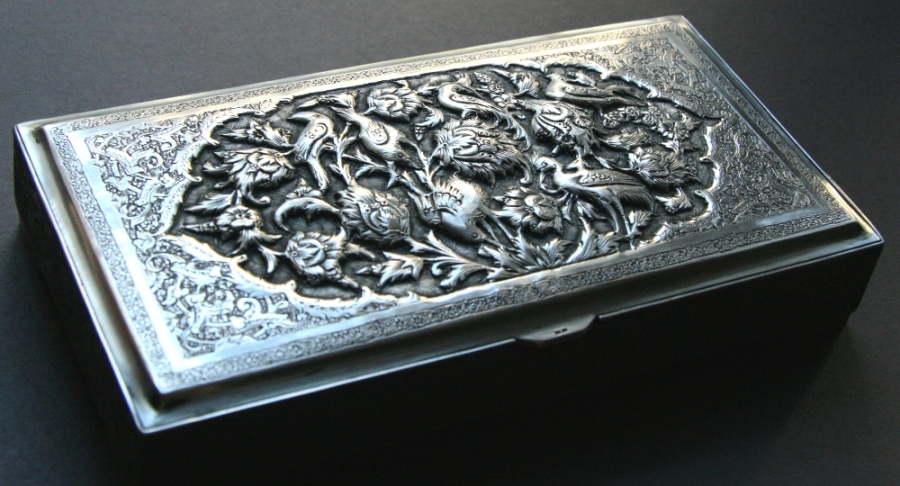
I was given this beautiful silver case as a New Year present by an Iranian 85 year-old man who had been my patient for several years before he died lately.

He had left his country in 1979 because of the Islamic Revolution. Once a political opponent, and now a person with a chronic renal disease who depended on dialysis for his survival , he painfully knew he would never see his homeland again. He was always cheerful and friendly to everyone though.

In fact, the old gentleman did not give me the box as such. He gave me chocolates... put inside the silver box. He was an upright and nice person I had become much attached to. I think of him often.

The Little Prince

There are few things about which I don't have any doubt, but here is one: by Antoine de Saint Exupéry is one of the greatest books ever.

I read Le Petit Prince — the original French title of the novella — for the first time when I was about eight, and I have read it again a lot of times since then... it is worth it, and also, this great book is a small book.

It is a children's story, yet it is also a philosophical tale, a poetical fable. The novella contains the best lessons of life, love and friendship you can read. Like Alice in Wonderland, it is a novel à tiroirs, with several levels of reading, in which everyone will find something different. Also, you will not find the same thing in it when you read it as a child, a teen or an adult, when you are young... or not that young any more.

To me [the fox said], you are still nothing more than a little boy who is just like a hundred thousand other little boys. And I have no need of you. And you, on your part, have no need of me. To you, I am nothing more than a fox like a hundred thousand other foxes. But if you tame me, then we shall need each other. To me, you will be unique in all the world. To you, I shall be unique in all the world [...] And then look: you see the grain-fields down yonder? I do not eat bread. Wheat is of no use to me. The wheat fields have nothing to say to me. And that is sad. But you have hair that is the color of gold. Think how wonderful that will be when you have tamed me! The grain, which is also golden, will bring me back the thought of you. And I shall love to listen to the wind in the wheat.
[...]
So the little prince tamed the fox. And when the hour of his departure drew near...
Ah said the fox, I shall cry.
It is your own fault, said the little prince. I never wished you any sort of harm; but you wanted me to tame you.
Yes, that is so, said the fox.
But now you are going to cry! said the little prince.
Yes, that is so, said the fox.
Then it has done you no good at all!
It has done me good, said the fox, because of the color of the wheat fields.
[...]
Goodbye, said the fox. And now here is my secret, a very simple secret: It is only with the heart that one can see rightly; what is essential is invisible to the eye.
What is essential is invisible to the eye, the little prince repeated, so that he would be sure to remember.
It is the time you have wasted for your rose that makes your rose so important.
It is the time I have wasted for my rose — said the little prince, so that he would be sure to remember.
Men have forgotten this truth, said the fox. But you must not forget it. You become responsible, forever, for what you have tamed. You are responsible for your rose...
I am responsible for my rose, the little prince repeated, so that he would be sure to remember.

If you haven't read the book yet, you have missed something... Yet you're also a lucky one, because it is a wonderful story to discover. You'll have no difficulty to find it in your native language, : Le Petit Prince is one of the most translated and published books ever.
Birdsong

There are two large bookstores in Paris where I will go several times a year and buy books in English: Brentano's, the American Bookstore in Paris and WHSmith in Paris, the English Bookshop. When I last went to Brentano's, I had my attention attracted to the title of a book: Birdsong, by Sebastian Faulks, an Englishman. I had never heard of it, although it was labelled as a bestseller. I flipped through a few pages: the book was about the First World War, and beautifully written. I bought it.
The book tells the story of a young Englishman who fights in France during the WWI, interspersed with scenes of the life of his granddaughter, Elizabeth, a young woman living in the 1970s, who travels to France to discover more about the life and dead of her grandfather.

As Elizabeth drives across empty fields, she notices a great arch in a field. She pulls over and has a closer look at it.

As she came up to the arch, Elizabeth saw with a start that it was written on. She went closer. She peered at the stone. There were names on it. Every grain of the surface had been carved with British names; their chiseled capitals rose from the level of her ankles to the height of the great arch itself; on every surface of every column as as far as her eye could see there were names teeming, reeling, over surfaces of yards, of hundred of yards, over furlongs of stone.

She moved through the space beneath the arch where the man was sweeping. She found the other pillars identically marked, their faces obliterated on all sides by the names that were carved on them.
Who are those, these...? She gestured with her hand.
These? The man with the brush sounded surprised. The lost.
Men who died in this battle?
No. The lost, the ones they did not find. The others are in the cemeteries.
These are just the... unfound?

She looked at the vault above her head and then around in panic at the endless writing, as though the surface of the sky had been papered in footnotes. When she could speak again, she said:
From the whole war?

The man shook his head.
Just these fields. He gestured with his arm.

Elizabeth went and sat on the steps on the other side of the monument. Beneath her was a formal garden with some rows of white headstones, each with a tended plant or flower at its base, each cleaned and beautiful in the weak winter sunlight.
Nobody told me. She ran her fingers with their red-painted nails back through her thick dark hair. My God, nobody told me.

Between 1914 and 1918, about 9 million people were killed, in Europe essentially: 2 million German, 1,300,000 Frenchmen, 750,000 British, 650,000 Italians... Beside the terrible loss of young men in every family — France lost about 10 percent of its working population in the conflict — the war changed the political map of Europe, and the world balance of power. Several European empires were dismantled. France and the UK, although the winners, were ruined. It was the very moment in history when Europe handed over to the USA as the world economical and political leader.

Seeking Freud in Fragonard

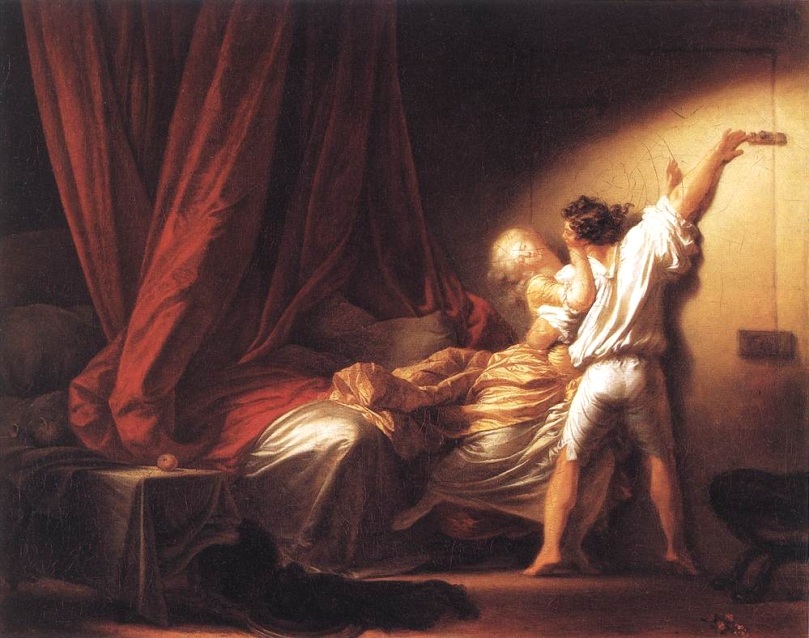
Fragonard Le Verrou (The Bolt)
Jean-Honoré Fragonard - The Bolt (Le Verrou)
Oil on canvas 73 x 93 cm, ca. 1778.
Musée du Louvre, Paris.

Although he painted in several styles including neoclassicism, Jean-Honoré Fragonard is particularly famous as a rococo painter, because he painted several remarkable ribald, suggestive paintings, according to what was in the mood among her aristocratic patrons at the end of the 18th century, before the French Revolution occurred.

The Bolt (Le verrou), one of the most famous canvases by Fragonard, is a beautiful piece of art that is worth a analytical explanation... in every meaning of the word.

The painting is split by a diagonal, from the upper right to bottom left. On the well-lit right side, a man embraces a woman, while he pushes to the bolt of the door with the fingertips of his right hand. The woman seems half-fainting and resisting him mildly. Yet we all know that what must happen will happen. Hmm... 'will happen?' Why such untidiness on the darker left side then? A rumpled bed, scattered pillows, a hanging down canopy... how can there be so much disorder in a room where nothing has yet happened?

A specialist of paintings by Fragonard once wrote "On the right side, there is a couple; on the left side, there is nothing". Such a nothing is about half the painting though. Daniel Arasse, a French Art historian, rightly wrote in a fantastic book entitled Histoires de Peintures (Tales of Paintings) that much of the meaning of this canvas lies precisely in this nothing.

The Bolt — Detail

At first sight, there does not appear to be any real topic in the left part of the painting indeed, but drapes and folds. With a closer look though, you will see that the pillows are strangely put up as tips. In the canopy, a red material comes slightly unfastened, a slit sinking into the darkness. And the bed's corner, in the foreground, is covered by a sheet whose material is the same as the woman's dress. Look better: this corner is a knee. The knee of a widely open leg, a pair of breasts, a female sex above them, all allude to what is just going to happen. It refers to the man's fantasy and desire. The nothing on the left half of the painting is actually the thing.

Or... perhaps I am totally wrong? What do you think? Perhaps there is nothing to see there, but a rumpled bed? This is the whole ambiguity of art: you see (you can see, you want to see...) or you don't. Nobody can tell who is 'right' and who is 'wrong' if we disagree, but it does not matter anyway: when you look at a piece of art, it is not the meaning you see in it — or not — that is important, but how much the work appealed to you and gave rise to emotion.

Microcredit

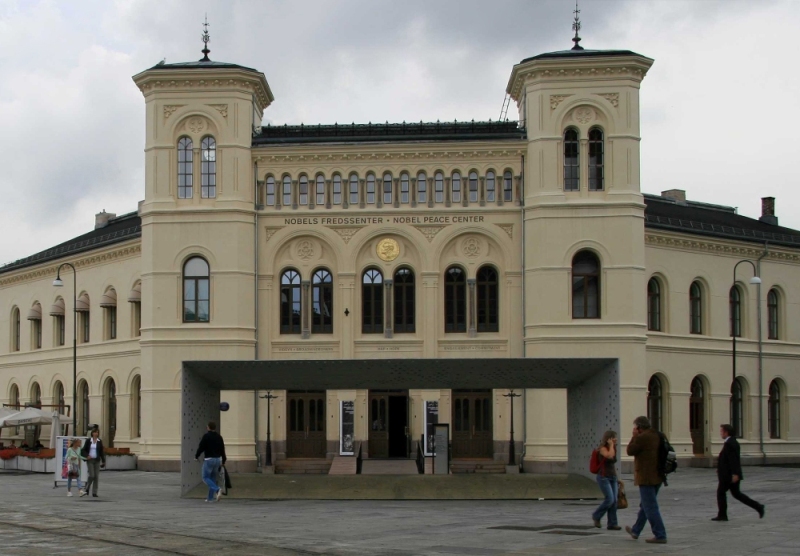
The Nobel Peace Centre in Oslo
The Nobel Peace Centre in Oslo - August 2006

Sufia Begum lived in Jobra, a village in Bangladesh where she wove bamboo stools for a living. In 1974, a professor of economics visited the village with students, and asked her how much she earned. She replied that she contractually had to sell the stools back to the man who had sold him bamboos, and because she never had money enough to buy bamboos, she borrowed it from a middleman. Her net income, after deduction of the interest, was about $0.02 per stool.

The following day, the professor did a survey in Jobra with his students. They found out that 42 families in the village were in the same predicament. Altogether, the 42 families owed the usurer a total of... $27. The professor gave them $27 and explained they would then be able to buy their own materials, cut out the middleman, and pay him back some day, whenever they could. They all paid him back, day by day, over a year.

Image The idea of microcredit was born from this spur-of-the-moment generosity. It then grew into a full-fledged business concept that came to fruition with the founding of the Grameen Bank in 1983 ('Grameen' means 'Village' in Bengalese). In the years since, the bank has lent $5.72 billion to more than 6 million Bangladeshis. Worldwide, microcredit financing has now helped some 17 million people.

The professor was called Muhammad Yunus. Here comes an excerpt from his lecture when he was awarded the .

Poverty is a Threat to Peace [...]
The new millennium began with a great global dream. World leaders gathered at the United Nations in 2000 and adopted, among others, a historic goal to reduce poverty by half by 2015. Never in human history had such a bold goal been adopted by the entire world in one voice, one that specified time and size. But then came September 11 and the Iraq war, and suddenly the world became derailed from the pursuit of this dream, with the attention of world leaders shifting from the war on poverty to the war on terrorism. Till now over $ 530 billion has been spent on the war in Iraq by the USA alone. I believe terrorism cannot be won over by military action. [...] I believe that putting resources into improving the lives of the poor people is a better strategy than spending it on guns.

The funny thing here: warmongers in the USA or elsewhere cannot say this guy is naive or inexperienced. It is just the contrary: he is not a dogmatic, and knows what he is talking about.

Related Posts Widget for Blogs by LinkWithin

Home

Atom
Feed
Timeless Music
The Magic Flute
by W. A. Mozart


Timeless Reading
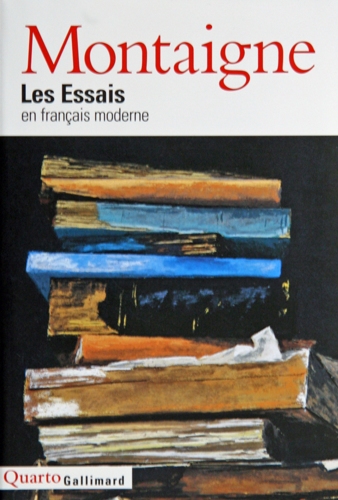
Les Essais
by Michel de Montaigne