Klaus Nomi

Klaus Nomi

Klaus Nomi started being famous in the late seventies when he performed with David Bowie in New-York. Quite unusually, the German countertenor was involved in underground and pop music, and in opera as well.

He was not only famous because of his exceptionally wide tessitura, but also because of his elfin look and usual appearances on stage as a black and white alien. Yet his career was short: he was one of the first celebrities to die from AIDS.

In November, 1982, before his home crowd in Munich, Klaus Nomi performed The Cold Song from King Arthur by Henry Purcell. Although the audience did not know, he was already seriously ill at the time, which appears obvious on the movie below. He died a few months later, aged 39 only.


Klaus Nomi - The Cold Song

What power art thou, who from below
Hast made me rise unwillingly and slow
From beds of everlasting snow
See'st thou not how stiff and wondrous old
Far unfit to bear the bitter cold,
I can scarcely move or draw my breath
Let me, let me freeze again to death.

The lyrics to this old aria appear strangely prophetic when you watch at it now, the last two lines especially... Knowing what a difficult time Klaus Nomi was having then, just adds to its intensity and frightening beauty.

Ipanema

Ipanema Beach
Ipanema Beach – Rio de Janeiro, April 2007

The World Congress of Nephrology was taking place in Rio de Janeiro and I was there!

For several months, I had waited to go to this dreamy city, and hoped I could visit it a little between sessions. I certainly was there for working, yet not every communication in a convention is interesting: you usually go from one session to another then, and listen to the talks about topics you're interested in only. Hopefullythen, there are a few gaps in your schedule, when there is really nothing on the programme you feel worth attending. You may then leave the convention centre for one hour or two without guilt, and visit the place.

In Rio de Janeiro, it was not possible though, because the Convention Centre was located in an almost deserted neighbourhood, far away from the city centre, beaches, stores, everything.

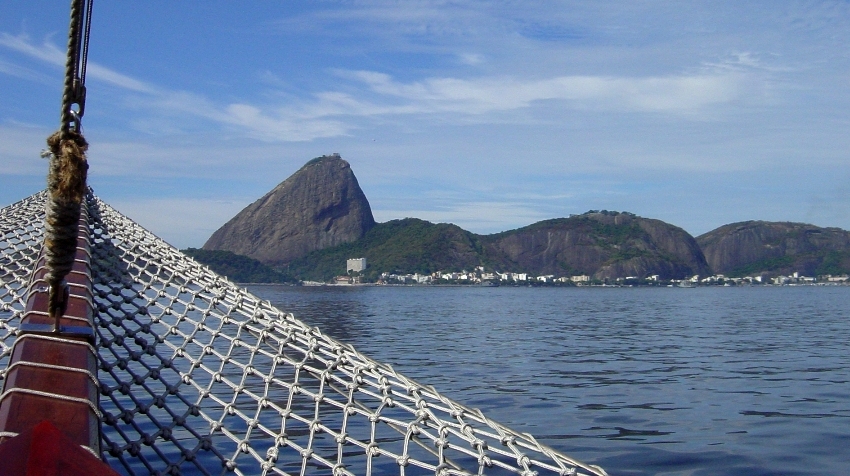
Sugar Loaf
Rio de Janeiro's Sugar Loaf – April 2007
Pic taken from a boat on Guanabara Bay

On the last day then, I decided not to go to the congress at all. Instead of taking a bus at 7:00 again, I remained downtown and played the perfect tourist: I took the cable-car to the Sugar Loaf, went round the Botanical Garden, strolled around in Old Rio streets, went on a two-hour cruise on Guanabara bay, had a swim in the ocean at Ipanema beach, and on the evening, at Ipanema also, I went to the Vinícius Piano Bar, a famous Bossa-Nova club in Vinícius de Moraes street.


Toni Barreto sings Garota de Ipanema
by Tom Jobim & Vinícius de Moraes
There were about 50 people in the club only, and it was packed. Locals mainly, which was of good omen for the music to come. The Vinícius Piano Bar is in the same street as a restaurant called A garota de Ipanema — what the famous song Girl from Ipanema is called in the original Brazilian version.

The place is where Vinícius de Moraes, Antonio Carlos (Tom) Jobim and João Gilberto, in the early sixties, used to ogle a beautiful girl called Heloisa Pinheiro, on her way to the very same Ipanema Beach where I was swimming a few hours earlier. A new song was born, and a new musical genre, Bossa-Nova.

Drinking caipirinhas and eating a very good meal of which I forgot the name, I listened to a talented singer called Toni Barreto, who accompanied himself on the guitar while singing compositions of his own and Bossa-Nova standards such as Águas De Março, Água De Beber... and Garota de Ipanema, of course.

Eclipse

There was a lunar eclipse last night, you could see in Europe and Africa essentially. From about 9:30 pm onwards, the moon progressively took an unusual coppery colour, when every first light and sunset in the world focused on its surface.

A lunar eclipse occurs when the moon enters the Earth's shadow. One would think it looks darker, more greyish than usual. Yet, on the contrary, it turns red, because the atmosphere of the Earth of the Sun, and changes its colour.

The partial eclipse reached its peak shortly before midnight. Then the moon progressively returned to its usual paleness. It was time for me to go to bed, and read poetry by Charles Baudelaire again.

-:-:-:-:-:-:-:-

Tristesses de la lune
(Charles Baudelaire)

Tristesses de la lune

Ce soir, la lune rêve avec plus de paresse ;
Ainsi qu'une beauté, sur de nombreux coussins,
Qui d'une main distraite et légère caresse
Avant de s'endormir le contour de ses seins,

Sur le dos satiné des molles avalanches,
Mourante, elle se livre aux longues pâmoisons,
Et promène ses yeux sur les visions blanches
Qui montent dans l'azur comme des floraisons.

Quand parfois sur ce globe, en sa langueur oisive,
Elle laisse filer une larme furtive,
Un poète pieux, ennemi du sommeil,

Dans le creux de sa main prend cette larme pâle,
Aux reflets irisés comme un fragment d'opale,
Et la met dans son coeur loin des yeux du soleil.

Charles Baudelaire

Sorrow of the Moon

More drowsy dreams the moon tonight. She rests
Like a proud beauty on heaped cushions pressing,
With light and absent-minded touch caressing,
Before she sleeps, the contour of her breasts.

On satin-shimmering, downy avalanches
She dies from swoon to swoon in languid change,
And lets her eyes on snowy visions range
That in the azure rise like flowering branches.

When sometimes to this earth her languor calm
Lets streak a stealthy tear, a pious poet,
The enemy of sleep, in his cupped palm,

Takes this pale tear, of liquid opal spun
With rainbow lights, deep in his heart to stow it
Far from the staring eyeballs of the Sun.

Transl. Roy Campbell, Poems of Baudelaire
(New York: Pantheon Books, 1952)

Sometimes One Must Jump In

Saint-Alexis-des-Monts, Québec — July 2005

Sometimes one must jump in

When you do that

You might wind up over your head

Or perhaps

You will float downstream

Worrying if there are rocks below

But when one stands

On riverside for too long

Then one is thinking too much

La Bise

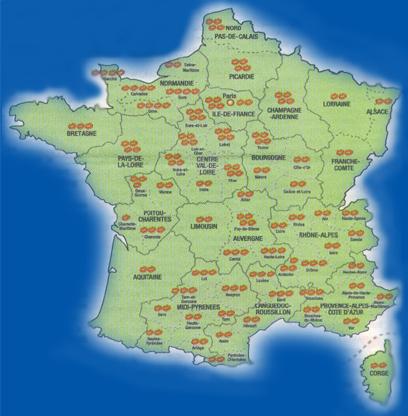
Kissing Customs Regional Distribution in France
More than one year ago, I wrote a in France, almost a national sport here. Yet it is way more interesting to know of La Bise (to be pronounced 'beez'), these quick kisses the French are used to exchanging all the time.

Careful here though: you'd better not mix up a French Kiss and a Bise. I am pretty sure you don't need an explanation about what a French kiss is, do you? Let's focus on the bise then.

Although a word in the singular, la bise refers to a couple of pecks on the checks given and received when you say hello or good bye. Men in France usually shake hands and don't kiss other men but close relatives such as father and son, or brothers. Women usually don't shake hands of other women they know. They kiss each other. Between a man and a woman, la bise is also the usual way to greet, as soon as you know the other one reasonably well. Male and female friends exchange la bise to say hello and good bye. At work, male and female colleagues will practice la bise also.

There is no standard French pattern for the number of kisses kissed in a bise. Some regions go for only one, others for three or four. Parisians once used to give four pecks, alternately put on each cheek, but modern speedy life did a lot of damage there also: it is usually made of two pecks only now. For your information, and because a scientific article such as the present one should supply detailed and accurate information to the reader, the map above displays French kissing habits among French regions. I found it somewhere on the web, but since there were a couple of errors, I amended it so that it depicts the state of the art in 2008 — isn't it mere professionalism?

Briefly said then, there is nothing suggestive in la bise, but socialization and friendship. Granted, friendship between a man an a woman is usually enlivened with just a , a flake of titillation. However, such a kiss is not at all intimate. It does not even matter if it is an air kiss, that doesn’t touch skin, or if it does.

In fact, being a Frenchman, I consider a bise as much less intimate than a hug. Just think about it: pressing your body against someone else's body... even when, say, you're a heterosexual man and the other person is male also? How weird.

Related Posts Widget for Blogs by LinkWithin

Home

Atom
Feed
Timeless Music
The Magic Flute
by W. A. Mozart


Timeless Reading
Les Essais
by Michel de Montaigne