You think English is Easy?

You Think English is Easy? OK. Therefore, you will appreciate the text that follows, I received by mail some time ago:

In what language do people recite at a play and play at a recital? Ship by truck and send cargo by ship? Have noses that run and feet that smell?

How can a slim chance and a fat chance be the same, while a wise man and a wise guy are opposites?

You have to marvel at the unique lunacy of a language in which your house can burn up as it burns down, in which you fill in a form by filling it out and in which an alarm goes off by going on.

Can you read these sentences right the first time?

  1. The bandage was wound around the wound.
  2. The farm was used to produce produce.
  3. The dump was so full that it had to refuse more refuse.
  4. We must polish the Polish furniture.
  5. He could lead if he would get the lead out.
  6. The soldier decided to desert his dessert in the desert. !
  7. Since there is no time like the present, he thought it was time
      to present the present
  8. A bass was painted on the head of the bass drum.
  9. When shot at, the dove dove into the bushes.
10. I did not object to the object.
11. The insurance was invalid for the invalid.
12. There was a row among the oarsmen about how to row .
13. They were too close to the door to close it.
14. The buck does funny things when the does are present.
15. A seamstress and a sewer fell down into a sewer line.
16. To help with planting, the farmer taught his sow to sow.
17. The wind was too strong to wind the sail.
18. Upon seeing the tear in the painting I shed a tear.
19. I had to subject the subject to a series of tests.
20. How can I intimate this to my most intimate friend?

English is a crazy language. There is no egg in eggplant, nor ham in hamburger; neither apple nor pine in pineapple. English muffins weren't invented in England or French fries in France. Sweetmeats are candies while sweetbreads, which aren't sweet, are meat. Quicksand can work slowly, boxing rings are square and a guinea pig is neither from Guinea nor is it a pig.

English was invented by people, not computers, and it reflects the creativity of the human race. Which, of course, is not a race at all.

Vowels

From the black A[lpha] of original darkness to the light of white E, and finally the violet O[mega], the last colour in the spectrum. Letters in this poem by Arthur Rimbaud are considered graphic or sound objects that have inherent meaning and ability to awaken a lot of other ones.

About two years ago, I went to an exhibition in Le Grand Palais in Paris. Italia Nova was dedicated to Italian paintings and sculptures in the first half of the twentieth century. I was amazed then to see that several Italian Futurists of the 1920's would use letters and numbers as objects in the same modern way Rimbaud had first used half a century earlier and pop-artists such as Andy Warhol would do later as well.

-:-:-:-:-

Voyelles

A noir, E blanc, I rouge, U vert, O bleu : voyelles,
Je dirai quelque jour vos naissances latentes :
A, noir corset velu des mouches éclatantes
Qui bombinent autour des puanteurs cruelles,

Golfes d'ombre ; E, candeurs des vapeurs et des tentes,
Lances des glaciers fiers, rois blancs, frissons d'ombelles ;
I, pourpres, sang craché, rire des lèvres belles
Dans la colère ou les ivresses pénitentes ;

U, cycles, vibrements divins des mers virides,
Paix des pâtis semés d'animaux, paix des rides
Que l'alchimie imprime aux grands fronts studieux ;

O, suprême Clairon plein des strideurs étranges,
Silences traversés des Mondes et des Anges ;
- O l'Oméga, rayon violet de Ses Yeux !

Arthur Rimbaud

Vowels

A black, E white, I red, U green, O blue: vowels,
I shall tell, one day, of your mysterious origins:
A, black velvety jacket of brilliant flies
which buzz around cruel smells,

E, whiteness of vapours and of tents,
lances of proud glaciers, white kings, shivers of cow-parsley;
I, purples, spat blood, smile of beautiful lips
in anger or in the raptures of penitence;

U, waves, divine shudderings of viridian seas,
the peace of pastures dotted with animals, the peace of the furrows
which alchemy prints on broad studious foreheads;

O, sublime Trumpet full of strange piercing sounds,
silences crossed by Worlds and by Angels:
O the Omega! the violet ray of His Eyes!

Arthur Rimbaud

Flower of Scotland

The Saltire flag of Scotland
(The Highlander, a Scottish Pub in Paris)

I arrived in Scotland two days ago, for a 9-day vacation trip in the country of and . News from the Castles and Highlands to come then, and from Nessie also perhaps, who knows?

Scotland is not an independent country anymore, therefore it does not have a national anthem. Yet a few songs are used instead, that convey Scottish will to differentiate themselves from the rest of Great Britain.

It is especially the case of Flower of Scotland, the beautiful, patriotic song by . Resolutely directed at the English, the song celebrates Robert the Bruce's victory against the troops of King Edward II at in 1314.

O Flower of Scotland
When we sill see
Your like again
That fought and died for,
Your wee bit Hill and Glen
And stood against him, Proud Edward's army
And sent him homeward
Tae think again.

In particular, Scots break into Flower of Scotland at the Highland Games — sometimes — and before a match by the Scottish national rugby team — always.

Edinburgh, 17 March 1990. Scotland previously defeated Wales, Ireland and France in the Five Nations Championship. Today, in Murrayfield Stadium, the last match in this championship is about to start, against the auld enemy and hot favourite, England, undefeated also. Victory in the Championship, and a Grand Slam, are at stake.

ImagePlayers are on the field. Five minutes ago, while the English team ran into the Stadium as usual, David Sole, who captains the Scots, deliberately walked his men onto the pitch, in a slow, belligerent march, to deafening cheering of the home crowd.
English against Scots. Hundred years of conflicting history. Furthermore, British Prime Minister Margaret Thatcher has experimented the Community Charge (aka Poll Tax) for one year in Scotland only, leading to massive disobedience, and riots to come shortly in the whole country.

Scotland vs England — 17 March 1990

Both teams are lined up in front of the VIP stand. Fifteen English players bravely sing God Save the Queen as strong as they can, while TV cameras slowly pass in review the staring faces of every Scot player fixed in a provocative silence. For the first time in their history, they don't sing the anthem.

Then, David Sole turns his head toward the musicians, and bagpipes start playing, while the Scottish team and whole home crowd — 50,000 souls — all together launch with fire into Flower of Scotland.

Needless to stay, Scots won the match and the Grand Slam. On that day, they just could not lose.

Bastille Day

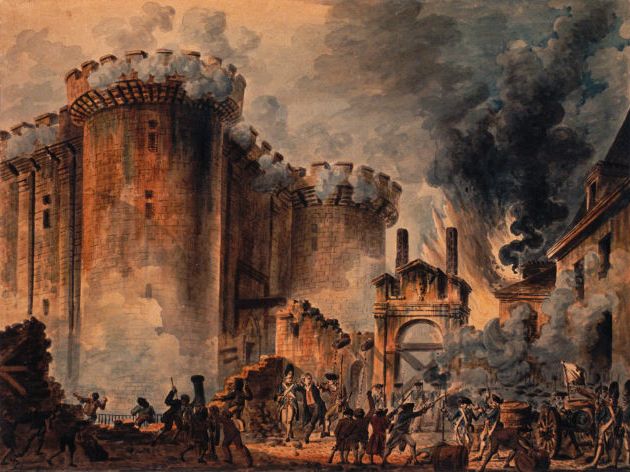
Jean-Pierre Houel — The Storming of the Bastille
July 14, 1789, by night. Louis XVI, King of France went asleep one hour ago in the Palace of Versailles, where Kings of France have resided since his ancestor Louis XIV, , made it the centre of its absolute power.

Every day, the King writes a few words in his diary. Today, he hunted for several hours as usual, so he wrote: Nothing...

His closer courtier, the Duke of La Rochefoucauld-Liancourt, has just been told about , the medieval fortress and prison in Paris. He decides to awaken the King, and breaks the news to him.

The Bastille? it has fallen? the King asks, half asleep still.

Yes, Your Majesty. A messenger just told me the prison has been taken by the people. They killed Governor de Launay and Provost Flesselles, and walked their heads on poles by the streets of Paris.

Aw, it is a rebellion! the King says.

Oh no, Sire, it is not a rebellion. It is a revolution

Firemen's Dance

Firemen's place
A lantern and the tricolour
before a fire station in Paris
Bonjour Monsieur ! the guy told me with a big smile while I was quietly walking in the boulevard. How about a couple of tickets?

Damn, I was lost in thought, I did not see him. A fireman, selling raffle tickets for the firemen's dance. Firemen have been everywhere in Paris for several weeks. I succeeded in steering clear of them until now, but I got nabbed at the end! No luck, definitely!

French people celebrate their national holiday, Bastille Day, on July 14. Le 14 Juillet, as they call it, commemorates the storming of the Bastille fortress on 14 July 1789, an event that marked the beginning of the French Revolution. Although the prison held few prisoners at the time, its storming has become a symbol of freedom and fight against oppression for the French.

The holiday symbolizes the birth of the Republic, whose motto is Liberté, Égalité, Fraternité (Freedom, Equality, Brotherhood). Firemen are undoubtedly a good illustration of the brotherhood part of the motto, all the more since the French are not that fond of other people who wear a uniform.

Bastille Day's festivities begin on the evening of July 13 with free dances organized in the streets of every town, and especially in every fire station — it is Le bal des pompiers, Firemen's Dance. Hence the tickets the guy wanted to sell me, for a tombola during the dance at his fire station. He'd got some nerve, don't you think? After all, if you decide to go to a fire station tonight, you'll see a lot of gorgeous women for sure, but they won't even look at you, interested as they will be in firemen only. And this, frankly speaking, is something I can hardly understand: these guys in uniform are young, strong, handsome, cheerful, and they save lives... so what?

So, how about a couple of raffle tickets? the fireman repeated.

Well, see, I answered hypocritically with a friendly smile, I'd better not buy any. My wife and daughter will be so glad to buy them by themselves, you know!

Related Posts Widget for Blogs by LinkWithin

Home

Atom
Feed
Timeless Music
The Magic Flute
by W. A. Mozart


Timeless Reading
Les Essais
by Michel de Montaigne