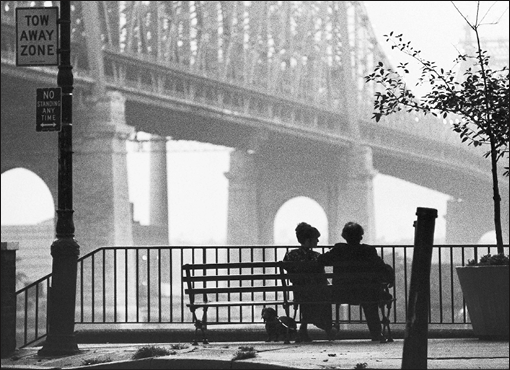
Queensboro Bridge

Manhattan by Woody Allen (1979)
"Fifty-five seconds. That's the time Woody Allen needed, in 1979, to make this place — in his dear Upper Side, by the East River — one of the most famous places in the world. A pilgrimage as much necessary to lovers than Venice [...] This sequence is made in the image of Woody's Manhattan: it's a dream, a fantasy. One more time, artifice created the reality of art."
(Pierre Murat)

Simon & Garfunkel – The 59th Street Bridge Song (Feelin' Groovy)
Every week on Wednesday, I will receive Telerama, a French culture magazine to which I subscribe. I have not received this week's issue of the magazine though, because I left home before mail distribution yesterday for a one-week trip to New-York City. However, I found out what is the main topic of this week's issue of the magazine when I reached Charles de Gaulle airport: the cover coincidentally ran New-York, 24 hours in the life of a city. Of course, I bought it and read it in the plane.

I translated into English a few sentences of an article by Pierre Murat about New-York and the cinema, that was illustrated with the iconic photo above, part of the famous sequence in Woody Allen's movie Manhattan.
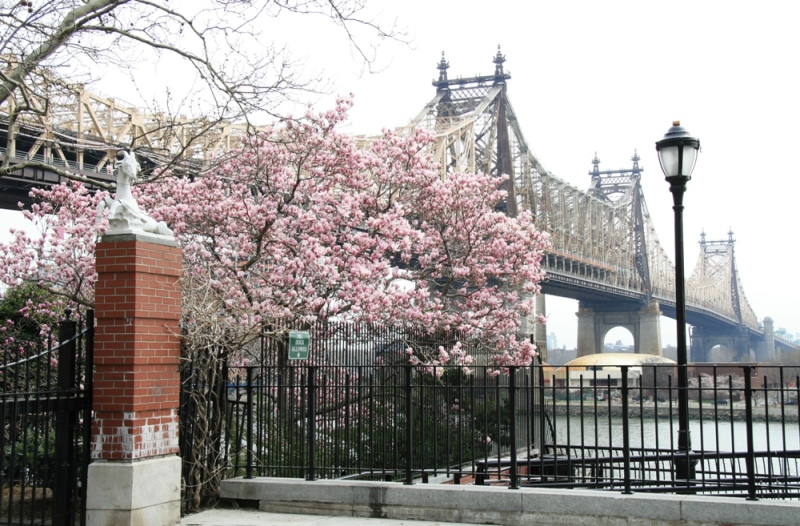
Queensboro bridge, Upper East side, Manhattan
Queensboro bridge.
Upper East side, Manhattan — April 2008

Woody Allen is considered one of the main US film directors by the French – whereas I've been told he is not acknowledged as such in his country – and I love Manhattan particularly.

I have wanted for years to be in this place, in the same way people from elsewhere may long to go and see the banks of the Seine River. Because of the movie by Woody Allen, because of the song by Simon and Garfunkel also. So, a couple of hours after the plane landed only, I was at the Eastern end of the 59th Street in Sutton Place Park and was gazing at the Queensboro Bridge.

It was 10 am in Paris when my plane took off yesterday. It was about 5 pm in New-York on the same day when I took the picture on the right. A dramatic scene shift in a few hours from Amélie by Jean-Pierre Jeunet to Manhattan by Woody Allen, sort of.

A New Shape for the Eiffel Tower?

Eiffel Tower — New shape
Built between 1887 and 1889 as the entrance arch for the Exposition Universelle, a World's Fair marking the centennial celebration of the French Revolution, the Eiffel Tower has become a global icon of France, and one of the most recognizable structures in the world.

It wight have a new look next year though, in time for its 120th anniversary: Serero Architects of Paris recently won an open competition to redesign its public viewing platform and reception areas. According to the new plan, the top floor plate of the tower would be extended by grafting a high performance carbon Kevlar structure on it.

A spokesperson for Serero explained that the plan to restructure the top of the tower aims to increase the quality of access. I would be useful indeed, because the average waiting times for the tower's elevators currently run at more than an hour at peak times.

New Top of the Eiffel Tower
The New Top
The design is already causing controversy. Some think it would be pleasant to see the Old Lady with a new appearance. On the opposite, critics question the wisdom of tinkering with the famous silhouette and spending money on upgrading a tourist attraction which attracts 6.9 million visitors a year. Others wonder if this is something else than a promotion campaign for the architect team... It would not be the first time that the Eiffel Tower is used for promoting a hoax.

High Speed Train

I am in a Thalys TGV right now, on my way to Brussels where I'll spend the week-end. TGV is usual acronym for Train à Grande Vitesse (High-Speed Train). Thalys TGVs are international high-speed trains using tracks in France, Belgium, Germany and The Netherlands. Part of the tracks is shared with Eurostar trains that go from Paris or Brussels to London via Lille and the Chunnel — the Channel Tunnel — and with French domestic TGV trains. Thalys trains are red, Eurostar are yellow, French domestic TGV are either orange or iron grey.
Through the window pane, I watch the scenery flash by. Travelling that fast is somewhat magic, even more than taking a plane: no need to reach an airport outside the city, fewer controls, no waiting time. I arrived to the train station five minutes before the departure, showed my ticket to the collector, went to my seat... a few minutes later the train was racing along through the countryside at 300 km/h.

I'll be in Brussels one hour and twenty minutes after I left downtown Paris. Beyond Brussels, the main cities Thalys trains reach are Antwerp, The Hague, Rotterdam, Amsterdam, Liège, Aachen and Cologne... yet I won't go there today.

Global Responsibility

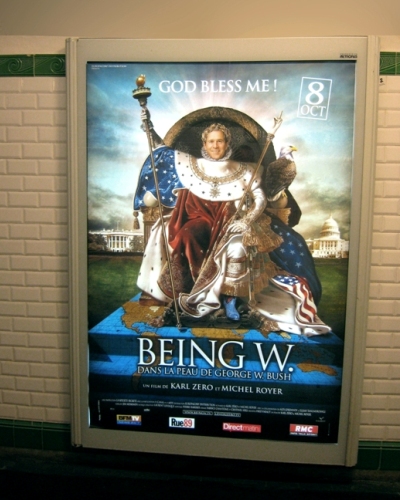
Karl Zero's 'Being W.' Poster Movie
A poster of Karl Zero's movie 'Being W.'
in a metro corridor in Paris
U.S.Americans will elect their new president on November 4, 2008. Although the total U.S. population (around 300 million) is only 2,2% of the whole world population, elections in this country are the most important in the world. First, because the U.S.A. has remained the sole military superpower after U.S.S.R. collapsed; secondly, because it has the world's largest economy, if you don't take the European Union as a single entity.

Georges W. Bush, the most controversial U.S. President for decades, to say the least, has been in charge for eight years. His time is almost over at last, phew. The next U.S. President will hardly do worse than him, but who will that be? Hillary Clinton? John McCain? Barack Obama? People all around the world are very concerned with this question, that raises a paradox: they cannot vote in the U.S. election obviously, even though its consequences — in as crude terms as life and death — will be more important for many of them, in the Middle East especially, than for U.S. citizens.

It is fairly understandable that U.S. citizens vote according to personal and internal reasons essentially. It is the same in every country. Yet not every country has a commitment in world's affairs and an army like the U.S.A. has. It is a pity then that many U.S. people are little interested in international politics, and often ill-informed about countries, people, and cultures abroad... 97 percent of the world, that is.

U.S. citizens should not hide their head in the sand: fairly or not, their votes carry a global responsibility. The choice they will make at the end of the year is of overwhelming importance for people all over the world — these 6 billion+ people that will not vote on November 4, 2008.

Torture

Algerian prisoners — Algiers, 1960

The following takes place 50 years ago, when France was still an imperialist country with colonies.

During the Algerian War [1954-1962], the French essentially fought the Algerian National Liberation Front (FLN), engaged in violent acts of guerrilla warfare, bombings and assassinations.

At the time, the French military denied using torture, or rarely admitted it but justified it with claims that they were leading an operation of peace against terrorism by the FLN. Later though, several high-ranked officers aknowlegded there was generalized torture by the French military, following orders of the politicians in charge of the country.

No one shall be subjected to torture or to cruel, inhuman or degrading treatment or punishment.
(Universal Declaration of Human Rights. Article 5)
The social-democratic government of Prime Minister Guy Mollet had given a free hand to the occupying forces in Algeria to carry out torture. In June 1956, the National Assembly accepted Mollet's proposal to set aside individual freedoms in Algeria and permit the gendarmes and soldiers stationed there to use what was officially called extended questioning, coercive measures or special treatment.

Because FLN fighters were not looked upon as enemy forces but terrorists, The French Republic did not consider its military tied by the Geneva Conventions, France had signed several years earlier. Detainees were thus not granted prisoner of war status. On the contrary, since they were looked upon as terrorists, they were deprived of the rights that are legally entitled to belligerents during a war.

Image
Shortly said, torture was an integral part of France's war policy in Algeria. Part of the daily practice included mass rapes, submerging victims in freezing water or excrement, and repeated use of electric shocks. Even in the Algerian hinterland, where there was no electricity, electric shock torture was carried out using the so-called Gégène, using the generation system intended to radio stations.

Yet when the use of torture became public knowledge in France, support for the war in Algeria quickly dwindled. After the French military won the battle of Algiers, French Président Charles de Gaulle decided the French should leave Algeria and give it back to the Algerians — which was the only possible solution, for that matter. In a March 1962 referendum, almost 90 percent of voters in mainland France backed the Évian Accords that ended the hostilities and gave Algeria its independence.

At least 400,000 Algerians were killed during the war — some say one million. In 2008, after several decades, many dramas and slaughters, Algeria still is not really a democratic country.

Related Posts Widget for Blogs by LinkWithin

Home

Atom
Feed
Timeless Music
The Magic Flute
by W. A. Mozart


Timeless Reading
Les Essais
by Michel de Montaigne