Maria Callas
Sunday, September 16, 2007 by Billy
 | The Gods were bored, |
| Thirthy years ago, the most famous Greek since Socrates died in her appartment in Paris. | |
Sunday, September 16, 2007 by Billy
| | The Gods were bored, |
| Thirthy years ago, the most famous Greek since Socrates died in her appartment in Paris. | |
Saturday, September 15, 2007 by Billy

You probably heard of this study, that was reported at great length in the media all over the world. The paper concluded that many older adults are sexually active. Okay. Nothing that surprising or brand new here, yet interesting to know.
Only, there was another great article published in the very same issue of the New England Journal of Medicine that received much less attention from the media. Its title was Healing Our Sicko Health Care System, by Jacob S. Hacker, Ph.D. The article dealt with the last movie by Michael Moore bearing this name in a level-headed way, not at all hagiographic of a movie of which the limitations were underscored. Quoting its first paragraphs:
There is a scene in Sicko — Michael Moore's controversial new film about U.S. health care — that captures both the power and the limits of Moore's cinematic polemic.
A mother is speaking about her 18-month-old daughter, Mychelle, who became ill one evening with vomiting, diarrhoea, and a high fever. At the nearest emergency room, Mychelle is treated by a physician who suspects, rightly, that she has a life-threatening bacterial infection. But rather than give her antibiotics, the doctor calls her insurer, whose physician-gatekeeper tells him that Mychelle is not covered at the hospital and must be taken to another facility. The doctor repeatedly says that Mychelle needs care, and he is repeatedly told that she must be transferred first. Finally, nearly 3 hours after arriving at the hospital, wracked by seizures, Mychelle is taken to the approved facility. She dies 15 minutes later.
As Mychelle's mother, Dawnelle Keys, recounts this awful sequence of events, a swing hangs empty in the background. Even if we had not witnessed multiple tragedies already — a woman seriously injured in a car crash whose insurer denies payment because she doesn't obtain "prior authorization" to visit the emergency room, an elderly couple who move into their daughter's storage room because they cannot afford their medicine, an uninsured man forced to choose which of his two fingers to have reattached after an accident — we'd know how the story ends.
And yet, when the moment comes, and Dawnelle Keys's voice cracks as she describes losing her daughter, the effect is still devastating. We can't but wonder how our rich, powerful country can let so many citizens face such unnecessary pain and loss. How could a government "of, by, and for the people" fail so miserably to protect the people from such vast and preventable tragedies?

A few years ago, USA was ranked 37th in the World Health Organization's ranking of the world's health systems, and at the same time, about $5 billion a month are spent in Iraq? There must be an error somewhere.
Thursday, September 6, 2007 by Billy
Sunday, August 5, 2007 by Billy
 Afghan Girl — Steve McCurry, 1984 |
I spent several hours this morning walking in the 6th arrondissement (administrative district) of Paris, playing a treasure hunt game. There was no treasure actually, nor hurry or competition. It was only a game with the family, where we found our way according to hints taken from a dedicated book. It was fun.
We strolled around for about four hours in the Latin quarter, walking from street to street in an area usually crowded with people, but almost empty in this sunny morning of an August Sunday. I enjoyed a lot seeing in an unusual way places I think I know well, as if I were a tourist walking in a foreign city.
It was not in the riddle book for sure, but it was not a surprise either, since I read about it some days ago in a photo magazine: Steve McCurry exhibits at a Gallery rue de Seine at the moment. It was then planned we would have a look, if by chance our journey brought us in this street, and it did.
Steve McCurry is a photojournalist who became famous for his coverage of the Russian invasion of the Afghanistan in 1979. Disguised in native garb, he crossed the Pakistan border into rebel-controlled Afghanistan just before the invasion. When he emerged, he had rolls of films sewn into his clothes. His coverage of the conflict won the Robert Capa Gold Medal for Best Photographic Reporting from Abroad, an award dedicated to photographers exhibiting exceptional courage and enterprise.
You probably know the famous picture displayed above, the portrait of a young Afghan Girl with unforgettable piercing look, whose identity remained mysterious for years. Her photograph was exhibited there this morning, with several other great photos.
Thursday, June 28, 2007 by Billy
 Casa Batlló — Barcelona, June 2007 |
It is not surprising that when it was being built, people started to call it "Casa dels ossos" (House of Bones) : the entire facade of the Casa Batlló looks as if it is covered with bones, skulls, shoulder blades or hip bones, in the form of bone coloured balconies, as well as real visions of shinbones and fibulas on the lower part.
A little round turret on the top, crowned with a four-armed cross, looks like a huge sword thrust into a roof similar to a dragon's back.
Obviously, the tradition of Sant Jordi (Saint George, who killed the dragon), very popular in Catalonia, inspired Gaudí here, as it did in several occasions elsewhere also.
Yet you can see many things rather than a killed dragon and the bones of his victims in the outside of the Casa Batlló. You can see a representation of Venice carnival, with masks, confetti and arrays of colours. Or some kind of a vertical lake, with water reflections, water plants and underwater caves. And finally, all and none of these, but abstract shapes and forms designed for their own sake and in a coherent interaction. In any case, the facade has nothing to do with the natural properties of stone with which the house has been built, and this is typical feature of buildings by Gaudí.
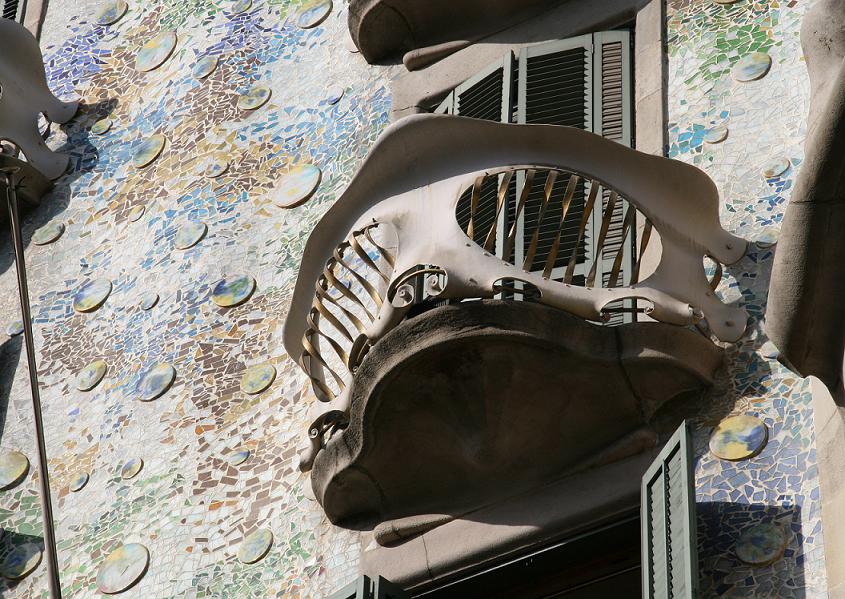 A balcony |
His life's work, the Church of the Sagrada Familia — not finished yet, more than 120 years after the building started — is also an explosion of life where plants, animals, human beings and saints palpitate through the stone.
La Casa Batlló was called after the name of its owner, who commissioned Gaudí to tear down the old apartment building and reconstruct a new one. Not only Gaudí conceived the building as an architect, but as a project manager and a foreman. He gave directly orders to the workmen on the scaffolding, telling them exactly where to put each coloured piece.
When I arrived there last Sunday, it was 9:00 am exactly. They were just opening the gates. The night before had been sleepless for many Barcelonians, because of San Juan celebrations. There was still little people in the streets and no tourist had reached the place yet. I was alone. For about 10 minutes, the Casa Batlló was mine.
This house is more than a building, it is a myth of art.The windows provide natural light everywhere inside, even to the most interior rooms and stairs, and every nook, every detail contains a surprise. Here come a couple of pictures I took in there. You'll find much more, and better ones, on its dedicated website.
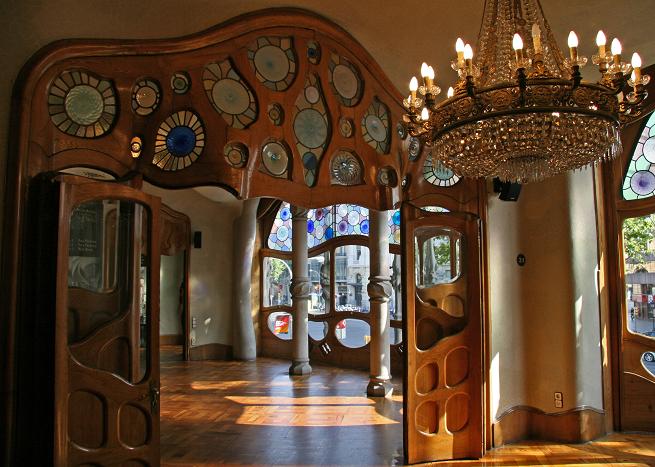 Main room on the first floor | 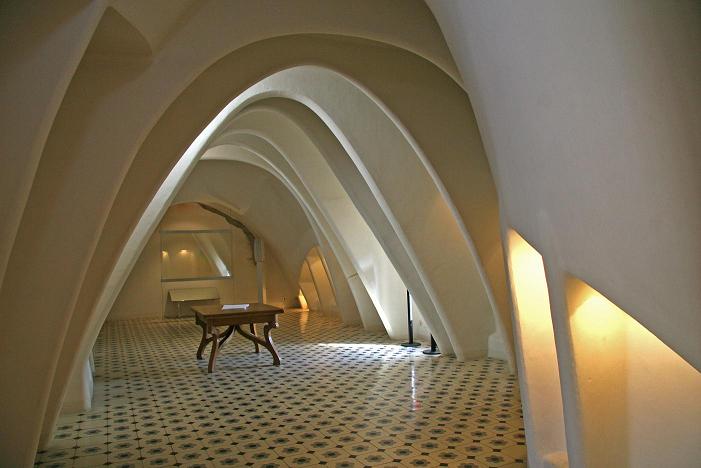 Room on the last floor |
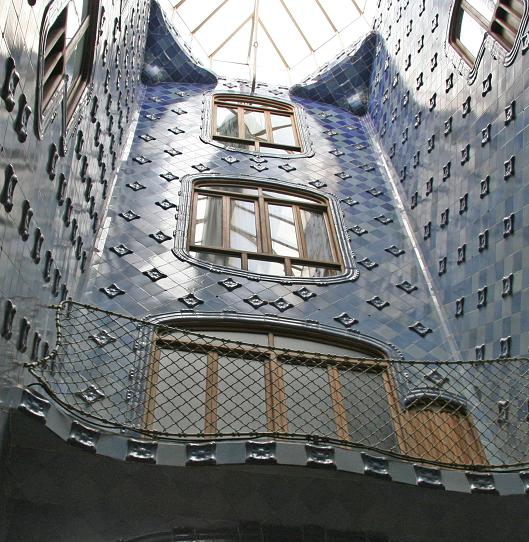 The light shaft |
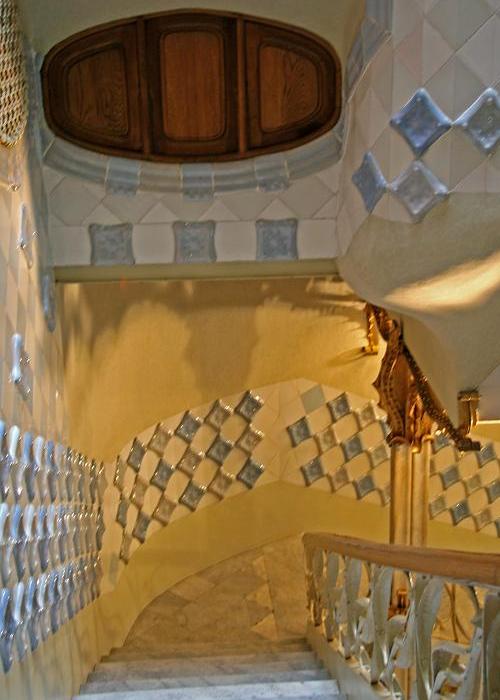 Stairs | 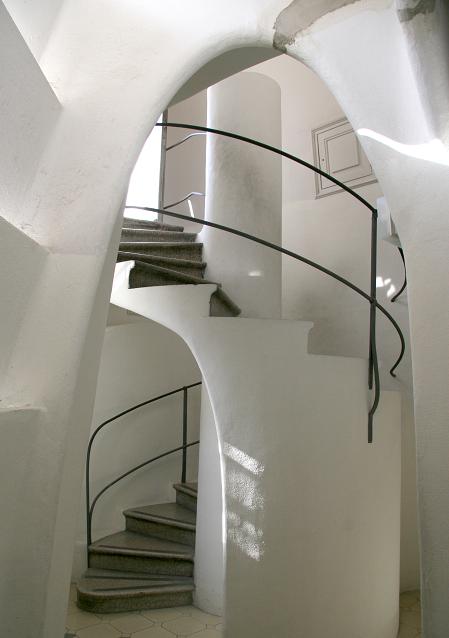 Stairs to the roof | 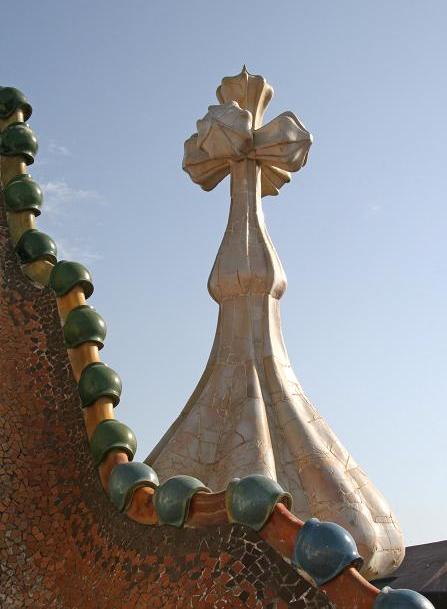 Cross on the roof |


|
Home |

|
Feed
|
Les Essais
by Michel de Montaigne |

Copyright 2008 | All Rights Reserved.