Showing posts with label life. Show all posts

Paris in August

August in Paris
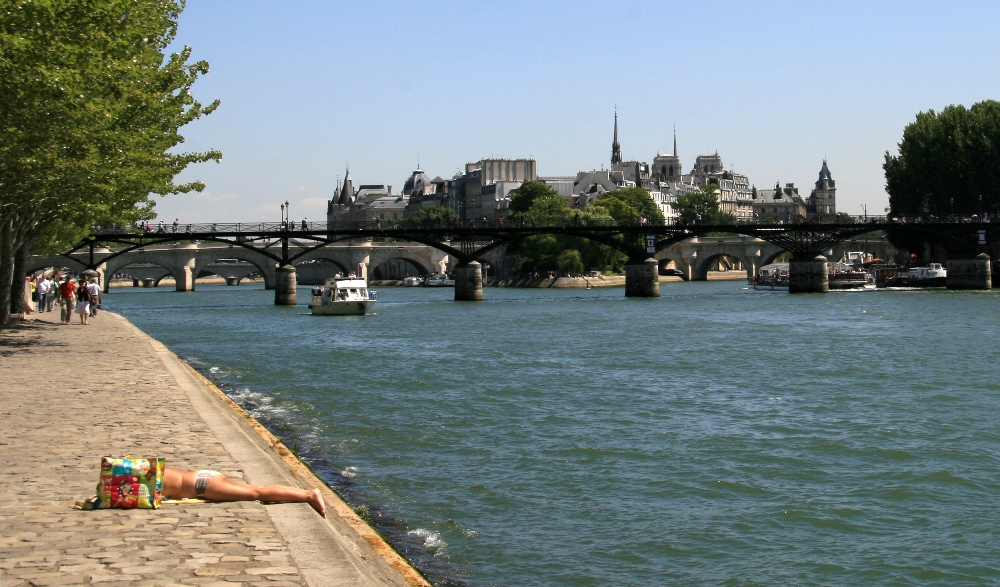
Taking a Sunbath in Paris

I love Paris in August. Because many people have the month of August off in France, several hundred thousand Parisians then leave the city for weeks. Fewer Parisians, many tourists, warm and sunny weather usually, there is a special atmosphere. The air is filled with tranquillity, like a Sunday that would last for one month.

You must go and work every day as usual; you feel as if you were in vacation though. For lunch, you will improvise a picnic with colleagues, in the or the . On the evening, you will stroll around, have a beer at the terrace of a café. You will sit on the grass in a garden perhaps, to take a nap or read a book.

It's August. The eighth month in the year, and a blessed month in Paris, when the City of Lights gets rid of its usual frenzy. Traffic jams, subway's crowd, all that makes it a hard place to live in sometimes, has disappeared for a while. The city reveals itself, warm and cheerful. It has put on its leisure clothes, for the sake of tourists, most of whom don't realize how special the atmosphere is.
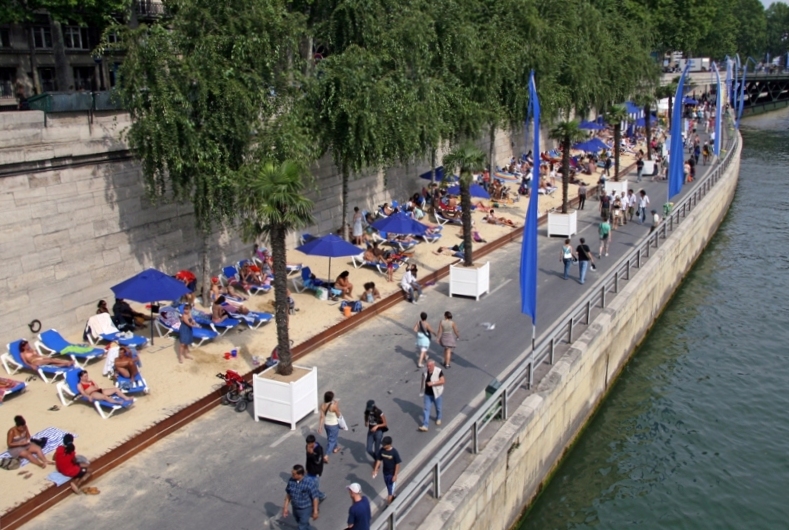
Paris Plage
Paris-Plages, on the banks
of the Seine River

Paris is weightless in August. It's culture without stress, moving around without hurry. No more queues in front of movie theatres. No more traffic jams on the . You will find a parking space anywhere at once, and it's free! You can sit in the bus. Metro cars are empty.

You can take a (Paris' self-service bike-hire system) safely and bike everywhere, even on the .

    [BbN #8]
You may decide to go to ('Paris-Beaches', eighth occurrence this year) and have a sunbath on the banks of the Seine River or Bassin de la Villette, why not? You feel as if you were a tourist yourself.

In August, Parisians rediscover space in a city that misses it so much during the rest of the year. La Joie de Vivre is back, it is almost Italy. Oh yes. I do love Paris in August.
2 Lovers —> 1 Couple

— 2A — At the beginning

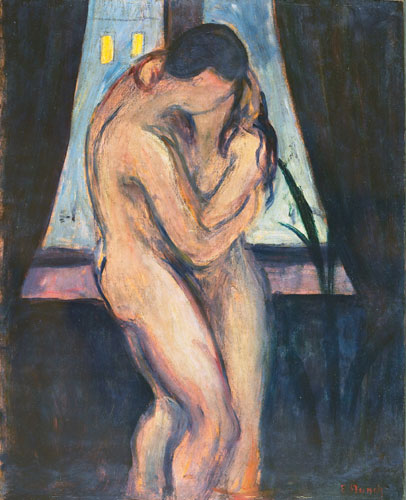
The Kiss by Edvard Munch
Kyss [The Kiss] by Edvard Munch (ca. 1895)
Oil on wood, 38.7 x 32.5 cm — Munch-museet, Oslo.

Önceleyin [At First] by Cemal Süreya

Önce bir ellerin vardı
Yalnızlığımla benim aramda
Sonra birden kapılar açılıverdi
Ardına kadar,
Sonra yüzün onun ardından
Gözlerın
Dudakların
Sonra her şey çıkıp geldi.
At first there were your hands
Between me and my loneliness
Then the doors opened
Suddenly all through,
Then your face,
Your eyes,
Your lips
Then everything came up.
Bir korkusuzluk aldı yürüdü çevremizde
Sen çıkardın utancını
Duvara astın
Ben masanın üstüne kodum kuralları
Her şey işte böyle oldu önce.
A fearlessness surrounded us
You took off your embarrassment
And hang it on the wall
I left the rules on the table
Everything happened this way at first.

-:-:-:-:-:-

— 2B — I Don't Want to Be a Couple

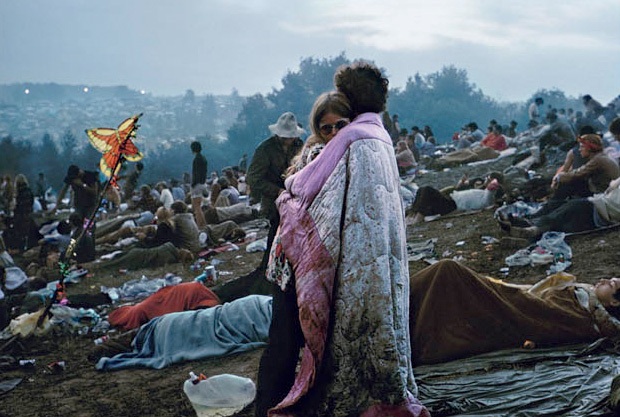
Woodstock by Burk Uzzle
Woodstock  by (1969)
[This photo has become famous as the cover of the first Woodstock album]

I don't want to be a couple.
Couples are stupid.
Couple kiss all the time.
Couple moan.
Couple fight.

I want to kiss you when I want.
I want to leave you when I want.
I want to come back when I want.
I want to be free.

I don't want to spoil everything.
I don't want to be a couple.

-:-:-:-:-:-

— 2C — Looking Together in the Same Direction

The Kuss by Gustav Klimt
Der Kuss [The Kiss] by Gustav Klimt (1907)
Oil and Gold Leaf on canva
s, 180 x 180 cm
Osterreichische Galerie, Vienna
Years pass.

S'aimer, ce n'est pas se regarder l'un l'autre, c'est regarder ensemble dans la même direction.
[Loving is not looking at each other, it's looking together in the same direction.]
 
in Terre des Hommes [Wind, Sand and Stars]

-:-:-:-:-:-

— 2D — Old Lovers


La chanson des vieux amants [Song of Old Lovers] by

[...] But finally, finally,
It took us a lot of talent
To be old without being adult.

Oh my love
My sweet, my tender, my marvellous love
From bright dawn until the end of day,
I still love you, you know,
I love you.

And more the time marches on
The more time torments us.
But isn't it the worst trap
For lovers to live in peace?

Two of Hearts
[BbN: #2]

Toilet Paper

Dollars
I found the roll of toilet paper displayed on the left in La Grande Épicerie du Bon Marché, a big department store close to my building. I could not help but buying it.

After my attention has been attracted on the topic, I could not help either but looking for up-to-date information about toilet paper. The funny thing is: I found a lot! Especially, several detailed articles about how people would manage, before paper, hence toilet paper, was invented, including a chapter of the novel by François Rabelais, Gargantua, published in 1534.

ImageFocusing on the design of toilet tissue in the 21st century though, I found out that there are dozens, even hundreds of designs: TP with euros, frogs, razor blades, funny tales, whatever. Then, of course, there are collectors for it.

If you are a Sudoku addict for instance, I have good news for you: you can now find Sudoku-printed toilet paper rolls. Hmm... Making reference to a previous entry, I wonder if the wrapping clearly stipulate: 'Don't fill in the grid after you used the paper?''

WARNING: the video below is in bad taste undoubtedly.
(Yet it is funny)


Sandy Toilet Tissue - For Men.

Dubrovnik, in the Off Season

A rainbow in Dubrovnik
A rainbow in Dubrovnik — March 11, 2009.

Dubrovnik this evening bears scarcely any resemblance with the sunny, exuberant city they talk about in the guide I read in the plane this morning.

The crowd that was supposed to fill the streets of the old town, was made up in actual fact of one tourist with a camera, a couple of local women doing the shopping for tonight's dinner, and half a dozen schoolboys messing around at a bus stop.

Hors-saison (Off Season)
by Francis Cabrel

It has been raining the entire day in Dubrovnik, and now it's getting dark. We're in the off season undoubtedly.

The atmosphere makes me think of a song by Francis Cabrel, that says:

C'est le silence qui se remarque le plus,
Les volets roulants, tous descendus,
De l'herbe ancienne dans les bacs à fleurs sur les balcons,
On doit être hors-saison.

La mer, quand même, dans ses rouleaux continue
Son même thème, sa chanson vide et têtue,
Pour quelques ombres perdues sous des capuchons,
On doit être hors-saison...

What you notice most is silence,
Rolling curtains, which are all down,
Some old grass in planters, on the balconies
We're probably in the off season.

Yet the sea, with its rollers, goes on
Its only theme, its empty and obstinate song,
For a few shadows, lost under their hoods
We're probably in the off season...

Yet, when I went out of the hotel a moment ago, there was a wonderful rainbow over the ramparts of the old town and the sea, standing out against the dark sky. Without rain, you cannot have rainbows, can you? Hurrah for the rain then. Anyway, a few drops of water will not prevent me to get to know the ancient city of Ragusa tomorrow.

Happy Unbirthday!

Well, let's see...

(Checking my organizer) Today is October 23... nothing written here.

(Checking my address book) No, no one among my relatives. None of my friends either.

(Checking my memo board) Nope, no one actually. I knew I was not mistaken! Nobody I know has his birthday today!

Happy unbirthday, everyone! A very merry unbirthday to you! (yes, you)

Loss

I had the following talk once, with a friend who does not work in the medical field:

— As a kidney physician, you are in charge of a lot patients on dialysis, and see many people with terrible diseases. It must be tough. I admire doctors, I could never be one of them. I could not endure the death of a patient, it would depress me so much!
 
— It may take a toll, yes. With experience however, we physicians learn not to feel too guilty when a patient of ours die. If we did our best in conscience, we try to think we did the best.
 
— But this cannot be true every time... I know I would keep on believing that I could have done better.
 
— Oh yes, it happens. Sometimes I feel guilty because I was not able to do more. Sometimes, I think I should have managed the situation otherwise. It happens. Most often though, I know it was not possible to prevent the evolution. At least I helped for a while hopefully...

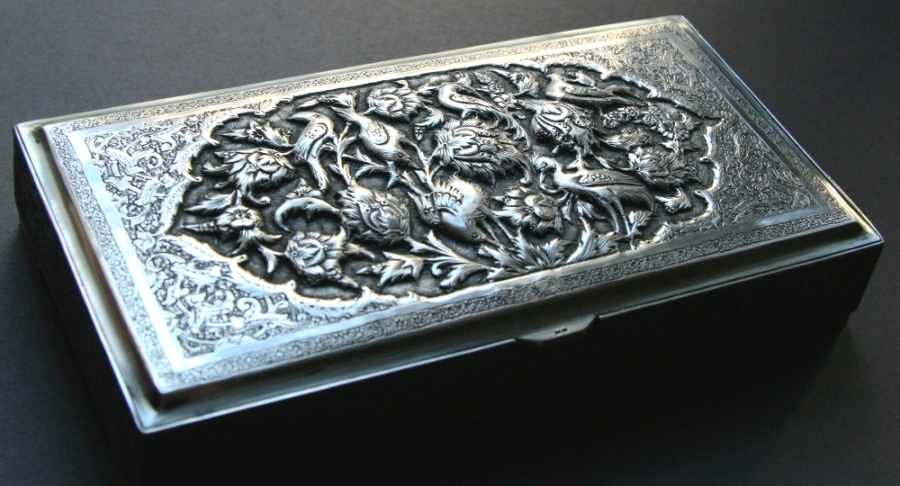
I was given this beautiful silver case as a New Year present by an Iranian 85 year-old man who had been my patient for several years before he died lately.

He had left his country in 1979 because of the Islamic Revolution. Once a political opponent, and now a person with a chronic renal disease who depended on dialysis for his survival , he painfully knew he would never see his homeland again. He was always cheerful and friendly to everyone though.

In fact, the old gentleman did not give me the box as such. He gave me chocolates... put inside the silver box. He was an upright and nice person I had become much attached to. I think of him often.

The Little Prince

There are few things about which I don't have any doubt, but here is one: by Antoine de Saint Exupéry is one of the greatest books ever.

I read Le Petit Prince — the original French title of the novella — for the first time when I was about eight, and I have read it again a lot of times since then... it is worth it, and also, this great book is a small book.

It is a children's story, yet it is also a philosophical tale, a poetical fable. The novella contains the best lessons of life, love and friendship you can read. Like Alice in Wonderland, it is a novel à tiroirs, with several levels of reading, in which everyone will find something different. Also, you will not find the same thing in it when you read it as a child, a teen or an adult, when you are young... or not that young any more.

— To me [the fox said], you are still nothing more than a little boy who is just like a hundred thousand other little boys. And I have no need of you. And you, on your part, have no need of me. To you, I am nothing more than a fox like a hundred thousand other foxes. But if you tame me, then we shall need each other. To me, you will be unique in all the world. To you, I shall be unique in all the world [...] And then look: you see the grain-fields down yonder? I do not eat bread. Wheat is of no use to me. The wheat fields have nothing to say to me. And that is sad. But you have hair that is the color of gold. Think how wonderful that will be when you have tamed me! The grain, which is also golden, will bring me back the thought of you. And I shall love to listen to the wind in the wheat.
[...]
So the little prince tamed the fox. And when the hour of his departure drew near...
— Ah said the fox, I shall cry.
— It is your own fault, said the little prince. I never wished you any sort of harm; but you wanted me to tame you.
— Yes, that is so, said the fox.
— But now you are going to cry! said the little prince.
— Yes, that is so, said the fox.
— Then it has done you no good at all!
— It has done me good, said the fox, because of the color of the wheat fields.
[...]
— Goodbye, said the fox. And now here is my secret, a very simple secret: It is only with the heart that one can see rightly; what is essential is invisible to the eye.
— What is essential is invisible to the eye, the little prince repeated, so that he would be sure to remember.
— It is the time you have wasted for your rose that makes your rose so important.
— It is the time I have wasted for my rose — said the little prince, so that he would be sure to remember.
— Men have forgotten this truth, said the fox. But you must not forget it. You become responsible, forever, for what you have tamed. You are responsible for your rose...
— I am responsible for my rose, the little prince repeated, so that he would be sure to remember.

If you haven't read the book yet, you have missed something... Yet you're also a lucky one, because it is a wonderful story to discover. You'll have no difficulty to find it in your native language, : Le Petit Prince is one of the most translated and published books ever.

Eclipse

There was a lunar eclipse last night, you could see in Europe and Africa essentially. From about 9:30 pm onwards, the moon progressively took an unusual coppery colour, when every first light and sunset in the world focused on its surface.
A lunar eclipse occurs when the moon enters the Earth's shadow. One would think it looks darker, more greyish than usual. Yet, on the contrary, it turns red, because the atmosphere of the Earth of the Sun, and changes its colour.

The partial eclipse reached its peak shortly before midnight. Then the moon progressively returned to its usual paleness. It was time for me to go to bed, and read poetry by Charles Baudelaire again.

-:-:-:-:-:-:-:-

Tristesses de la lune
(Charles Baudelaire)

Tristesses de la lune

Ce soir, la lune rêve avec plus de paresse ;
Ainsi qu'une beauté, sur de nombreux coussins,
Qui d'une main distraite et légère caresse
Avant de s'endormir le contour de ses seins,

Sur le dos satiné des molles avalanches,
Mourante, elle se livre aux longues pâmoisons,
Et promène ses yeux sur les visions blanches
Qui montent dans l'azur comme des floraisons.

Quand parfois sur ce globe, en sa langueur oisive,
Elle laisse filer une larme furtive,
Un poète pieux, ennemi du sommeil,

Dans le creux de sa main prend cette larme pâle,
Aux reflets irisés comme un fragment d'opale,
Et la met dans son coeur loin des yeux du soleil.

Charles Baudelaire

Sorrow of the Moon

More drowsy dreams the moon tonight. She rests
Like a proud beauty on heaped cushions pressing,
With light and absent-minded touch caressing,
Before she sleeps, the contour of her breasts.

On satin-shimmering, downy avalanches
She dies from swoon to swoon in languid change,
And lets her eyes on snowy visions range
That in the azure rise like flowering branches.

When sometimes to this earth her languor calm
Lets streak a stealthy tear, a pious poet,
The enemy of sleep, in his cupped palm,

Takes this pale tear, of liquid opal spun
With rainbow lights, deep in his heart to stow it
Far from the staring eyeballs of the Sun.

Transl. Roy Campbell, Poems of Baudelaire
(New York: Pantheon Books, 1952)

Sometimes One Must Jump In

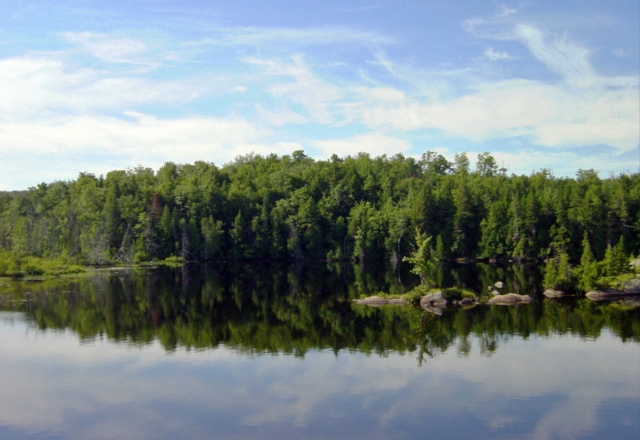
Saint-Alexis-des-Monts, Québec — July 2005

Sometimes one must jump in

When you do that

You might wind up over your head

Or perhaps

You will float downstream

Worrying if there are rocks below

But when one stands

On riverside for too long

Then one is thinking too much

La Bise

Kissing Customs Regional Distribution in France
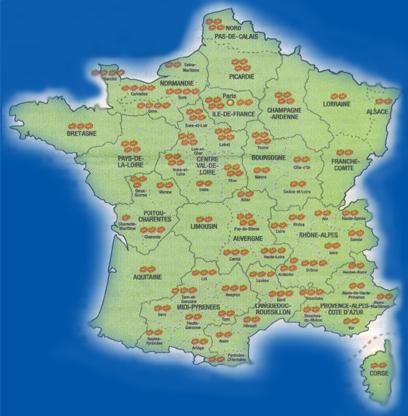
More than one year ago, I wrote a in France, almost a national sport here. Yet it is way more interesting to know of La Bise (to be pronounced 'beez'), these quick kisses the French are used to exchanging all the time.

Careful here though: you'd better not mix up a French Kiss and a Bise. I am pretty sure you don't need an explanation about what a French kiss is, do you? Let's focus on the bise then.

Although a word in the singular, la bise refers to a couple of pecks on the checks given and received when you say hello or good bye. Men in France usually shake hands and don't kiss other men but close relatives such as father and son, or brothers. Women usually don't shake hands of other women they know. They kiss each other. Between a man and a woman, la bise is also the usual way to greet, as soon as you know the other one reasonably well. Male and female friends exchange la bise to say hello and good bye. At work, male and female colleagues will practice la bise also.

There is no standard French pattern for the number of kisses kissed in a bise. Some regions go for only one, others for three or four. Parisians once used to give four pecks, alternately put on each cheek, but modern speedy life did a lot of damage there also: it is usually made of two pecks only now. For your information, and because a scientific article such as the present one should supply detailed and accurate information to the reader, the map above displays French kissing habits among French regions. I found it somewhere on the web, but since there were a couple of errors, I amended it so that it depicts the state of the art in 2008 — isn't it mere professionalism?

Briefly said then, there is nothing suggestive in la bise, but socialization and friendship. Granted, friendship between a man an a woman is usually enlivened with just a , a flake of titillation. However, such a kiss is not at all intimate. It does not even matter if it is an air kiss, that doesn’t touch skin, or if it does.

In fact, being a Frenchman, I consider a bise as much less intimate than a hug. Just think about it: pressing your body against someone else's body... even when, say, you're a heterosexual man and the other person is male also? How weird.

I Love Paris

Paris, rue de Sèvres — May 2006.

I live in Paris. Paris is the capital of France. Twenty centuries ago, when France was called Gaul, Paris was called Lutetia. Gaulish people living in Lutetia were called the Parisii Tribe, hence the name later given to the city.

Like a lot of cities, Paris has been built on the banks of a river, and on a couple of small islands between the banks. This river is called the Seine river. It is my river, with gorgeous views and marvelous light. The left bank (la rive gauche) is where I live now, and will always rather have a stroll. The right bank (la rive droite) is where I work, and lived for long time in the past. I have a lot of memories in both areas.

I don't know every street in Paris for sure, but always know approximately where they are. I could hardly get lost in Paris, even on purpose. When I take the metro, I always know what direction I should take. I can explain to a taxi driver the way I want him to go. I know where the train stations are. I know the buses routes reasonably well. Also, I have a lot of landmarks here. A café, a monument, a park, a church... Paris is the place where I belong.

I love to stroll in my city. At random often. Sometimes, I take the metro or the first bus that stops where I happen to be, and get out of it later as the mood takes me. At other times on the contrary, I follow a well-prepared itinerary. At other times again I walk with constraints, such as "take the 1st street on the left, then the 2nd on the right, then the 3rd on the left, and so on" or any other silly rule I imagine on the moment.

It may sound crazy, but it is efficient: when you do this, you cannot but have another sight of places you think you know well. You discover small streets, tiny places or public gardens. You walk this usual street in the opposite direction, and it looks different. You reach by chance a place where you have not been for years. You remember friends who would live in this street long time ago, or see again the café where you once awaited that ravishing brunette who never came to the date.

Richard Avedon at Le Jeu de Paume

Richard Avedon talking with a model of his In the American West series

A portrait is not a likeness. The moment an emotion or fact is transformed into a photograph it is no longer a fact but an opinion.
There is no such thing as inaccuracy in a photograph. All photographs are accurate. None of them is the truth.
(Richard Avedon)

Take a large sheet of white paper, approximately 2 meters high and 2.5 meters wide. Fix it on a wall, somewhere in the shade. Put your photographic chamber on its tripod in front of this screen, at about 2 meters.

When your settings are finished, don’t look in the viewfinder any more. Stand beside the camera and have a relaxed face to face chat with the model you’re going to take the picture, without any equipment getting in your way. If you’re talented, your name is .

Charles Chaplin — His last day in America, 1957
Charles Chaplin
His last day in America, 1957
I must acknowledge I was somewhat prejudiced against the work of Richard Avedon: I knew him as a fashion photographer only… and fashion is not my cup of tea. I did not know the other sides of his work until recently, when I read articles about the exhibit now held in Le Musée du Jeu de Paume in Paris, where they said he didn’t take fashion photos only, but also portraits.

Clarence Lippard, drifter - Interstate 80, Sparks, Nevada - August 29, 1983
Clarence Lippard, drifter.
Interstate 80, Sparks, Nevada
August 29, 1983

I went to the exhibition earlier this week, and discovered how huge a photographer I had missed for many years. Besides the fashion pictures, I saw awesome portraits of celebrities: Anna Magnani just out of bed, Henry Kissinger scared by the camera, Karen Blixen sparkling with mischievousness, Charles Chaplin making fun of McCarthyism, Marylin Monroe touching and fragile…

Sandra Bennett, twelve years old — Rocky Ford, Colorado, 1980
Sandra Bennett, 12 year old
Rocky Ford, Colorado, 1980
Essentially, in two dedicated rooms, were exhibited about 30 portraits of middle class and poor Americans from the 17 western states, taken at the beginning of the 1980s, part of his In the American West series.

These are large portraits in black and white, about 1.50 meter high and 1.20 meter wide, that hang side by side on black walls, in shadowy light. Bare introverted faces of workers, children, women, old people, looking you straight in the eye, that bear an intense but subjacent emotional power.

Red Owens, oil field worker — Velma, Oklahoma - December 6, 1980
Red Owens, oil field worker.
Velma, Oklahoma
December 6, 1980
Faces, good looking or not, and so many marks on them… scars, freckles, oil marks, coal marks.

Roberto Lopez, oil field worker - Lyons, Texas - September 28, 1980
Roberto Lopez, oil field worker.
Lyons, Texas
September 28, 1980

Such photos immortalize their models. Many people will never forget these faces, that were anonymous once, in the same way they will not forget the untameable will shown in the piercing look of the by Stephen McCurry.

Even though a photo cannot show but the surface of a body or face, pictures by Richard Avedon and other great portraitists reveal the deepest part of the soul of their models, their character, sadness, strength, despair, fear, loneliness. A great exhibition, about a great photographer.

Tao Tale

Yin & Yang Once upon a time in northern China, a small farmer lived close to steppes of which hordes of nomads had taken control. One day, he went back from the fair with a wonderful filly, for which he had squandered all his savings.

A few days later though, the young horse galloped away and disappeared beyond the dangerous border. The news quickly went around the village, and his neighbours each came in turn to sympathize with the peasant. Only he shrugged and said imperturbably:

— Clouds hide the sun, yet they bring rain. From a misfortune sometimes a benefit arises. We shall see.

Three months later, the mare came back with a superb wild stallion besides her. She was pregnant. Neighbours came and congratulated the lucky owner:

— You were right in being optimistic, they said. You lost a horse first, but now you have three!
— Clouds sometimes bring rain, and devastating storms sometimes, the farmer said. Misfortune hides in the folds of happiness. Let us wait.

The farmer's only son broke the fiery stallion in, and loved to ride him. Several weeks later, he felt seriously and almost broke his neck. He came out of the accident with one broken leg. When the neighbours came and sang their complain again, the country philosopher answered:

— Calamity or blessing, who could know? Changes have no end in this impermanent world.

A few days later, general mobilization was enacted in the district to repel a Mongolian invasion. Every able-bodied young man had to go and fight. Few returned to their home. Thanks to his crutches, farmer's only son escaped the slaughter.
Related Posts Widget for Blogs by LinkWithin

Home

Atom
Feed
Timeless Music
The Magic Flute
by W. A. Mozart


Timeless Reading
Les Essais
by Michel de Montaigne