Primidi, 1 Vendémiaire CCXVIII, day of Grapes
Tuesday, September 22, 2009 by Billy
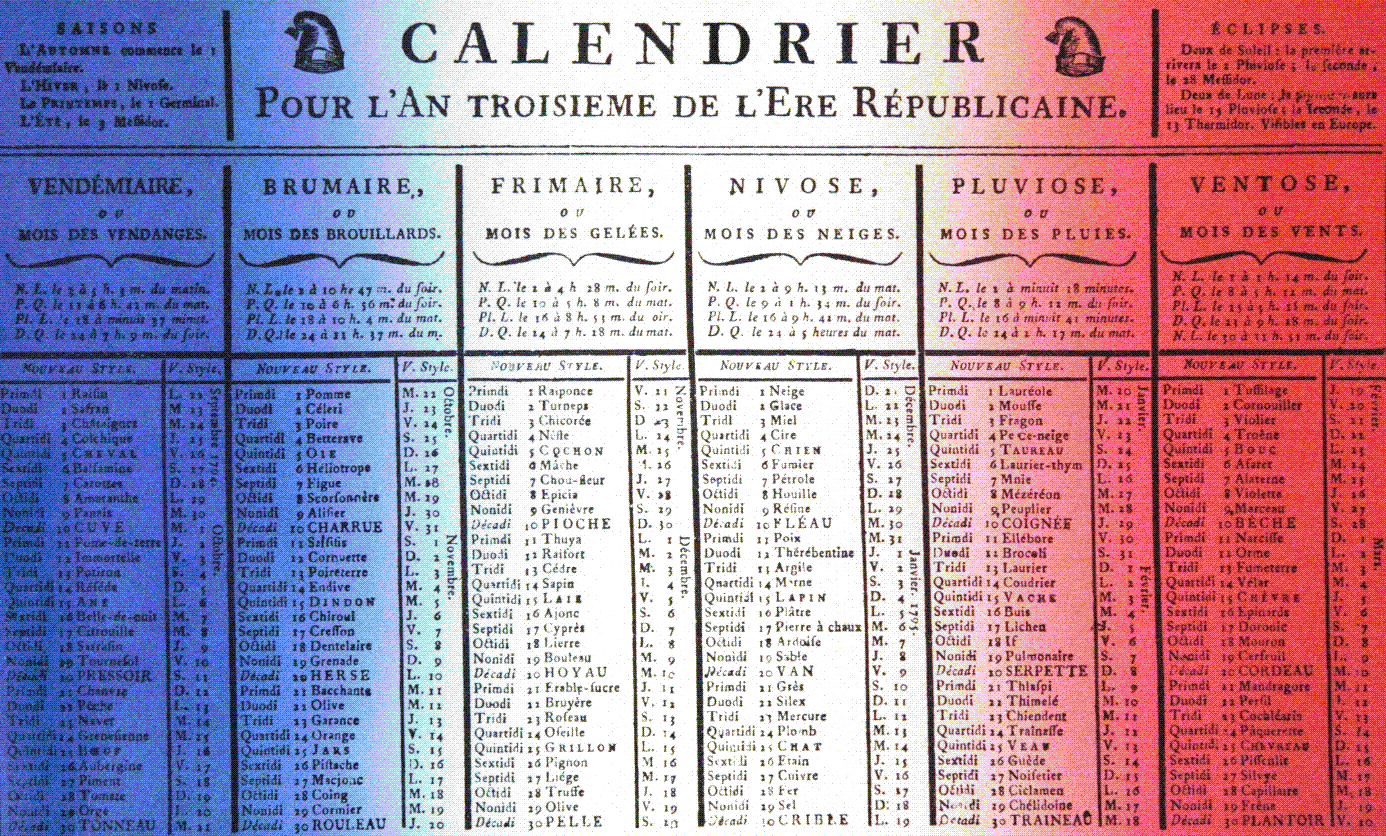 The French Republican Calendar – Year III |
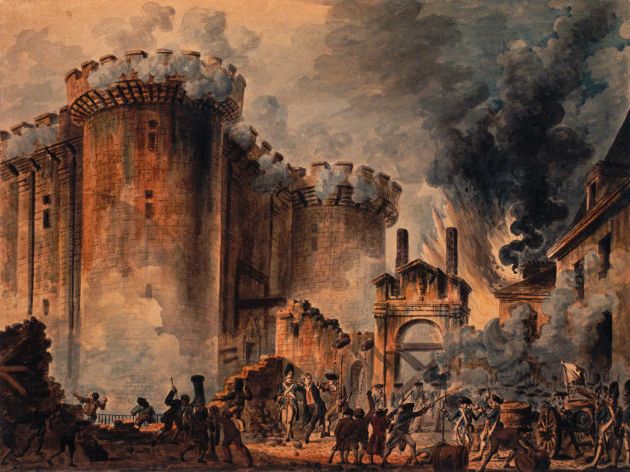
Today, September 22, is the day of the September Equinox, when Autumn begins in the Northern (and Spring in the Southern) hemisphere. It was also the first day of the French Republican Calendar. On September 22, 1792 in France, the First Republic was born, and the new calendar (although it was fully conceived some months later only) started on this very same Equinox day.
The new calendar was part of a plan of rationalizing, standardizing, and secularizing systems of measurements named the Metric System, then the Système International (S.I.). At the time in Europe, you would not have a same value for a French, British, Spanish or Italian league, mile, pound, ounce, gallon, whatever. Values would even change between counties or cities in a same country sometimes. A few years earlier then, French King Louis XVI had commissioned a group of scientists headed by Antoine Lavoisier to create a unified and rational system of measures. The Revolutionary Government intensified it.
French scientists decided modern values should be based as much as possible on number 10. Their work led to the present unification and rationalization of measurements, with the development of meter, kilogram, then the second, kelvin, ampere, candela, mole, etc. The metric system/S.I. is of widespread use in science, and it has been progressively adopted in ordinary life by every country in the world but three: Liberia, Myanmar and the USA.
One attempt was a failure though: the Revolutionary Calendar, that lasted for about 13 years only (plus 18 days in 1871 during the Paris Commune) and never spread outside France. Every year was written in Roman letters (year CCXVIII begins today). It had twelve months of 30 days each, that were given new names based on seasons and nature, principally having to do with the prevailing weather in and around Paris. For instance, Vendémiaire that begins today, means "the month of Winds". It obviously made the calendar pretty inaccurate in most countries, and especially in the Southern hemisphere.
Every months was divided into three decades, 'weeks' of 10 days called Primidi (first day), Duodi (second day), Tridi (third day) and so on. One Decadi every ten days instead of one Sunday every seven days was certainly another good reason for the new calendar to fail. Instead of Saints as in the Christian calendar, every day in the year was associated to a plant or a tool (Grape today for example).
 [BbN #10] |
At the end of the year, 5 or 6 Complementary Days (or Sansculotides) were respectively called Celebration Day of Virtue, Talent, Labour, Convictions, Honours, and on lap years, Celebration of the Revolution.
Today is Primidi, 1er Vendémiaire CCXVIII, day of Grapes. Happy New Republican Year, everyone.







 Very often too, the picture is used in a way that would make El Che turn in his grave: "The revolutionary struggle of the cherries was squashed as they were trapped between two layers of chocolate", reads the copy on this ice-cream's wrapper. "May their memory live on in your mouth".
 Dinner time. We are eating together, in the kitchen of our apartment. My mother, father, brother, and me.


 Another day, in the
 Independence Hall
 Franklin Court, where once stood Franklin's house. Below the court is the Franklin Museum, that is filled with paintings, objects, and inventions associated with Benjamin Franklin...
 Okay, let's stop making fun of the way Philadelphians worship 'Ben', because he actually was one of the most historically fascinating personalities in the
 18th century. Although he was given little education as a child, he became famous for being a printer, an inventor, a scientist, a musician, a champion swimmer, an economist, a writer, a philosopher, and a statesman.
 Especially, Benjamin Franklin personifies the 18th century approach to science. When a subject interested him, he gathered information, experimented, and then developed a practical application.
 Franklin was in England in 1761, when he heard a performer playing musical glasses. He wrote then: "He collected a number of glasses of different sizes, fixed them near each other on a table, and tuned them by putting into them water, more or less as each note required. The tones were brought out by passing his fingers round their brims."

 There are two large bookstores in Paris where I will go several times a year and buy books in English:

 Although I know it is the way the whole story is usually told and taught in the USA, I wondered how a smart and articulate guy could seriously think that killing more than 200,000 civilians "actually saved lives". The whole bloody fighting in the Pacific killed about 40,000 US soldiers 'only'... When the US President Harry S. Truman ordered to drop Little Boy on Hiroshima on August 6, 1945, then Fat Man over Nagasaki three days later, the point was certainly not about saving lives then, but saving lives of US soldiers, at the expense of much more lives of foreign civilians.
 There's a legend in Japan, the country of

 Players are on the field. Five minutes ago, while the English team ran into the Stadium as usual,


 I arrived today at Ajaccio, in Corsica, a French island in the Mediterranean sea, where I'll spend three days. The island and city are essentially known as the hometown of Napoleon Bonaparte. In Ajaccio, Napoleon is everywhere indeed, from the big bust that is the first thing you see when you arrive in the main hall of the airport, to street names and many cafés' signs.