Showing posts with label Paris. Show all posts

Paris in August

August in Paris
Taking a Sunbath in Paris

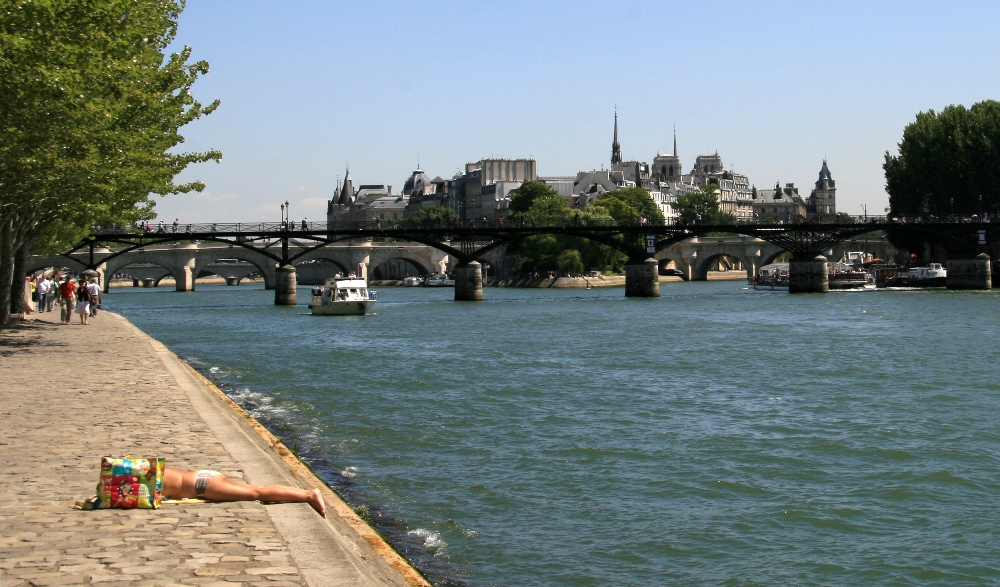
I love Paris in August. Because many people have the month of August off in France, several hundred thousand Parisians then leave the city for weeks. Fewer Parisians, many tourists, warm and sunny weather usually, there is a special atmosphere. The air is filled with tranquillity, like a Sunday that would last for one month.

You must go and work every day as usual; you feel as if you were in vacation though. For lunch, you will improvise a picnic with colleagues, in the or the . On the evening, you will stroll around, have a beer at the terrace of a café. You will sit on the grass in a garden perhaps, to take a nap or read a book.

It's August. The eighth month in the year, and a blessed month in Paris, when the City of Lights gets rid of its usual frenzy. Traffic jams, subway's crowd, all that makes it a hard place to live in sometimes, has disappeared for a while. The city reveals itself, warm and cheerful. It has put on its leisure clothes, for the sake of tourists, most of whom don't realize how special the atmosphere is.

Paris Plage
Paris-Plages, on the banks
of the Seine River

Paris is weightless in August. It's culture without stress, moving around without hurry. No more queues in front of movie theatres. No more traffic jams on the . You will find a parking space anywhere at once, and it's free! You can sit in the bus. Metro cars are empty.

You can take a (Paris' self-service bike-hire system) safely and bike everywhere, even on the .

    [BbN #8]
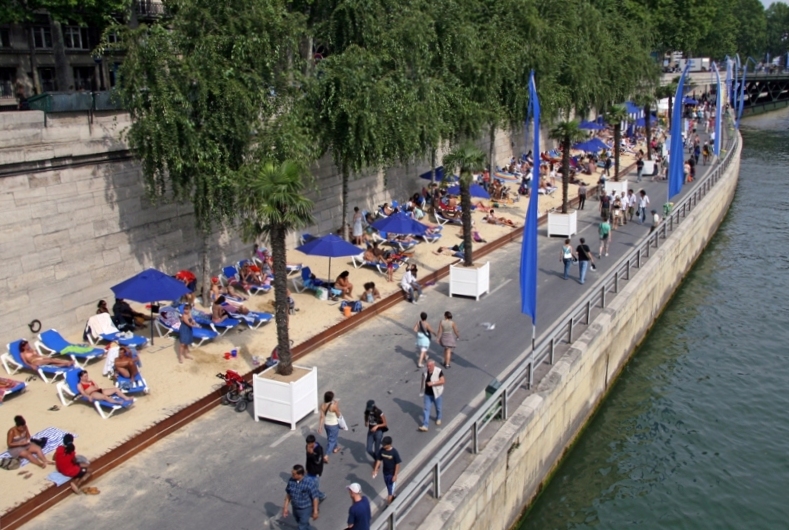
You may decide to go to ('Paris-Beaches', eighth occurrence this year) and have a sunbath on the banks of the Seine River or Bassin de la Villette, why not? You feel as if you were a tourist yourself.

In August, Parisians rediscover space in a city that misses it so much during the rest of the year. La Joie de Vivre is back, it is almost Italy. Oh yes. I do love Paris in August.

A Story of Three Friends

Forensics for Dummies
by B.T. Kidney and G. Grissom

I used to have an old friend, who was a reputable doctor. Nobody would have asked him about their symptoms or small complaints though, because with him, you would never know where such questions could lead you.

You should not think he was a dangerous doctor or a charlatan though. He was not at risk to be struck off the medical register, although his career was punctuated with a lot of death: my friend was an expert in forensics. He was even a leading expert in his field, among the best in the world.

A specialist in difficult diagnoses, death in suspicious circumstances, questionable suicides and unequivocal murders, he would find the diagnosis that explained the inexplicable. He was able to turn the irrational into the rational, and bring mysterious death back to normality.

Microscope
You will not be surprised then that he was often asked for a diagnosis about victims from all over the globe. He was always between two planes, always in a hurry. A globe-trotting doctor, although he did not have the look. Several years older than me, he was a very unobtrusive person, with a quiet elegance and temperate language. He looked like a man of law, a solicitor, a judge, rather than a doctor.

For that matter, his area of specialisation required frequent contacts with men of law because his offices would often come to settlement of complex inheritance issues, sometimes in a way quite unexpected by the heirs of the dear departed, when coveted legacies turned into sentences of life imprisonment.

Shoes

I had another very dear friend, who was quite different. About ten years younger than me, she was a very beautiful woman and a talented nude dancer at a famous Parisian cabaret.

I had followed her career and supported her for long. We were very hopeful she would become the first dancer soon.

My two friends met for the first time at a reception I gave on the occasion of my birthday. Between them, it was love at first sight. A few months later, my old friend divorced his wife, and mother of three grown-up children, and married her.

Yet aging persons are possessive sometimes. He made her interrupt her career. The young bride suffered a great deal, I can tell you. Her husband thanked her with long travels abroad rather than tokens of his affection. Soon, she only thought of keeping boredom at bay, and succeeded in this purpose in the most pleasant and Parisian way... I can surely tell you too.

Murder is always a mistake — one should never do anything one cannot talk about after dinner.
Oscar Wilde

My friend died shortly after their third anniversary. Nobody found the cause of his death, despite two autopsies: the first one performed at the request of his children, the other one by letters rogatory demanded by his insurance company, obviously reluctant to pay his young widow a premium that amounted to three million euros.

"No one will ever know why my poor husband died", she used to moan. "He was the only one who could find it out, but he cannot do it any more. He was the only one who knew how to kill your fellow man so that nobody can prove it." She would burst into tears then, and I comforted her in her grief the best I could.

Commelina
She wanted to publish his fascinating last book, that was almost finished when he passed on. When he was away from home, we both used to read the manuscript during our long evenings alone together. She deemed it her duty towards the deceased to publish the book — a last way to show him how grateful she was.

The book was truly of utmost scientific importance: in particular, it revealed the formula of a new toxic substance, unknown to the most eminent of specialists, that anyone could easily extract from the stamens of a common wild flower, thanks to a clever and innovative process.

Fireplace
If the book was to be published, no doubt that the plant poison would be called by my friend's name, giving him post-mortem fame, and immortality,  sort of.

Anyway, at the end, my old friend's widow bowed to my reasons. Hardly silencing her scruples, with a lot of tears in her eyes, she burned the manuscript in the bonfire we lit in our home's hearth, the very day we received the check from the insurance company.

[BbN #3]
-:-:-:-:-:- 

I first published this short story a couple of years ago in a previous blog, now deleted. My friend Vanessa was kind enough at the time to read it and point out several English errors. Thank you again, Vanessa.
Ada Lovelace Day: Pantheon of Women

[I have not found the time to write a blog about Marie Skłodowska Curie, as I thought of doing within the context of Ada Lovelace Day. I will use a subterfuge then: on March 8, 2008, for the International Women's Day, I posted an entry on my defunct blog on Yahoo! 360° that dealt with nine French Women who would deserve to rest in the Panthéon in Paris. The entry disappeared with that blog. Here it is again in this one. Granted, most of the women celebrated were not involved in technology. Yet everyone of them, each in her field, can be considered 'female role models' undoubtedly.]
 
— : — : — : — : — : —

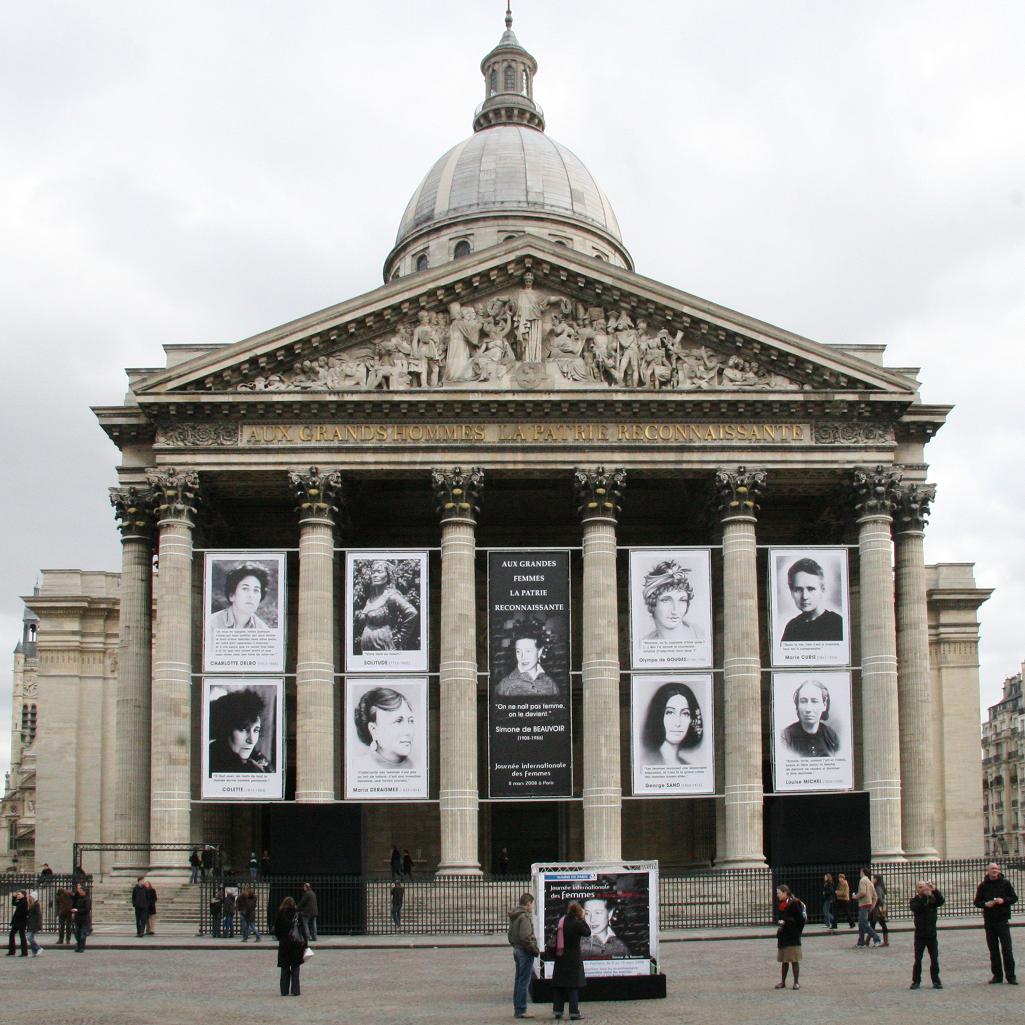
The Panthéon — Paris, 8 March 2008
I must say I am divided about the International Women's Day, celebrated every March 8th. I certainly agree women are still not considered equal to men in a lot of countries, for cultural and religious reasons. Even in western countries, there is no fair equality between genders in many fields, salaries especially.

On the other hand, I don't believe a yearly celebration can change the way men consider women, or make a religion evolves. I find it cheaply gives people clear conscience sometimes: one Women's Day a year, and 364 (365 even, this year) uncelebrated Men's Days!

Anyway... I went to the Panthéon this morning to see the portraits of nine French female figureheads displayed on its facade to celebrate Women's Day, and take pictures myself. Le Panthéon is a neoclassical monument on the top of the Montagne Sainte-Geneviève, in the 5th arrondissement of Paris. It was originally built as a church dedicated to St. Genevieve, the patron of the city. It is now the burial place for 'French National Heroes' (Pantheon in Greek means 'All the Gods'). The inscription in letters of gold above the entrance reads AUX GRANDS HOMMES LA PATRIE RECONNAISSANTE (To the great men [from] the grateful homeland).

The word Men here is supposed to mean Human beings, yet among the 73 honoured people buried here, there is only one woman, Marie Curie. Although it was definitely theoretical, I was interested to see which women the Parisian elites had considered deserving enough to be next to Mirabeau, Voltaire and Hugo. Here they are.

ImageSimone de Beauvoir (1908-1986 — philosopher and writer). An existentialist, she lived with Jean-Paul Sartre for several decades. She was among the most influential intellectuals in the second half of 20th century. Her book The second sex is regarded as a major feminist book.
ImageColette (1873-1954 — writer). Her literary talent was first exploited by her husband Willy, but she became emancipated... and scandalous for a time (music-hall shows and overt affairs with men and women). She published around 50 novels, one can divide into idyllic natural tales and dark struggles in relationships and love.
ImageMarie Curie (1867-1934 — Physicist) Born in Poland, Maria Skłodowska went to Paris aged 24 to study and became a naturalized French. At the Sorbonne, she met and married Pierre Curie. She won the Nobel Prize twice: in Physics in 1903 (discovery of radioactivity) and Chemistry in 1911 (discovery of Radium and Polonium).
ImageCharlotte Delbo (1913-1985 — resistance fighter). She was arrested by the Nazis in 1942 and sent to Auschwitz concentration camp. She was one of the 49 women who survived. She wrote several books about it, including a biography of every prisoner who was with her in the convoy to Auschwitz.
ImageMaria Deraismes (1828-1894 — politician and freemason). A figurehead of feminism, she was a republican (i.e. not royalist), antireligious politician. In 1893, she co-founded the first International Order of Mixed Freemasonry, advocating equality between women and men, Le Droit Humain.
ImageOlympe de Gouges (1748-1793 — politician). She is regarded as one of the first French feminists. In her Declaration of the Rights of Woman and the Female Citizen, she challenged the practice of male authority and the notion of male-female inequality. She was executed by guillotine during the Reign of Terror.
ImageLouise Michel (1830-1905 — politician). A revolutionary and an anarchist, she was active during the Paris Commune as an ambulance woman. After the Versaillais won, she was sentenced to deportation in New-Caledonia. She returned to Paris 7 years later and preached the revolution until her death, despite several stays in jail and exile in London.
ImageGeorge Sand (1804-1876 — writer) Born Aurore Dupin, she decided to take a male nick to be more easily published. She would dress as a man, smoke the pipe, ride like a man, yet she had tumultuous liaisons with Alfred de Musset and Frédéric Chopin. She was a feminist, asking for women's right to divorce and equality in civil rights.
ImageSolitude (1772-1802 — fighter against slavery). In 1794, the revolution freed this mulatto slave. When Napoléon Bonaparte restored slavery in 1802, Solitude rose up in arms although she was pregnant. She was wounded, captured and sentenced to death. Her hanging was delayed until the day after she gave birth. Slavery in France was abolished for good in 1848 only.

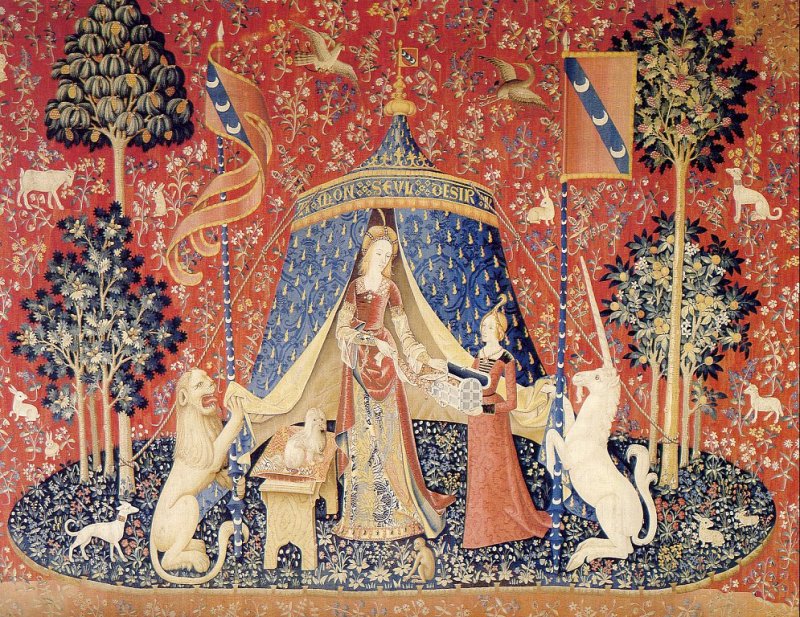
The Lady and the Unicorn

A mon seul désir
The Lady and the Unicorn — To my only desire.
Cluny Museum of Middle Ages, Paris.

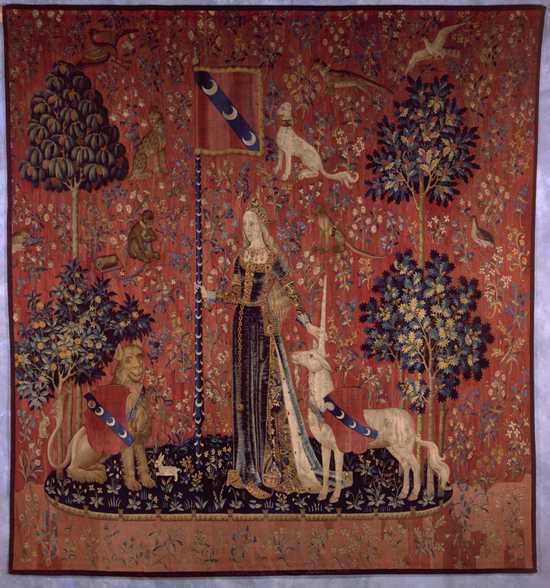
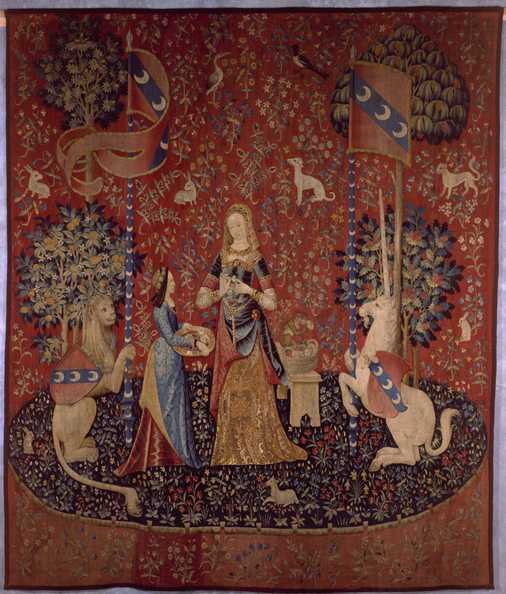
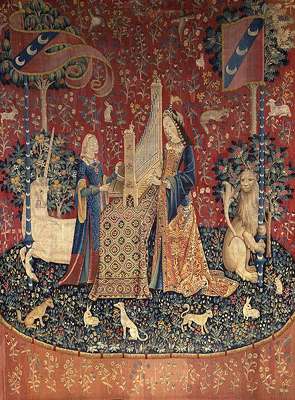
The Hôtel de Cluny, in the Quartier Latin (the Latin Quarter) in Paris, was built in the 14th and 15th century. It is a beautiful structure that combines Gothic and Renaissance architecture. It is worth seeing as a building then, yet essentially it is the French Museum of the Middle-Ages. It houses many early Medieval sculptures, wonderful illuminated manuscript, and an important tapestry collection, that includes one of the greatest works of art of the whole Middle Ages, the famous series of tapestries named 'La dame à la licorne' — 'The Lady and the Unicorn'.

The Lady and the Unicorn — Taste
Taste (detail)
Click for the whole image

The Lady and the Unicorn
by John Renbourn

I went there again yesterday, for the tenth time maybe, because they have just opened new rooms to the public, dedicated to art and life in the Middle-Ages. Also, I wanted to see the red tapestries again, a few months after I went to the Cloisters in New-York and watched the green series of Unicorn tapestries they hold there [This series was the topic of the last blog I published on Yahoo. I might post an emended version of it here some day].

The Lady and the Unicorn — Sight
Sight (detail, click)

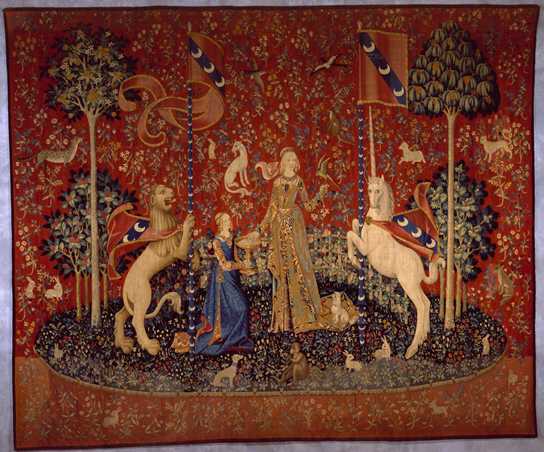
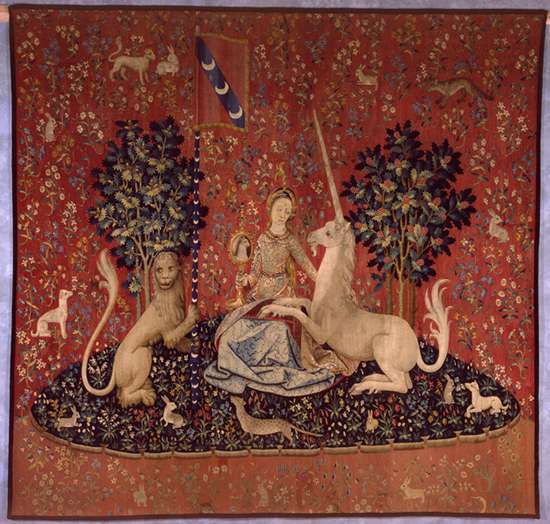
Both series are dated back to the 15th century. They are so-called 'Tapisseries mille fleurs' ('Thousand flowers tapestries'), named that way because they contain thousands of details, flowers and small animals especially.

While the Unicorn is the main character of the green tapestries held in New-York, that tell the story of the Hunt of the Unicorn, the Lady is the centre of the red tapestries displayed in Cluny Museum. My eyes this morning remain filled with visions of the beautiful, enigmatic Lady.

The Lady and the Unicorn — Touch
Touch (detail, click)
There are six tapestries in the series. Five hang side by side on a same larger curved wall in front of the only door. They are really huge, several meters wide and high. You see nothing but them when you enter the room. They depict the five senses: Taste, Sight, Touch, Smell, Hearing, in that order. Touch is situated in the middle, a very sensual picture where the Lady holds a standard in her right hand and the horn of the unicorn in her left one.

The Lady and the Unicorn — Smell
Smell (detail, click)
After you have looked at the five senses for a while, you turn round to the exit door, but then you have a view of the sixth tapestry, that has been hanging alone on the straight wall behind you from the beginning. In this tapestry, the Lady places her necklace into a case held out by her servant.  The Lion and the Unicorn are here, and many little animals. She will leave then soon though, and enter the tent behind her of which the door is wide open for her. 'A mon seul désir' ('To my only Desire'), an inscription on the tent says.

The Lady and the Unicorn — Hearing
Hearing (detail, click)

Nobody knows for sure what this tapestry means. I have the feeling that the Lady has experienced many things in her life already, using her five senses, and she has reached the end of this path now.

The wise, beautiful Lady, might have decided to renounce pleasures of the world. Or she knows she will pass soon perhaps. Whatever the reason, she now leaves her jewels forever, as a symbol of her physical life, before she enters the tent, as a symbol of her inner spirituality, a convent, or the Other World.

Le Lapin Agile

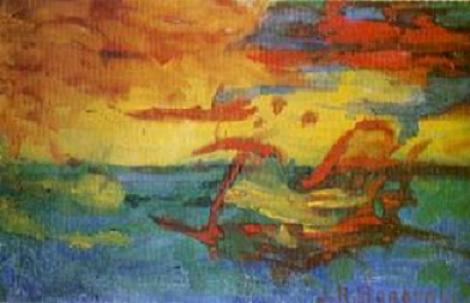
Joachim-Raphaël Boronali — Coucher de soleil sur l'Adriatique (Sunset on the Adriatic)
Joachim-Raphael Boronali — Sunset on the Adriatic [Coucher de soleil sur l'Adriatique]

The painting on the left induced some hurly-burly when it was exhibited at the Salon des Indépendants in Paris in 1910. The canvas was signed by a person of obscure repute named Joachim-Raphael Boronali, who had prepared the picture's appearance by drafting a manifesto about a new, dissident futurist school, Excessivism.

ImageMany specialized critics who saw the painting in the show found the work 'very interesting'. It was sold twenty Golden Louis (400 French francs, about 1,800 current dollars). And yet, its author, who appears in the adjacent photo with his best friend, was not a painter at all.

There is a famous cabaret at 22 Rue des Saules in Montmartre, named Le Lapin Agile, where, in the 1900s-1910s, unknown people called Picasso, Utrillo, Modigliani, Braque, Derain, Dorgelès, Apollinaire or Max Jacob would meet, talk, joke, sing and drink together. The owner of the place was Frédéric Gérard, Le Père Frédé as everyone called him, who is the bearded man who appears in the photo above.

ImageThe cabaret had existed since 1860. It was originally called Le Cabaret des Assassins — Cabaret of Murderers — until Andre Gill, a caricaturist, painted in 1875 the sign that was to suggest its permanent name: the picture of a humanized rabbit with a top-hat, who jumps out of a saucepan with a bottle of wine in his hand.
Residents soon called their neighbourhood night-club Le Lapin à Gill — Gill's rabbit — a name that naturally evolved into Le Lapin Agile — The Agile Rabbit.

Cora Vaucaire — Frédé
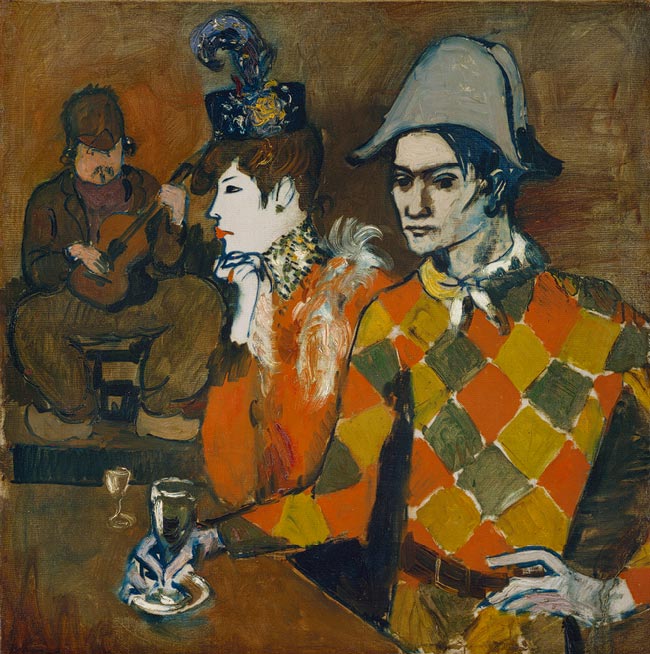
Pablo Picasso - Au Lapin Agile
Pablo Picasso— At the Lapin Agile
[Au Lapin Agile] 1905.
Oil on Canvas, 99 cm × 100 cm
Metropolitan Museum of Arts, New-York.

The cabaret still exists nowadays. It is still full of customers who come and listen to French songs dating back as far as the fifteenth century.

Frédéric Gérard— aka Frédé — the owner of the place shown with his donkey on the photo above, was a character. Songs have been written about him, and he is the man playing the guitar in the background, in the adjacent painting by .

In this painting, Picasso portrayed himself dressed as a Harlequin, accompanied by his model Germaine Pichot. According to the tale, Picasso once paid a lunch with this painting, that Frédé sold in 1912 for the equivalent of 20 dollars. In 1989, it was auctioned at Sotheby's for 41 million dollars.

Anyway, how about 'Joachim-Raphael Boronali'? Who hid under the nickname? You know it was not Picasso or any of the abovementioned artists since I wrote that the painter was portrayed in the photo displaying Frédé with his donkey. Yet the painter was not Frédé but... Lolo, the donkey!

The painting was a hoax by the writer Roland Dorgelès and a few friends, to make fun of art critics. They tied a brush to the tail of Lolo, which daubed a canvas with several colours in front of witnesses, official ones included. They coined the nickname Boronali because it is an anagram for Aliboron, as Jean de la Fontaine would call the donkey in his fables.

Image
Boronali in the process of creating his masterpiece
The painting is now permanently exhibited in a museum in Milly-La-Forêt, near Paris.

Riddle: A Hint of a Hitch

The Obelisk at the Place de la Concorde, Paris
The Place de la Concorde in Paris

Our paths crossed on that day. You were ravishing, smooth blonde hair and preppy look. The light strip of a pearl necklace, above your peach-coloured cashmere sweater, was slightly iridescent in the first beams of this sunny morning of spring. I had the shadow of a doubt: weren't you notorious, Rebecca... something?

Under the pelisse on the back seat (mornings were still a little chilly), caught in a glimpse through the rear window of your tiny Parisian car, I could make out your mother's Grace Kelly purse, near the birds-patterned Carré Hermès you had left there, skilfully undone. Everything in your appearance indicated this special sense of sophistication passed down through several generations of strong economic power. I felt spellbound.

ImageThere was a frenzy of traffic on the Place de la Concorde. Young and innocent, you did not yield to me — I was just the wrong man at the wrong place. I confess I had the ghost of a frown, barely the mark of minor annoyance. A beautiful manicured hand with a fine golden ring and a topaz let go of the blond wood steering wheel. You gave me the finger.

People who still believe in elegance and refinement never drove a car.

I Love Paris

Paris, rue de Sèvres — May 2006.

I live in Paris. Paris is the capital of France. Twenty centuries ago, when France was called Gaul, Paris was called Lutetia. Gaulish people living in Lutetia were called the Parisii Tribe, hence the name later given to the city.

Like a lot of cities, Paris has been built on the banks of a river, and on a couple of small islands between the banks. This river is called the Seine river. It is my river, with gorgeous views and marvelous light. The left bank (la rive gauche) is where I live now, and will always rather have a stroll. The right bank (la rive droite) is where I work, and lived for long time in the past. I have a lot of memories in both areas.

I don't know every street in Paris for sure, but always know approximately where they are. I could hardly get lost in Paris, even on purpose. When I take the metro, I always know what direction I should take. I can explain to a taxi driver the way I want him to go. I know where the train stations are. I know the buses routes reasonably well. Also, I have a lot of landmarks here. A café, a monument, a park, a church... Paris is the place where I belong.

I love to stroll in my city. At random often. Sometimes, I take the metro or the first bus that stops where I happen to be, and get out of it later as the mood takes me. At other times on the contrary, I follow a well-prepared itinerary. At other times again I walk with constraints, such as "take the 1st street on the left, then the 2nd on the right, then the 3rd on the left, and so on" or any other silly rule I imagine on the moment.

It may sound crazy, but it is efficient: when you do this, you cannot but have another sight of places you think you know well. You discover small streets, tiny places or public gardens. You walk this usual street in the opposite direction, and it looks different. You reach by chance a place where you have not been for years. You remember friends who would live in this street long time ago, or see again the café where you once awaited that ravishing brunette who never came to the date.

Bastille Day

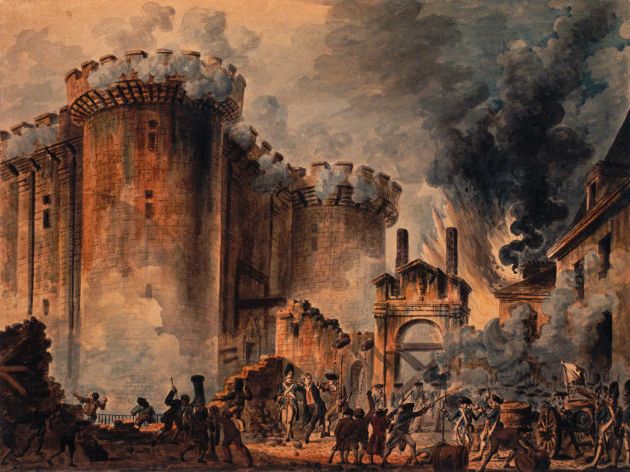
Jean-Pierre Houel — The Storming of the Bastille
July 14, 1789, by night. Louis XVI, King of France went asleep one hour ago in the Palace of Versailles, where Kings of France have resided since his ancestor Louis XIV, , made it the centre of its absolute power.

Every day, the King writes a few words in his diary. Today, he hunted for several hours as usual, so he wrote: Nothing...

His closer courtier, the Duke of La Rochefoucauld-Liancourt, has just been told about , the medieval fortress and prison in Paris. He decides to awaken the King, and breaks the news to him.

— The Bastille? it has fallen? the King asks, half asleep still.

— Yes, Your Majesty. A messenger just told me the prison has been taken by the people. They killed Governor de Launay and Provost Flesselles, and walked their heads on poles by the streets of Paris.

— Aw, it is a rebellion! the King says.

— Oh no, Sire, it is not a rebellion. It is a revolution

The Statues of Liberty

The Statue of Liberty in Ellis Island, New-York
The Statue of Liberty — Ellis Island, New-York.
The Statue of Liberty, whose actual name is Liberty Enlightening the World, has stood in Ellis Island in New-York for more than 120 years: aimed at commemorating the 100th anniversary of the Declaration of Independence of the Thirteen Colonies in 1776, it arrived at New-York in 1886.
The Statue was the work of French sculptor Frédéric Bartholdi, with engineering help from Gustave Eiffel, and a present from the people of France to the people of the United States, dedicated to the friendship established between the two countries during the American war of independence.
The Statue of Liberty in the Jardins du Luxembourg, Paris
The Statue of Liberty.
Jardins du Luxembourg, Paris.
There are a lot of everywhere around the world, but Paris is probably the only city that gets two. First, a small Statue de la Liberté stands in Les Jardins du Luxembourg (Luxembourg Gardens), a nice park in the centre of Paris, behind the French Senate on the left bank of the Seine River.

Les jardins du Luxembourg are in two basic parts. The organized part is a typical Jardin à la française, with straight dusty paths bordered with trees and playgrounds; there are also tennis courses, and pony rides, a marionette theatre, food kiosks and open-air cafes, and a big round fountain basin where you can rent sailboats and float them in... with the other ten-year-olds.
The wild part of Le Luxembourg is quite different. It is wilder, with deep bushes, many flowers, a fruit garden, beehives, and many statues, including this tiny model of the Statue of Liberty. In fact, it is not a replica, but the original bronze model of the statue. Frédéric Bartholdi used it as a pattern to have the New-York statue built, about 15 years later. He gave it to the city of Paris for the 1900's Universal Exhibition.

The Statue of Liberty in the Ile aux Cygnes, Paris
The Statue of Liberty.
Ile aux Cygnes, Paris.
There is another Statue de la Liberté in Paris. It stands in the Ile aux cygnes (Swans Island), near Grenelle Bridge on the Seine River. This statue is a copy. It was given by the city of New-York to the city of Paris in 1889. It faces west, towards its 'sister' in New York Harbour, which was erected a few years earlier and looks east, to the old world across the Atlantic Ocean.
To Auguste Bartholdi [...] America, with its democratic ideals and Republican government, was already enlightened, Barry Moreno, a librarian at the Statue of Liberty National Monument, once wrote. Europe, still full of czars and emperors, was not. Sadly, things have changed; enlightenment now appears a feature of countries on this side of the Atlantic rather. Yet hopefully, it will reappear in the U.S.A., with time...
Anyway. Happy July 4 to all the U.S. Americans!

Ingrid Betancourt freed
Postscript : I could not imagine when I wrote this blog that would arrive in Paris this afternoon, after she was rescued by Colombian forces on Wednesday.
Over the years of Ingrid Betancourt’s captivity in the Colombian jungle (almost six and a half year), France championed the Colombian-French politician and anti-corrupt activist as a symbol of endurance, holding rallies, marches and other events to draw attention to her plight.
Large posters bearing her face hang from the entrances of hundreds of French city and town halls, including in Paris, and on the summit of Mont-Blanc in the Alps. The posters are now crossed by the word LIBRE! (free!), at last.
Today was undoubtedly a great day to publish a blog about Liberty.

Saint-Germain-des-Prés

The Steeple of Saint-Germain-des-Prés
The steeple of Saint-Germain-des-Prés (Paris - May 2006)

Taking photos of monuments and places in Paris is often discouraging: wherever you go for a stroll in the city, you see hundreds of postcards on display, whose pictures are identical or (most often) better than yours. Nevertheless, I've never seen something similar to the pic above, of which I must admit I am quite proud. It is the steeple of Saint-Germain-des-Prés, Paris' oldest church, seen between the bronze slabs of a fountain situated on the opposite sidewalk of the Boulevard Saint-Germain.

Image Home to a number of famous cafés, such as Les Deux Magots and Le Café de Flore, where artists, writers and philosophers would meet, Saint-Germain-des-Prés area used to be the centre of gravity for the surrealists painters and writers (André Breton especially) in the 1920s and 1930s, then the headquarters of existentialists Jean-Paul Sartre and Simone de Beauvoir in the 1950s and 1960s. The area is much older though: the first parts of the church were built as an abbey in the 6th century.

There is a fountain in front of the church, in the Place du Québec, at the crossing of Boulevard Saint-Germain, Rue de Rennes and Rue Bonaparte (see Wikimapia location).

ImageIt's a modern fountain, the work of a Québecois artist named Guillaume Daudelin. More than an ordinary fountain, it is a sculpture, given in 1984 as an hommage from Quebec to the city of Paris. It is called L'Embâcle, which means Ice Jam (that is, obstruction of a river bed with blocks of ices). There is no gap between the sidewalk's large paving stones and the fountain's four slabs of bronze, so that the pavement seems lifted up by the water that sprays through it.

Image L'Embâcle beautifully conjures up break-up of ice in Québec when springs arrives at last. It is famous because of its artistic value, and functional originality as well. Among kids, it is well known also... as the best slide in the neighbourhood!

The day I took the photo on top of this entry was my lucky day: the fountain had been switched off because the weather was cold. No spray any more, no water inside, only little puddles on the ground. I could sneak into the fountain as a housebreaker, kneel down in there, and steal a couple of shots.

The 'Fête de la Musique'

Fête de la Musique 2008 June 21, the day of the Summer solstice in the Northern hemisphere, falls on a Saturday this year. I expect there will be a lot of people in the streets this night then, to celebrate the Fête de la Musique, the World Music Day.

Fête de la musique means Festival of Music in French. Launched in 1982 in France, it is now held in more than one hundred countries all over the world. New cities join the festivities every year, the main newcomers in 2008 being Melbourne (Australia), Sacramento (USA), Erbil (Iraqi Kurdistan), Cebu (Philippines), Port-Moresby (Papua New Guinea), Hannover (Germany), Ostrava (Czech Republic), Málaga (Spain) and Québec (Canada). Several traditional festivals happening on solstice day, such as the and Saint John's Eve festival, now take part in the popular festival.

Fête de la Musique The purpose of the festival is to make all genres of music accessible to the public, with a multitude of free concerts everywhere, including places that are not usually used for concerts.

Officials say that more than 10,000 free concerts will be held in France today. Also, amateur musicians are encouraged to perform in the streets. The slogan Faites de la musique ! (Make music!) — which is pronounced the same as Fête de la Musique — is used to promote this goal in French speaking countries.

Fête de la Musique I'll probably spend most of next night strolling around in the Latin Quarter, listening to a musician, singer, or band after another one. Leaning on a wall at the corner of a street sometimes, sometimes seating on a bench in a public garden or at the terrace of a café, no doubt I'll hear the best and the worst: the festival is open to everybody, without discrimination to résumé, background, style and experience. Musicians only need to find a place where to put their gear, which in Paris means they'd better arrive early if they intend to play in a place where a lot of people walk through.

sings
Voi Che Sapete by W. A. Mozart

A good classical guitarist may come on right after a dreadful heavy metal band... or the contrary. You can leave the rap singer on the boulevard and get closer to the piano and mezzo-soprano performing Voi Che Sapete in a courtyard, if you are lucky enough to be in the right place at the right time. The unstructured nature of the festival is the basis of its success.

Patti Smith

There are such moments in life: you look at a person you like, or love, and you realize in your deepest self that you will probably never see him or her again.

(Patti Smith, May 06, 2008 — approximate quote).

The Fondation Cartier pour l'art contemporain is an airy glass and steel building in the 14th arrondissement of Paris. It was designed specially by Jean Nouvel, also the creator of the Institut du Monde Arabe and the Musée du Quai Branly. Fondation Cartier Building in ParisAs the name indicates, it is devoted to contemporary art. That's also the building where the great, yet disturbing, exhibition of David Lynch's works I wrote about previously took place in 2007.

The Fondation Cartier is now displaying an exhibition dedicated to the visual work of Patti Smith, named “Land 250”. Drawings, films, objects, and essentially photographs taken with a Land 250 polaroid camera. I went there past Tuesday, tooking advantage of evening opening hours.

I did not know that Patti Smith would be there in person on that evening. Few people knew obviously, since we weren't much more than 150 people there. I easily found a free space to be seated on a carpet, at 5 meters from her standing at the micro. It was not a show, nor a concert, but a lecture, a discussion with the public, questions and answers in both directions.

Patti Smith talked about her photos, about the poets she loves: William Blake, Arthur Rimbaud, Jean Genet, René Daumal. She sang a couple of songs, and read poems.

When someone in the public asked which photos she loved most, she did not answer, but said (quoting from memory): “I love some photos because they are technically, well... quite good” [laughing]. “There are also many photos that I love despite they are not that good technically, because they embody significant personal meaning: travels I made, people I met, objects that once belonged to people who mean something to me”.

“For example”, she added, “see this horse, on the poster of the exhibition. It's not a bad photo, it's not technically perfect though. Yet it means something to me. I took it in Africa, at the end of a horse ride. Just before we left the place. I was about to climb up into the truck, and suddenly felt a gaze on my back. I turned round, and it was him. The horse I had gone riding for several days. He did not move, he waited while I looked for my camera in my bag, looked at me when I focused and took this only Polaroid. Then, he went away. We both knew we'd never see the other one again.”

I could not help but think it was a shame this picture could not be used as the cover for her great album, Horses, 30 years ago.

The whole happening did not last more than 90 minutes, but it was pleasant and friendly, although the public was quite reverent and talked little (I am simply not sure most people were fluent enough in English to ask her questions).

After she left, I spent about one more hour wandering around the exhibition. Several photographs were good, but I did not felt the same as last year about David Lynch's exhibit, that it was a great artistic event. More than once, to tell the truth, I even wondered if these little photographs of beds, guitars and statues, or this stone "from the river where Virginia Woolf committed suicide" would be in an exhibition if they were not put in display by a famous rock singer named Patti Smith.

Related Posts Widget for Blogs by LinkWithin

Home

Atom
Feed
Timeless Music
The Magic Flute
by W. A. Mozart


Timeless Reading
Les Essais
by Michel de Montaigne