Showing posts with label war. Show all posts

Historic Pictures

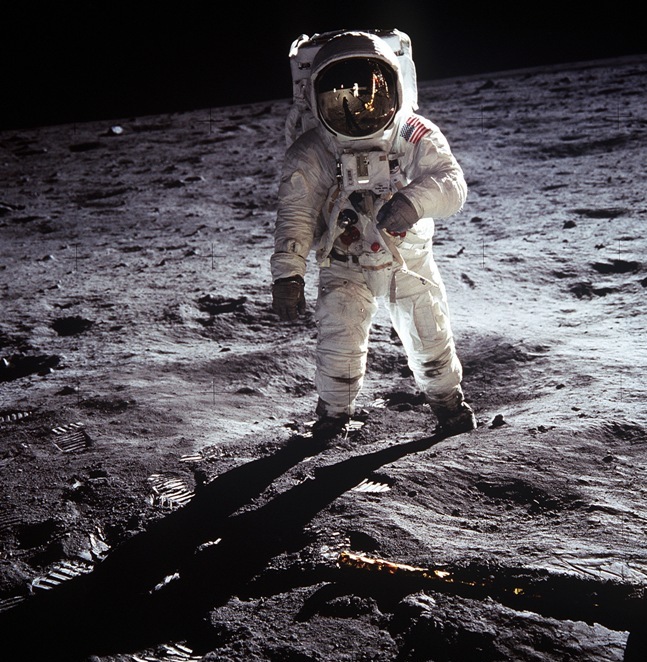
Buzz Aldrin on the Moon

Several years ago, I was given a book entitled Chronique du vingtième siècle (The 20th Century Saga), edited by newspaper.

It is a huge book (1350 pages, A4 size) that contains excerpts of most relevant articles published in French newspapers in the 20th century. 'Sarajevo: Archduke shot dead' (June, 1914); 'Lindbergh flies over the Atlantic' (May, 1927); 'Paris is now free' (August, 1944); 'Explorers on the Moon' (July, 1969), and so on.

You have a strange feeling when you read articles written many decades ago, on the very day historic events happened. They fill in a gap between personal experience and what you have been told. Obviously, the journalists who wrote the articles could not know about a future that is part of a well-known past for present readers. Yet, paradoxically, such a lack of knowledge adds a lot. When an event happened long time ago, before you were born, or able to understand it, you see it as a piece of History; almost an abstraction. On the opposite, when you can remember a event, how you heard of it, what you thought about it at the time, it is part of *your* history. Quite not the same.

Churchill, Roosevelt and Stalin in Yalta

When you read articles in such a book, you feel as if this gap has been filled in. Past events become more real, because you hear about them happening 'live'. Furthermore, beside words, you see pictures, some of which are known throughout the world: Churchill, Roosevelt and Stalin in Yalta. Edwin 'Buzz' Aldrin on the moon, photographed by Neil Armstrong who appears also as a reflection on the visor of Aldrin's helmet. Vietnamese girl , badly burnt, running down a road after a Napalm attack...

'Napalm Girl' by Nick Ut

It works with articles, it works with photos. It works also with films. I remember the year 1989 very well: resistance and demonstrations in communist countries, protesters in Tiananmen Square, the . The youngest cannot remember how hopeful we Westerners felt at the time, and how sad and angry after the massacre  in Beijing. Yet, thanks to the movie below — that I have displayed — they can feel the same as we did, 20 years ago exactly, when the desperate action of the testified about what the courage of a unique human being can be.
The Unknown Rebel

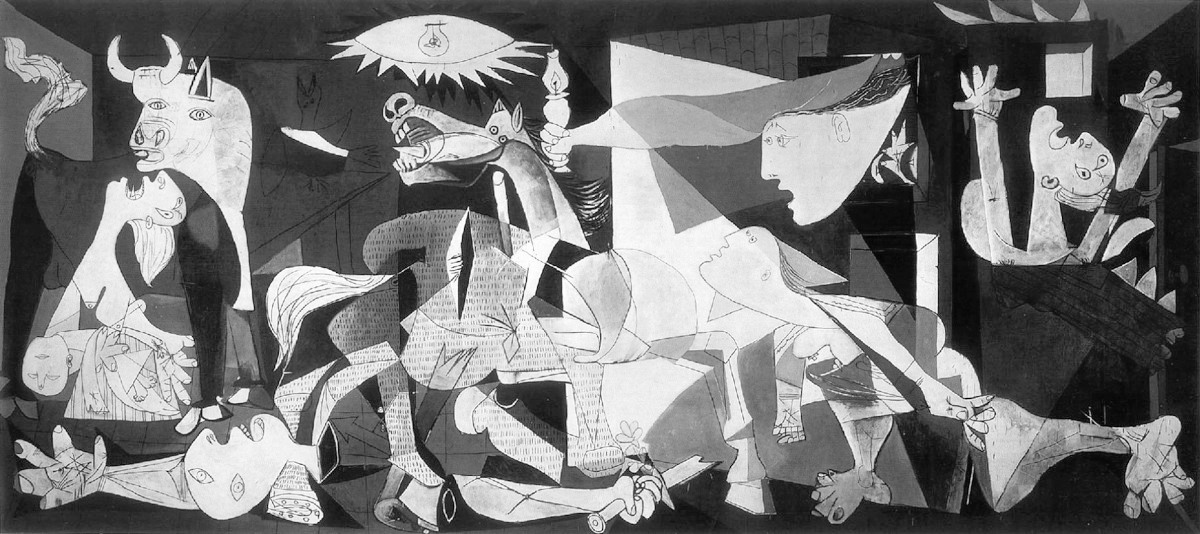
Guernica

Guernica by Pablo Picasso
Guernica by Pablo Picasso (1937) — Oil on canvas, 349 cm x 776 cm 
Museo Centro de Arte Reina Sofía, Madrid.
In the form of its execution and the scale of the destruction it wrought, no less than in the selection of its objective, the raid on Guernica is unparalleled in military history. Guernica was not a military objective [...] The object of the bombardment was seemingly the demoralization of the civil population. George Steer, The Times (27th April, 1937)

Seventy-two years ago, on April 26, 1937, a little Basque town called Guernica was bombed by planes from the Condor Legion, a unit composed of soldiers from the German air force (Luftwaffe), which was allied to the Nationalists headed by Francisco Franco during the Spanish Civil War. It was the first time in modern history — but not the last one — that an urban population was slaughtered on purpose by the means of a military attack.

Picasso paints Guernica by Dora Maar
Picasso paints Guernica
by Dora Maar (Paris, 1937)
Pablo Picasso had lived in Paris for several decades when Guernica was bombed, yet he began painting sketches for the canvas four days later only, as soon as he heard of it in the newspapers. The painting was finished in a few weeks, to be exhibited in June, 1937 in the Spanish pavilion at the Universal Exhibition in Paris. According to the tale, a German general then asked Picasso: "So, you are the one who made 'this'?" and Picasso answered: "No, you are".

Picasso put Guernica at the disposal of the struggle for the Spanish Republic. After it was defeated and Franco established his fascist power on the country, he insisted that it should return in Spain as soon as its government was restored (which happened in 1981 only). There is no allusion in the painting to a precise war action though. Picasso himself always insisted on the generality of Guernica's meaning, and described it as "the picture of all bombed cities".

Indeed, Guernica represents much more than an illustration of the destruction of the Basque town. It has become a symbol of the suffering of helpless civilians, in any war terror inflicted by a powerful army. As such, the painting could be called Coventry, Dresden or Hiroshima as well.

Mostar

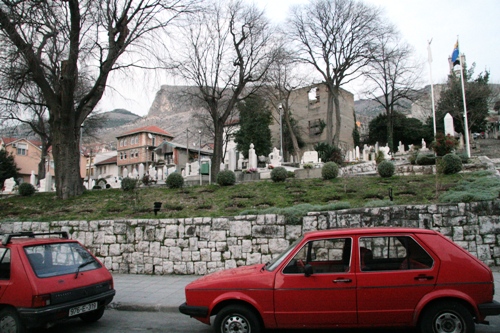
A graveyard in the city of Mostar
A graveyard inside Mostar — March 14, 2009

There are many little parks in the city, with grass and trees. Anywhere else, such places of greenery would be called 'public gardens'. Not in East-Mostar though, because there are tombs between the trees. Dozens of tombs.

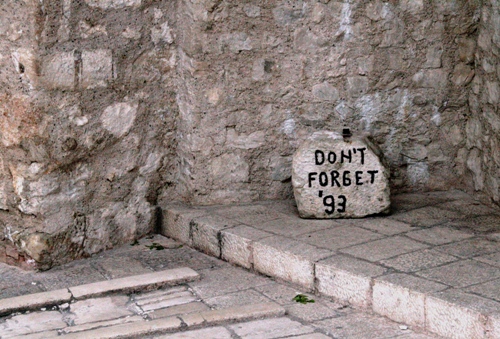
Each tomb is engraved : it displays a name, a date of birth, a date of death: 1993 usually. Thousands of people died during the civil war in Mostar, and graveyards seem to have replaced public gardens.

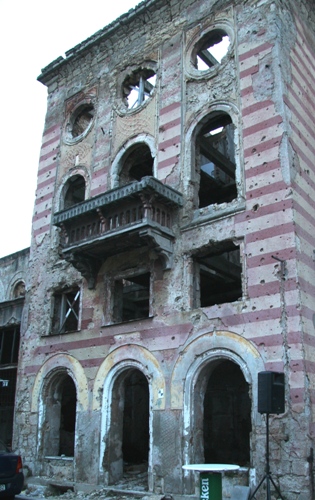
A ruin in Mostar
A ruin in Mostar

The war in Bosnia ended fourteen years ago but you can still see it everywhere. The streets and avenues are lined with destroyed buildings, dangerous ruins of which the fronts are riddled with holes of bullets and shrapnel. There is a same poster everywhere, that warns people against going into the ruins, children against playing there.

Constructions are coming on slowly in Mostar apparently. They are rebuilding, but you can guess that money is lacking.

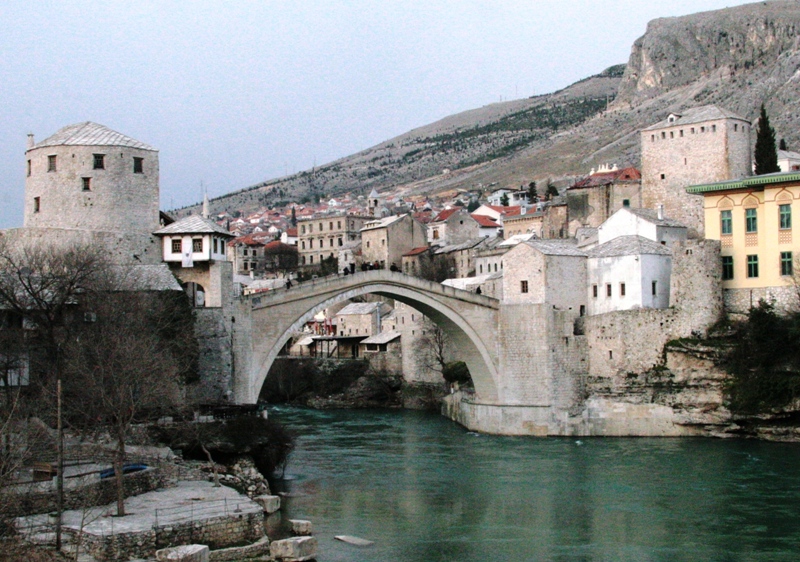
Stari Most, the Old Bridge after which Mostar was named, was the symbol of the city, and a chef-d'oeuvre of Ottoman architecture. It was commissioned by Suleiman the Magnificent to Mimar Hajruddin, a pupil of Sinan, "the father of classic Ottoman architecture".

On Stari Most, close to the right bank

Built in 1566, Stari Most consisted of a single 30 metres long hump-backed arch that stood more than 20 metres above the green waters of the Neretva River. It had withstood all sorts of calamities, invasions, wars, and even earthquakes.

Nevertheless, it was destroyed when Croats and Bosnians, who used yet to be allies against the Serbs during the civil war in Bosnia (1992-1995), fought during one year in Mostar. On November 9, 1993, the Old Bridge was destroyed by the artillery of the HVO Croatian forces, allegedly to stop Bosnian troops, in reality for its symbolic value as an Ottoman piece of art and a link between communities.

Mostar — Stari Most
Stari Most, the Old Bridge — March 14, 2009.

Under the aegis of the UNESCO, and thanks to a loan from the World Bank and grants from donor countries, the Old Bridge was rebuilt for the very same reason: as a symbol of peace and tolerance.

After two years of scientific and archeological research, it was rebuilt in 2004 exactly as it was, using identical blocks of white stones found in nearby quarries and according to traditional methods, using quoins, cramps and dowels. It is now listed as a World Heritage Site.

Noir Désir

Gagnants/Perdants by <em><u>Noir Désir</em>
Gagnants/Perdants by Noir Désir

Noir Désir became famous in 2001 with their song 'Le vent nous portera'. Yet the band was disrupted after singer Bertrand Cantat was jailed for the manslaughter of his girlfriend, actress Marie Trintignant after a violent row in a Lithuanian hotel in July 2003. He was sentenced to eight years imprisonment, but left jail last year after he had served half the sentence.

"Noir Désir died the same day as Marie", Cantat once said. Yet the band does not appear to be that dead, since they released on the Internet last Thursday, that everyone can download for free.

Le vent nous portera (Noir Désir)

For several months, I did not listen to 'Le vent nous portera' because I could not help thinking this voice belonged to a man who once beat his wife to death. I still have mixed feelings about it: the song exists anyway, and it is a great song.

Giorgio de Chirico — The Red Tower
Giorgio de Chirico
The Red Tower (1913)
The Barnes Foundation

When I was in Philadelphia lately, I visited , a fascinating place where hundreds (!) of chef-d'oeuvres are displayed. It owns a lot of Impressionist paintings especially. Also, many canvases by various painters who were not impressionists are exhibited, among which several pieces by .

I like many paintings by Chirico, in particular those he painted during his 'metaphysical' period. Yet the artist later joined the futurist movement 'Valori Plastici', then its 'Novecento' following, who both supported Mussolini's fascism. I sure dislike what were the ideas and behaviour of the individual. I still love many of his paintings anyway.

Another example: French writer , also a doctor in medicine. His first novel, 'Journey to the End of the Night' (Voyage au bout de la nuit) is among my favourite books ever. 'Death on the Instalment Plan' (Mort à crédit) is another great novel by him. His medical thesis about , who discovered the cause of puerperal fever and introduced hand washing in medicine, is at the same time a marvel of smartness and independence of mind, and splendid literature.

Yet Céline was a racist and anti-Semite, who shared many opinions with the Nazis. He wrote shameful pamphlets about the Jews before and during WWII. After the war, he was convicted a collaborator and imprisoned. I despise the man, I deeply admire several novels he wrote.

So... I still look at paintings by Chirico. I still read Céline. I still listen to music by Wagner. I may still listen to the songs by Bertrand Cantat also then. It does not mean I would shake the hand of the man, if it ever happened that I met him.

Birdsong

There are two large bookstores in Paris where I will go several times a year and buy books in English: Brentano's, the American Bookstore in Paris and WHSmith in Paris, the English Bookshop. When I last went to Brentano's, I had my attention attracted to the title of a book: Birdsong, by Sebastian Faulks, an Englishman. I had never heard of it, although it was labelled as a bestseller. I flipped through a few pages: the book was about the First World War, and beautifully written. I bought it.

The book tells the story of a young Englishman who fights in France during the WWI, interspersed with scenes of the life of his granddaughter, Elizabeth, a young woman living in the 1970s, who travels to France to discover more about the life and dead of her grandfather.

As Elizabeth drives across empty fields, she notices a great arch in a field. She pulls over and has a closer look at it.

As she came up to the arch, Elizabeth saw with a start that it was written on. She went closer. She peered at the stone. There were names on it. Every grain of the surface had been carved with British names; their chiseled capitals rose from the level of her ankles to the height of the great arch itself; on every surface of every column as as far as her eye could see there were names teeming, reeling, over surfaces of yards, of hundred of yards, over furlongs of stone.

She moved through the space beneath the arch where the man was sweeping. She found the other pillars identically marked, their faces obliterated on all sides by the names that were carved on them.
— Who are those, these...? She gestured with her hand.
— These? The man with the brush sounded surprised. The lost.
— Men who died in this battle?
— No. The lost, the ones they did not find. The others are in the cemeteries.
— These are just the... unfound?

She looked at the vault above her head and then around in panic at the endless writing, as though the surface of the sky had been papered in footnotes. When she could speak again, she said:
— From the whole war?

The man shook his head.
— Just these fields. He gestured with his arm.

Elizabeth went and sat on the steps on the other side of the monument. Beneath her was a formal garden with some rows of white headstones, each with a tended plant or flower at its base, each cleaned and beautiful in the weak winter sunlight.
— Nobody told me. She ran her fingers with their red-painted nails back through her thick dark hair. My God, nobody told me.

Between 1914 and 1918, about 9 million people were killed, in Europe essentially: 2 million German, 1,300,000 Frenchmen, 750,000 British, 650,000 Italians... Beside the terrible loss of young men in every family — France lost about 10 percent of its working population in the conflict — the war changed the political map of Europe, and the world balance of power. Several European empires were dismantled. France and the UK, although the winners, were ruined. It was the very moment in history when Europe handed over to the USA as the world economical and political leader.

Sadako

Crane Origami
"I will write peace on your wings
and you will fly all over the world"
"Suppose Germany had developed two bombs before we had any bombs. And suppose Germany had dropped one bomb, say, on Rochester and the other on Buffalo, and then having run out of bombs it would have lost the war. Can anyone doubt that we would then have defined the dropping of atomic bombs on cities as a war crime, and that we would have sentenced the Germans who were guilty of this crime to death at Nuremberg and hanged them? "
Leo Szilard,
father of the US atomic bomb.

I was chatting the other day with a US friend about the trip I had in New-York a few months ago. As it happens often when you chat, our conversation turned, from , the movie by Woody Allen at the time, to the and atomic bombs. I was very surprised when he genuinely said that the atomic bombs dropped on Hiroshima and Nagasaki were "good things" because they actually "saved lives".

ImageAlthough I know it is the way the whole story is usually told and taught in the USA, I wondered how a smart and articulate guy could seriously think that killing more than 200,000 civilians "actually saved lives". The whole bloody fighting in the Pacific killed about 40,000 US soldiers 'only'... When the US President Harry S. Truman ordered to drop Little Boy on Hiroshima on August 6, 1945, then Fat Man over Nagasaki three days later, the point was certainly not about saving lives then, but saving lives of US soldiers, at the expense of much more lives of foreign civilians.

Little Boy and Fat Man had killed about 140,000 people in Hiroshima and 80,000 in Nagasaki by the end of 1945, of which about half within the first days after the bombings. Several ten thousands more people died from radiation-induced diseases in the following years. In both cities, the overwhelming majority of casualties were civilians. These are to date the only nuclear bombings in history. Yet, as the historian and Pulitzer prize winner Gary Wills wrote once: "Only the winners decide what were war crimes".

Sadako Sasaki lived in Hiroshima. She was two year-old when the first nuclear bomb was dropped on her city. Although she lived close to ground zero, she was not harmed. Nine years later, she was a healthy 11 year-old girl practicing running. After the end of a race, she fainted, was hospitalised and diagnosed radiation-induced leukaemia.

ImageThere's a legend in Japan, the country of origami. It says that if you can fold a thousand , the Gods will make your first wish become true. Sadako decided she would fold one thousand origami and wish to be cured. She folded 654 cranes before she died, in October, 1955. Yet, she was buried with one thousand paper cranes, because her classmates had finished her uncompleted vow.

After her death, her friends and schoolmates raised funds to build a memorial to her and all of the children who had died from the effects of the atomic bomb. In 1958, a statue of Sadako holding a golden crane was unveiled in the Hiroshima Peace Memorial. At its base a plaque reads: "This is our cry. This is our prayer. Peace in the world." Every year, on August 6, the statue is decorated with thousands of paper cranes sent by children from all over the world.

Tao Tale

Yin & Yang Once upon a time in northern China, a small farmer lived close to steppes of which hordes of nomads had taken control. One day, he went back from the fair with a wonderful filly, for which he had squandered all his savings.

A few days later though, the young horse galloped away and disappeared beyond the dangerous border. The news quickly went around the village, and his neighbours each came in turn to sympathize with the peasant. Only he shrugged and said imperturbably:

— Clouds hide the sun, yet they bring rain. From a misfortune sometimes a benefit arises. We shall see.

Three months later, the mare came back with a superb wild stallion besides her. She was pregnant. Neighbours came and congratulated the lucky owner:

— You were right in being optimistic, they said. You lost a horse first, but now you have three!
— Clouds sometimes bring rain, and devastating storms sometimes, the farmer said. Misfortune hides in the folds of happiness. Let us wait.

The farmer's only son broke the fiery stallion in, and loved to ride him. Several weeks later, he felt seriously and almost broke his neck. He came out of the accident with one broken leg. When the neighbours came and sang their complain again, the country philosopher answered:

— Calamity or blessing, who could know? Changes have no end in this impermanent world.

A few days later, general mobilization was enacted in the district to repel a Mongolian invasion. Every able-bodied young man had to go and fight. Few returned to their home. Thanks to his crutches, farmer's only son escaped the slaughter.

Corsica — Jean Nicoli

I arrived today at Ajaccio, in Corsica, a French island in the Mediterranean sea, where I'll spend three days. The island and city are essentially known as the hometown of Napoleon Bonaparte. In Ajaccio, Napoleon is everywhere indeed, from the big bust that is the first thing you see when you arrive in the main hall of the airport, to street names and many cafés' signs.

Yet Napoleon is not the Corsican 'hero' I wish to talk about now. On my way from the airport to the Convention Centre, the taxi passed though Le Cours Jean Nicoli ('Jean Nicoli walk'). It recalled me that I read a book about this great name a couple of years ago, and several quotes by him have marked me.

In 1942, Corsica département was annexed by the Italians, still Germans allies in the first years of WWII. Jean Nicoli was a French Resistance fighter. He was caught captive in 1943, tried for terrorism, and sentenced to death. The night before he was executed, Jean Nicoli wrote a letter to her wife, daughter, and the people of the world. Here come an extract of this letter (English translation of mine, any correction welcome):

I can give men an advice: don't be afraid of death. It scares you because you don't know it, yet believe me: it is not evil at all. It is nothing terrible, and as soon as you are getting closer to the large black gate, it seems welcoming and cheerful.

Do not lament that much over your leaving ones: you are much more to be pitied than us. We have arrived, and we see you, at the foot of your death, struggling to catch up with us. Poor you... You are climbing, and you are afraid to arrive at the top and rest.

Don't be scared of the top. I have reached the last meters. I feel that I will rest soon on the springy smoothness of the top. You think: "how awful it must be, when you know you're going to be shot in four hours!" Well, no, you see, it is not...

Torture

Algerian prisoners — Algiers, 1960

The following takes place 50 years ago, when France was still an imperialist country with colonies.

During the Algerian War [1954-1962], the French essentially fought the Algerian National Liberation Front (FLN), engaged in violent acts of guerrilla warfare, bombings and assassinations.

At the time, the French military denied using torture, or rarely admitted it but justified it with claims that they were leading an operation of peace against terrorism by the FLN. Later though, several high-ranked officers aknowlegded there was generalized torture by the French military, following orders of the politicians in charge of the country.

No one shall be subjected to torture or to cruel, inhuman or degrading treatment or punishment.
(Universal Declaration of Human Rights. Article 5)
The social-democratic government of Prime Minister Guy Mollet had given a free hand to the occupying forces in Algeria to carry out torture. In June 1956, the National Assembly accepted Mollet's proposal to set aside individual freedoms in Algeria and permit the gendarmes and soldiers stationed there to use what was officially called extended questioning, coercive measures or special treatment.

Because FLN fighters were not looked upon as enemy forces but terrorists, The French Republic did not consider its military tied by the Geneva Conventions, France had signed several years earlier. Detainees were thus not granted prisoner of war status. On the contrary, since they were looked upon as terrorists, they were deprived of the rights that are legally entitled to belligerents during a war.

Image
Shortly said, torture was an integral part of France's war policy in Algeria. Part of the daily practice included mass rapes, submerging victims in freezing water or excrement, and repeated use of electric shocks. Even in the Algerian hinterland, where there was no electricity, electric shock torture was carried out using the so-called Gégène, using the generation system intended to radio stations.

Yet when the use of torture became public knowledge in France, support for the war in Algeria quickly dwindled. After the French military won the battle of Algiers, French Président Charles de Gaulle decided the French should leave Algeria and give it back to the Algerians — which was the only possible solution, for that matter. In a March 1962 referendum, almost 90 percent of voters in mainland France backed the Évian Accords that ended the hostilities and gave Algeria its independence.

At least 400,000 Algerians were killed during the war — some say one million. In 2008, after several decades, many dramas and slaughters, Algeria still is not really a democratic country.

The Thorn Humans

Image Recommended accompanying music:
 
[When the War is Over by J.J. Cale & Eric Clapton]

Seeking on the Internet yesterday after last news in Iraq, I unexpectedly found : despite the ongoing conflict across the country, no bird species has gone extinct in the Mesopotamian marshes — that used to be among the most biodiverse regions in the Middle-East — since the last assessments were conducted in the 1970s.

A Field Guide to the Birds of Iraq was even published recently, the authors of which proudly state that it "covers the 387 bird species that have been recorded in Iraq", being the "first comprehensive, fully illustrated field guide to the birds of an Arabic speaking country and first field guide of its kind for Iraq".

Granted, several US soldiers are killed in Iraq every day. Granted again, several hundred thousand Iraqi civilians died because of the war that began 3 years ago, and bombs still kill dozens of men, women and children every day or so. It made me think that is a great pity that they are not Buddhists or Hindus, instead of Christians and Muslims. If they were, they could be reincarnated as birds! Hopefully, they would live and breed then, despite the noise of bombs.

Satan met his lover, at last!

Saddam and his lover
What was usually displayed in South Park
could well be true now, don't you think?
It was not a surprise the Iraqi prime minister, Nuri al-Maliki, was glad with Saddam's execution. Same with Iran, two decades after a war with about two millions Iranians killed. No surprise either that many Muslims were shocked he was killed on the day of Eid el-Kbir.

George Bush said yesterday that Saddam's execution was an important milestone on Iraq's course to becoming a democracy... It appears quite strange to a European, since there are few democratic countries that still enforce death penalty! (see previous blog entry) It has been outlawed in all European countries, usually for decades. Then no surprise again that official reactions in Europe were similar to the German one: There are no doubts whatsoever about Saddam's crimes. But we are opposed to the death penalty, no matter where it is used. EU Commissionner Louis Michel even said: You don't fight barbarism with acts that I deem as barbaric.

Fully agreed: murdering a murderer puts you down to his level. Also, I cannot help but being worried the trial undoubtedly failed to satisfy international fair standards. Quoting Amnesty International:

Saddam Hussein's trial [...] was a deeply flawed affair. Political interference undermined the independence and impartiality of the court, causing the first presiding judge to resign and blocking the appointment of another. The court did not take measures to protect witnesses and defence lawyers, three of whom were assassinated during the course of the trial. Saddam Hussein was denied access to legal counsel for the first year after his arrest. The appeal process was obviously conducted in haste and failed to rectify any of the flaws of the first trial.

Therefore, this hasty killing will be seen by many as nothing else than victor's justice. Most probably, it will not help things to go better in Iraq, just the contrary.

Terrorism works

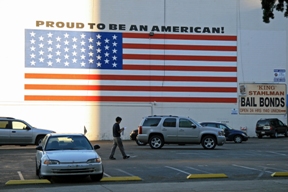
Why so? — San Diego, November 2006

Has Osama Bin Laden heard about the recent decision by US congress to legalize torture – ooops, “coercive interrogation”, pardon my French... — in some Pakistani cave or in the Heaven of Allah?

Actually, it does not mind. Wherever he is, dead or alive, the greatest instigator of international terrorism just won another victory, because this the very reason of terrorists' strategy: inducing their ennemy to forget their own principles and show a hideous face that, in return, justifies violence.

After the invasion on Iraq based on fake reasons, and prisoners kept in Guantanamo jails for years without a trial or even an accusation, now comes the official disregard of ... where is the USA going with George W. Bush and its administration? Do they still know what the word ethics mean?

It seems now the present most powerful democracy is on the road to decline of human rights and sorry renouncement of proclamed values. It is a distressing evidence that terrorism does work.

Related Posts Widget for Blogs by LinkWithin

Home

Atom
Feed
Timeless Music
The Magic Flute
by W. A. Mozart


Timeless Reading
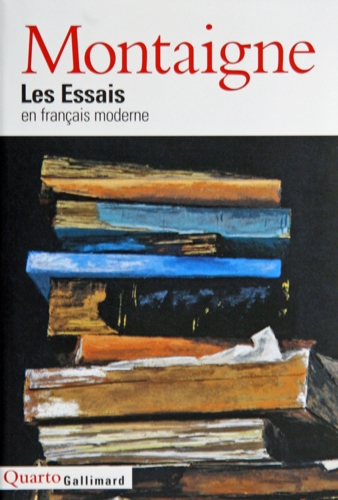
Les Essais
by Michel de Montaigne