Riddle: A Hint of a Hitch

The Obelisk at the Place de la Concorde, Paris
The Place de la Concorde in Paris

Our paths crossed on that day. You were ravishing, smooth blonde hair and preppy look. The light strip of a pearl necklace, above your peach-coloured cashmere sweater, was slightly iridescent in the first beams of this sunny morning of spring. I had the shadow of a doubt: weren't you notorious, Rebecca... something?

Under the pelisse on the back seat (mornings were still a little chilly), caught in a glimpse through the rear window of your tiny Parisian car, I could make out your mother's Grace Kelly purse, near the birds-patterned Carré Hermès you had left there, skilfully undone. Everything in your appearance indicated this special sense of sophistication passed down through several generations of strong economic power. I felt spellbound.

ImageThere was a frenzy of traffic on the Place de la Concorde. Young and innocent, you did not yield to me — I was just the wrong man at the wrong place. I confess I had the ghost of a frown, barely the mark of minor annoyance. A beautiful manicured hand with a fine golden ring and a topaz let go of the blond wood steering wheel. You gave me the finger.

People who still believe in elegance and refinement never drove a car.

Titian

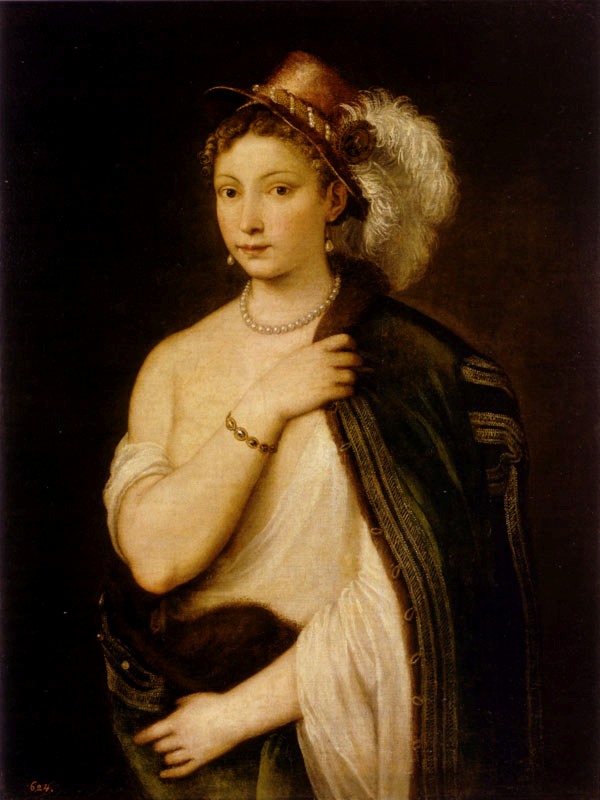
Titian — Portrait of a young woman
Portrait of a young woman (1536)
Oil on canvas, 96 x 75 cm
State Hermitage Museum, St. Petersburg

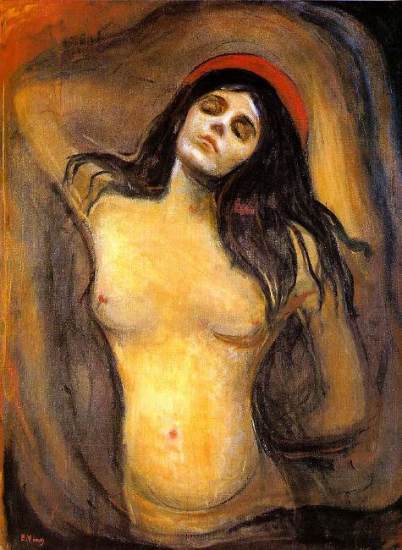
It is funny when you recognize somebody you 'know' in a painting.
how it happened to me in Oslo two years ago: I was amazed to recognize Edvard Munch's painting in the young woman portrayed in .

I had the same experience at an exhibition called Titien, le pouvoir en face (Titian, power straight in the face) held last year in Paris at the Palais du Luxembourg, the museum of the French Senate. The portraits exhibited were essentially those of powerful men of the time, of which Titian was the official portraitist, such as several Doges of Venice, Dukes of Urbino, Kings of Spain Carlos V and Felipe II, King of France François I, and so forth.

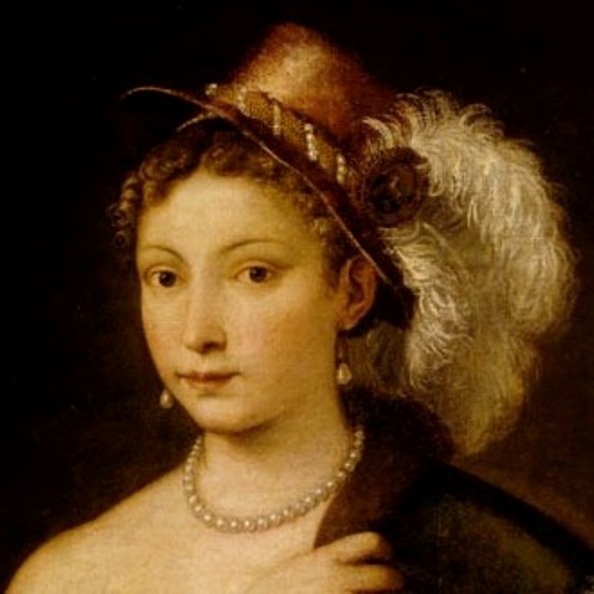
A few portraits of women were also displayed though, among which I particularly loved the canvas displayed above. This young lady with an elegant feathered hat, who wears her coat on one shoulder in a very casual way, is showed before a dark background. Yet the whole picture is lightened by her brilliant skin and white shirt.

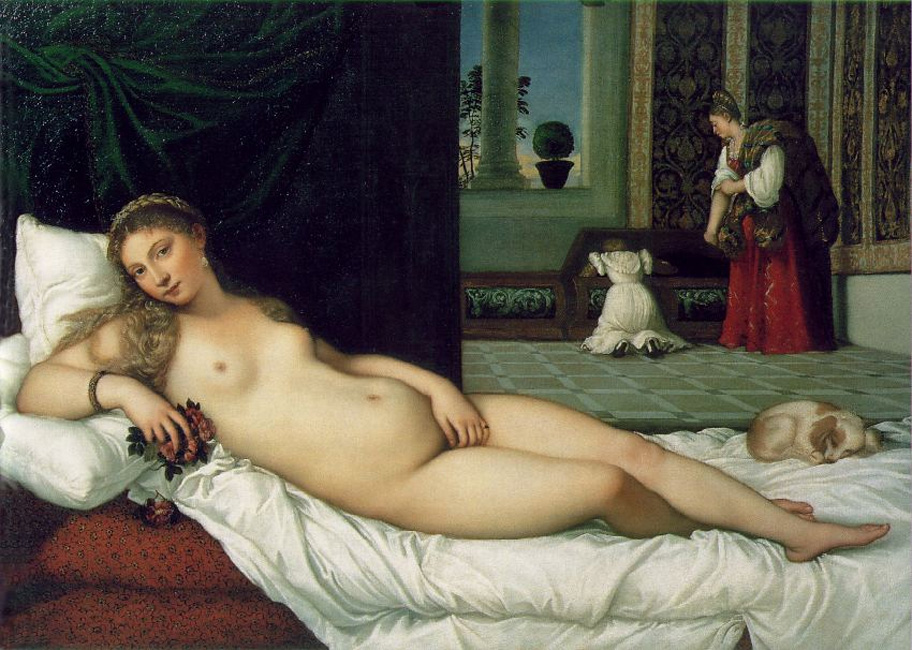
Titian — The Venus of Urbino
The Venus of Urbino (1538). Oil on canvas, 119 x 165 cm
Galleria degli Uffizi, Florence

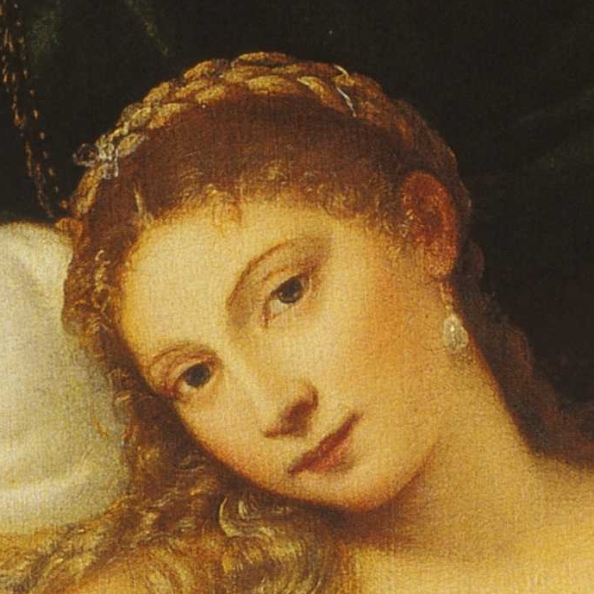
Watching at the portrait of this young woman, I progressively had a weird feeling, that I knew her in person. I realized it was almost the case indeed, a few minutes only after I left the exhibition: the woman portrayed here was also the sitter of the Venus of Urbino, one of the most famous paintings by Titian.

I'll probably write here some day about how Titian took the topic of the Venus of Urbino from a painting by Giorgione, the (also called the Venus of Dresde), that Titian finished after his master died in 1510, and how his painting in turn inspired Édouard Manet when he painted , more than three hundred years later.

ImageImageIn fact, I had just hoped to see this wonderful painting in the exhibition, but it was not there. Probably it does not leave the Galleria degli Uffizi in Florence more than the Mona Lisa ever leaves the Musée du Louvre in Paris...

Well, at least I saw the face of Venus on that day, if not her whole naked body.

The Padlock Wall

Padlocks in Pécs, Hungary
On the Padlock Wall — Pécs, July 2007
If you ever go to the city of Pécs with your lover, don't forget to bring a padlock!
Several decades ago, a student left his padlock and its key on a grate in the center of this city of Southern Hungary, in a street close to the cathedral. It was his last day of school before summer holidays, and there was no need for him to bring such an old padlock back home.
A few days later, a couple of lovers saw the padlock on the grate. They engraved their names on another padlock, then locked it beside the first one. Other couples did the same. The tradition was born that lovers who lock a padlock to these grates get hitched forever themselves.
Thousands of padlocks are now locked on the grates of the padlock wall in Pécs. No doubt, it certainly means that the spell works.

Camille "Ta Douleur"

Camille – Le Fil
Camille Dalmais, who goes by the stage name , is a French songwriter and singer unlike anyone: most of the sounds in her records come from the human body. Clicks, slaps, rubs, purr... and many more sounds, including her voice of course.

Ta douleur (Your pain) was the second song in Camille's second album Le fil (The Thread), released 2005.


Camille – Ta douleur

Here are the French lyrics of the song and their translation into English. It is noteworthy that the word 'douleur' (pain) is feminine in French, which allows Camille a poetic licence: she speaks of pain as if it were a female... a female rival? Hence the use of 'she' instead of 'it' in the translation below, so that it renders the ambiguity of French lyrics... of which the meaning is probably obvious for their author only anyway.

Lève-toi, c'est décidé
Laisse moi te remplacer
Je vais prendre ta douleur

Doucement, sans faire de bruit
Comme on réveille la pluie
Je vais prendre ta douleur
Prendre ta douleur
Je vais prendre ta douleur

Elle lutte elle se débat
Mais ne résistera pas
Je vais bloquer l'ascenseur...
Prendre ta douleur
Je vais prendre ta douleur
Saboter l'interrupteur
Prendre ta douleur
Je vais prendre ta douleur

Mais c'est qui cette incrustée
Cet orage avant l'été
Sale chipie de petite soeur ?

Je vais tout lui confisquer
Ses fléchettes et son sifflet
J'vais lui donner la fessée...
Prendre ta douleur
Je vais prendre ta douleur
La virer de la récré
Prendre ta douleur
Je vais prendre ta douleur

Mais c'est qui cette héritière
Qui se baigne qui se terre
Dans l'eau tiède de tes reins ?
J'vais la priver de dessert
Lui faire mordre la poussière
De tous ceux qui n'ont plus faim...
Prendre ta douleur
Je vais prendre ta douleur
De tous ceux qui n'ont plus rien
Prendre ta douleur
Je vais prendre ta douleur

Dites moi que fout la science
A quand ce pont entre nos panses ?
Si tu as mal là où t'as peur
Tu n'as pas mal là où je pense !

Qu'est-ce-qu'elle veut cette connasse
Le beurre ou l'argent du beurre?
Que tu vives ou que tu meures ?
Faut qu'elle crève de bonheur
Ou qu'elle change de godasses
Faut qu'elle croule sous les fleurs
Change de couleur...
Je vais prendre ta douleur
Je vais jouer au docteur
Prendre ta douleur
Je vais prendre ta douleur

Dites moi que fout la science
A quand ce pont entre nos panses ?
Si tu as mal là où t'as peur
Tu n'as pas mal là où je chante !

Lève-toi lève-toi lève-toi
Elle a envie de toi ta douleur
Elle a envie de ttt ttt tt…

Get up, it's a done deal
Let me take your place
I'm going to take your pain

Gradually, without a noise
As one wakes up the rain
I'm going to take your pain
Take your pain
I'm going to take your pain

She fights, she struggles,
But she won't overcome
I am going to stop the lift...
Take your pain
I'm going to take your pain
Mess up the switch
Take your pain
I'm going to take your pain

Well, who is she, settled down,
Such a storm before summer
Such a brat little sister?

I'm going to seize her everything
Her darts and whistle
I am going to spank her…
Take your pain
I'm going to take your pain
Kick her out of the break
Take your pain
I'm going to take your pain

Well, who is that heiress,
Who has a bath, who goes to earth
In the warm water of your back?
I'm going to deprive her of dessert
Make her bite the dust
Of those who are not hungry any more...
Take your pain
I'm going to take your pain
Of those who don't have anything left
Take your pain
I'm going to take your pain

Tell me what the hell science is up to
When for a bridge between our bellies?
If you're aching where you're scared
You're not aching where I think!

What does she want, that bitch?
Your cake or she eats it?
You living or you dying?
She must be full of happiness
Or change her shoes
She must be snowed under with flowers
Change your colour…
I'm going to take your pain
I'm going to play at doctors
Take your pain
I'm going to take your pain

Tell me what the hell science is up to
When for a bridge between our bellies?
If you're aching where you're scared
You're not aching where I sing!

Get up get up get up
She wants you, your pain
She wants…

Sadako

Crane Origami
"I will write peace on your wings
and you will fly all over the world"
"Suppose Germany had developed two bombs before we had any bombs. And suppose Germany had dropped one bomb, say, on Rochester and the other on Buffalo, and then having run out of bombs it would have lost the war. Can anyone doubt that we would then have defined the dropping of atomic bombs on cities as a war crime, and that we would have sentenced the Germans who were guilty of this crime to death at Nuremberg and hanged them? "
Leo Szilard,
father of the US atomic bomb.

I was chatting the other day with a US friend about the trip I had in New-York a few months ago. As it happens often when you chat, our conversation turned, from , the movie by Woody Allen at the time, to the and atomic bombs. I was very surprised when he genuinely said that the atomic bombs dropped on Hiroshima and Nagasaki were "good things" because they actually "saved lives".

ImageAlthough I know it is the way the whole story is usually told and taught in the USA, I wondered how a smart and articulate guy could seriously think that killing more than 200,000 civilians "actually saved lives". The whole bloody fighting in the Pacific killed about 40,000 US soldiers 'only'... When the US President Harry S. Truman ordered to drop Little Boy on Hiroshima on August 6, 1945, then Fat Man over Nagasaki three days later, the point was certainly not about saving lives then, but saving lives of US soldiers, at the expense of much more lives of foreign civilians.

Little Boy and Fat Man had killed about 140,000 people in Hiroshima and 80,000 in Nagasaki by the end of 1945, of which about half within the first days after the bombings. Several ten thousands more people died from radiation-induced diseases in the following years. In both cities, the overwhelming majority of casualties were civilians. These are to date the only nuclear bombings in history. Yet, as the historian and Pulitzer prize winner Gary Wills wrote once: "Only the winners decide what were war crimes".

Sadako Sasaki lived in Hiroshima. She was two year-old when the first nuclear bomb was dropped on her city. Although she lived close to ground zero, she was not harmed. Nine years later, she was a healthy 11 year-old girl practicing running. After the end of a race, she fainted, was hospitalised and diagnosed radiation-induced leukaemia.

ImageThere's a legend in Japan, the country of origami. It says that if you can fold a thousand , the Gods will make your first wish become true. Sadako decided she would fold one thousand origami and wish to be cured. She folded 654 cranes before she died, in October, 1955. Yet, she was buried with one thousand paper cranes, because her classmates had finished her uncompleted vow.

After her death, her friends and schoolmates raised funds to build a memorial to her and all of the children who had died from the effects of the atomic bomb. In 1958, a statue of Sadako holding a golden crane was unveiled in the Hiroshima Peace Memorial. At its base a plaque reads: "This is our cry. This is our prayer. Peace in the world." Every year, on August 6, the statue is decorated with thousands of paper cranes sent by children from all over the world.

Related Posts Widget for Blogs by LinkWithin

Home

Atom
Feed
Timeless Music
The Magic Flute
by W. A. Mozart


Timeless Reading
Les Essais
by Michel de Montaigne