Nine by nine

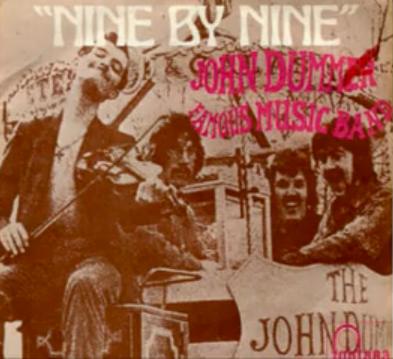
Nine By Nine by the John Dummer Famous MusicBand (1970)
Cover of the Nine by Nine 45 rpm record (1970)

I confess that I deliberately waited for nine days since my previous blog, because I wanted to post this entry today 9/9/9, at 9:9 am.

Nine by nine by The
John Dummer Famous Music Band

nine
    [BbN #9]
This piece was a huge hit in France in the 1970s. I still find it great now.

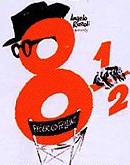
Otto e Mezzo

I thought I had something so simple to say. Something useful to everybody. A film that could help bury forever all those dead things we carry within ourselves. Instead, I'm the one without the courage to bury anything at all. When did I go wrong?
I really have nothing to say, but I want to say it all the same.
Guido, in 8½ by F. Fellini)
The present blog certainly comes as a joke, located as it is between 8 and 9 in the Blogging by Numbers series of blogs I have been unwinding for several weeks. Yet 8½ by was a movie that remains worth seeing, almost half a century later, far from the usual hyped-up blockbusters now released every week. Also, the music by Nino Rota is justly famous.
The movie depicts the crisis of a creative mind, the despondency of an artist who doesn't succeed in creating any more.
    [BbN #8.5]
Guido, played by Marcello Mastroianni — and a transparent alter ego of Fellini himself — has lost inspiration. He is overwhelmed by an uncontrolled flood of dreams, fantasies, and hallucinations.
From this movie on, Federico Fellini took up a style of Realistic Fantasy, where extravagance is more real than reality, filled up with humanity, fantasizing and imagination.

Paris in August

August in Paris
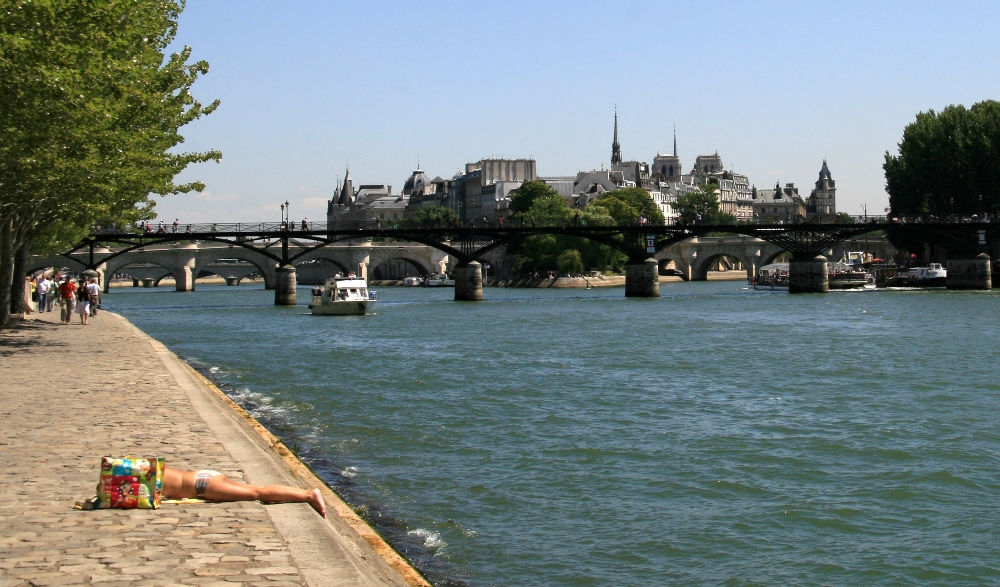
Taking a Sunbath in Paris

I love Paris in August. Because many people have the month of August off in France, several hundred thousand Parisians then leave the city for weeks. Fewer Parisians, many tourists, warm and sunny weather usually, there is a special atmosphere. The air is filled with tranquillity, like a Sunday that would last for one month.

You must go and work every day as usual; you feel as if you were in vacation though. For lunch, you will improvise a picnic with colleagues, in the or the . On the evening, you will stroll around, have a beer at the terrace of a café. You will sit on the grass in a garden perhaps, to take a nap or read a book.

It's August. The eighth month in the year, and a blessed month in Paris, when the City of Lights gets rid of its usual frenzy. Traffic jams, subway's crowd, all that makes it a hard place to live in sometimes, has disappeared for a while. The city reveals itself, warm and cheerful. It has put on its leisure clothes, for the sake of tourists, most of whom don't realize how special the atmosphere is.

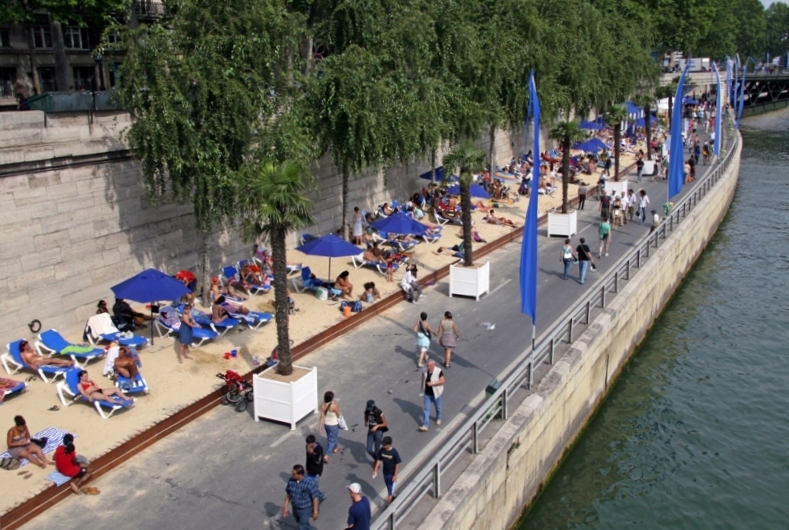
Paris Plage
Paris-Plages, on the banks
of the Seine River

Paris is weightless in August. It's culture without stress, moving around without hurry. No more queues in front of movie theatres. No more traffic jams on the . You will find a parking space anywhere at once, and it's free! You can sit in the bus. Metro cars are empty.

You can take a (Paris' self-service bike-hire system) safely and bike everywhere, even on the .

    [BbN #8]
You may decide to go to ('Paris-Beaches', eighth occurrence this year) and have a sunbath on the banks of the Seine River or Bassin de la Villette, why not? You feel as if you were a tourist yourself.

In August, Parisians rediscover space in a city that misses it so much during the rest of the year. La Joie de Vivre is back, it is almost Italy. Oh yes. I do love Paris in August.

N°5

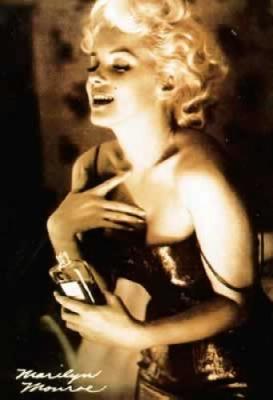
Marilyn Monroe
"What do I wear to bed? Why, Chanel N°5, of course"  (Marilyn Monroe)

Since my entry entitled Blogging by Numbers, I have written blogs under the constraint stated as 'Write blogs on topics one can associate with successive ascending numbers' — and still am I now. It was not the first time I assigned myself a constraint as a challenge, and a help to my inspiration as well: I did the same two years ago with a constraint of writing about the 5 senses and Paris. It ended up in blogs about Sight, Hearing, Touch, Taste, and Smell.

When you talk about the five senses, it is but logical to name sight and hearing first, because they are the most important senses in humans. Taste, and essentially smell, on the contrary, will be named last, because they are of much lesser use in humans than many animals.

It is the same when it comes to arts. Arts are usually based on one sense only, and arts based on a sense that acts from a distance — sight or hearing — are seen as noble arts. Painters, sculptors, composers, musicians, are undisputed artists. On the opposite, few people will spontaneously consider that chefs, wine experts and perfumers are artists as well. There is a hierarchy among senses: senses that need closeness are trivial. Touch, taste, and smell, especially.

Every art needs education and practice. It is the case especially with arts that rely upon underused senses. It is probably not only coincidental then that France, a country where even body smell has traditionally been considered a normal feature of men and women, is especially famous for its cuisine, cheeses, wines, and perfumes.

Everybody knows Leonardo, Picasso, Rodin, Mozart, and so many other artists relying on sight or hearing. Few people, on the opposite, have heard of , who invented the Eau de Cologne and served as a model for the character of César Birotteau in the novel by , or who created Chanel n°5, probably the most famous perfume ever.

quote I want to give women an artificial perfume. Yes, I really do mean artificial, like a dress, something that has been made. I am a fashion craft worker. I don’t want any rose or lily of the valley, I want a perfume that is a composition.
Coco Chanel

When Mademoiselle commissioned Ernest Beaux to make several perfumes for her choosing, she was already a famous fashion designer who had imposed her conception of elegance, with modern women feeling free because they wore simple and comfortable clothing.

At the time though, fashion and perfumes were distinct areas, and the idea of creating a perfume that would be an image of the brand was new. Beaux produced two series of samples numbered 1 to 5 and 20 to 24. Chanel chose the bottle labelled as N°5 and decided to keep the name, probably for superstitious reasons.

      [BbN #5]
The new perfume was introduced on May 5, 1921, on the 5th day of the 5th month of the year. In the light of what its destiny has been for more than 80 years, Coco Chanel was undoubtedly right in thinking that 5 was her lucky number.

Scrambled Eggs

Let it Be
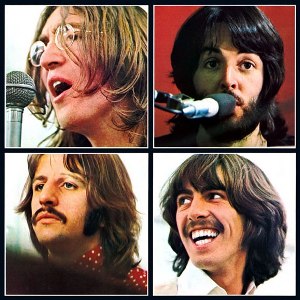
John, Paul, Ringo and George
(Cover of Let it Be – 1970)

Paul McCartney had only just woke up in his room in London, one morning in 1964, when he hurried to the piano and turned on a tape recorder. During the night, he had dreamed of a melody he did not want to let slip into the recesses of his mind.

In order not to lose it then, he played it with temporary lyrics inspired by the breakfast he was just about to take with his girlfriend: 'Scrambled Eggs… Oh, baby, you've got so lovely legs'.

The music was here, the whole of its melody so precisely composed that McCartney was not sure at first it was truly a creation of his own. He feared it might be involuntary plagiarism, that he subconsciously remembered a music composed by someone else. 'For about a month', he told later, 'I went round to people in the music business and asked them whether they had ever heard it before. Eventually it became like handing something in to the police. I thought if no-one claimed it after a few weeks then I could have it.'

was as its peaks at the time. The group of four boys from Liverpool — whose name was a pun made of The Beetles (one among their many first names, and a tribute to Buddy Holly's group The Crickets) and 'to beat' — had turned into the world's most famous band in the history of popular music in the 20th century. Even, first dissensions had appeared, that would make the band break in 1970.

In 1964 though, would always sing together. John Lennon and Paul McCartney composed most of the songs, they would always sign together — Lennon/McCartney. It was the case also with Scrambled Eggs when McCartney succeeded at last to add real lyrics to the music composed during his sleep. Yet, for the first time, the song was not sung by the whole Beatles but Paul alone, accompanying himself on an acoustic guitar, with a string quartet on the background.

Yesterday has become one of the world's most popular songs ever, with more than 3,000 recorded versions. In a poll of  British music experts and listeners in 1999, it was even voted the best song of the 20th century. I do love the song, but I somewhat regret it has not remained an Ode to Scrambled Eggs, just for the sake of fun and originality.

[BbN #4]
Related Posts Widget for Blogs by LinkWithin

Home

Atom
Feed
Timeless Music
The Magic Flute
by W. A. Mozart


Timeless Reading
Les Essais
by Michel de Montaigne