Seeking Freud in Fragonard
Sunday, September 21, 2008 by Billy
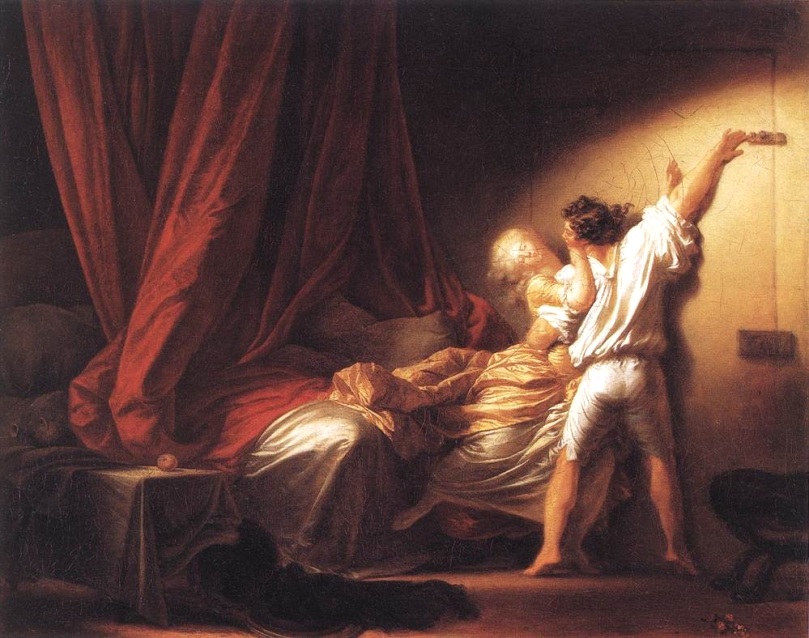 Jean-Honoré Fragonard - The Bolt (Le Verrou) Oil on canvas 73 x 93 cm, ca. 1778. Musée du Louvre, Paris. |
Although he painted in several styles including neoclassicism, Jean-Honoré Fragonard is particularly famous as a rococo painter, because he painted several remarkable ribald, suggestive paintings, according to what was in the mood among her aristocratic patrons at the end of the 18th century, before the French Revolution occurred.
The Bolt (Le verrou), one of the most famous canvases by Fragonard, is a beautiful piece of art that is worth a analytical explanation... in every meaning of the word.
The painting is split by a diagonal, from the upper right to bottom left. On the well-lit right side, a man embraces a woman, while he pushes to the bolt of the door with the fingertips of his right hand. The woman seems half-fainting and resisting him mildly. Yet we all know that what must happen will happen. Hmm... 'will happen?' Why such untidiness on the darker left side then? A rumpled bed, scattered pillows, a hanging down canopy... how can there be so much disorder in a room where nothing has yet happened?
A specialist of paintings by Fragonard once wrote "On the right side, there is a couple; on the left side, there is nothing". Such a nothing is about half the painting though. Daniel Arasse, a French Art historian, rightly wrote in a fantastic book entitled Histoires de Peintures (Tales of Paintings) that much of the meaning of this canvas lies precisely in this nothing.
 |
At first sight, there does not appear to be any real topic in the left part of the painting indeed, but drapes and folds. With a closer look though, you will see that the pillows are strangely put up as tips. In the canopy, a red material comes slightly unfastened, a slit sinking into the darkness. And the bed's corner, in the foreground, is covered by a sheet whose material is the same as the woman's dress. Look better: this corner is a knee. The knee of a widely open leg, a pair of breasts, a female sex above them, all allude to what is just going to happen. It refers to the man's fantasy and desire. The nothing on the left half of the painting is actually the thing.
Or... perhaps I am totally wrong? What do you think? Perhaps there is nothing to see there, but a rumpled bed? This is the whole ambiguity of art: you see (you can see, you want to see...) or you don't. Nobody can tell who is 'right' and who is 'wrong' if we disagree, but it does not matter anyway: when you look at a piece of art, it is not the meaning you see in it — or not — that is important, but how much the work appealed to you and gave rise to emotion.
 The idea of

 There was a