Camille "Ta Douleur"

Camille – Le Fil
Camille Dalmais, who goes by the stage name , is a French songwriter and singer unlike anyone: most of the sounds in her records come from the human body. Clicks, slaps, rubs, purr... and many more sounds, including her voice of course.

Ta douleur (Your pain) was the second song in Camille's second album Le fil (The Thread), released 2005.


Camille – Ta douleur

Here are the French lyrics of the song and their translation into English. It is noteworthy that the word 'douleur' (pain) is feminine in French, which allows Camille a poetic licence: she speaks of pain as if it were a female... a female rival? Hence the use of 'she' instead of 'it' in the translation below, so that it renders the ambiguity of French lyrics... of which the meaning is probably obvious for their author only anyway.

Lève-toi, c'est décidé
Laisse moi te remplacer
Je vais prendre ta douleur

Doucement, sans faire de bruit
Comme on réveille la pluie
Je vais prendre ta douleur
Prendre ta douleur
Je vais prendre ta douleur

Elle lutte elle se débat
Mais ne résistera pas
Je vais bloquer l'ascenseur...
Prendre ta douleur
Je vais prendre ta douleur
Saboter l'interrupteur
Prendre ta douleur
Je vais prendre ta douleur

Mais c'est qui cette incrustée
Cet orage avant l'été
Sale chipie de petite soeur ?

Je vais tout lui confisquer
Ses fléchettes et son sifflet
J'vais lui donner la fessée...
Prendre ta douleur
Je vais prendre ta douleur
La virer de la récré
Prendre ta douleur
Je vais prendre ta douleur

Mais c'est qui cette héritière
Qui se baigne qui se terre
Dans l'eau tiède de tes reins ?
J'vais la priver de dessert
Lui faire mordre la poussière
De tous ceux qui n'ont plus faim...
Prendre ta douleur
Je vais prendre ta douleur
De tous ceux qui n'ont plus rien
Prendre ta douleur
Je vais prendre ta douleur

Dites moi que fout la science
A quand ce pont entre nos panses ?
Si tu as mal là où t'as peur
Tu n'as pas mal là où je pense !

Qu'est-ce-qu'elle veut cette connasse
Le beurre ou l'argent du beurre?
Que tu vives ou que tu meures ?
Faut qu'elle crève de bonheur
Ou qu'elle change de godasses
Faut qu'elle croule sous les fleurs
Change de couleur...
Je vais prendre ta douleur
Je vais jouer au docteur
Prendre ta douleur
Je vais prendre ta douleur

Dites moi que fout la science
A quand ce pont entre nos panses ?
Si tu as mal là où t'as peur
Tu n'as pas mal là où je chante !

Lève-toi lève-toi lève-toi
Elle a envie de toi ta douleur
Elle a envie de ttt ttt tt…

Get up, it's a done deal
Let me take your place
I'm going to take your pain

Gradually, without a noise
As one wakes up the rain
I'm going to take your pain
Take your pain
I'm going to take your pain

She fights, she struggles,
But she won't overcome
I am going to stop the lift...
Take your pain
I'm going to take your pain
Mess up the switch
Take your pain
I'm going to take your pain

Well, who is she, settled down,
Such a storm before summer
Such a brat little sister?

I'm going to seize her everything
Her darts and whistle
I am going to spank her…
Take your pain
I'm going to take your pain
Kick her out of the break
Take your pain
I'm going to take your pain

Well, who is that heiress,
Who has a bath, who goes to earth
In the warm water of your back?
I'm going to deprive her of dessert
Make her bite the dust
Of those who are not hungry any more...
Take your pain
I'm going to take your pain
Of those who don't have anything left
Take your pain
I'm going to take your pain

Tell me what the hell science is up to
When for a bridge between our bellies?
If you're aching where you're scared
You're not aching where I think!

What does she want, that bitch?
Your cake or she eats it?
You living or you dying?
She must be full of happiness
Or change her shoes
She must be snowed under with flowers
Change your colour…
I'm going to take your pain
I'm going to play at doctors
Take your pain
I'm going to take your pain

Tell me what the hell science is up to
When for a bridge between our bellies?
If you're aching where you're scared
You're not aching where I sing!

Get up get up get up
She wants you, your pain
She wants…

Sadako

Crane Origami
"I will write peace on your wings
and you will fly all over the world"
"Suppose Germany had developed two bombs before we had any bombs. And suppose Germany had dropped one bomb, say, on Rochester and the other on Buffalo, and then having run out of bombs it would have lost the war. Can anyone doubt that we would then have defined the dropping of atomic bombs on cities as a war crime, and that we would have sentenced the Germans who were guilty of this crime to death at Nuremberg and hanged them? "
Leo Szilard,
father of the US atomic bomb.

I was chatting the other day with a US friend about the trip I had in New-York a few months ago. As it happens often when you chat, our conversation turned, from , the movie by Woody Allen at the time, to the and atomic bombs. I was very surprised when he genuinely said that the atomic bombs dropped on Hiroshima and Nagasaki were "good things" because they actually "saved lives".

ImageAlthough I know it is the way the whole story is usually told and taught in the USA, I wondered how a smart and articulate guy could seriously think that killing more than 200,000 civilians "actually saved lives". The whole bloody fighting in the Pacific killed about 40,000 US soldiers 'only'... When the US President Harry S. Truman ordered to drop Little Boy on Hiroshima on August 6, 1945, then Fat Man over Nagasaki three days later, the point was certainly not about saving lives then, but saving lives of US soldiers, at the expense of much more lives of foreign civilians.

Little Boy and Fat Man had killed about 140,000 people in Hiroshima and 80,000 in Nagasaki by the end of 1945, of which about half within the first days after the bombings. Several ten thousands more people died from radiation-induced diseases in the following years. In both cities, the overwhelming majority of casualties were civilians. These are to date the only nuclear bombings in history. Yet, as the historian and Pulitzer prize winner Gary Wills wrote once: "Only the winners decide what were war crimes".

Sadako Sasaki lived in Hiroshima. She was two year-old when the first nuclear bomb was dropped on her city. Although she lived close to ground zero, she was not harmed. Nine years later, she was a healthy 11 year-old girl practicing running. After the end of a race, she fainted, was hospitalised and diagnosed radiation-induced leukaemia.

ImageThere's a legend in Japan, the country of origami. It says that if you can fold a thousand , the Gods will make your first wish become true. Sadako decided she would fold one thousand origami and wish to be cured. She folded 654 cranes before she died, in October, 1955. Yet, she was buried with one thousand paper cranes, because her classmates had finished her uncompleted vow.

After her death, her friends and schoolmates raised funds to build a memorial to her and all of the children who had died from the effects of the atomic bomb. In 1958, a statue of Sadako holding a golden crane was unveiled in the Hiroshima Peace Memorial. At its base a plaque reads: "This is our cry. This is our prayer. Peace in the world." Every year, on August 6, the statue is decorated with thousands of paper cranes sent by children from all over the world.

Klaus Nomi

Klaus Nomi

Klaus Nomi started being famous in the late seventies when he performed with David Bowie in New-York. Quite unusually, the German countertenor was involved in underground and pop music, and in opera as well.

He was not only famous because of his exceptionally wide tessitura, but also because of his elfin look and usual appearances on stage as a black and white alien. Yet his career was short: he was one of the first celebrities to die from AIDS.

In November, 1982, before his home crowd in Munich, Klaus Nomi performed The Cold Song from King Arthur by Henry Purcell. Although the audience did not know, he was already seriously ill at the time, which appears obvious on the movie below. He died a few months later, aged 39 only.


Klaus Nomi - The Cold Song

What power art thou, who from below
Hast made me rise unwillingly and slow
From beds of everlasting snow
See'st thou not how stiff and wondrous old
Far unfit to bear the bitter cold,
I can scarcely move or draw my breath
Let me, let me freeze again to death.

The lyrics to this old aria appear strangely prophetic when you watch at it now, the last two lines especially... Knowing what a difficult time Klaus Nomi was having then, just adds to its intensity and frightening beauty.

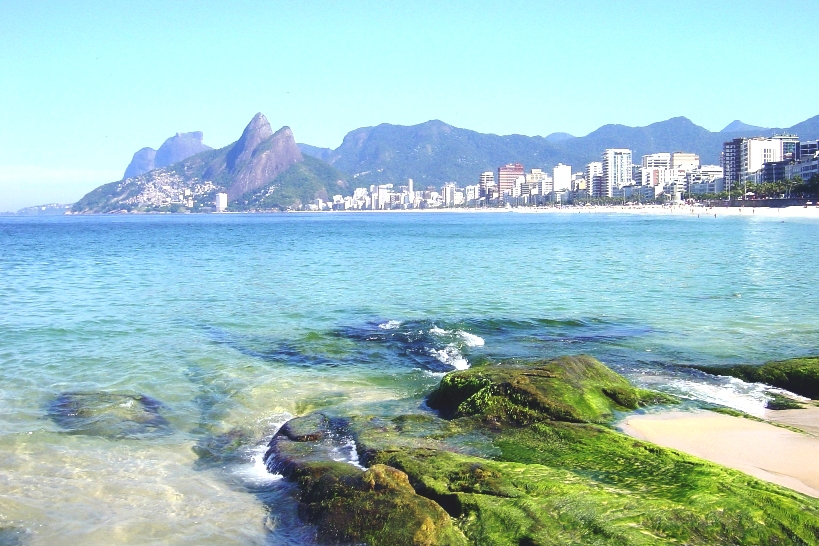
Ipanema

Ipanema Beach
Ipanema Beach – Rio de Janeiro, April 2007

The World Congress of Nephrology was taking place in Rio de Janeiro and I was there!

For several months, I had waited to go to this dreamy city, and hoped I could visit it a little between sessions. I certainly was there for working, yet not every communication in a convention is interesting: you usually go from one session to another then, and listen to the talks about topics you're interested in only. Hopefullythen, there are a few gaps in your schedule, when there is really nothing on the programme you feel worth attending. You may then leave the convention centre for one hour or two without guilt, and visit the place.

In Rio de Janeiro, it was not possible though, because the Convention Centre was located in an almost deserted neighbourhood, far away from the city centre, beaches, stores, everything.

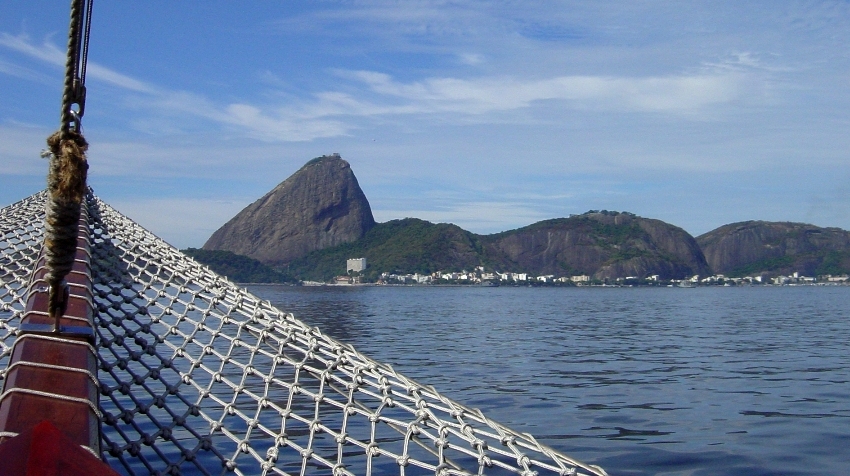
Sugar Loaf
Rio de Janeiro's Sugar Loaf – April 2007
Pic taken from a boat on Guanabara Bay

On the last day then, I decided not to go to the congress at all. Instead of taking a bus at 7:00 again, I remained downtown and played the perfect tourist: I took the cable-car to the Sugar Loaf, went round the Botanical Garden, strolled around in Old Rio streets, went on a two-hour cruise on Guanabara bay, had a swim in the ocean at Ipanema beach, and on the evening, at Ipanema also, I went to the Vinícius Piano Bar, a famous Bossa-Nova club in Vinícius de Moraes street.


Toni Barreto sings Garota de Ipanema
by Tom Jobim & Vinícius de Moraes
There were about 50 people in the club only, and it was packed. Locals mainly, which was of good omen for the music to come. The Vinícius Piano Bar is in the same street as a restaurant called A garota de Ipanema — what the famous song Girl from Ipanema is called in the original Brazilian version.

The place is where Vinícius de Moraes, Antonio Carlos (Tom) Jobim and João Gilberto, in the early sixties, used to ogle a beautiful girl called Heloisa Pinheiro, on her way to the very same Ipanema Beach where I was swimming a few hours earlier. A new song was born, and a new musical genre, Bossa-Nova.

Drinking caipirinhas and eating a very good meal of which I forgot the name, I listened to a talented singer called Toni Barreto, who accompanied himself on the guitar while singing compositions of his own and Bossa-Nova standards such as Águas De Março, Água De Beber... and Garota de Ipanema, of course.

Eclipse

There was a lunar eclipse last night, you could see in Europe and Africa essentially. From about 9:30 pm onwards, the moon progressively took an unusual coppery colour, when every first light and sunset in the world focused on its surface.

A lunar eclipse occurs when the moon enters the Earth's shadow. One would think it looks darker, more greyish than usual. Yet, on the contrary, it turns red, because the atmosphere of the Earth of the Sun, and changes its colour.

The partial eclipse reached its peak shortly before midnight. Then the moon progressively returned to its usual paleness. It was time for me to go to bed, and read poetry by Charles Baudelaire again.

-:-:-:-:-:-:-:-

Tristesses de la lune
(Charles Baudelaire)

Tristesses de la lune

Ce soir, la lune rêve avec plus de paresse ;
Ainsi qu'une beauté, sur de nombreux coussins,
Qui d'une main distraite et légère caresse
Avant de s'endormir le contour de ses seins,

Sur le dos satiné des molles avalanches,
Mourante, elle se livre aux longues pâmoisons,
Et promène ses yeux sur les visions blanches
Qui montent dans l'azur comme des floraisons.

Quand parfois sur ce globe, en sa langueur oisive,
Elle laisse filer une larme furtive,
Un poète pieux, ennemi du sommeil,

Dans le creux de sa main prend cette larme pâle,
Aux reflets irisés comme un fragment d'opale,
Et la met dans son coeur loin des yeux du soleil.

Charles Baudelaire

Sorrow of the Moon

More drowsy dreams the moon tonight. She rests
Like a proud beauty on heaped cushions pressing,
With light and absent-minded touch caressing,
Before she sleeps, the contour of her breasts.

On satin-shimmering, downy avalanches
She dies from swoon to swoon in languid change,
And lets her eyes on snowy visions range
That in the azure rise like flowering branches.

When sometimes to this earth her languor calm
Lets streak a stealthy tear, a pious poet,
The enemy of sleep, in his cupped palm,

Takes this pale tear, of liquid opal spun
With rainbow lights, deep in his heart to stow it
Far from the staring eyeballs of the Sun.

Transl. Roy Campbell, Poems of Baudelaire
(New York: Pantheon Books, 1952)
Related Posts Widget for Blogs by LinkWithin

Home

Atom
Feed
Timeless Music
The Magic Flute
by W. A. Mozart


Timeless Reading
Les Essais
by Michel de Montaigne